
Your readers decide what makes a villain a villain long before your big reveal, because they feel it in the character’s choices and in the harm those choices cause. You can dress a character in black leather or give them a tragic backstory. However, if their actions never create credible damage, your antagonist reads like set dressing. If their actions cause damage without a believable inner logic, they read like a plot tool. Your job is to build a villain whose behavior feels inevitable to them and terrifyingly costly to everyone else.
I’ve edited and marketed enough fiction to tell you what happens in the wild. Flat villains hurt reviews. Readers don’t say, “The antagonist lacked coherent moral psychology.” They say, “The villain was cartoonish,” or, “I didn’t buy their motivation.” That is a craft problem that becomes a sales problem.
The cleanest way to write villains that hold up is to separate four moving parts and make each one deliberate: the villain’s values, their goal, their methods, and the story’s moral frame. When those four align, readers will hate what the villain does while believing the villain would do it.
Table of Contents
The Core Definition: Harm With Agency
A villain is a character who chooses harm in pursuit of a goal and keeps choosing it when other options exist. That “choice” piece matters. For example, a tornado is destructive, but it’s not a villain. A mind-controlled pawn can commit atrocities, but the villainy sits in the controller, not the puppet.
I want you to test your villain with a blunt question: “Where did they have a real alternative, and what did they pick?” If you can’t point to those decision points on the page, readers will struggle to feel moral heat. They might still enjoy the spectacle, but the story won’t land with the kind of satisfaction that drives word-of-mouth.
Choice Beats Backstory
Backstory explains while a choice condemns. Your villain can have the most sympathetic origin in the world, and it will not create villainy on its own. For example, a painful childhood is common. A willingness to hurt others because of it is what earns the label.
On the page, this means you should dramatize an early moment where the villain crosses a line, knowing it is a line. I like a scene where they rationalize it, then repeat it later with less effort. That second time tells the reader, “This is who they are becoming.”
Harm Must Be Specific
Vague harm produces vague emotion. “They’re evil” is not harm. For example, a villain who steals the protagonist’s research, frames their brother, rigs the zoning board vote, or burns down a tenant building gives the reader something concrete to fear and hate. The more personal the damage, the less you need melodrama.
When you outline, write the harm as a sentence with a verb and a victim: “X does Y to Z.” If you can’t write it that cleanly, your villain is probably still fog.
Agency Creates Tension, Not Power Levels
Writers often try to make a villain work by inflating power. This approach includes giving more money, more soldiers, more magic, or more connections. That can raise stakes, but it does not create villainy. Agency does. The villain sees options and keeps selecting the one that breaks people.
If you want an actionable revision pass, highlight every scene where the villain affects the plot. Then mark whether they are acting or reacting. If your villain mostly reacts, they will feel secondary even when they win.

Motivation: The Villain’s Internal Logic
Readers will forgive a lot if your villain makes psychological sense. They will not forgive a villain who shifts what they want whenever the plot needs a twist. The trick is to build a motivation that is coherent, emotionally charged, and stable under pressure.
Coherent motivation does not mean moral justification. It means the villain has a value system, even if it’s warped, and their actions follow from it. This is where many manuscripts fall apart. The villain says they want “order,” then behaves like they enjoy chaos because it’s convenient for the next set piece.
Values First, Goals Second
I recommend you write your villain’s values in plain language before you write their scheme. Values are what they believe about how the world should work. Goals are what they want right now. A value can generate a dozen goals across a series, and that is how you get a villain who stays interesting beyond book one.
Examples that generate plot:
- “People are resources.”
- “Loyalty is owed to me.”
- “Security matters more than freedom.”
- “I deserve what was denied.”
- “Love means possession.”
Once you have that, you can predict how they’ll respond in any scene. That predictability is not boring. It is suspense.
Desire, Wound, Lie
If you’ve studied character arcs, you already know the “wound and lie” toolkit. It applies to villains as well. The villain wants something. They have a wound that shaped them. They carry a lie about the world that justifies their methods. That lie is where your theme lives.
When I want the lie to feel human rather than writerly, I draw on moral psychology research into how people justify harmful behavior through rationalizations. Psychologist Albert Bandura describes mechanisms of “moral disengagement,” including euphemistic labeling and displacement of responsibility, which maps cleanly onto villain dialogue and self-talk.
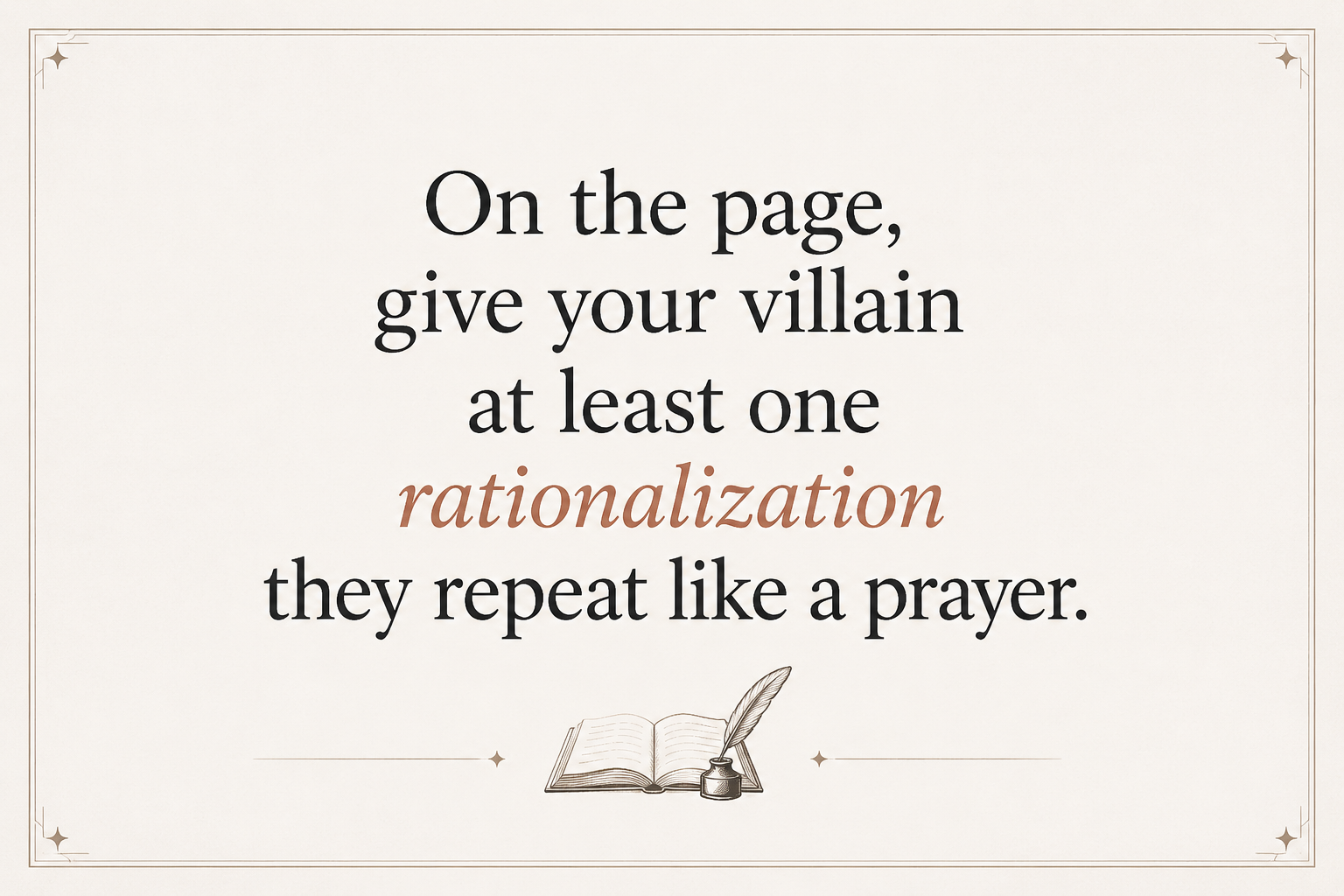
On the page, give your villain at least one rationalization they repeat like a prayer. It should be short enough to fit in dialogue and flexible enough to justify escalating harm.
Competence Creates Credibility
A villain who is incompetent by author fiat is not satisfying. Readers can smell when the protagonist wins because the antagonist suddenly stops thinking. Competence does not mean omniscience. It means the villain pursues their goal with believable skill and adapts when reality punches them.
If you need a practical tool, outline your villain’s plan in three steps. Then list what could go wrong at each step and how a smart person would mitigate it. If the villain never mitigates anything, you do not have a villain. You have a punching bag in a cape.
Methods: The Line The Villain Crosses
Villainy becomes visible in methods. Two characters can want the same thing, and one becomes the villain because they are willing to pay with other people’s bodies, consent, or futures. This is where you control reader emotion with precision.
As an author, you’re also controlling tone and audience expectations. For example, a cozy mystery villain can be a murderer. However, their method and depiction stay within the subgenre’s social contract. A grimdark villain can be far more explicit, but you still need purpose on the page. Gore without narrative function reads like empty calories.
Four Method Buckets That Readers Recognize
I think in four broad buckets. It keeps my drafts clean and helps me escalate without random cruelty.
- Coercion: threats, blackmail, hostage dynamics, control of access to safety or belonging.
- Corruption: bribes, ideology, seduction, incremental compromises that trap the hero.
- Predation: exploitation of vulnerability, grooming, manipulation, feeding on the weak.
- Destruction: physical violence, sabotage, scorched earth tactics, reputation assassination.
Pick one primary bucket that matches your villain’s values. Then add a secondary bucket revealing how far they’ll go under pressure. That gives you escalation that feels earned.
Escalation Needs A Trigger
Escalation without a trigger feels like the writer turning a dial. Escalation with a trigger feels like character. The trigger can be the villain losing control, getting publicly humiliated, facing exposure, or having their core value threatened.
Write the trigger into the scene as an observable event. Then show the villain making a choice that costs them something human, such as a relationship, a reputation, or self-respect. Cost matters because it prevents escalation from reading like wish fulfillment.
When The Villain Thinks They Are The Hero
Some villains know they are doing wrong and do it anyway. Others believe they are righteous. Both can work, but you need to pick, because the voice on the page changes. For example, a self-aware villain uses jokes, contempt, or cold pragmatism. Meanwhile, a righteous villain uses sermons, systems, and moral accounting.
If you want to apply this, write a scene in which the villain reacts emotionally before explaining themselves. The explanation should sound rehearsed, because they have told themselves the story for years.
The Story’s Moral Frame: How You Guide Reader Judgment
Villainy is partly a social label inside your book. The same act can read differently depending on the story’s moral frame, genre conventions, and the reader’s alignment with the protagonist. This is why antiheroes and villain protagonists can work. The book invites empathy and then tests it.
As the author, you control that invitation through point of view, consequence, and what the narrative treats as normal. If your villain tortures people and the story treats it as a cool character beat, many readers will either bounce or leave reviews noting, “I didn’t connect.”
Point Of View As A Moral Lever
Close POV can create empathy for almost anyone. That is a powerful tool. Use it with intent. When you go inside a villain’s head, you should still show the distortion, the rationalization, the self-serving edit. If the villain’s inner monologue reads like your own neutral narration, you accidentally excuse them.
A reliable technique is to let the villain notice what benefits them and miss what harms others. Then let the reader see the harm through another lens, such as the protagonist, a side character, or the consequences that echo later.
Consequences Build Trust
Readers accept dark material when the book keeps its moral math consistent. Harm should leave scars. Institutions should respond. Communities should change. Even if the villain gets away with it for a while, the narrative should show that the cost is real.
If you want a grounding reference for how people judge harm, the American Psychological Association has a clear overview of how empathy and moral development shape social behavior. Their public-facing resources are a useful reminder that humans track intention and outcome, not just outcome. Start with APA resources on empathy and build your consequence chain from there.
Genre Promises And Reader Tolerance
Reader tolerance depends on genre, and ignoring that is a marketing mistake just as much as it’s a craft mistake. For example, romance readers will forgive a lot of emotional mess but have low patience for a love interest who crosses consent lines without the story treating it as a problem. On the other hand, epic fantasy readers will accept sprawling moral conflict, but they still want coherent stakes and payoffs. Thriller readers want a villain who forces hard choices, not one who exists to monologue.
This is also where your blurb and cover need to be honest. If you signal a light, witty caper and deliver a predator villain with explicit cruelty, you get the kind of mismatch that kills read-through.
Practical Tools For Building Villains That Stick
Craft talk is only useful if you can apply it under deadline. When you are drafting fast, it is easy for a villain to become a bundle of scenes you like rather than a coherent engine that drives your plot. I rely on a few repeatable tools to keep the villain sharp.
The Villain Equation
Write this as four lines and keep it at the top of your outline.
- Value: What do they believe about how people should live?
- Goal: What do they want in this story, right now?
- Method: What line will they cross to get it?
- Blind Spot: What truth about themselves can they not face?
If a scene does not connect to at least two of these lines, it is probably filler. Cut it or revise it to transfer the villain’s pressure on the protagonist.
The Three Decision Points
I like to include three moments where the villain could choose a less harmful path but refuses it. These moments should escalate.
- Early: They choose harm to gain advantage.
- Middle: They choose harm to avoid exposure or loss.
- Late: They choose harm even when it will cost them something they claim to value.
This pattern produces a villain whose arc feels like a tightening spiral. Your protagonist’s arc then becomes a response to that spiral, which keeps the plot cohesive.
Dialogue That Reveals The Lie
Villain dialogue works when it reveals the villain’s lie about the world. It fails when it is only threat language. Threat language has a short shelf life. A worldview lasts.
If you write in tools like Adazing QuickWrite when you are stuck, a useful prompt is, “Write the villain explaining their actions to someone they want to impress.” That forces them to choose a justification that fits their identity. Then write the same explanation to someone they do not respect. The gap between those versions is character.
Names And Symbol Choices That Do Not Feel Cheesy
Writers love naming villains. Readers love rolling their eyes at villain names. There is a narrow lane where symbolism helps and a wider lane where it turns into a moustache-twirling signal flare.
I recommend you pick a name that fits the character’s culture and era first, then layer subtle meaning through sound and association. For example, a harsh consonant cluster can imply severity. A softer rhythm can hide menace. Adazing has name generators that can get you out of the “I only have three good names in my brain” trap. However, remember that the final filter should always be your story’s social reality.
FAQs for What Makes a Villain a Villain: Unpacking the Dark Side of Fictional Characters
Can a villain be sympathetic and still feel like a villain?
Yes, as long as you keep the harm and the choices on the page. Sympathy usually comes from understandable emotion, such as grief, fear, humiliation, or longing. Villainy comes from how they act on that emotion. If you soften consequences or remove alternatives, you drain the villainy.
Do I need to give my villain a tragic backstory?
No. A backstory is optional, and it can even dilute tension if you use it to excuse behavior. I use backstory when it sharpens the villain’s internal logic or raises the stakes for the protagonist. If it only exists to ask the reader for pity, I keep it off-page or reduce it to a single detail.
How do I keep my villain from overshadowing my protagonist?
Give your protagonist an active goal, a difficult strategy, and real moral choices that cost them something. A strong villain exposes weaknesses, so you want your hero making decisions under pressure, not waiting for the villain to act. When the protagonist’s choices drive the turning points, the villain can be magnetic without stealing the book.
A Villain That Works Feels Unavoidable
The villains readers remember are not the ones with the most shocking scenes. They are the ones whose values, goals, and methods lock together so tightly that every step feels like the next step. If you build agency, coherent motivation, deliberate methods, and consistent consequences, your villain becomes a story engine, and your protagonist suddenly has something real to push against.
If you want a fast revision pass, write your villain equation, mark your three decision points, and then reread only those scenes. Your villain will either snap into focus or reveal exactly what you need to rewrite.
