
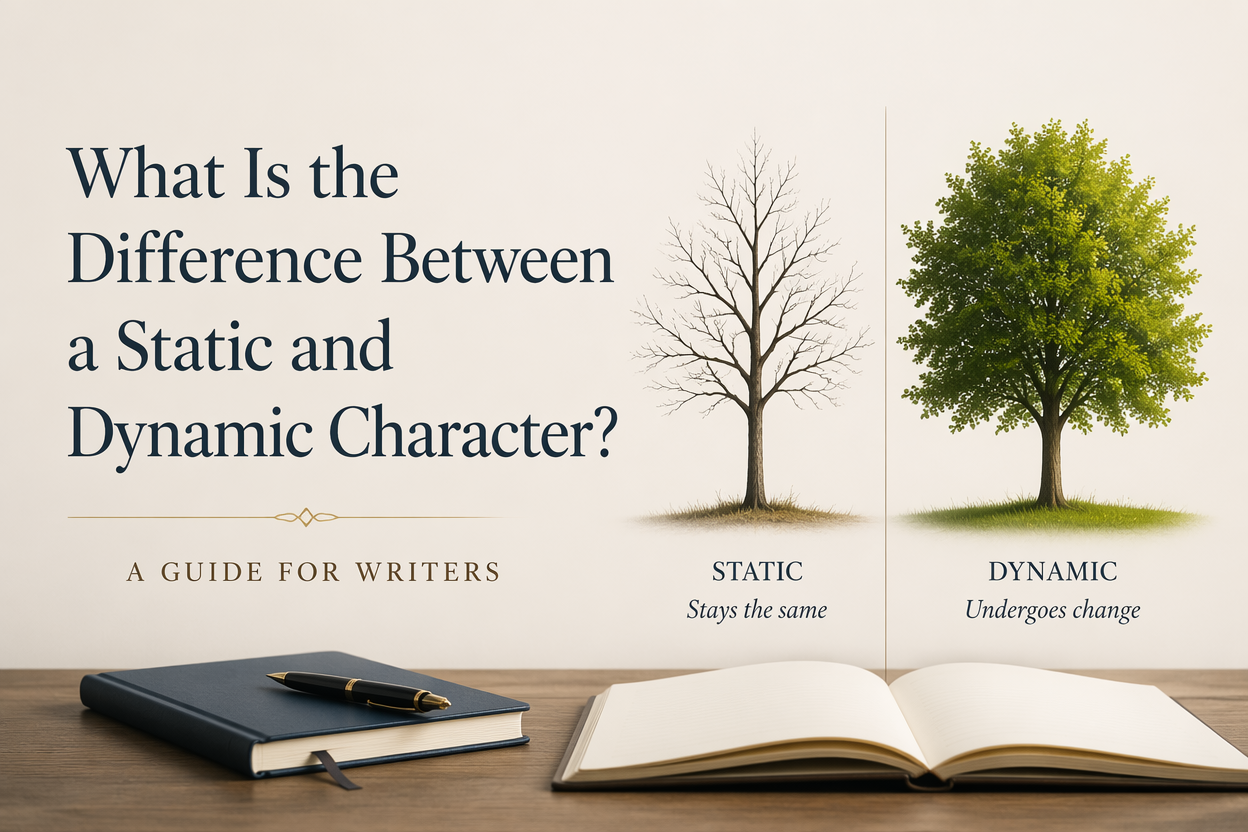
What is the difference between a static and dynamic character? Knowing the answer to this matters because it controls what kind of satisfaction your reader gets at the end of your story. If you pick the wrong type for the job, your plot can land perfectly and still feel hollow, like you built a beautiful house on the wrong foundation.
A dynamic character changes internally in a way that is meaningful and traceable through the story. On the other hand, a static character stays essentially the same person inside, even though their circumstances may change dramatically. Neither is automatically better. What matters is whether the change, or the refusal to change, fits the promise your book is making.
I see writers get tangled here for one main reason: they confuse “stuff happens to the character” with “the character changes.” Your protagonist can get chased across three kingdoms, lose a hand, and inherit a cursed throne and still be a static character if their core worldview and values never shift. If you want your book to hit with emotional force, you need to choose deliberately.
Table of Contents
Static And Dynamic Characters In One Clear Test
If I could give you only one diagnostic tool, it would be this. Compare your character’s internal state on page one to their internal state in the final scene. If the core belief that drives their choices has changed because of the story’s pressure, you have a dynamic character. If that core belief holds, you have a static character, even if the external situation ends in flames.
This test works because readers track characters through patterns. They pay attention to what your protagonist assumes about love, power, safety, God, money, family, loyalty, and self-worth. Those assumptions create choices, and those choices create consequences. Change the assumption, and you change the character.
One warning! “Dynamic” does not mean “gets better.” A character can change for the worse. For example, a hero can corrode into a tyrant, or a pacifist can become someone who believes violence is the only language that works. The direction of change is a craft choice, not a moral one.
What Counts As Real Change
Real change shows up in decisions under pressure. If your character says, “I’ve learned to trust,” but when the final act squeezes them, they still hoard information and push allies away, the story has performed growth without paying for it.
I look for three markers on the page.
- First, the character faces the same kind of choice more than once.
- Second, the later choice comes from a different internal logic than the earlier one.
- Third, the story shows the cost of the new choice, because change always costs something.
What Looks Like Change But Is Not
Plenty of things read as development and still leave your character static. For example, learning a skill is not necessarily inner change. Getting a new job is not necessarily inner change. Falling in love is not necessarily inner change. Those events can trigger change, but only if they force a shift in belief.
Even trauma does not automatically produce a dynamic arc. Sometimes trauma hardens a person into the same belief even more intensely. That can be an excellent static arc, as long as you treat it as a deliberate shape and not a missing piece.

Dynamic Characters And The Engine Of Transformation
A dynamic character arc is an internal transformation that the plot keeps demanding payment for. The most reliable way to build it is to give your protagonist a flawed or incomplete belief about the world, then design events that keep testing that belief until it breaks or evolves.
In practice, this is less mystical than it sounds. It is cause and effect. Your character believes something. That belief leads to a choice. The choice creates consequences. The consequences make the belief harder to hold. Over time, the character either adapts or self-destructs.
If you want a working model, novelist and writing teacher K.M. Weiland has a clear framework built around the lie your character believes, which many novelists adapt because it forces specificity about what the character has to unlearn.
Three Common Dynamic Arc Shapes
Positive change arc: The character starts with a limiting belief and grows into a truer one. An example is Elizabeth Bennet learning she has misjudged Darcy and herself in “Pride and Prejudice.” The plot forces her to re-evaluate what she thinks she knows about character and status.
Negative change arc: The character starts with a belief that could have been corrected, then doubles down until it ruins them. Think of a detective who starts with a small ethical compromise and ends with a full collapse. The story makes the compromise “work” often enough that it becomes a philosophy.
Flat-to-change arc in a series: In long series fiction, you often see a character change early, then stabilize. Book one is dynamic. Books two through ten are closer to static in the sense that the hero’s internal compass holds while the world throws new problems at it. This is common in cozy mysteries, action-adventure, and some romance subgenres where readers come back for a consistent emotional experience.
How To Draft A Dynamic Arc Without Hand-Waving
I outline the arc in plain language before I worry about beautiful scenes. I write one sentence for the opening belief, one for the ending belief, and then list three moments where the old belief causes harm. That harm becomes the fuel for the change.
If you use writing software like Adazing’s QuickWrite, put those sentences in a pinned note at the top of your draft. When you get stuck mid-book, you can check whether the scene is applying pressure to the belief. If it is only moving chess pieces around, it belongs to a different draft or book.
Static Characters And The Power Of Steadfastness
A static character stays fundamentally the same inside, and that can be exactly what your story needs. The satisfaction comes from watching the world change around them, or watching them reveal more of who they already are as stakes rise.
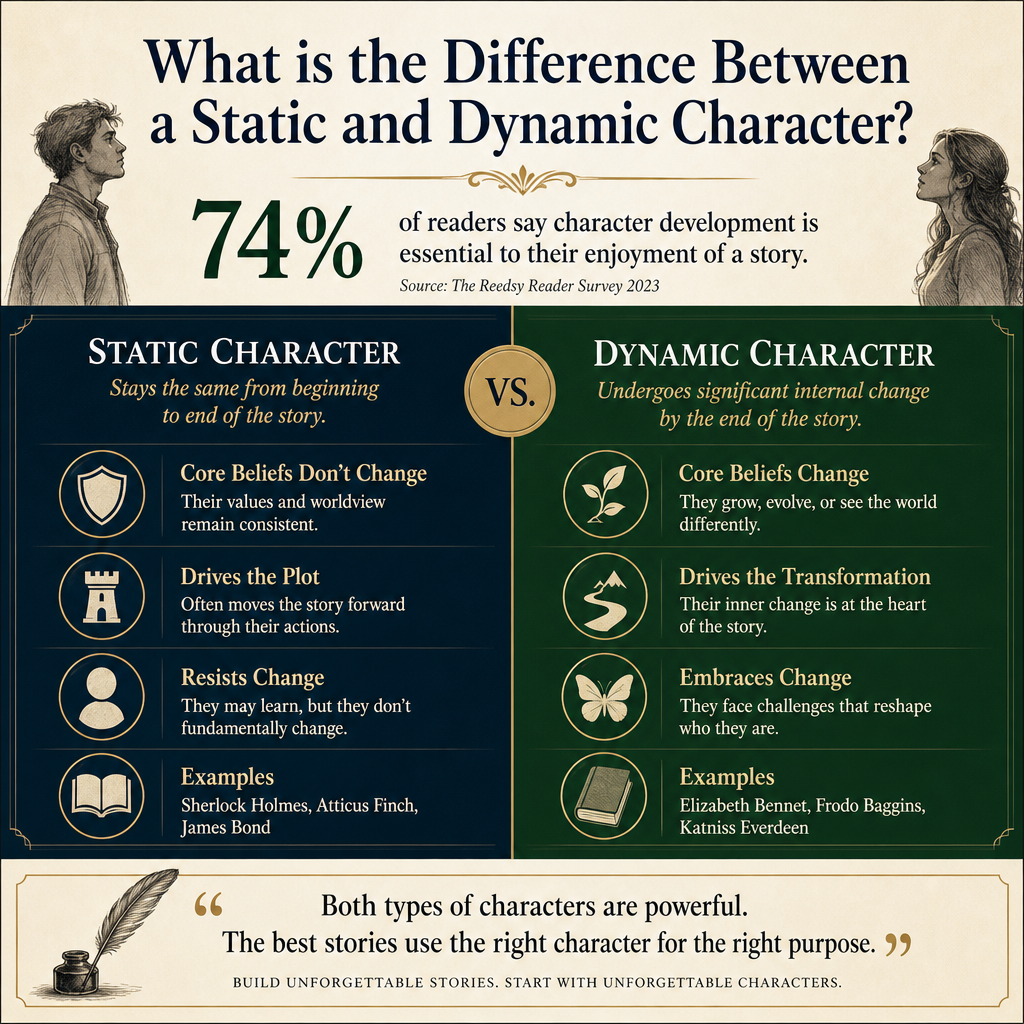
This works best when the character’s internal steadiness creates external consequences. For example, a steadfast hero forces other characters to change, exposes corruption, holds a moral line, or refuses a temptation that would be easier and more profitable in the short term. The plot becomes a series of tests designed to make them bend. The story payoff is that they do not bend.
Superman is the classic example in many interpretations. The drama often comes from whether he can remain the person he chooses to be under impossible pressure, rather than whether he will “learn to be good.” More grounded examples appear in thrillers and procedurals where a protagonist’s competence and values stay stable as the case gets uglier.
When A Static Protagonist Is The Right Call
A static protagonist fits stories where the point is the effect the hero has on the world. Adventure stories and mysteries often lean on this. Some romances use a version of it where one partner is already emotionally mature, and the other does most of the changing.
It also fits stories with a strong theme that you want embodied. The protagonist becomes a tuning fork. Every time the world hits them, the same note rings out, and readers absorb the theme through repetition under shifting pressure.
How Static Characters Still Feel Alive
Static does not mean flat. Your character can reveal new layers without changing their core. The trick is escalating the severity of the test. Early tests are low-cost. Later tests cost reputation, freedom, love, or identity. The reader learns who this person is by watching what the character is willing to pay.
I also rely on surface-level contradiction. For example, a steadfast character can still have habits, blind spots, a wicked sense of humor, and a private fear they manage. They stay the same where it counts, but they remain human.
Choosing The Right Arc For Your Genre And Promise
This choice becomes much easier when you think like a marketer for ten minutes. Your book is a promise, and readers buy the experience they believe you are offering. A dynamic character arc often pairs well with genres where inner transformation is the payoff. Meanwhile, a static arc often pairs well with genres where competence, justice, or survival is the payoff.
You can still mix them, and plenty of books blend a strong external plot with an internal change arc. What matters is deciding which one gets the final emotional spotlight.
Genre Expectations That Actually Affect Read-Through
Romance readers often expect meaningful internal growth, even when the external plot is light. The emotional movement is part of the contract. If your leads behave the same way at the end as they did at the start, the relationship can feel like a coincidence rather than an earned bond.
In mystery and procedural fiction, readers often prize a stable investigator. They want to trust the detective’s lens across a series. You can still write dynamic arcs in this space. However, they tend to be slower, or pushed into subplots that do not break the character’s reliability.
In epic fantasy, you have room for either, because the genre supports long arcs and big external change. Your job is to decide whether your story is about a person becoming someone new, or about a person staying true while the world tries to rewrite them.
A Practical Publishing Check
Before you commit, scan the top 20 books in your Amazon category and read their blurbs. Blurbs do not tell the whole truth, but they signal what the reader is paying for. If most blurbs emphasize transformation, your static hero may feel emotionally underpowered unless the external story is electric. If most blurbs emphasize an external mission, your heavy internal arc may slow the pace unless you build pressure into every scene.
This is also where Adazing’s tools can help in a grounded way. I use category research, comp-title language, and blurb drafting as a craft check. Marketing and storytelling share a backbone. Both depend on clearly promised change, whether internal or external.
Fixing Common Draft Problems With Static And Dynamic Arcs
Most character arc problems surface as plot problems: the middle sags, the ending feels unearned, and beta readers say they “didn’t connect” without explaining why. When I diagnose those manuscripts, the issue is often that the writer wanted a dynamic arc, wrote a static one, then tried to patch the gap with more events.
You can fix this, but you have to decide which story you are actually telling. Then you revise for that story, not the version you wish you had drafted.
Problem: Your Character Changes Too Fast
This happens when the character “learns the lesson” right after the first big shock. Readers rarely buy that because change usually requires repetition, relapse, and cost. Behavioral science supports the general point: Mark Bouton’s research on why behavior change is difficult to sustain shows that new behavior sits atop the old one rather than wiping it out, so frequent lapses should be expected rather than treated as a detour.
Slow the arc down. Add at least one moment where the character sees the better choice and still fails, because failure undercuts ego and makes the later success feel earned. Then force a consequence that cannot be ignored.
Problem: Your Dynamic Arc Never Lands
When the ending feels like the character stayed the same, the usual culprit is vague beliefs. A line like “I need to be brave” is too broad, while “I believe I am only safe when I control every variable” gives you something you can test in scenes.
Rewrite the belief in a single sentence that includes a trigger, something along the lines of “When someone gets close, I assume they will leave, so I leave first.” Now you can build scenes where closeness appears, the pattern fires, and the character either repeats it or breaks it.
Problem: Your Static Character Feels Like A Passenger
This shows up when the world acts on the protagonist while they do little more than absorb the blows. Give your static character a clear value they will defend, then make them act from it early. A steadfast protagonist needs agency, because their purpose in the story is to push back.
If your plot is already built, you can retrofit agency by changing who initiates the major turns. Let the protagonist choose the risky plan, confront the antagonist first, and become the reason the final conflict happens at all. Even a morally steady hero can be strategically reckless.
Problem: Side Characters Outshine The Protagonist
Sometimes the side characters have dynamic arcs, and the protagonist does not, and that is fine in ensembles. It becomes a problem when your protagonist has no arc shape at all. Decide whether the protagonist is meant to change, stay steady, or function as a lens character. Then align the cast so the arcs do not compete for the same emotional climax.
If you are tracking a lot of characters, a simple spreadsheet or a board inside your drafting tool helps. I keep a column for each character’s belief and whether it changes. A name generator does not fix structure, but a clean system for your cast and notes can keep you from losing the thread when you are 80,000 words deep. Adazing’s generators and writing tools are handy for keeping that production side from eating your creative energy.
FAQs for What is the Difference Between a Static and Dynamic Character?
Can a character be both static and dynamic?
A character can be dynamic in one domain and static in another. They might change their view of love while holding firm on justice, faith, or loyalty. What matters is whether the story treats the change as the emotional payoff and tracks it through decisions.
Do static characters work in literary fiction?
They can, as long as the story has a strong thematic or social pressure that the character resists, exposes, or reframes. Literary fiction often prizes interiority, so you may reveal depth through perception and language even when the core belief holds steady.
How do I show a dynamic arc without explaining it to the reader?
Put the change inside repeated choice points. Give the reader two or three scenes that ask the same emotional question in different forms. When the character answers differently in the final act, the reader feels the shift without any need for you to name it.
A Cleaner Way To Decide Your Character Arc
Your job is to pick the arc that matches the story’s promise, then build scenes that test the character’s belief until the ending feels inevitable. If you want a dynamic protagonist, define the belief, design repeated pressure, and make the final choice cost something real. If you want a static protagonist, give them agency, escalate the tests, and let their steadiness reshape the world around them.
When you do this on purpose, your draft stops feeling like a chain of events and starts feeling like a story that could only end the way it ends. That is the feeling readers chase, and it is the feeling that builds read-through across your backlist.
