
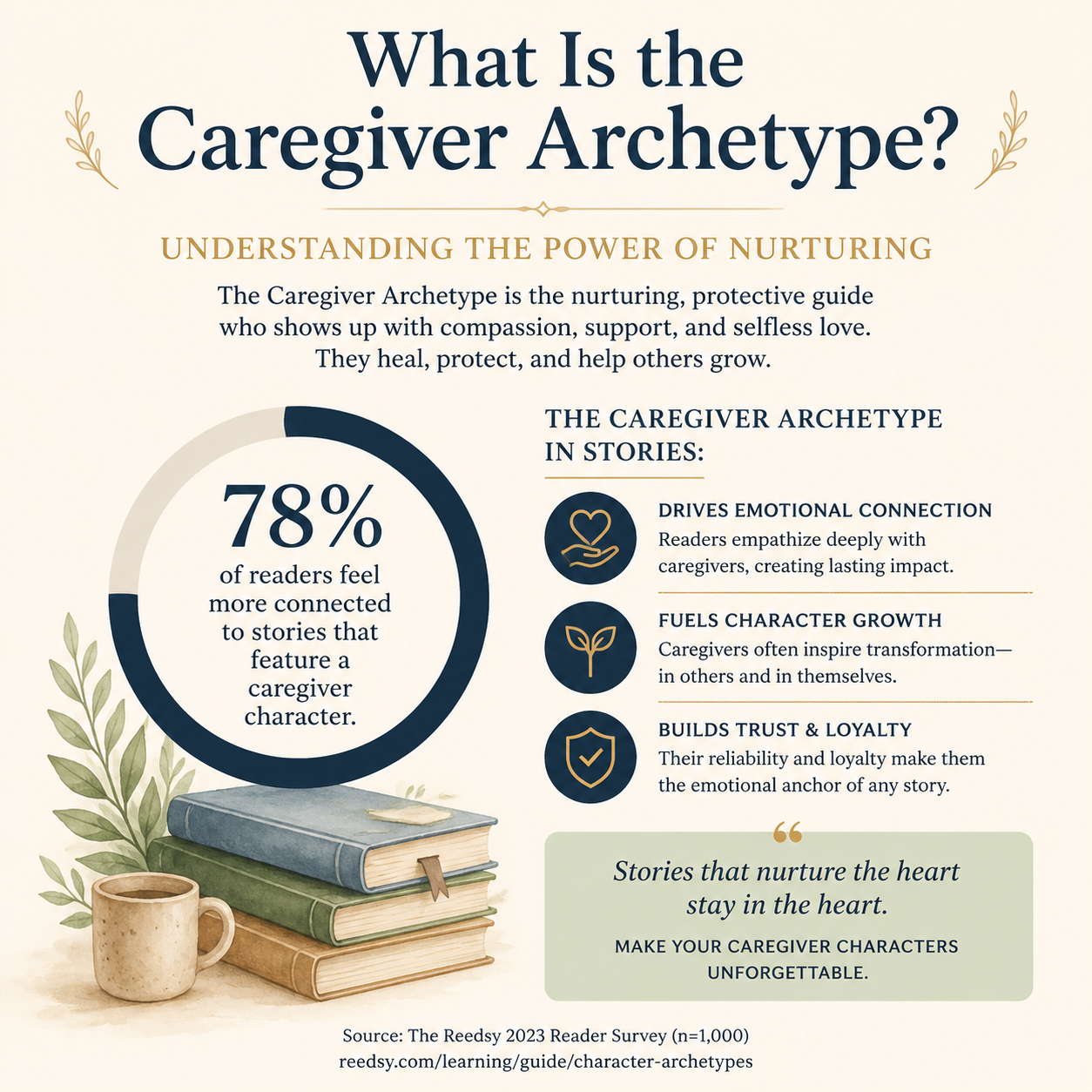
If you keep asking “What is the caregiver archetype?”, you are already circling the real craft problem: how do you write nurturing without turning your character into a doormat, a saint, or unpaid emotional labor for the plot? The Caregiver archetype is power expressed through protection, steadiness, and sacrifice, and readers respond to it because it promises safety in a story world that is about to hurt somebody.
For you as an author, the Caregiver is a structural tool as much as a personality type. This character creates contrast, raises stakes, and gives your protagonist someone worth becoming better for. Handle it lazily, and you get bland “goodness” that reads like a greeting card. Handle it with teeth and boundaries, and you get a character readers would follow into a burning building.
I want you to treat the Caregiver as a promise you make to the reader: someone will see the vulnerable, someone will show up, and someone will pay a cost. Then you decide what that cost does to the character over the length of the book.
Table of Contents
What The Caregiver Archetype Really Means In Story Terms
In archetype language, the Caregiver is oriented toward others. In story language, the Caregiver is the character who converts empathy into action when it would be easier to walk away. That action can be physical care, protection, mentorship, advocacy, triage, feeding people, hiding fugitives, patching wounds, or building systems that keep the group alive.
Writers often confuse a Caregiver with a nice character. Niceness sits on the surface, while caregiving is a choice made under pressure, repeated, and paid for. Your reader believes the archetype when it costs something tangible: time, status, money, safety, reputation, sleep, pride.
Motivation That Actually Holds Up
If the Caregiver’s motivation is “because they are good,” it collapses as soon as the plot applies pressure. Give them a specific wound or vow, or a concrete role they refuse to abandon. Perhaps they grew up without protection and cannot watch it happen to anyone else, or they failed someone once and built an identity around never failing again, or they are the only competent adult in a room full of chaos and competence has hardened into their moral code.
Your next move is to write a short private manifesto for them, three sentences, no poetry. What do they believe they owe people? What line do they refuse to cross? What would make them stop helping?
Competence Versus Martyrdom
The Caregiver reads strongest on the page when their nurture comes with skill. Picture the nurse who reads a monitor at a glance, the older sister who knows how to talk someone down from a panic attack, the captain who rations food without cruelty. Competence is the difference between “sweet” and “formidable.”
Martyrdom is the trap. If your Caregiver exists to suffer so others can feel feelings, readers start resenting the book even if they cannot name why. Give them agency by letting them choose the burden, and sometimes refuse it.
Why Readers Attach To The Caregiver So Fast
Humans are tuned to notice care because it signals safety and group survival. You do not need to cite evolutionary psychology to use it well; you need to stage a moment where the Caregiver acts before they speak. When I edit manuscripts, the fastest way to establish this archetype is a single scene of unglamorous help done without applause.
Write that scene early, keep it specific, and let the reader witness it without any explanation from you.

The Caregiver As A Character Engine, Not A Stereotype
If you want the Caregiver to matter beyond page-one likability, build them around tension. Caregiving creates friction with ambition, romance, freedom, revenge, faith, and even justice. A character who gives and gives without internal conflict is not a character; they are a plot device.
Boundaries That Create Plot
Boundaries are where your story begins. A Caregiver without boundaries becomes a vending machine for emotional comfort. On the other hand, a Caregiver with boundaries creates hard decisions that force scenes to happen.
Pick one boundary and put it in front of your protagonist. Any genre can use a line like refusing to lie to protect someone, refusing to endanger a child, refusing to treat an abuser, or refusing to abandon the sick even when the mission demands it. Then make the plot demand the opposite.
The Shadow Side You Should Write On Purpose
The Caregiver has a shadow, and writing it cleanly is where your book gains depth. Overhelping can shade into control, protectiveness into suffocation, self-sacrifice into an excuse for skipping their own life, and kindness into moral superiority.
Give the Caregiver one ugly strategy they use to keep caring without breaking. They micromanage, or guilt-trip, or keep score, or “fix” people who never asked. Then force them to face the damage it causes.
Agency In The Person Being Cared For
This is where many manuscripts accidentally go wrong. If the cared-for character has no agency, your Caregiver turns into a rescuer in a story that reads like infantilization. The vulnerable person needs competence in a different domain, room to sometimes refuse help, and chances to help back.
On your revision pass, highlight every scene where care happens and ask one question: what choice does the recipient get? If the answer is “none,” rewrite the scene until they have one.
How To Write The Caregiver In Different Genres Without Breaking Tone
The archetype travels well, but its expression has to match your genre’s expectations. For example, a cozy mystery Caregiver reads as community glue. A thriller Caregiver reads as a shield with a pulse. A fantasy Caregiver can be a healer, a steward, a guardian, or the person who keeps the chosen one fed and sane between prophecies.
Romance And The Caregiver Without Codependency
Romance loves caretaking, and romance also punishes fake caretaking. If the relationship dynamic is one partner constantly rescuing the other, you risk drifting into codependency unless you show growth and reciprocity.
I recommend a simple test. Each lead needs a scene where they are the Caregiver and a scene where they are the cared-for, and neither scene can be played for humiliation. That balance reads as intimacy rather than imbalance.
Fantasy And Science Fiction Caregiving As Systems
Speculative fiction gives you a gift: you can make care structural. For example, a ship’s medic becomes the moral center of the crew. A village midwife becomes the information network. A necromancer who raises the dead to finish unresolved goodbyes becomes a Caregiver with a controversial method.
Write one paragraph of worldbuilding that answers, “How does this society treat caretakers?” Are they revered, exploited, regulated, paid, drafted? Then let your Caregiver character collide with that system.
Thrillers And Crime Fiction Caregiving Under Threat
In high-danger genres, care becomes tactical. Consider a detective who protects a witness, a bodyguard who keeps a client alive, or a journalist who refuses to burn a source. These Caregivers show love through procedure and vigilance.
Put your Caregiver in a situation where care makes the mission harder. If protecting the witness costs the arrest, the archetype becomes story fuel instead of decoration.
Craft Tools For Building A Memorable Caregiver On The Page
The Caregiver is easiest to write poorly because “helpful” scenes feel repetitive. You can keep them fresh by varying the kind of care, sharpening the cost, and giving the character a distinctive care style.
A Care Style That Feels Like A Fingerprint
Decide how your Caregiver gives care. Do they talk, touch, feed, fix, organize, defend, teach, or listen? Most writers default to listening because it is clean on the page. Listening can be powerful, but it is not automatically dramatic.
Give them two signature behaviors. For example, consider a chef who always puts a plate down before asking questions, a manager who assigns a task because structure is their love language, or an aunt who checks exits in every room. Then repeat those behaviors at higher stakes as the book goes on.
Dialogue That Avoids Sermons
Caregivers often get written as mouthpieces. If your Caregiver delivers speeches about compassion, readers feel the author behind the curtain. Let them speak in specifics and in constraints.
Try this pattern for a scene where someone is falling apart. The Caregiver names what is happening, offers one concrete option, and sets one boundary. “You are spiraling. Sit, drink water, and tell me what you need first. I can stay for ten minutes, then I have to go back.” That reads like care and character at the same time.
Scene Design That Proves The Archetype
I look for three scene types when I diagnose whether a Caregiver is working.
Start with a public care scene where others see the Caregiver’s role, since that establishes reputation and social pressure. Follow it with a private one where they reveal what the work costs them, which builds intimacy. Then give them a refusal scene, a moment where they say no, proving they have boundaries and keeping them from turning into a prop.
Outline those three scenes before you revise. If you only have the first two, your Caregiver probably feels flat.
Using The Caregiver Archetype To Strengthen Your Book Brand
The Caregiver archetype is not only a character choice. It can be a brand choice. Readers who love nurturing dynamics often seek them across series, and they reward authors who consistently deliver that emotional experience.
This matters for your packaging. Your cover, blurb, categories, and even your series promise can signal whether your book offers “found family,” healing arcs, protector energy, mentorship, or tender competence. When those signals match the actual read, you build trust and read-through.
Blurb Language That Signals Care Without Sounding Sentimental
Back-cover copy can hint at caregiving by naming stakes that involve responsibility. Use verbs that imply protection and repair: shelter, guard, tend, carry, keep, teach, raise, patch, escort. Then put a price tag on it. “If she shelters him, she loses her post.” That kind of line tells the reader you understand what care costs in story.
If you want help drafting, I built tools at Adazing for this exact stage. I use Adazing’s writing tools, like QuickWrite, to quickly generate alternative blurb angles. Then I pick the one that best reflects the Caregiver promise and revise by hand until it reads as a human wrote it.
Series Positioning For Caregiver-Driven Books
When a Caregiver lead holds your series together, consistency matters more than cleverness. Readers return for the reliable experience of someone showing up when it matters, never for random twists in tone.
Write a one-sentence series promise that includes the caregiving angle. Consider these examples:
- “Each book ends with the community safer than it began.”
- Every case forces her to choose between the law and the person who needs her.”
Then check every plot outline against that sentence.
Reader Research That Keeps You Honest
I trust reader language more than author intention. When you study reviews for comparable books, look for phrases like “comfort read,” “healing,” “found family,” “protector,” “soft,” “safe,” “cozy,” “heart.” Those are market signals that the Caregiver dynamic is landing.
Use that language carefully in your product description and ads because it attracts the right audience and repels the wrong one. If you promise comfort and deliver brutality, your ratings will show it.
For broader context on how often Americans read and how formats differ, Pew Research tracks reading habits in its 2026 report on print, ebook, and audiobook use, which helps when you are deciding whether your Caregiver-led story should be positioned for ebook binge readers or print-first gift buyers.
FAQs for What Is the Caregiver Archetype? Understanding the Power of Nurturing
How do I keep a Caregiver character from feeling bland?
Give them a cost, a boundary, and a skill. Cost creates consequences, boundary creates choices, and skill makes the care feel specific rather than generic kindness. Then put their boundary under pressure at least twice, once early and once late, so the reader sees growth or fracture.
Can the villain be a Caregiver archetype?
Yes, and it often works frighteningly well. A villainous Caregiver can justify harm as protection, control people through “help,” and punish anyone who threatens their dependents. Write their care as real to them, then show the harm it causes when their definition of safety becomes coercion.
What is the difference between the Caregiver and the Mentor archetype?
The Mentor primarily transfers knowledge, discipline, and worldview. The Caregiver primarily protects well-being and keeps people functioning. One character can do both, but you should decide which role drives their choices under stress. If the pressure scene ends with a lesson, you are writing a Mentor. If it ends with someone kept safe at a personal cost, you are writing a Caregiver.
Writing The Caregiver So Readers Trust You
The Caregiver archetype works because it is easy to read. Readers spot it fast, and they bring their own hunger for safety, tenderness, and loyalty to the page. Your job is to earn that hunger with boundaries, consequences, and real competence, until the archetype reads as a person rather than a label.
Draft one early caregiving scene that costs your character something, then draft one late scene where they either pay that cost again or finally refuse it. When those two scenes land, the rest of the book has a backbone.
