
If you keep asking “What is the advantage of suspense over surprise in storytelling?”, it is because surprise feels flashy on the page. Meanwhile, suspense keeps paying rent across whole chapters. In my experience with editing and writing for commercial markets, surprise wins moments, and suspense wins books.
Surprise is a single transaction. The reader receives an unexpected reveal, reacts, and then the story has to earn their attention all over again. Suspense works more like a standing agreement. You teach the reader what could happen, you show them the fuse burning, and then you make them watch your character walk toward the fireworks anyway.
When you are writing with an audience in mind, suspense also protects your most valuable asset: read-through. Readers who feel a steady forward pull will finish book one, buy book two, and tell a friend, while those who get whiplashed from one twist to another will admire the cleverness and still put the book down.
Table of Contents
Suspense Creates Ongoing Tension You Can Control
Surprise is binary. It either lands or it does not, and when it fails, it often looks like author meddling. Suspense gives you a dimmer switch. You can raise pressure, release it, and raise it again without changing the core problem, which lets you pace the reader’s stress level across scenes.
Alfred Hitchcock’s famous explanation is still the cleanest craft lens: if a bomb goes off under the table, you get a few seconds of shock; if the audience knows the bomb is under the table while the characters talk about baseball, you get minutes of tension. Hitchcock outlined this contrast in his 1962 interview with François Truffaut, and it remains a practical guide for scene design.
Suspense Builds When The Reader Knows Something Specific
The most reliable way to create suspense is informational advantage. Give the reader one piece of concrete knowledge that changes how they interpret what they are watching. It can be “the killer is in the house,” “the deal is a trap,” or “the ship’s oxygen is failing.” The reader then scans every line for when the truth collides with the character’s choices.
I recommend you write a one-sentence “reader knows” note at the top of each suspense scene. If you cannot state what the reader knows that the character does not, you are probably writing surprise setup, not suspense.
Suspense Works Best With Visible Stakes And A Timer
Stakes that stay abstract do not create sustained tension. “Something bad might happen” is mush. “If she answers this call, her location is compromised, and her son dies” is a story engine. Add a timer, and it becomes even harder to look away, because the reader can measure how close you are to the cliff.
Your timer need not be a literal clock. It can be pages until the hearing, hours until sunrise, a limited number of air canisters, or even “three more lies until the marriage collapses.” What matters is the sense that the story is moving toward an unavoidable point of contact.
Surprise Still Belongs In Suspense Scenes
I use surprise as a spice inside suspense, rather than as the meal. When you have tension already running, a small reversal hits harder because it changes the reader’s predictions. The safe house turns out to be compromised, the ally shows up late, the door is unlocked when it should not be. Those are surprises, but they land because the suspense made the reader care about the outcome.
If you rely on surprise without the underlying tension, you tend to reach for bigger and bigger twists, and the story starts to feel like it is trying to win an argument with the reader.

Suspense Improves Reader Trust And Emotional Investment
Suspense is honest with the reader. You signal danger, risk, desire, or dread, and then you invite them to stay with you through the consequences. Surprise can feel like you withheld the real story to get a reaction. Readers do not always articulate that feeling, but they register it as mistrust.
There is also a psychological reason suspense can be more satisfying. When people anticipate an outcome, they experience a build of emotion and attention that can become part of the pleasure. Neuroscience and psychology research on anticipation and reward has repeatedly shown that dopamine activity is strongly tied to wanting and expecting rewards, not only receiving them. A 2010 review in Neuron discusses dopamine’s role in motivation, prediction, and anticipation, which maps cleanly onto why readers enjoy the buildup as much as the reveal.
On the craft side, suspense forces you to attach tension to character need. If your protagonist can lose something they value, the reader feels the stakes in their gut. Surprise can dodge that work. You can twist a plot without deepening the character, and the result is a story that feels clever without feeling alive.
Suspense Lets You Pay Off Promises Instead Of Hiding Them
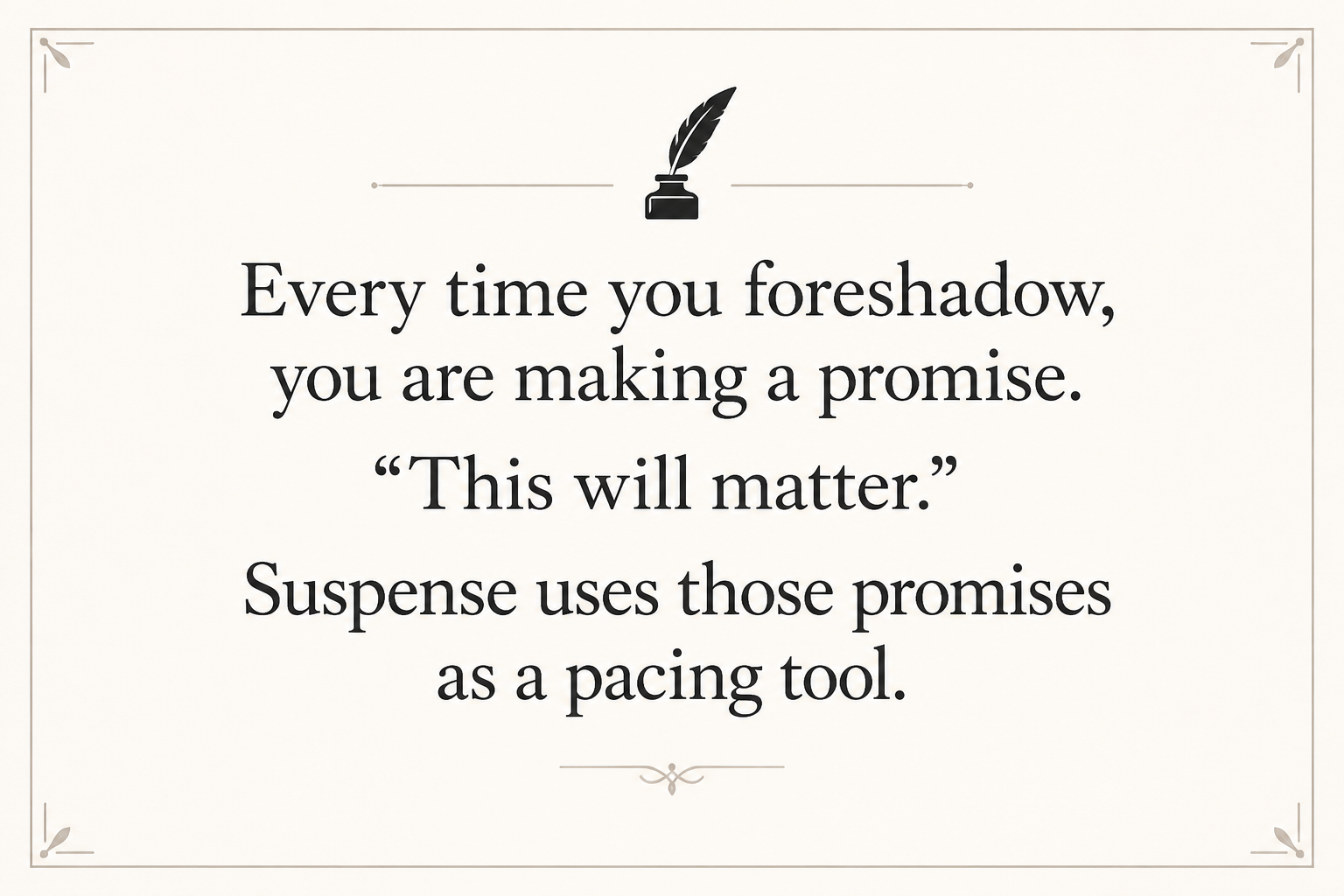
Every time you foreshadow, you are making a promise. “This will matter.” Suspense uses those promises to control the story’s pace. You can plant a gun on the mantle, let the reader notice it, and then have them wait through a scene where the wrong person reaches for it. The payoff feels earned because the reader watched the chain of events grow tighter.
If you keep your promises invisible so the twist stays “unpredictable,” you also remove the reader’s ability to participate. Many readers do not want to be fooled. They want to be guided toward the reveal.
Suspense Reduces The Feeling Of Manipulation
Writers sometimes confuse “surprising” with “better.” A twist can be perfectly logical and still feel cheap if the narrative conveniently avoided showing information the viewpoint would reasonably notice. Suspense gives you a clearer approach. You can show what matters while keeping the outcome uncertain by presenting multiple plausible paths.
I recommend you do a fairness pass on your big reveals. Read the chapters that precede them and ask: would my chosen viewpoint naturally register this information? If yes, it belongs on the page in some form. If no, do not smuggle it in through author convenience.
Suspense Supports Series Read-Through And Book Marketing
This is where craft and career link arms. A surprise-heavy book can earn great reactions on social media. However, it can also teach readers that the story is unpredictable in a way that feels unstable. Suspense teaches readers that you will deliver a steady pull, and that matters for series because each book needs to feel satisfying while also leaving the reader hungry.
When you look at successful series fiction, the engine is rarely “twist of the week.” It is a repeating tension pattern: a long problem that worsens, a mid-book complication that reframes the threat, and a climactic confrontation that resolves one layer while exposing the next. That pattern is suspense architecture, and it is what makes “just one more chapter” turn into “just bought the next book.”
Suspense Creates Better Blurbs And Better Hooks
A blurb is a promise, and suspense is promise-shaped. You can state the danger, the desire, and the consequence without revealing the answer. Surprise-based stories are harder to pitch because the interesting part is often the concealed twist, which you cannot put on the back cover.
If your blurb keeps collapsing into vagueness, it is usually because your story is built around a reveal instead of a dilemma. I would rather you write toward an impossible choice than toward a hidden fact. Choices sell books because they imply character, stakes, and motion.
Suspense Plays Well With Reader Psychology On Retail Pages
On Amazon, Kobo, or Apple Books, the reader is skimming. They glance at the cover, read a few lines of description, maybe sample the first page. Suspense gives you clean, legible questions: Will she get away before the deadline? Can he keep the secret without losing the relationship? What happens when the lie collapses?
Surprise asks for trust up front. Suspense earns trust by immediately showing the shape of the problem. That trust is what gets the click on “Look inside” and what keeps the reader from drifting to another tab.
Tools Help When You Are Building Suspense On Purpose
When I build suspense, I track promises and payoffs like inventory. If you lose track, you either overpay too early, or you forget to pay at all. Tools can help you see the structure of what you have written. In Adazing’s QuickWrite, for example, I would keep a running “open loops” note for each chapter and a simple checklist of what builds tension or resolves it in the next scene. The tool does not invent tension for you, but it keeps you from dropping it when you are tired on draft three.
Surprise Has Real Value And Clear Limits
Surprise is not the villain. It is just expensive. Each big surprise costs you setup, misdirection, and revision to keep it fair, and it only buys you a brief spike of emotion unless it changes the reader’s understanding of character and stakes.
I use surprise best in three places: at the end of a scene, at the midpoint where the plan collapses, and at the reveal that forces the protagonist to reevaluate what they want. In each case, the surprise is a lever that moves the suspense to a new track. The surprise works because it creates a new, sharper question.
When Surprise Hurts The Story
A surprise falls flat when it replaces believable motivation. If the twist depends on a character behaving in a way that doesn’t fit who they are, the reader feels it. It can also weaken the story by blocking the emotional processing. A constant string of reversals keeps the reader too busy adjusting to each new development to feel anything deep.
Another common failure is the “withheld explanation” surprise, where the protagonist had a plan all along, and the author kept it secret to look clever. That move can work in heist fiction with the right viewpoint control, but it often reads like you did not want to write the hard parts of problem-solving on the page.
When Surprise Is Exactly The Point
Some genres thrive on surprise as a headline feature. Many mystery readers want the killer’s identity concealed, and many thriller readers want a twist that recontextualizes earlier scenes. Even then, the best books still run on suspense scene by scene. The reader may not know who did it, but they should know what is at risk and what the protagonist is doing about it.
If you write twist-forward stories, consider creating two outlines. One is the protagonist’s lived experience. The other is the true sequence of events. The revision work comes from aligning them so every scene plays fair while maintaining uncertainty.
Practical Ways To Shift A Draft From Surprise To Suspense
If your draft feels flat until the big reveal, you probably have a surprise spine with suspense missing in the ribs. You do not need to throw the twist away. You need to stop treating it like the only source of energy.
Expose The Threat Earlier Than Feels Comfortable
Writers often hide the threat because they think mystery equals interest. In practice, a visible threat creates more pages of tension. Reveal the nature of the danger early, then keep the specifics uncertain. The reader does not need to know every detail of the bomb. They need to know it is real and close.
Consider picking one major fact you are withholding and revealing it about a quarter of the way into the book. Then revise the later scenes so the protagonist acts with that knowledge hanging over them. The story will feel like it starts sooner, because it does.
Turn Secrets Into Dilemmas
A secret becomes suspenseful when it forces action. If your character is hiding a past crime, the suspense question is not “What is the secret?” The suspense question is “What will she do when the investigator knocks, and which relationship will she sacrifice to keep the lie intact?” Dilemmas create scene choices. Choices create tension that survives even after the secret is revealed.
On revision, underline every secret in your manuscript and write the associated dilemma in the margin. If you cannot write one, the secret is decorative. Either cut it or attach a consequence that changes what the character must do next.
Use Prediction And Interruption In Your Scene Endings
Suspense endings work when the reader can predict a likely consequence, and you interrupt the path to it. A character commits to a risky plan, and then an unforeseen constraint appears. The reader sees the collision coming and reads faster because they want to watch it happen.
This is also where a quick craft tool comes in handy. I often draft two possible scene endings and label them “expected” and “interruption.” If both endings feel like pure shocks, I slow down and plant a clearer expectation earlier in the scene so the interruption has something to cut across.
FAQs for What is the Advantage of Suspense Over Surprise in Storytelling?
Can I spoil a twist and still keep the story tense?
Yes, and it often improves the book. If you reveal the twist to the reader while the protagonist remains unaware, you create an informational advantage that strongly drives suspense. You then focus the scenes on consequence and choice, which keeps the narrative moving even though the reader knows what is true.
What genres benefit most from suspense-heavy storytelling?
Thrillers, romance, horror, and epic fantasy all benefit because they rely on sustained forward pull and long-range stakes. Even cozy mysteries, where comfort and pattern matter, still run on suspense beats like deadlines, escalating pressure, and the risk of accusing the wrong person. If you write lit fic, suspense still applies whenever a character faces a looming decision with emotional cost.
How do I know if I am relying too much on surprise?
If beta readers say the middle drags, or they only talk about the ending, that is a warning sign. Another tell is when your scenes lack a clear question that remains unanswered at the end. I would audit your chapters for open loops, then add visible stakes and a timer to the ones that feel like they exist mainly to protect a reveal.
Suspense Is The Better Long Game
Surprise gives you a spike. Suspense gives you a line that keeps pulling. If you want readers to stay up too late, finish the book, and come back for the next one, build your draft around what the reader fears will happen, what the character risks anyway, and how close the consequences are. Then use surprise as a pressure change inside that system, not as the system itself.
