
Most writers only ask “What is suspense in a story?” when their draft reads fine on the sentence level and still feels flat in the reader’s gut. Suspense is the deliberate management of uncertainty plus consequence across time, so your reader keeps turning pages to reduce that uncertainty before the consequence lands.
That definition matters because suspense works as a controllable craft effect rather than a genre label or a pile of cliffhangers. When you can control it, you can fix sagging middles, raise read-through, and stop relying on late-stage line edits to do structural work they cannot do.
I see suspense fail in two predictable ways. Some books reveal too much too early, so nothing has to be feared or guessed. Others hide everything, so the reader cannot form expectations and stops caring. Your job is to tell enough truth that the reader can anticipate outcomes, then delay certainty as the stakes keep tightening.
Table of Contents
Suspense As Uncertainty Plus Consequence
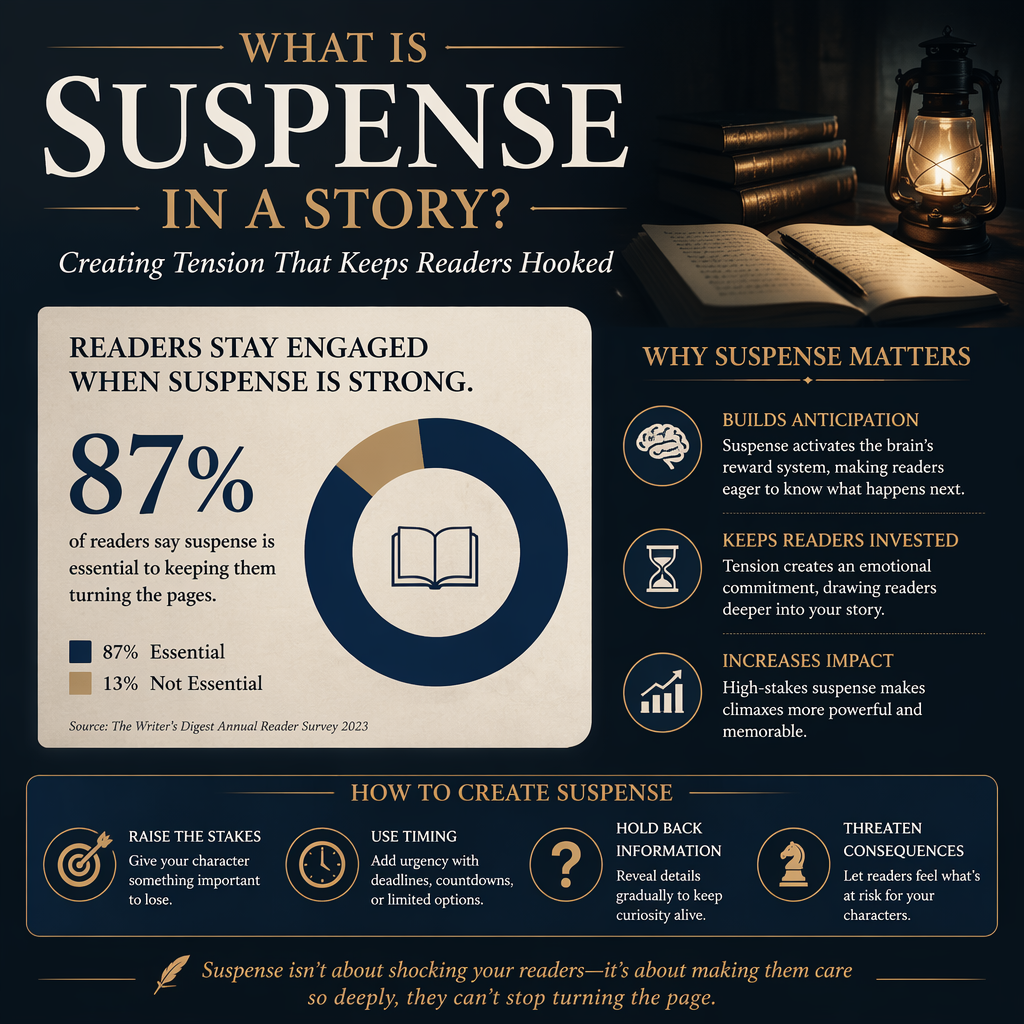
Suspense happens when the reader can ask a specific question and can feel that the answer will matter. Uncertainty alone produces curiosity. Consequence alone produces seriousness. Put them together, and you get tension that persists across chapters.
Think in terms of a reader running a mental simulation. They take what you have shown them, predict what might happen, and then keep reading to confirm or correct the prediction. A 2015 paper in Neuron describes curiosity as a drive state for information. That matches what you feel on the page when the question is sharp while the price of staying in the dark keeps climbing.
Specific Uncertainty
Vague uncertainty does not create suspense. “Something bad might happen” is background noise. “The bomb is under the table” is suspense because the reader can track time, proximity, and outcome. Alfred Hitchcock made the same point in his well-known table-and-bomb explanation, which he gave to François Truffaut in the interviews published as Hitchcock/Truffaut and which David Bordwell unpacks here.
For your draft, write the suspense question in plain language in the margin of every scene. “Will she sign the contract before she reads the clause?” beats “Will she succeed?” A question you cannot write down is one the reader will never feel.
Consequences That Are Felt Before They Arrive
Rather than a speech about what could happen, stakes work as a lived constraint that changes what the character can safely do right now. The best suspense scenes show the consequence arriving in advance as pressure, sacrifice, or narrowing options.
In practice, that means you show the cost of failure early and then keep reminding the reader through concrete, escalating indicators. For example, a deadline in three days reads as mild on its own, but pair it with an injury and a witness who can be bribed and the scene turns tense, because every choice closes doors.
Time As A Tool, Not A Calendar
Suspense often rides on time, though not always on literal ticking clocks. You can compress time to intensify decisions or stretch time to force endurance. The craft move comes down to making the reader feel that delay carries a price.
Try a diagnostic on your scenes. For example, if a character can pause indefinitely to think, eat, sleep, and research at leisure, then the lever that suspense pulls has already been removed.

Three Suspense Engines You Can Install Anywhere
You can build suspense with plot, with character, or with information. Strong books usually use all three, and they do not wait for the third act to start.
Dramatic Irony
Dramatic irony means the reader knows something the viewpoint character does not. This is one of the cleanest suspense engines because it turns ordinary actions into loaded actions. For example, a character unlocking a door becomes tense when the reader knows the killer is inside.
To use it without cheapening your protagonist, give the character a believable reason to overlook the fact. For example, they might be exhausted, or trusting the wrong person, or fixed on a different threat entirely. Suspense collapses the moment a character has to turn dense to protect your secret.
Deadline Pressure
Deadlines work because they convert uncertainty into a countdown. They also force prioritization, and that pressure is where character shows up: what a person chooses to save under a deadline reveals what they value.
The trade-off is that artificial deadlines feel like an author’s control. I recommend you tie the deadline to a system that already has momentum of its own. For example, a court date, a flight, a scheduled launch, an expiring visa, a storm front, a wedding, or a parole hearing all keep moving on their own schedule. Readers accept deadlines that would exist even if the protagonist did nothing.
Resource Depletion
Resource depletion raises suspense because it shrinks the margin for error. Money runs out, allies stop picking up the phone, batteries drain, and sleep debt piles on until judgment slips. Even in fantasy, spell components and political capital drain the same way.
This engine gets overlooked in manuscripts that otherwise have good ideas. Writers who love adding threats often forget to remove support. If your hero holds infinite backup plans and unlimited competence, suspense has no room to breathe.
Micro-Suspense On The Page
Big-picture suspense is structural. Micro-suspense works at the page level, keeping a reader moving even between major plot turns. This is where you steer attention beat by beat.
Promise, Progress, Payoff
Every scene can be framed as a promise, a series of partial progress beats, and a payoff that is either an answer or a sharper question. Writers often skip the progress beats. They jump from promise to payoff and wonder why the scene felt thin.
One practical fix is to outline the scene in three to five beats, with each beat changing what the character believes. Suspense grows when those shifts in belief happen under pressure.
Answer One Question, Open A Better One
Answer everything and the reader rests. Answer nothing and the reader quits. The sweet spot resolves a local uncertainty while widening the larger one.
For example, in thriller terms, the murder weapon gets identified, only for it to belong to the detective. In romance terms, the confession arrives, and then the job offer surfaces, starting in two weeks across the country. The reader gets motion and destabilization at once.
Scene Endings That Turn The Screw
Cliffhangers work, though a steady diet of them starts to feel like a commercial break. I prefer scene endings that change the situation rather than interrupt it. For example, a door opens, a choice gets made, a lie surfaces, or a plan collapses into something impossible.
When you revise, I recommend you mark every ending scene with one label: escalation, revelation, reversal, or decision. If a scene ends with none of those, you probably have a soft landing.
Information Control Without Cheap Tricks
Suspense is often mistaken for secrecy. What you are really controlling is the order in which the reader understands the situation. You can be generous with information and still create tension if the consequences of that information are unresolved.
Fair Play Clues
In mystery and suspense-heavy genres, readers want to feel you played fair. Playing fair does not require handing over the answer, only making it possible to infer, however difficult that inference may be.
When you hide a clue, hide it in plain sight among competing priorities. For example, the character notices the muddy boot print, then the phone rings, then the witness collapses. The clue sits there in the open while attention shifts for a reason that belongs to the story world.
Withholding Versus Delaying
Withholding denies the reader access to a required fact, leaving them unable to form meaningful predictions. Delaying gives the reader enough to predict several outcomes while you stretch the moment of uncertainty.
If beta readers tell you they feel confused rather than tense, you are withholding. Fix it by giving them a stable frame: who wants what, what stands in the way, and what happens if they fail. Confusion rarely produces suspense. It produces skimming.
Viewpoint Discipline
Point of view is a suspense dial. Close POV increases immediacy and limits information. Multiple POV gives you opportunities for dramatic irony and cross-cut pressure. Omniscient can work, though it requires tight control or it turns into summary.
Choose the POV strategy that serves the kind of suspense you want. If you want dread, give the reader knowledge the protagonist lacks. If you want mystery, keep the reader locked to what the investigator can truly see and infer.
Revision Methods For Stronger Suspense
You cannot reliably draft suspense on vibes alone. I have written enough books and edited enough manuscripts to tell you that suspense is built in revision, where you can align questions, stakes, and timing across chapters.
The Suspense Map
Open a document and list every chapter with two lines: the primary question introduced, and the primary outcome delivered. This exercise exposes dead zones where no question stays active, as well as clutter where five questions compete and none of them resolve.
Keep one dominant question per act and let smaller questions feed it. In romance, that question might be whether two people can build a life together. In fantasy, it might be whether the protagonist can stop a war they helped start. Everything else should raise pressure on that question.
Escalation Ladders
Suspense sags when obstacles repeat at the same intensity. Build an escalation ladder where each rung adds a new constraint. For example, the character is watched; the watcher turns out to be a friend who needs something, and helping them will expose the protagonist.
In revision, highlight obstacles by type: physical, social, legal, emotional, moral. Five scenes of the same type in a row signal a monotony problem. Switch the obstacle type, and tension rises without a single added explosion.
Tools That Support The Craft
When I am tightening suspense, I want fast iteration. I will often re-draft a scene in three ways, changing only the sequence in which facts reach the reader, then pick the version that yields the cleanest questions. A focused drafting tool helps because you are not fighting formatting or distractions while you test variants. Adazing’s QuickWrite is built for that kind of undistracted drafting, and it pairs well with a suspense map since you can keep the map open and write directly to it.
Names and nouns also affect suspense more than people admit. If your reader cannot track who is who, where they are, and what the object is, tension leaks out. When I need stable naming at speed, I use Adazing generators for character names and place names so I can stop stalling on placeholders and keep the pressure moving forward.
FAQs for What Is Suspense in a Story? Creating Tension That Keeps Readers Hooked
Is suspense only for thrillers and mystery?
No. Suspense is a reader effect, so it works in romance, fantasy, literary fiction, and even narrative nonfiction. In romance, suspense often lives in emotional risk and timing. In epic fantasy, it often lives in information gaps and looming consequence. You tune the consequences to the genre promise.
How do I create suspense without cliffhangers?
End scenes with a changed situation rather than a cut-off moment. Give the reader a decision, a new constraint, a revelation that forces a different plan, or an irreversible action. The reader keeps turning pages because the story moved, not because you stopped mid-sentence.
Why do my beta readers say they feel confused rather than tensed?
Confusion usually means the reader cannot form a clear question in suspense because the goal, the obstacle, or the stakes are fuzzy. Clarify what the protagonist wants in the scene, show what blocks them in concrete terms, and attach a consequence that will matter within the next few pages. When the reader can predict outcomes, tension has something to grip.
Suspense As A Repeatable Craft Skill
Suspense is not something you sprinkle on at the end. It comes from designing uncertainty that the reader can track and consequences they can feel before they arrive. If you map your story’s questions, escalate constraints with intent, and control the order of information with discipline, you will create the kind of tension that pulls readers through the middle and straight into your last page.
