
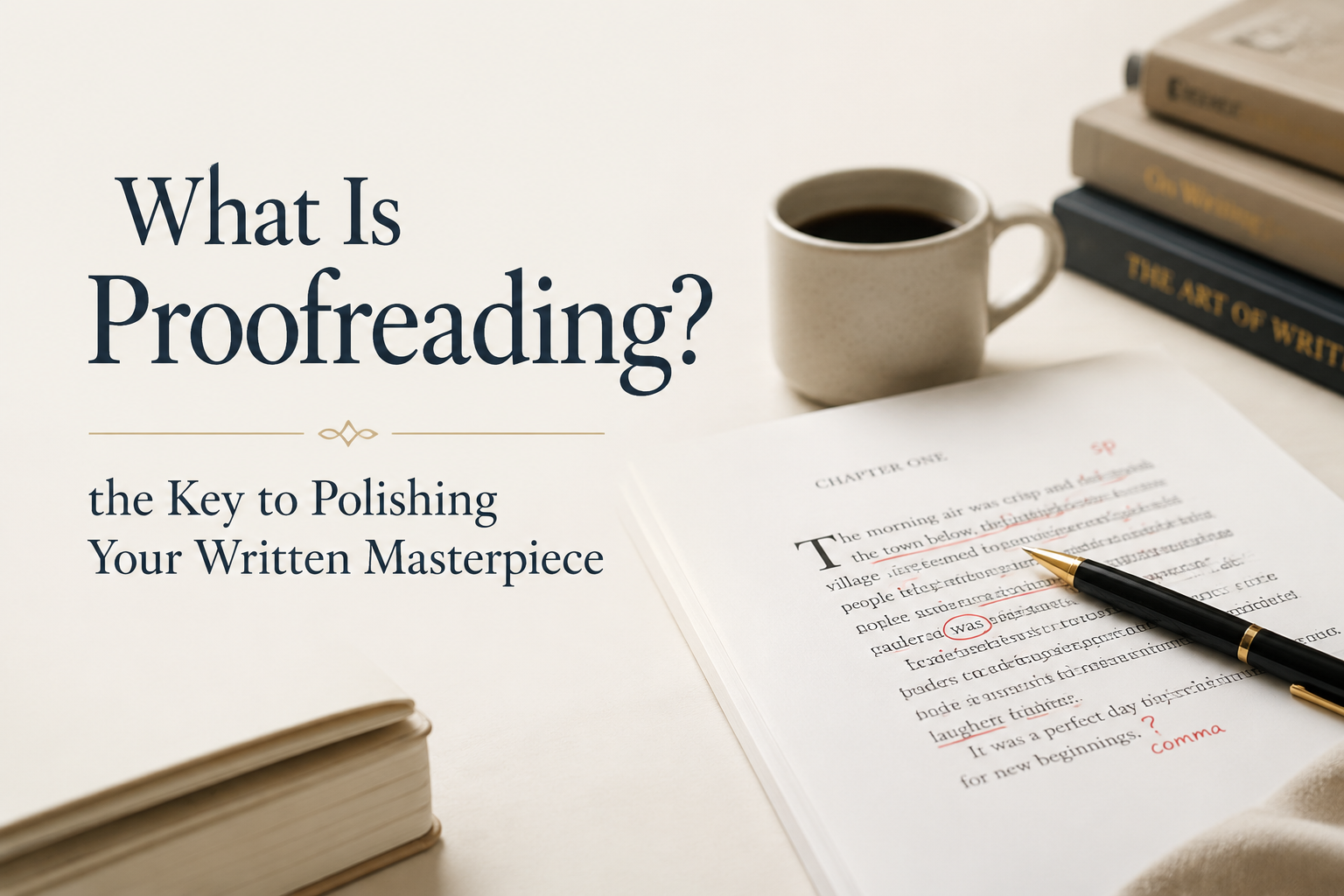
If you are asking “What is proofreading?”, you are already closer to a professional-quality book than many writers who hit publish the moment they type “The End.” Proofreading is the final quality pass on text that has already been edited and laid out. Its job is simple: catch the last visible errors before readers do.
Readers forgive a slow first chapter more than they forgive obvious mistakes on page one. A typo signals you did not care enough to finish the job, and once that doubt lands, it colors every line that follows.
I treat proofreading as part of publishing, not part of writing. The manuscript stage is where you solve story, voice, structure, and clarity. Proofreading is where you remove the grit that makes a finished book feel homemade in the bad way.
Table of Contents
Proofreading Defined for Working Authors
Proofreading is the last check of your book against a near-final version, ideally the formatted proof, to catch surface-level errors. Think spelling, punctuation, spacing glitches, inconsistent capitalization, missing words, duplicated words, wrong homophones, and formatting issues that appear after layout.
The timing matters. If you proofread too early, you are polishing sentences you are about to cut. If you proofread too late, you have already distributed ARCs, uploaded to Amazon KDP, or ordered print copies, and every fix becomes slower and more expensive.
What Proofreading Actually Catches
Here are the categories I see most often in books that skipped a real proof pass:
- Typos that spellcheck will miss: “form” for “from,” “pubic” for “public,” “trail” for “trial.”
- Punctuation and rhythm breaks: missing commas, extra commas, mismatched quotation marks, inconsistent dialogue punctuation.
- Consistency slips: “Email” on one page, “e-mail” on another, “Chapter Twenty-One” later becoming “Chapter 21.”
- Continuity at the micro level: a character called “Marin” once and “Marina” later, a town spelled two ways.
- Layout and formatting problems: widows and orphans, missing italics, broken scene breaks, header mistakes, strange spacing after importing into Vellum, Atticus, Word, or InDesign.
- Production errors: missing acknowledgments page, wrong edition note, a duplicated chapter file, a bad hyperlink in an ebook.
Notice what is not on that list: plot holes, weak character motivation, unclear arguments, or flabby chapter structure. Those are editing problems, and proofreading is the wrong tool for that job.
Where Proofreading Sits in the Editing Chain
Authors mix up these terms, and the mix-up costs money and time. The common sequence looks like this:
- Developmental edit: big-picture story or structure, pacing, argument flow, chapter order.
- Line edit: voice, clarity, style, sentence-level craft.
- Copyedit: grammar, usage, consistency, basic fact-checking, style sheet creation.
- Proofread: the final check on the proof, focused on errors that remain or were introduced during formatting.
There is overlap in reality because humans work on text, not tidy labels. Still, if you ask a proofreader to fix developmental problems, you will pay twice because the book still needs the bigger edit afterward, and every structural change creates new typos.
Proofreading for Ebooks and Print Books
Proofreading for print has extra landmines: page numbers, running headers, chapter starts, hyphenation, and the way justified text can produce awkward rivers of white space.
Proofreading for ebooks has different traps: broken internal links, inconsistent paragraph styling, missing italics, and device-specific rendering oddities.
If you publish in both formats, I recommend proofreading the formatted PDF for print and also reviewing the ebook file on at least two devices or apps, since Kindle Previewer exists for a reason.
Why Proofreading Changes Reader Trust and Reviews
Every editing stage improves your book. Proofreading has a special effect on reader trust because it lives on the surface. Readers might not be able to articulate why your prose feels professional. However, they can spot a missing word, a misplaced quotation mark, or a chapter title that doesn’t match the table of contents.
On retail platforms, trust becomes outcomes. A book that reads clean earns longer reading sessions, better completion rates, and fewer “needs an editor” reviews that poison conversion. Written Word Media has consistently found that covers, blurbs, and reviews drive sales in its reader and author surveys, and sloppy proofreading tends to show up in reviews in the most unhelpful way. Their annual survey is worth reading with a pen in hand, which you can start with Written Word Media’s 2023 Author Survey.
None of this means a spotless book automatically sells. Marketing still matters, cover and blurb still matter, and genre fit still matters. Proofreading removes a completely avoidable reason for a reader to bounce.
The Real Cost of “Readers Will Forgive It”
Some readers will forgive errors. Enough will not, and the ones who do not tend to be your most valuable audience: binge readers who buy series, leave reviews, and tell friends. If you are building read-through, you want fewer reasons for a reader to put your book down and never start book two.
When a reader hits a typo, the reading trance breaks. They stop seeing the story and start seeing the page. You can earn them back, yet you are forcing your writing to overcome a self-inflicted obstacle.
Proofreading and Audiobook Narration
If you plan an audiobook, clean text becomes even more important. A narrator will stumble on missing words, malformed sentences, and inconsistent names. Fixing those after recording can mean pickups, patch edits, and added cost. The proofread is where you remove the tripwires.
When to Proofread and What to Proofread
The best time to proofread is after the copyedit and after formatting, when the book is in the form readers will see. This means a PDF proof or the exported EPUB or KPF for ebooks.
I recommend two proof passes if you can afford the time. The first pass catches the obvious errors and the formatting problems. Meanwhile, the second pass, done after fixes are applied, catches the new errors that sneak in during corrections.
Proofreading Pass One
On the first pass, I focus on global problems before I chase individual typos. If your chapter headings are inconsistent, or your scene breaks drift, those issues repeat and multiply. Fixing them early prevents you from fixing the same thing fifty times.
- Check front matter and back matter: title page, copyright page, dedication, acknowledgments, about the author, also-by pages.
- Check chapter starts: consistent styling, spacing, and any ornamental elements.
- Check italics, bold, small caps, and special characters: these often break in format conversion.
- Check hyperlinks in ebooks: table of contents, back-to-top links, retailer links, newsletter links.
Proofreading Pass Two
The second pass is slower and narrower. I read for micro errors and consistency, and I verify that every correction was applied cleanly. This is also where I run a last sweep for the common gremlins that survive earlier stages, such as double spaces, missing closing quotation marks, and repeated words.
What Counts as a Proof
A proof is not your Word document full of tracked changes and unresolved comments. A proof is a stable, exported version that resembles the final reader experience. If you are using Vellum, Atticus, Reedsy Book Editor, or InDesign, export the file you plan to upload. If you are publishing print, order a physical proof copy when possible. Paper reveals errors your screen politely hides.
Amazon KDP even provides a “Look Inside” preview experience, which is another place formatting can misbehave. I always check that view before I stop touching the files.
Tools and Methods I Trust for a Cleaner Proof
Software will never replace a human proofread, and pretending otherwise is how you get a book where “pubic” survives into print. Still, tools help you find patterns, speed up the boring checks, and reduce the chance you miss something obvious after staring at the same pages for months.
My Baseline Proofreading Toolkit
- Spellcheck plus a second checker: I like having two different engines because they catch different problems.
- Search functions with a hit list: I search for double spaces, space before punctuation, repeated punctuation, and common homophones in my draft.
- Read-aloud or text-to-speech: Hearing your book exposes missing and repeated words your eyes glide over.
- A style sheet: This is how you keep “email” vs “e-mail” decisions consistent across 90,000 words.
If you write fiction with lots of names, places, or invented terms, a custom dictionary saves time. If you write nonfiction with references, a citation and link check saves embarrassment.
How I Use Adazing Tools Without Pretending They Are Editors
Adazing builds tools for authors, and I like that because writing and publishing involve many small tasks that steal momentum. I will use Adazing name generators to sanity-check spelling and consistency for character names and invented terms, especially in fantasy and science fiction where a single swapped vowel can create two different characters by accident.
If you draft quickly, a focused writing tool like QuickWrite can help you get a clean draft out. However, remember that the proof stage still needs a different mindset. Drafting is flow. Proofreading is precision. Mixing those mental modes in the same session leads to missed errors and second-guessing.
Print-Proof Tactics That Catch Hidden Problems
When I really want to catch what my screen is hiding, I change the medium:
- Print the pages or use an e-ink device to simulate how readers will see it.
- Temporarily change the font and line spacing when proofreading inside a document. Your brain stops auto-filling the lines.
- Proof backward by paragraph for a short section when you are hunting typos, not meaning.
These tricks work because they interrupt familiarity. Familiarity is the enemy of catching errors.
Hiring a Proofreader or Doing It Yourself
You can proofread your own book, and many authors do, especially early in their careers. You will miss things. That is not a character flaw. It is a brain feature. Your mind reads what it expects to be there, particularly when you wrote the text and know what you meant.
If you have budget, hiring a proofreader is one of the cleanest investments you can make because the results show up immediately on the page. The trade-off is time. Good proofreaders book out, and you need to schedule them around your formatting timeline.
What to Ask a Proofreader Before You Pay
- Will you proof the formatted file or the manuscript file? You want the formatted file for a real proofread.
- Do you use a style sheet, or are you following the one from the copyedit?
- What is your scope? Typos only, or also formatting issues, consistency checks, and front matter?
- How do you mark changes? PDF comments, annotated proof, or a list of corrections?
I also ask what the proofreader expects from me. Some want a clean, final file with no more rewriting. Others can work with minor edits still happening. The cleaner your process, the less you pay for rework.
A Realistic DIY Proofreading Workflow
If you are doing this yourself, I recommend planning multiple short sessions across several days. Your attention drops after about an hour of true proofreading, and the mistakes you miss will cluster at the end of your marathon session.
- Export your proof file.
- Do one pass for formatting and global consistency.
- Do one pass for typos and punctuation.
- Apply the fixes as one controlled batch, then export a fresh proof.
- Do a final verification pass, focusing on the lines you changed.
The strongest habit you can build here is restraint. When you find a sentence you want to rewrite, mark it and move on. Rewriting during proofreading creates new errors and drags you back into drafting mode.
FAQs for What is Proofreading? The Key to Polishing Your Written Masterpiece
Do I still need proofreading if I used a grammar checker or another proofreading tool?
Yes. Automated checkers are good at patterns and common errors. However, they are weaker at context, voice, and layout. They also do not see what happens when your manuscript becomes a formatted book file, and many new problems arise.
Should I proofread before or after ARC readers?
I prefer a clean copyedit and at least one proof pass before you send ARCs. ARC readers are giving you feedback and reviews, not doing production quality control. If the ARC is messy, you waste goodwill, and you risk reviews that complain about editing rather than talking about the story.
What is the difference between copyediting and proofreading?
Copyediting happens at the manuscript stage and focuses on grammar, usage, consistency, and clarity, often using a style sheet and queries. Proofreading happens on the proof and focuses on remaining typos, as well as errors introduced by formatting, file conversion, or late changes.
Proofreading as Part of Publishing Like a Pro
Proofreading is the last pass that keeps small mistakes from becoming public mistakes. If you want your book to compete with traditionally published titles and the best indie work in your category, schedule the proofread after copy edits and after formatting, then treat the corrections like a controlled production step.
If you are building a catalog, this discipline compounds. A clean first book supports read-through, a clean series earns trust, and a reputation for quality sells your next release before the reader even reads the blurb.
