
Authors searching for “What is creative nonfiction examples” usually need more than a definition. You need to know how factual material becomes shaped, paced, and emotionally persuasive on the page. Creative nonfiction uses real events, people, places, and research while applying the tools of literary craft, including scene, character, voice, image, tension, and structure.
The genre gives you room to write a memoir chapter, reported essay, personal essay, travel narrative, cultural criticism piece, or literary biography with the energy of a story. The facts remain accountable. Your arrangement of those facts creates the reader’s experience.
I recommend treating creative nonfiction as a contract with the reader. You promise accuracy about what happened, clarity about what you remember, and honesty about what you cannot know. You also promise to shape the material so the reader has a reason to continue. After all, a notebook full of true events still needs a narrative spine.
Table of Contents
Creative Nonfiction Definition And Boundaries
Creative nonfiction tells true stories through literary techniques. The word “creative” refers to the craft of presentation, not permission to invent evidence. You can compress time, select telling details, recreate dialogue from reliable memory, and arrange scenes for dramatic force. Each choice needs to preserve the underlying truth.
Creative Nonfiction’s explanation describes it as a literary genre, sometimes called the fourth genre alongside poetry, fiction, and drama, and an umbrella term covering many different ways of writing creative nonfiction. That distinction gives you a useful test. Ask whether every major claim can be supported, remembered, documented, or clearly presented as interpretation.
Fact, Memory, And Interpretation
Creative nonfiction contains several kinds of truth. A date in a court record carries documentary certainty. Your memory of the room carries emotional and sensory truth. However, the exact shade of the curtains may have changed in your mind. Your interpretation of a parent’s silence belongs to the essay as a considered reading of the event.
Signal those differences through language: “I remember the kitchen smelling of bleach” when you are working from memory, “The police report records the call at 11:42 p.m.” when you have documentation, and “I understood her silence as anger” when you are interpreting another person’s behavior. Precision protects your credibility.
Ethics And Narrative Permission
Real people can recognize themselves even when you change their names. Before publication, consider privacy, potential harm, legal exposure, and the purpose of the detail. A vivid fact needs a place in the story. If a detail exists only to punish someone, it probably belongs in your private draft.
Keep an evidence file for a book-length project. Save interviews, emails, photographs, dates, transcripts, and source links in a folder that matches your chapter plan. I also recommend marking uncertain passages in your manuscript with a note such as “memory check” or “source check.” You will find errors sooner when uncertainty has a visible label.

Creative Nonfiction Forms And Literary Examples
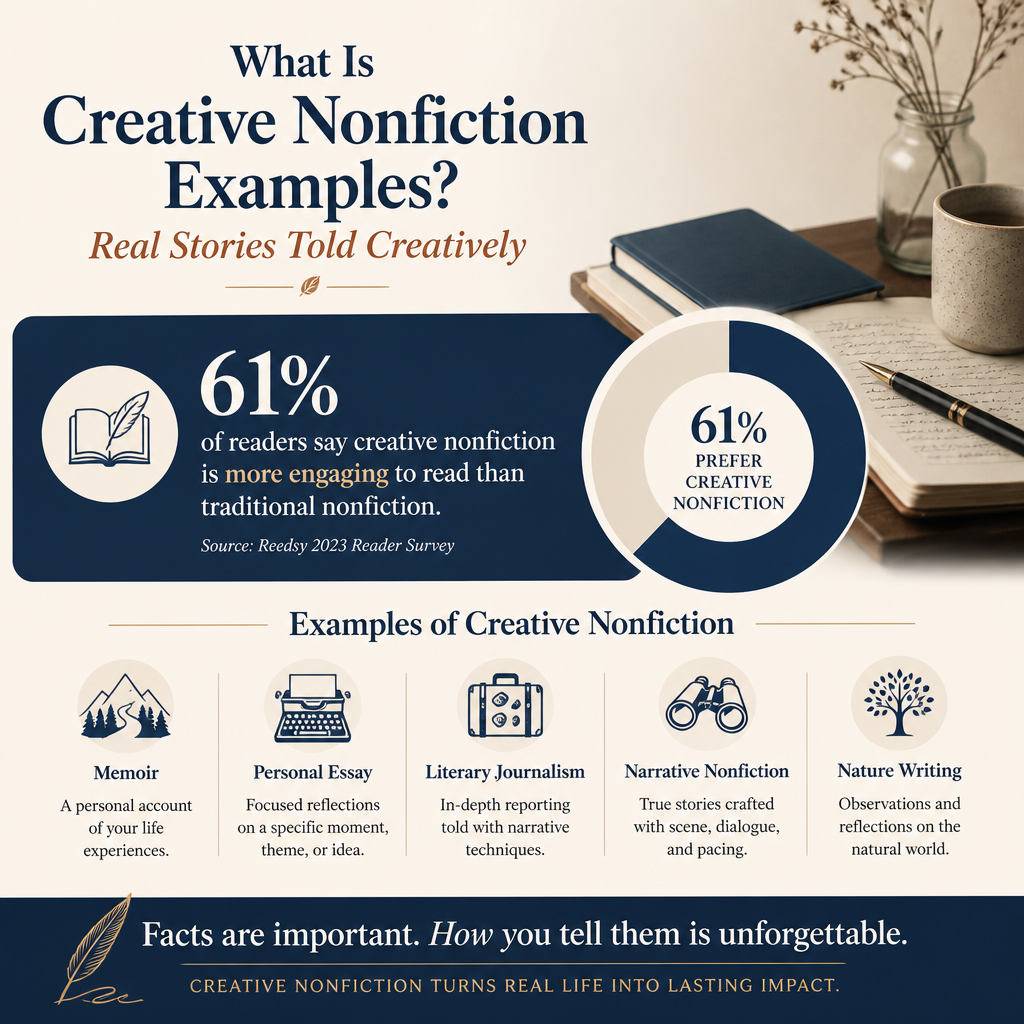
Creative nonfiction appears in several forms, and each form creates different demands for the writer. For example, a personal essay may center on one change in your thinking. A memoir builds a larger emotional or chronological arc. Literary journalism relies more heavily on reporting, interviews, documents, and observation. A lyric essay may move through association and image rather than a conventional plot.
Memoir And Personal Essay
Memoir selects a portion of a life and gives it shape. Mary Karr’s The Liars’ Club focuses on childhood, family, and memory through a tightly controlled voice. Joan Didion’s The Year of Magical Thinking examines grief after the death of her husband and the illness of her daughter. The books do not attempt to document every day of their authors’ lives. Each selects material that serves a central emotional inquiry.
Your memoir needs the same discipline. Choose the period that contains the change, pressure, or question your reader will follow. Then cut scenes that repeat the same emotional information. A childhood memoir with thirty similar arguments becomes a record. A memoir with three carefully developed arguments can become a story.
Literary Journalism And Reported Narrative
Truman Capote’s In Cold Blood is a widely discussed example of literary journalism because it presents a real murder case through a set of scenes, characterization, and narrative pacing. Encyclopaedia Britannica’s account of In Cold Blood identifies the book as a nonfiction novel based on the 1959 murders of the Clutter family. The work also raises questions about reconstructed dialogue and the limits of narrative authority, which gives you a useful warning as a writer.
Reported narrative demands a source trail. Keep interviews separate from your own observations, and distinguish direct quotes from reconstructed conversation. If you cannot verify a line of dialogue, paraphrase it or identify it as remembered. A polished scene built on invented speech can damage an otherwise sound book.
Travel Writing And Lyric Essays
Travel writing often uses a physical journey to examine a cultural, political, or personal question. While the destination supplies movement, the deeper subject may be belonging, labor, class, faith, or memory. Lyric essays work through fragments, repetition, white space, and image. Although their structure can be associative, the reader still needs a pattern to follow.
Read across forms before choosing yours. Study a memoir for scene construction, a reported feature for source handling, and a lyric essay for image and rhythm. Then name the technique you want to borrow. “I want the compression of a personal essay” gives you a workable direction. “I want it to feel literary” gives you nothing you can act on when drafting.
Story Structure For True Events
True life arrives without a clean plot. People change their minds halfway through conversations, important evidence appears late, and the most revealing moment may occur during an ordinary Tuesday. Your job as a creative nonfiction writer is to find the pattern without pretending life followed a screenplay.
Start with the narrative question. In a memoir about leaving a religion, the question might be, “What did I have to lose before I could admit I no longer believed?” On the other hand, in a reported essay about a closed factory, it might be, “What happens to a town when its shared workplace disappears?” The question gives your research and scenes direction.
Scene, Summary, And Reflection
The scene places the reader inside a specific moment with an action, sensory details, and human choices. Summary covers time and supplies context. Reflection explains what the event means to you now. Strong creative nonfiction moves among all three.
A chapter about your father’s stroke may open in the hospital room, summarize the weeks of rehabilitation, and reflect on the way your family used competence to avoid grief. Each mode performs a different job. Scene creates presence. Summary controls scale. Reflection gives the material meaning.
Mark your draft with three colors for scene, summary, and reflection. If every page glows with reflection, you may be explaining an experience the reader has never witnessed. If every page contains scene, the book may feel breathless and shallow. Adjust the balance according to the form and subject.
Chronology And Thematic Design
Chronological structure offers clarity, especially for family memoir and personal history. A thematic structure can create sharper connections among events that happened years apart. You might arrange essays around objects, places, phrases, or recurring decisions.
Choose the structure that creates the strongest reading experience and remains honest about time. For example, a flash-forward can create a question that an earlier scene answers. A delayed explanation can build tension. Give the reader enough orientation to understand where they are, when the scene occurs, and why it sits alongside the surrounding material.
The Ending And The Changed Understanding
A creative nonfiction ending does not need to solve your life. It needs to change the reader’s understanding of the material. The final scene might return to an object from the opening. A final image might reveal what you can see now that you could not see then. A question may remain open after the inquiry has done its work.
Draft three possible endings before choosing one. Endings often become clearer after you understand the book’s recurring image or unresolved tension. Avoid closing with a broad statement about how everyone faces change. Give the reader a particular image, action, or realization that belongs to your story.
Crafting A Reliable Creative Nonfiction Draft
Begin with a scene list rather than a chapter list. Write one sentence for every scene you remember, report, or want to investigate. Include the location, people present, central action, and what changes by the end. This list reveals repetition before you spend months polishing it.
Next, build a fact ledger. Give each major claim a status such as documented, corroborated, remembered, inferred, or uncertain. Creative nonfiction becomes stronger when the writer understands the weight of every statement. You can then decide where to qualify a claim, where to research further, and where to remove it.
Voice And Point Of View
First person does not mean complete self-exposure. It means the reader experiences the material through a defined consciousness. Decide what your narrator knows in each scene, what the narrator misunderstands, and what the present-day writer understands later.
Read your pages aloud to test the voice. Listen for abstract nouns that hide the event. “I experienced a period of emotional difficulty” tells me little. Meanwhile, “I kept the unopened hospital bills under the toaster for six months” gives me a person, a choice, and a pressure point.
Dialogue And Description
Use dialogue to reveal power, evasion, affection, or conflict. A conversation deserves space when the language changes the relationship or redirects the story. Summarize routine exchanges that carry no new information.
Description should create evidence about people and places. For example, a cracked phone screen, a freezer full of labeled meals, or a motel sign missing one letter can carry more meaning than a paragraph of atmosphere. Choose details that make the reader revise an assumption.
Run a source-and-sensitivity pass after your craft pass. Check names, dates, geography, quotations, medical language, legal claims, and identifying details. Then ask whether each person has been rendered as a human being with motives and contradictions. You can write a hard truth with care.
Publishing And Marketing Creative Nonfiction
Genre clarity affects your cover, book description, categories, and reader expectations. For example, a memoir about surviving a corporate collapse will reach a different audience from a collection of personal essays about grief. A reported book about a local environmental fight may appeal to regional readers, activism readers, and narrative nonfiction readers.
Write a one-sentence promise before you design the book package. Name the subject, the human tension, and the reading experience. For example, “A memoir about rebuilding a family relationship after addiction, told through the objects left in an abandoned house” gives a cover designer and a blurb writer usable material.
Your description should present the central question and the cost of leaving it unanswered. A synopsis recounts the whole manuscript for an agent or editor. A retail description earns the click from a stranger browsing Amazon. Those jobs require different documents, and combining them produces vague copy.
For an independent release, test your cover at thumbnail size beside successful memoirs and narrative nonfiction books in your category. While a stock image may be faster and cheaper, it can resemble dozens of other books. On the other hand, while a custom illustration or professional photo direction costs more, it gives you greater control over the promise. Adazing’s tools can help you generate title ideas, refine your writing, and prepare early marketing material. However, your lived subject and literary judgment must drive the final package.
Plan promotion around the conversation your book can start. Offer an excerpt to an essay publication and create discussion questions for book clubs. Contact podcasts that cover your subject, and invite ARC readers who already read memoir or narrative nonfiction. A launch team cannot manufacture a reader’s interest in a blurry premise. It can help a clear book reach the right people.
FAQs for What Is Creative Nonfiction Examples? Real Stories Told Creatively
What Makes Creative Nonfiction Different From Fiction?
Creative nonfiction uses factual material as its foundation. Fiction allows invented events, characters, and dialogue. Creative nonfiction gives you literary freedom in structure, selection, voice, and description. Still, your central claims and representations of real people need factual support.
Can I Recreate Dialogue In A Memoir?
You can recreate dialogue from reliable memory if the exchange is presented honestly and no lines are added that change its meaning. Use direct quotation for words you recorded or documented. Paraphrase conversations you remember imperfectly, and consider a note about reconstruction when the distinction matters.
How Do I Find A Topic For Creative Nonfiction?
Start with an event that still contains an unanswered question. List the scenes, documents, objects, and people connected to it. Then write a paragraph explaining what changed in your understanding. The strongest topic usually carries personal stakes and a larger subject your reader can recognize.
True Material With Deliberate Craft
Creative nonfiction succeeds when accuracy and artistry work together. The facts give your story authority. Structure gives the facts momentum. Voice gives the reader a mind to follow.
Choose one real event from your life or reporting, write the central question beside it, and draft the opening scene without explaining its meaning too soon. Let the physical details carry the first burden. Then check every claim, shape the sequence, and decide what the reader should understand by the final page. Your story becomes creative nonfiction through those deliberate choices.
