
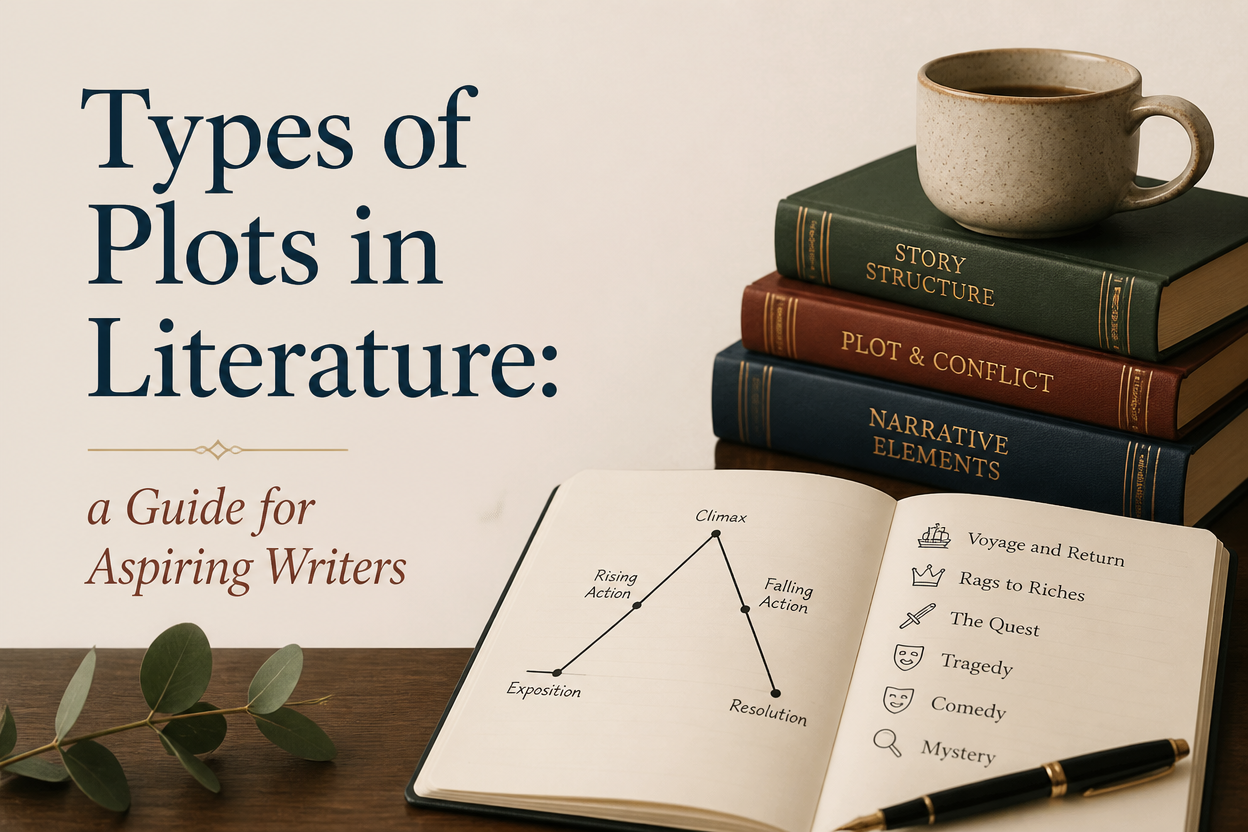
For any novelist or short-story writer, knowing the different types of plots provides a working map for pressure, choice, and consequence. Plot structure gives your characters somewhere to go, and even a familiar shape can produce a fresh book when the choices inside it feel specific. You need enough structure to keep a reader turning pages and enough flexibility to let the story surprise you.
I treat plot types as tools that bend to fit the story. For example, a romance, a murder mystery, and a literary family saga may all share the same underlying movement from desire to crisis to change. However, each genre gives that movement a different surface. Your task, then, is to choose the structure that puts the right pressure on your protagonist.
The strongest plot usually begins with a character who wants something concrete and faces a consequence for failing to get it. Start there, then choose a shape that can intensify the struggle throughout the manuscript.
Table of Contents
Plot Structure And Reader Expectation
Readers bring expectations to every genre. Take the mystery reader, who wants a question worth solving. Anyone who picks up a romance expects emotional movement toward a committed relationship. In fantasy, readers want to watch the central threat grow beyond the opening disturbance. You can bend those expectations, and breaking them well starts with understanding them.
Plot structure controls the timing of information. It determines when your reader learns the antagonist’s plan, when your protagonist understands the real cost of the goal, and when a private problem becomes a public crisis. A weak plot often piles up events that never build on one another or raise the stakes.
When I assess a draft, I write one sentence for each major turn. The first captures the disturbance, the second names the protagonist’s commitment, and the last pins down the choice that resolves the central conflict. Gaps in that chain usually reveal a middle that needs stronger cause-and-effect.
The Inciting Disturbance
The opening disturbance changes the conditions of your protagonist’s life. For example, in Suzanne Collins’s The Hunger Games, Prim’s selection forces Katniss into a public contest that threatens her survival and tests her loyalty. A quiet literary novel might open with a death, a betrayal, or a letter that reopens an old wound.
Give the disturbance a consequence your character cannot ignore. Without a cost, a strange event stays at the level of atmosphere. Let that event threaten a relationship, a livelihood, freedom, or identity, and it becomes plot.
The Escalating Complications
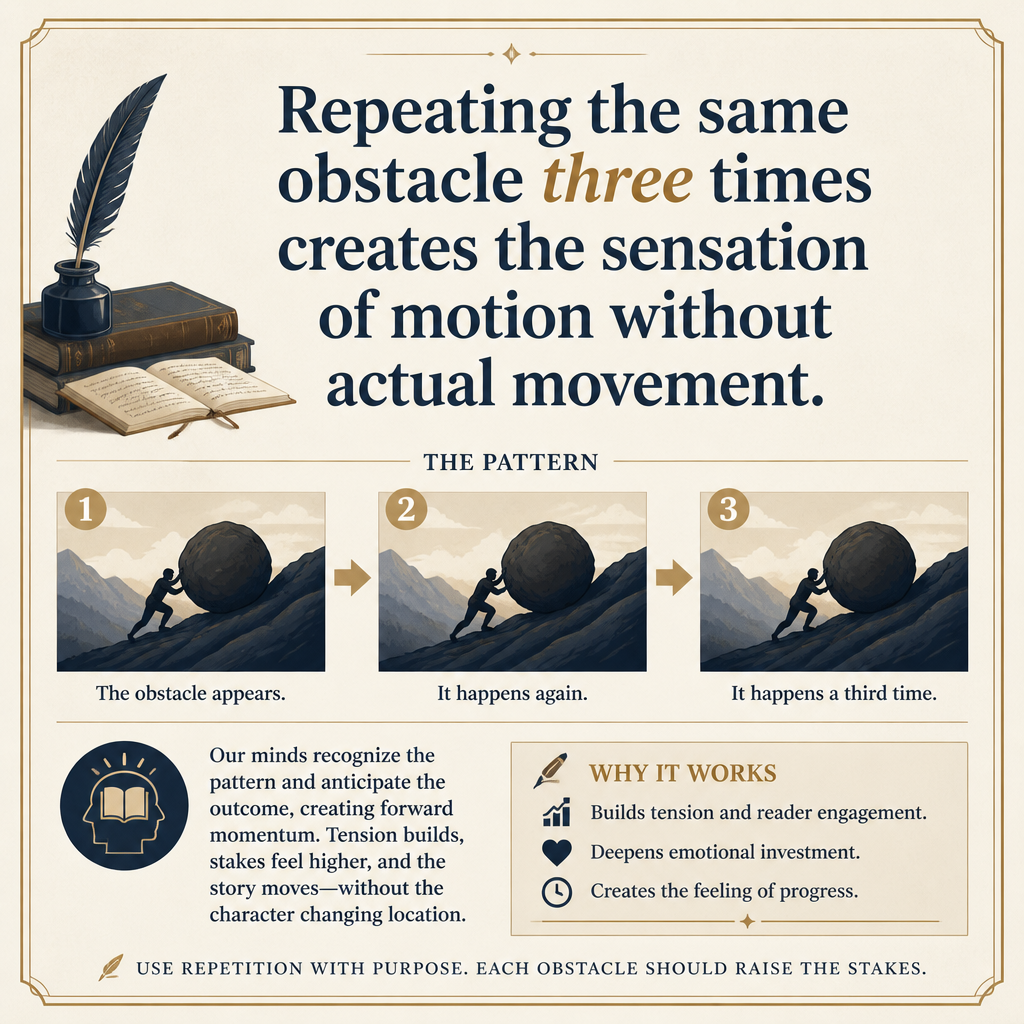
Each major complication should change the problem. Repeating the same obstacle three times creates the sensation of motion without actual movement. A stronger sequence forces your protagonist to spend resources, reveal information, damage a relationship, or surrender an earlier belief.
Beside every scene, write a short note that says, “The situation changes because…” Then complete the sentence with a specific cause. If no cause comes to mind, move the scene to your character notes and keep the manuscript for scenes that change something.
Classic Plot Shapes For Fiction
Several plot shapes appear across centuries of storytelling because they organize human change in ways readers recognize. Aristotle described a beginning, middle, and end in Poetics. Centuries later, Gustav Freytag outlined a five-part dramatic movement now known as Freytag’s pyramid. You can use these models as diagnostic tools during planning and revision.
Three-Act Structure
Three-act structure divides a story into setup, confrontation, and resolution. Act One establishes the ordinary world, introduces the central disruption, and ends with a decision that commits the protagonist to the main conflict. From there, the second act applies pressure through reversals, discoveries, and increasingly costly choices. In the final act, the conflict builds to a decisive confrontation, and its consequences play out on the page.
This structure works well for commercial fiction because it gives you clear places to test momentum. Around the first quarter, your protagonist should make a choice that closes off the old life. The midpoint then calls for a revelation or reversal that alters the meaning of the conflict. In the closing chapters, the protagonist faces a choice tied directly to the story’s central question.
Heroic Transformation
The hero’s journey follows a protagonist from an ordinary life into unfamiliar danger and back again with changed knowledge. You will see versions of it in fantasy, science fiction, mythic adventure, and coming-of-age fiction. Writers keep returning to this model because it pairs internal transformation with external action.
Use the structure when your protagonist must become capable of making a choice that would have been impossible at the beginning. The trouble starts when you fill every beat out of habit. For example, a character who refuses the call twice can stall the opening. Give the mentor no purpose beyond explaining the world, and the story’s tension drains away.
Tragedy And Downward Movement
A tragedy follows a character toward irreversible loss, often because a strength becomes destructive under pressure. Take ambition, which can harden into obsession. Under enough strain, loyalty turns into complicity. Confidence follows a similar path toward blindness. Choice by choice, the protagonist carries the story toward an ending that feels both painful and inevitable.
For a tragic plot to work, the reader has to feel how much the protagonist stands to lose. Build the desired future in concrete scenes before you take it away. Picture a couple the reader has watched make plans, solve problems, and imagine an ordinary life together, and their loss will hurt.
Genre-Specific Plot Patterns
Genre gives plot a contract with the reader. The contract covers the kind of problem at the center, the emotional payoff the book offers, and the shape of the ending. A hybrid novel can honor that contract too, as long as your cover, blurb, sample pages, and plot all signal the kind of reading experience waiting inside.
Mystery And Thriller Plots
A mystery organizes the plot around a question, usually involving a crime or hidden truth. Clues should perform double duty by revealing information and changing the suspect list, the stakes, or the protagonist’s understanding of the case. Red herrings work when they arise from the story’s real circumstances. For example, a character might hide an affair for a reason unrelated to the murder.
Thrillers run on escalating danger and narrowing options. Give the protagonist a clock, a vulnerable person, a limited resource, or an enemy who learns from every failed attempt. After drafting each major sequence, ask whether the threat has become more immediate and whether the protagonist has fewer safe choices.
Romance And Relationship Plots
Romance depends on emotional causality. Attraction alone cannot carry a full novel. The central pair need reasons to connect, reasons to resist, and experiences that expose the beliefs keeping them apart. Each encounter should alter their trust, their desire, or their willingness to accept a shared future.
The midpoint often brings deeper intimacy or a declaration that raises the emotional cost of failure. As the story nears its end, the crisis should grow from the couple’s established wounds and choices. A breakup inserted because the manuscript needs another obstacle will feel mechanical, so plant the conflict in the characters’ history from the opening chapters.
Literary And Speculative Plots
Literary fiction may place more weight on interior change, social pressure, or the meaning a character assigns to events. Speculative fiction, on the other hand, can build an entire system of magic, technology, or political control. Both forms still need movement. A new understanding, a broken alliance, or a changed moral position can carry a scene even when the external action stays quiet.
For a literary or speculative manuscript, track the protagonist’s belief at the beginning of each act. Write the belief in one sentence, then write the experience that weakens or strengthens it. Readers will follow a slow plot when each chapter changes how they interpret the character’s life.
Character Desire And Plot Pressure
Plot grows from the collision between desire and resistance. A protagonist who wants nothing can only observe events, and observation rarely creates a satisfying narrative. Give your character a specific goal, a personal reason for pursuing it, and a fear about what success or failure will reveal.
I often separate external desire from internal need during planning. External desire might be winning a promotion, escaping a haunted house, solving a disappearance, or publishing a dangerous discovery. Beneath that goal sits the internal need, which might involve accepting grief, surrendering control, or learning to trust another person. The plot becomes meaningful when the external pursuit forces contact with the internal wound.
External Goals
Write the protagonist’s goal as a verb with a visible result. For example, “Find the missing sister” gives you scenes to design. Set “Find happiness” as the goal, and you get a theme that lacks immediate pressure. A visible goal also helps you write a sharper blurb and choose more accurate categories for Amazon KDP or other retailers.
Raise the cost after each attempt. Picture a detective who loses a witness. In a romance, the bride might discover a financial secret. Let an apprentice use forbidden magic, and the whole town pays for it. Your protagonist should pay for progress, since free victories remove the pressure that makes readers care.
Internal Change
Internal change needs evidence. Announcing that your protagonist has become brave proves nothing. Put the character in a scene where fear remains present, and the new choice carries a real cost. The final decision should echo an earlier moment so the reader can measure the change without a speech explaining it.
During revision, mark every scene that changes the protagonist’s belief. A manuscript with many external events and few belief changes may need deeper character work. When the pages lean toward constant introspection and little external resistance, the fix usually involves firmer goals and consequences.
Choosing And Revising Your Plot
Choose a plot type by examining the story you already have. The central question matters more than the label. Ask what your reader should worry about, what kind of answer the ending must provide, and what decision will reveal the protagonist’s biggest change.
Write a one-page synopsis before you draft the full manuscript. That page should cover the opening disturbance, the protagonist’s first major commitment, the midpoint reversal, the lowest point, the climax, and the final image. A synopsis exposes structural problems at the stage where fixing them costs a page, long before they can cost a year.
Testing The First Draft
Read your chapter endings in sequence. Each ending should give the reader a reason to keep going, whether that comes from a question, a danger, a decision, or a new piece of information. Cliffhangers can wait for the right breaks, as long as every chapter leaves the situation changed.
Beta readers or ARC readers can answer questions your own reading cannot. Ask where they felt curiosity, where they felt confusion, and where they considered stopping. Their comments will help you separate a deliberate slow burn from a middle that has lost its pressure.
Revising The Middle
A sagging middle usually calls for sharper choices, and piling on more incidents seldom fixes it. Remove a scene that repeats an earlier discovery, then give its useful information to a scene where the protagonist must act. When several minor characters perform the same story function, combine them. Every retained scene should alter the problem or deepen the cost.
Adazing’s writing tools, including QuickWrite, can help you generate alternate complications, character names, or scene prompts when your outline stalls. I use generators for possibilities, then judge every suggestion against the book’s genre, voice, and existing cause-and-effect chain.
FAQs for Types of Plots in Literature: A Guide for Aspiring Writers
How Do I Choose A Plot Structure For My Novel?
Start with the reader’s central question. That question points you to the right form: a mystery structure when the pleasure comes from discovering hidden information, a romance structure when the emotional relationship drives the book, and a transformation structure when the protagonist’s changed identity carries the ending. You can combine forms after you understand the promise each one makes.
Can A Novel Use More Than One Plot Type?
Yes. For example, a fantasy novel can pair a heroic transformation with a mystery about a royal murder. Add a thriller plot to a romance, and it works as long as the danger keeps pressuring the relationship. Give each major thread its own goal, escalation, and resolution, then connect the threads through the protagonist’s choices.
How Do I Fix A Plot That Feels Slow?
The fix begins with the last scene where the protagonist made a consequential choice. Move forward from that choice with an obstacle that changes the situation and demands a response. From there, cut repeated explanations, combine scenes with the same purpose, and test every chapter ending for a fresh question or decision.
Build The Plot Your Characters Can Carry
A plot type gives your manuscript shape, and your characters give that shape meaning. Choose the structure that puts the greatest pressure on your protagonist’s desire, then revise until every major event grows from a choice, creates a consequence, or changes the reader’s understanding.
A perfect outline can wait. Before you begin, aim for a clear problem, an escalating chain of decisions, and an ending that answers the question your opening raises. Draft the one-page synopsis, test the first quarter, and let what those pages reveal guide the next revision.
