
Knowing the different types of novels helps you make better decisions about structure, audience, packaging, and promotion before you position a manuscript. A novel’s category makes a promise to readers before they read page one. It tells them what kind of tension to expect, how quickly the story may move, and which emotional payoff the ending should deliver.
Authors often treat genre as a label added after the writing. That approach creates expensive problems. Consider a manuscript with beautiful prose that still confuses readers because its cover suggests historical romance, its blurb sounds like domestic suspense, and its opening reads like literary fiction. You need to identify the book’s strongest promise early enough to guide the draft, title, cover, categories, keywords, and launch plan.
I use genre as a design tool that leaves plenty of room to move. You can write across traditions, combine forms, and create a book that resists a single shelf. Whatever shape the book takes, you still need to know which readers are most likely to buy it, because Amazon KDP categories, retailer keywords, comp titles, and advertising audiences all depend on that decision.
Table of Contents
Novel Types By Reader Promise
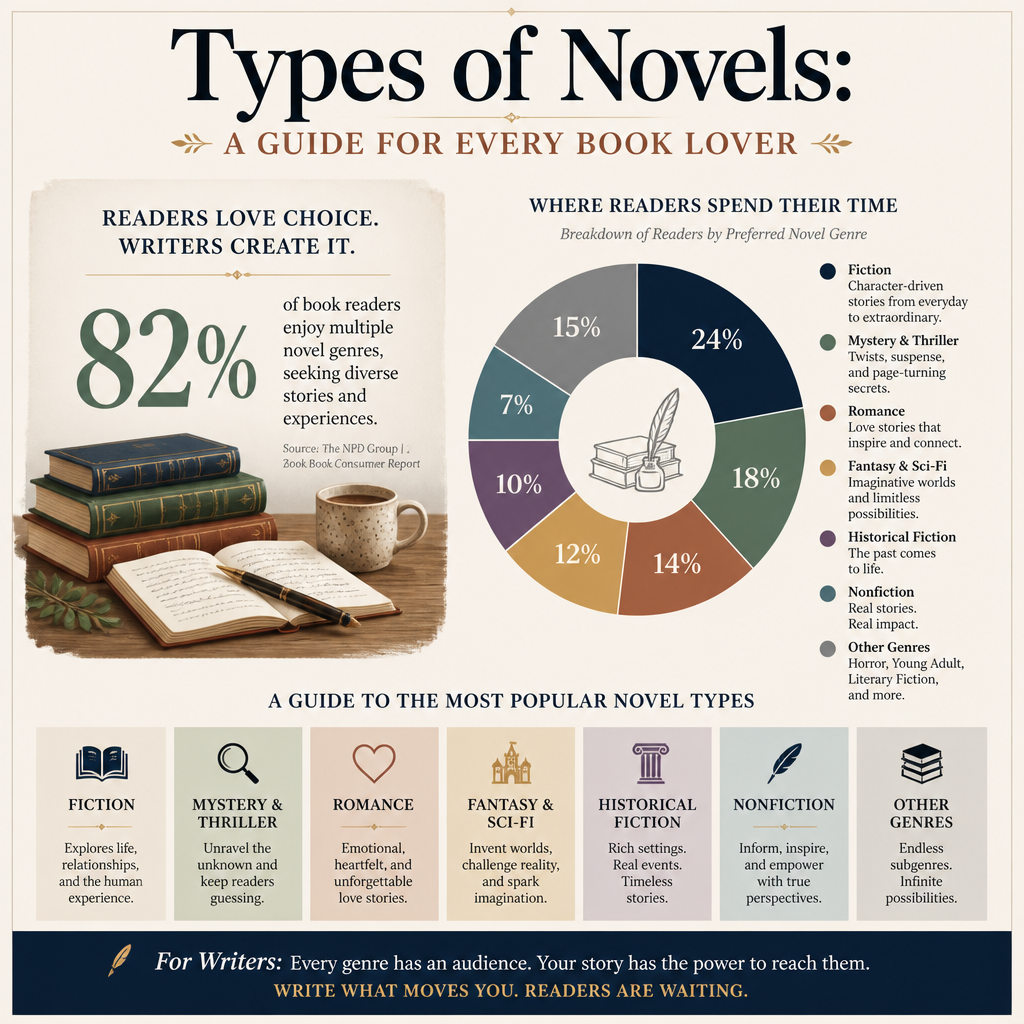
The clearest way to classify a novel is to ask what experience it promises. For example, a romance promises a developing relationship and an emotionally satisfying romantic resolution. Pick up a mystery, and you expect a question, a trail of evidence, and an explanation. With horror, readers sign up for dread, danger, and a confrontation with something that violates ordinary safety.
That promise affects every level of the manuscript. It shapes the opening disturbance, the pace of revelations, the character arc, and the ending. Genre readers bring strong expectations because they have read hundreds of books in the category. Meeting those expectations gives your inventions room to surprise them.
Literary Fiction And Commercial Fiction
Literary fiction usually leans hardest on language, interiority, ambiguity, and thematic depth. Its plot may stay quiet on the surface, and the emotional or moral change underneath can still be substantial. Commercial fiction, on the other hand, prioritizes momentum, immediate stakes, and a clear reading experience. Many successful novels combine both approaches.
Treating literary fiction as a synonym for serious writing misreads both forms. Take a commercial thriller, which can examine grief, class, or moral responsibility with considerable depth. Literary fiction, for its part, has no license to ignore reader orientation. A reader still needs to understand whose life is changing, what pressure is building, and why the next chapter matters.
Genre Fiction And Cross-Genre Fiction
Genre fiction is built around a recognizable set of conventions. Cross-genre fiction combines two or more promises. For example, historical mysteries, paranormal romances, cozy fantasies, and science fiction thrillers all belong in this group. The combination can give your book a strong sales position when both elements receive real attention on the page.
The common mistake is treating one genre as decoration. Picture a detective who happens to live in a fantasy world. If you market that book as a fantasy mystery, the case itself has to hold up. Before revising, write down the primary promise and the secondary promise, then give the primary one the larger share of the plot’s pressure.

Popular Novel Genres For Authors
Each major genre has a different contract with its readers. Bending that contract works best once you know its terms. The following categories describe common reader expectations, and each one leaves room for variation.
Romance And Romantic Fiction
Romance centers the developing relationship between the main romantic partners. The story needs meaningful obstacles, escalating intimacy, and an ending that provides a satisfying romantic future. That future may be marriage, a committed partnership, or another form of lasting union that fits the subgenre.
Contemporary romance often draws its conflict from family, work, identity, money, or social pressure. Move the story into the past, and historical romance adds research, period customs, and the setting’s limitations. In romantic suspense, relationship tension shares the page with external danger. Fantasy romance sets the love story inside a world shaped by magic, political power, or supernatural rules.
For a romance author, the cover, title, blurb, and sample pages need to signal the subgenre in concert. A dark, minimalist cover can attract readers in one category and repel readers in another. Study recent top-selling books in your intended subcategory and record repeated choices in typography, color, character pose, and wording.
Mystery, Thriller, And Suspense
A mystery begins with a question, often involving a crime, disappearance, secret, or unexplained event. The reader expects clues, suspects, reversals, and a solution that feels both surprising and supported by the evidence. Thrillers, on the other hand, lean on speed and physical or political danger. Suspense can operate across both forms because it describes the reader’s anxious anticipation of what may happen.
Cozy mysteries usually limit graphic violence and emphasize an amateur investigator, a distinctive community, and a satisfying resolution. Psychological thrillers, in contrast, unsettle the reader’s hold on memory, identity, trust, or perception. Move into legal, medical, domestic, or espionage territory, and each thriller brings its own professional world and research demands to the same basic engine of danger.
Outline the information each character knows before drafting. I often see mystery manuscripts fail because the author protects the twist so carefully that the middle loses movement. A fair mystery can conceal the answer without concealing every useful clue.
Fantasy, Science Fiction, And Horror
Fantasy depends on impossible elements, whether magic, invented cultures, gods, or nonhuman beings. In science fiction, the speculative pressure comes from science, technology, social systems, or imagined futures. Horror builds its effect on fear, vulnerability, and the violation of safety. These genres often overlap, and each one still leads the reader toward a different emotional destination.
Worldbuilding earns its space when it creates conflict. For example, a magic system matters because its limits force a difficult choice. A future technology earns its place by reshaping power, labor, family, or survival. Trap the characters in a haunted house they cannot leave without losing something they value, and the setting becomes plot.
Readers will forgive a strange world more readily than inconsistent rules. Create a private reference sheet for names, geography, history, technology, magic, and social customs. During early development, try Adazing’s word tools and name generators, then record your final choices in one living document so the terminology remains stable across the series.
Novel Forms And Narrative Design
Genre tells readers what kind of experience they are buying. Form, on the other hand, governs how the story arrives. A novel can use first person, third person limited, multiple viewpoints, an epistolary structure, or a nonlinear timeline. Choose the form that sharpens the story’s strongest source of interest.
First person creates intimacy and limits the reader to what the narrator knows, believes, or chooses to reveal. Third person limited offers close access to a character with slightly more flexibility in presentation. Multiple viewpoints can widen the world and create dramatic irony. To earn its place, each viewpoint needs a distinct desire, voice, and reason to exist.
Linear And Nonlinear Novels
A linear novel presents events in the order they occur. This structure often suits mysteries built around discovery, romances built around relationship progression, and adventure stories built around escalating obstacles. It reduces the reader’s work, giving you more room to spend attention on character and language.
In a nonlinear novel, time gets rearranged through flashbacks, parallel timelines, framed narratives, or delayed revelations. The form earns its complexity when the order of information changes the meaning of events. If a flashback only repeats background the reader already understands, cut it or convert it into a scene that creates new pressure.
Standalone Novels And Series
A standalone novel resolves its primary conflict within one volume. In contrast, a series builds a larger arc that extends beyond the first book. You can write a satisfying ending with open possibilities, as long as readers feel that the book they purchased delivers a complete experience.
Plan series length around the story’s natural pressure and your publishing capacity. For example, a trilogy may suit an epic fantasy with escalating political conflict. Connected mysteries tend to work better as an ongoing series with a new central case in each volume. Keep a series bible that tracks character ages, injuries, relationships, locations, unresolved questions, and timeline dates.
Choosing A Novel Type For Your Manuscript
Your category should come from evidence on the page, whatever label you might prefer. Look at the central conflict, how much page space goes to romance or investigation, the type of ending, and the emotional experience you want the reader to carry away. The dominant pattern usually reveals the most useful primary category.
Next, identify three to five recent comp titles that share audience, tone, genre, and market position. A famous classic may help you discuss theme. If your actual competitors are recent self-published releases on Kindle Unlimited, that classic offers weak packaging guidance.
The Manuscript Test
Write one sentence that names the protagonist, the disruption, the major goal, the opposing force, and the consequence of failure. A second sentence should then describe the expected reader payoff. If you cannot write those sentences without listing several unrelated promises, the manuscript may need a clearer center.
Read the first three chapters through the expectations of your chosen audience. In a romance, readers look for romantic potential or a meaningful obstacle early. A thriller should introduce danger or a destabilizing question before the pace has a chance to sag. Literary fiction can move more gradually, as long as it offers a compelling consciousness and a source of pressure.
The Packaging Test
Place your working title and one-sentence pitch beside six recent books in the category. Could a reader identify your shelf within a few seconds? From there, check the cover at thumbnail size, since many Amazon shoppers first encounter it there. A stock image may save money and time. The trade-off is a cover that can resemble dozens of others in your category. Custom covers cost more and still need clear genre signals.
A blurb works as a sales invitation, so resist the urge to summarize. Introduce the protagonist, the desire, the obstacle, and the consequence, then stop before you explain the entire plot. I use Adazing’s writing tools, including QuickWrite, to generate alternate hooks or pressure-test a premise. After that, I edit every line for accuracy and voice.
Publishing And Marketing By Novel Type
Your genre choice affects discoverability after publication. Select retailer categories and keywords that describe the book readers will receive. A misleading category may create a short spike in clicks. Disappointed readers then leave poor reviews and abandon the series. Read-through depends on trust built in the first purchase.
Build promotion around what your readers respond to. For example, romance authors can work with trope-based hooks, relationship excerpts, and launch teams. Mystery authors, on the other hand, get more traction from clue-driven teasers, reader groups, and questions about suspects. In fantasy, readers often want maps, lore snippets, character art, and a clear explanation of the world’s central conflict. A single graphic repeated across every platform rarely gives readers enough reason to stop.
Get your cover and metadata right before you spend heavily on ads. A campaign cannot repair a cover that looks wrong for its category or a blurb that hides the book’s central promise. Adazing’s book cover makers and promotion tools can help you test concepts and prepare marketing assets. Your judgment about genre fit still makes the final call.
Track useful signals after launch, including click-through rate, conversion, review language, newsletter signups, and read-through to the next book. A low number does not always mean the writing failed. Consider how often a weak conversion rate points to packaging. When a first book sells well, and few readers continue, disappointment is the likelier cause. Strong reviews paired with limited traffic usually signal a discoverability problem.
FAQs for Types of Novels: A Guide for Every Book Lover
What Are The Main Types Of Novels?
The main types include literary fiction, commercial fiction, romance, mystery, thriller, suspense, fantasy, science fiction, horror, historical fiction, contemporary fiction, young adult fiction, and children’s novels. These categories can overlap. Picture a historical mystery, a fantasy romance, or a literary horror novel. Each one works when the manuscript delivers the expectations its positioning implies.
How Do I Choose A Genre For My Novel?
Study the manuscript’s central conflict, dominant emotional experience, plot structure, and ending. From there, compare those features with recent books your ideal readers already buy. Once one category stands out with the clearest promise, align the title, cover, blurb, keywords, and opening chapters with it.
Can A Novel Belong To More Than One Genre?
Yes. Cross-genre novels often gain a strong identity when one genre leads, and the other adds depth. Decide which audience you need to reach first, then package the book so that audience understands the primary experience. Both genres still need enough page space to satisfy readers who arrive through either promise.
Give Your Novel A Clear Promise
The best novel type for your book is the category that matches the experience you deliver. Genre gives you a reader, a set of craft expectations, and a practical route to discoverability. Study the conventions, write with intention, and let your unusual choices grow from a structure readers can recognize.
Before publication, test the manuscript, cover, blurb, categories, and keywords as one system. When those pieces point toward the same reader promise, your book has a much better chance of finding the people who will value it.
