
Formal, colloquial, poetic, and other types of diction guide how readers judge your characters, trust your narrator, and experience your story, often before they understand every detail. For example, a detective who says “I observed an irregularity” creates a different impression from one who says “Something smelled wrong.” Both lines signal suspicion, and their diction hands that suspicion to two very different people.
Authors often treat word choice as a final polish pass, something to handle after plot, structure, and grammar. I see diction as a structural tool, one that can establish class, education, temperament, period, region, profession, and emotional state in a few words. Word choice also governs how near the reader stands to the action. A plain verb can bring a scene close to the skin. In contrast, an abstract noun can create the cool distance of a report.
Writing with authority doesn’t require an ornate vocabulary. It depends on words that belong to the speaker, scene, genre, and moment. In my experience, the strongest revisions come from replacing impressive words with precise ones, then adding texture where the story genuinely calls for it.
Table of Contents
The Core Meaning Of Diction
Diction refers to the words a writer selects and how those words create a particular voice. Merriam-Webster defines diction as word choice judged chiefly by its correctness, clarity, or effectiveness. That definition matters because diction involves more than vocabulary size. Beyond vocabulary, it covers register, connotation, rhythm, specificity, and the expectations attached to certain words.
Compare these sentences:
- She entered the room.
- She slipped into the room.
- She marched into the room.
- She materialized beside the conference table.
In every version, the basic event stays the same. What changes is the motive and energy each verb assigns to the character. With “slipped,” the reader senses caution or secrecy. “Marched” carries force or confidence. “Materialized” may suggest supernatural movement, comic exaggeration, or a narrator with an unusual habit of describing people.
That distinction gives you a useful editing question. Ask what your verb makes the reader assume about the character behind it. On the page, walking, looking, eating, and speaking all carry meaning, since the chosen verb tells the reader how to interpret each behavior.
Denotation And Connotation
Denotation refers to a word’s direct meaning. Connotation includes the feelings, associations, and judgments that gather around it. For example, “house” and “home” can refer to the same physical place. Only “home” suggests attachment built over years of shared history. The pair “frugal” and “cheap” works the same way by describing similar spending habits in opposite tones. Readers tend to hear admiration in the first word. The second usually lands as dismissive.
During revision, circle words that carry judgment. Then ask whether the judgment belongs to the narrator, the character, or you as the author. Consider a first-person narrator who calls a landlord “a parasite.” Set that voice beside one who calls him “a property owner.” Each label reveals a different mind.
Register And Social Meaning
Register describes the level and situation of language. Formal diction suits a legal notice, academic argument, or ceremonial speech. A text message or private conversation calls for informal diction, as does a narrator who thinks in everyday language. Technical diction ties itself to a profession or specialized community.
Register can expose tension. Picture a surgeon who uses exact clinical terms at work, then loses that controlled vocabulary during an argument with her sister. Similarly, a teenager may write polished school essays and still speak in clipped slang with friends. Both cases show how characters become more convincing when their diction changes according to audience and pressure.
Choose one passage from your manuscript and label each speaker’s register as formal, informal, technical, regional, literary, or mixed. If every voice receives the same label, your dialogue probably needs more social separation.

Formal, Informal, and Technical Diction
Formal diction creates distance, authority, ceremony, or restraint. Shift into informal diction, and the prose gains familiarity and speed. When a character speaks in technical diction, readers credit that character with competence within a field. Any of the three can work beautifully. The same choice weakens a scene when it arrives without a reason.
Consider a medical thriller. A doctor might say, “The patient is experiencing respiratory distress” during a handoff. In the same chapter, she might tell her frightened son, “His lungs are struggling, and the machine is helping him breathe.” The second sentence carries less professional terminology because the relationship demands clarity and comfort.
Formal Diction For Authority And Distance
Formal wording often relies on complete sentences, precise nouns, measured verbs, and restrained emotion. It can suit a judge, diplomat, professor, archivist, or narrator with a controlled point of view.
Used too heavily, formal diction makes every character sound as if a committee approved the dialogue. Reading speeches aloud exposes the problem. For example, if a furious character says, “Your conduct has produced an unacceptable outcome,” you may have given the line the voice of a policy memo. In contrast, “You ruined everything” carries heat because the syntax is direct and the vocabulary belongs to an upset person.
Informal Diction For Intimacy And Motion
Informal diction uses contractions, familiar phrases, shorter turns of speech, and words people reach for in ordinary conversation. It can create intimacy with a first-person narrator or make dialogue move at the speed of thought.
Informal writing still requires control. A page filled with filler phrases, loose intensifiers, and constant slang becomes tiring. Choose the details that reveal the speaker. Picture three characters hearing the same news. One mutters, “No kidding.” Another answers with “You cannot be serious.” Meanwhile, the third stares at the floor without a word. Each reaction carries a different history.
Technical Diction And Reader Access
Technical language earns its place when it teaches the reader something new, establishes a professional world, or reveals how a character thinks. Consider a marine biologist who identifies a species by its scientific name. She comes across differently from one who calls every creature a fish.
Technical terms can also create friction. This friction pays off when the viewpoint character understands the field, and someone else in the scene doesn’t. Give the reader enough context to follow the stakes. You can define a term through action, comparison, or a character’s response rather than pausing the story for a dictionary entry.
For nonfiction authors, technical diction needs the same discipline. Define specialized language on first use, then use it consistently. Readers will forgive a difficult term when it earns its space. They will resent three pages of terminology that never changes their understanding.
Concrete, Abstract, and Sensory Diction
Concrete diction names things a reader can perceive or measure. Ideas, qualities, and conditions belong to abstract diction. Your writing needs both kinds. Concrete words give a scene a body. Motives, beliefs, and consequences, in turn, depend on abstract terms to reach the page.
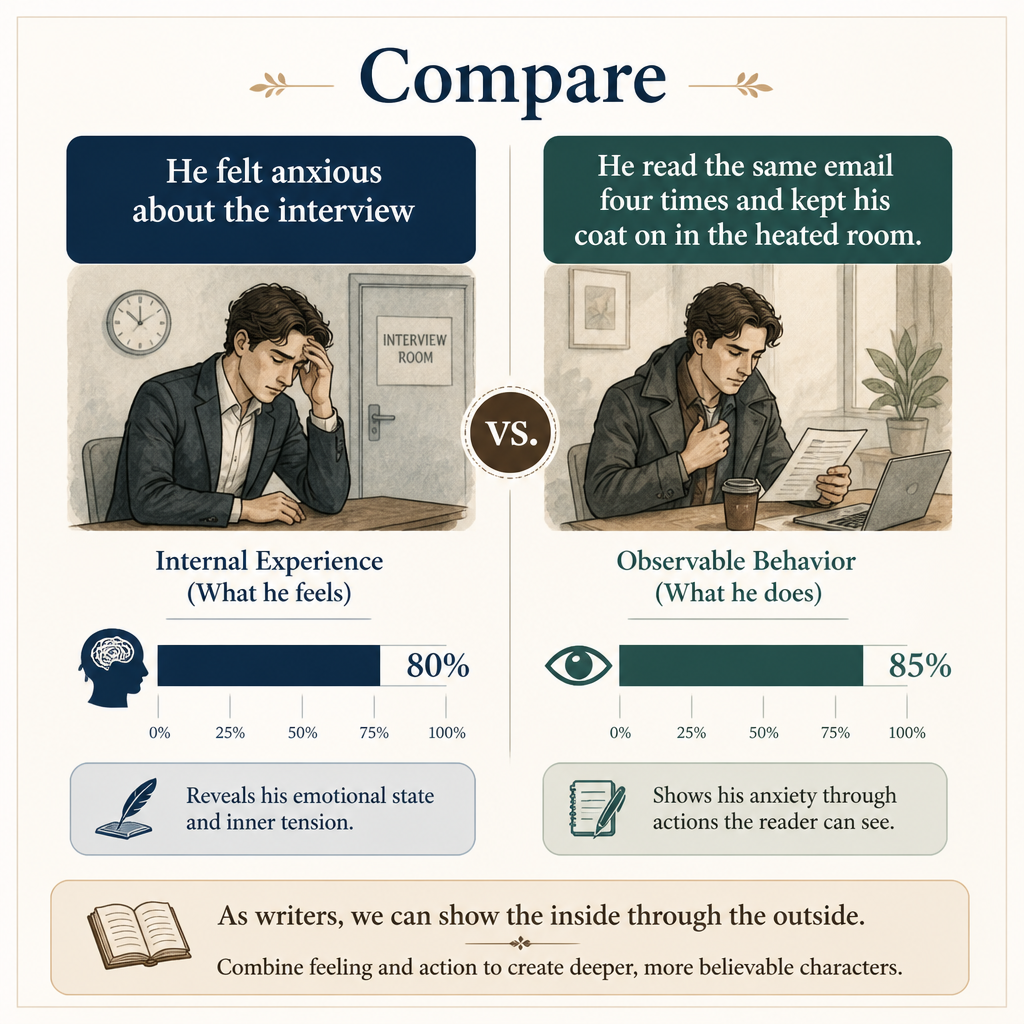
Compare “He felt anxious about the interview” with “He read the same email four times and kept his coat on in the heated room.” The first sentence states an emotion. With the second, readers get evidence and feel the anxiety through his body.
Concrete Words On The Page
Concrete diction works through objects, actions, textures, sounds, and specific places. For example, “a cup” gives the reader little to hold. Describe it as “a chipped blue mug with coffee dried along the rim,” and the scene gains a history and a surface.
Specificity doesn’t mean decorating every noun. Select the detail that changes the reader’s understanding. Take a locked medication cabinet, which matters in a scene about addiction. In a story about money, secrecy, or a recent fight, a cracked phone screen carries the same weight. Even a red scarf earns attention once its color helps the reader spot someone across a train platform.
During revision, search for nouns such as thing, place, problem, feeling, and situation. Replace some of them with the exact object, location, conflict, or emotion you mean. Leave a general word when the character genuinely lacks information.
Abstract Words With A Job
Abstract diction helps when you need to name a pattern or idea. In a memoir, you might reach for words such as grief, responsibility, faith, or shame. A business book calls for a different set, built around pricing, retention, positioning, or demand. The problem begins when abstract language replaces evidence.
Try pairing an abstract noun with a concrete example. For example, skip a line like “The town suffered from inequality” and describe two streets divided by a six-lane road, one with a grocery store and one with a shuttered pharmacy. The larger idea becomes visible through the details.
I often use a three-part check on abstract passages. What does the idea look like, what does it make someone do, and what object could represent it? Those questions turn a vague paragraph into material a reader can remember.
Diction Across Genres And Viewpoints
Genre creates a promise about language. Consider how readers of a cozy mystery expect a different verbal texture from readers of a military science-fiction novel. Breaking those conventions can work, provided you understand them first so the break feels deliberate.
Romance often depends on emotional precision and charged physical detail. Literary fiction can tolerate more abstraction, provided the voice has a strong interpretive mind. In a thriller, verbs that carry speed and risk usually serve the story best. Write historical fiction, and you need period awareness, with enough restraint to avoid modern phrases that pull the reader out of the setting.
Genre Fit And Reader Expectation
Read five recent books in your category and collect recurring language patterns. Look at sentence length, profanity, metaphor density, technical vocabulary, and how characters express emotion. Treat the exercise as research. Studying those books teaches you the contract your own diction needs to honor or challenge.
For example, a cozy mystery protagonist who describes a corpse in graphic anatomical detail can push the book toward a darker tone than its readers signed up for. Strip all operational vocabulary from a military science-fiction novel, and trained readers start questioning the world. Either choice can still succeed when the surrounding voice supports it.
Point Of View And Word Ownership
Point of view controls which words the reader receives. In close third person, description should pass through the viewpoint character’s knowledge and habits. Picture a botanist entering a room and naming every houseplant by species. A frightened child in that room fixes on the adult’s shoes and the sound of keys. Send a detective through the same door, and he notices the exits before the furniture.
First-person narration gives you an even sharper test. Every word needs to sound like something that narrator would think or say. Take a dishwasher with limited formal education. He can understand injustice perfectly and describe it in plain, forceful language. Education and intelligence don’t require the same diction.
Hide the character’s name and dialogue tags, then read a page. Ask whether you can identify the viewpoint from the word choices alone. When you can, the voice has begun doing real narrative work.
A Revision Method For Sharper Diction
Diction improves through targeted revision. A general instruction like “make the prose stronger” gives you too little to work with. I prefer several passes, with each pass focused on one kind of decision.
Pass One: For Verbs And Nouns
Underline every weak verb, especially forms of to be, have, get, go, and do. Of those, replace only the ones that hide meaningful action. Then examine broad nouns like issue, aspect, thing, and stuff. A precise replacement should change the image or clarify the argument.
Don’t replace every simple verb with a dramatic one. For example, “walked” can be exactly right. Swap in “staggered,” and the reader senses injury or instability. “Lurched” brings irregular motion. Let the scene’s evidence guide the choice, and resist the urge to make every sentence perform acrobatics.
Pass Two: For Repetition And Sound
Read the passage aloud. Your ear will catch repeated sentence openings, clustered adjectives, accidental rhyme, and words that feel too formal for the speaker. Controlled repetition can create rhythm. When it slips past unnoticed, the prose starts to sound mechanical.
Check the first and last word of each sentence. Strong placement gives important words more force. In a paragraph about a failed marriage, ending the final sentence on “silence” builds far more pressure than a generic phrase like “the situation.”
Pass Three: For Voice And Audience
Read the passage as your intended reader would. Ask what the language promises about the book and whether the promise matches the cover copy, category, and opening chapter. Consider a literary voice on a commercial thriller. The pairing can work as long as your blurb and sample pages prepare the same audience.
For nonfiction, read a page as a tired reader who wants a useful answer. Cut inflated phrases and define terms before they become obstacles. Adazing tools like QuickWrite can help you generate alternate wording during a draft. From there, trust your judgment to choose the version that sounds like you.
Keep a personal word bank as you revise. Record verbs that fit your genre, phrases your narrator would use, technical terms that need explanation, and words that sound borrowed from another book. That list becomes a practical reference for future chapters and marketing copy.
FAQs For Types Of Diction: Choosing The Right Words For Your Writing
What Are The Main Types Of Diction?
Most writers work with eight main types: formal, informal, technical, concrete, abstract, colloquial, poetic, and plain diction. In practice, these categories often overlap. For example, a memoir can rely on plain and concrete diction with occasional poetic language. On the other hand, a legal thriller tends to blend formal and technical language.
How Does Diction Affect Characterization?
Diction reveals what a character notices, understands, values, and hides. Word choice can suggest profession, education, region, age, emotional control, and social pressure. Give each major character a distinct vocabulary pattern, then let stress or intimacy bend it when the scene calls for it.
How Can I Improve Diction Without Making My Writing Purple?
Choose specific nouns and active verbs, then remove words that exist only to sound impressive. Read the passage aloud and test each unusual word against the speaker, scene, and genre. If a simpler word paints the same image just as precisely, choose it.
Words That Belong To The Story
Diction succeeds when every important word feels earned by the speaker, scene, and reader you have chosen. Begin with the plain meaning, add the social and emotional charge, then test the sound on the page. Impressive words matter far less than language that makes the character visible and the idea clear.
Take one page from your manuscript today and mark its verbs, abstract nouns, technical terms, and emotionally loaded words. Revise the five choices that do the least work. Once you finish, the page will tell you more about your book’s voice than a dozen general writing rules can.
