
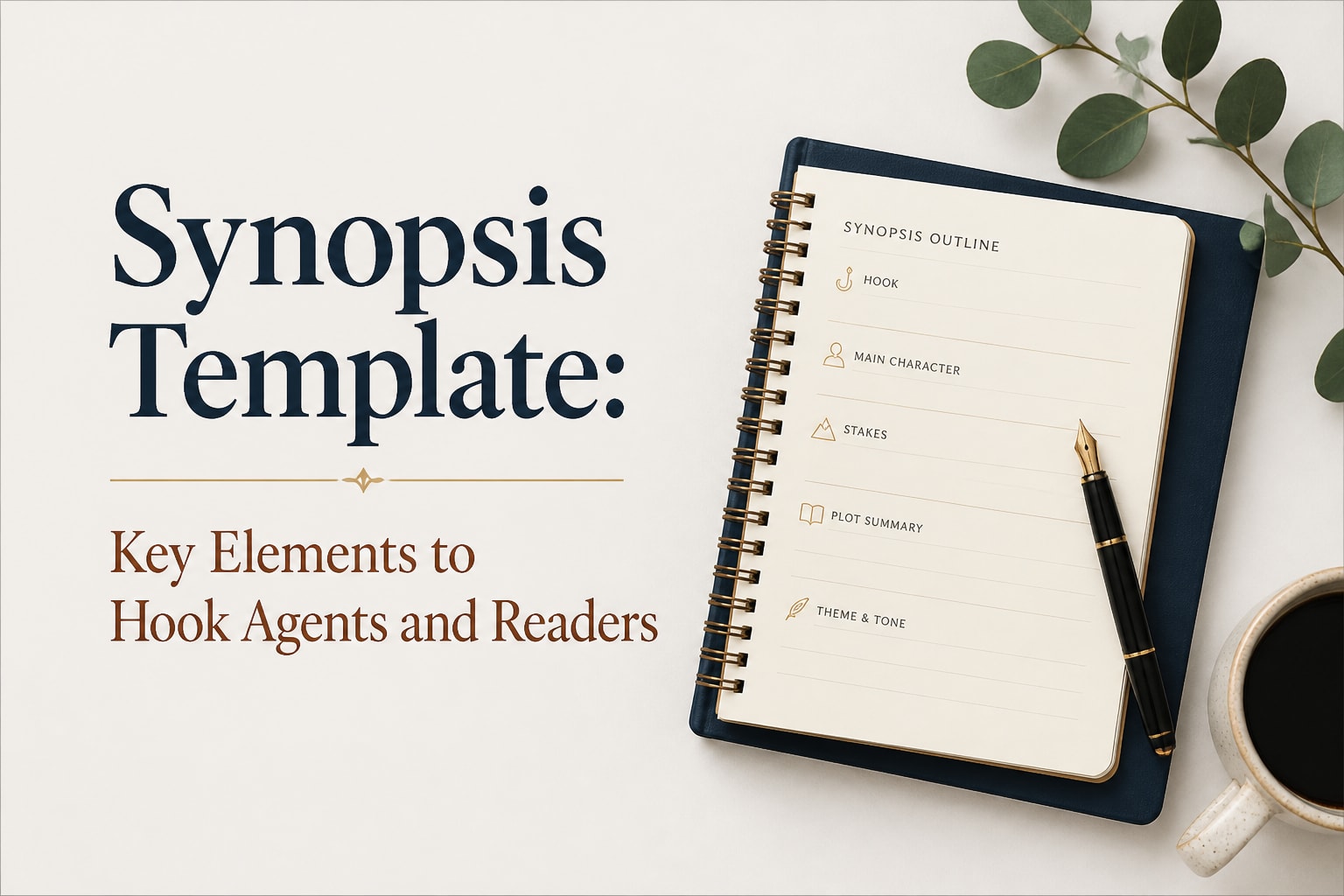
A synopsis template lets you demonstrate your story’s direction, pressure, and satisfying payoff before an agent ever opens the manuscript. Squeezing the story onto a page or two also surfaces flaws a long manuscript can hide, from a passive protagonist to a wandering middle or an ending that solves the wrong problem.
Because agents usually read a synopsis after a query has earned their attention, the document has a specific job. That job is to explain the full story, including the ending, in enough detail for a publishing professional to judge the plot and character arc. Think of the synopsis as a compressed blueprint of the novel, with no room for back-cover copy, teasers, or chapter-by-chapter reporting.
Since a blueprint works best when the building is finished, I recommend writing your synopsis after you have a complete draft, then revising it alongside the manuscript. That process sharpens your pitch, exposes structural trouble, and gives you a reliable document for submission packages. Use the framework below as a starting point, then adjust the length and format to match each agent’s guidelines.
Table of Contents
The Purpose Of A Synopsis
A synopsis tells an agent what happens, why it happens, and how the story ends. That sounds straightforward until you try to compress a 90,000-word novel into two pages. Doing so means separating the moments that change the story from the details that only decorate it.
To make those choices, test your synopsis against five questions.
- Who drives the story?
- What does that character want?
- What force blocks the goal?
- What decision redirects the plot?
- What does the character lose, learn, or choose by the ending?
Together, those questions turn the synopsis into a test of causality. Each major event should create a problem, force a decision, reveal information, or produce a consequence. Any paragraph built only from travel, conversation, research, or atmosphere probably belongs in the manuscript rather than the synopsis.
The Story Promise
Open with the protagonist, the setting, and the disruption that makes ordinary life impossible. Within that opening, name the central problem in concrete terms. For example, “Mara wants a new life” leaves little to hold onto. In contrast, “After Mara witnesses her brother robbing the family business, she has three days to recover the missing payroll before the police arrest him” creates a plot with pressure and a deadline.
Those first few sentences also need to set up the promise your genre makes. A romance synopsis needs the relationship and the obstacle, and a mystery needs the crime, the investigator, and the danger that comes with the investigation. Fantasy adds the threat, the unusual power or world rule, and the personal cost of failure.
The Full Resolution
Reveal the ending. Agents need to see whether the final act fulfills the story’s promises, and a withheld twist leaves them guessing. You can describe a surprise with precision without flattening its emotional force. To do that, state what the protagonist discovers, what choice follows, and what that choice changes.
Draft that ending in plain language before you polish the rest. Many writers spend pages building suspense around an ending they describe in one vague sentence. That imbalance usually means the final act needs more thought.

The Character And Conflict
A synopsis becomes readable when the plot stays tied to a person driven by an urgent desire. Without that desire, plot points line up as a timeline that never gathers momentum.
To build that momentum, name the protagonist early and give the reader a reason to track that person through the summary. Include a defining trait when it affects the plot. For example, “Elena is stubborn” has little value on its own. The fuller version, “Elena refuses to accept help after her father’s death, so she takes a dangerous loan from the only person who knows her family secret,” connects personality to action.
The Protagonist’s Goal
State the external goal in a way that could produce a visible result. Depending on the story, the protagonist may need to find a missing child, win a court case, escape a collapsing colony, or expose a murderer. Then add the internal need when it shapes the ending. Take a revenge-driven character, whose real need may be to surrender control. Give another character a hunger for independence, and the deeper need might be learning to trust someone.
Once both layers are in place, keep the goal active throughout the synopsis. When a new event arrives, explain how it changes the protagonist’s options. That habit gives the reader a chain of cause and effect rather than a stack of incidents.
The Antagonist And Pressure
Describe the opposing force with the same care you give the protagonist. That opposition may be a person, institution, natural force, cultural rule, or internal wound. Whatever form it takes, the reader should understand what it wants and why it has power.
Once that opposition is clear, its pressure should grow in stages. An early obstacle blocks the goal, and the next one raises the cost. Later, a consequence removes an option the protagonist thought would remain available. Show that escalation through specific events. For example, “Things get worse” tells the reader nothing. In contrast, “The mayor suppresses the witness statement, then frames Elena for the fire she was trying to stop” shows how the situation tightens.
Subplots face the same test. They deserve space when they change the main plot or complete a major character arc. Mention a secondary romance, family conflict, or professional rivalry when it creates a decision in the central storyline, and cut it when it exists only to add texture.
The Plot Structure In Compressed Form
A useful synopsis follows the novel’s major turns without recording every chapter. I usually draft a one-page list of the events that alter the protagonist’s plan, then turn that list into connected paragraphs.
The Opening Turn
Begin with the situation before the disruption and move to the event that changes it. That event should give the protagonist a clear reason to act. In a thriller, the opening turn may be a body turning up where it shouldn’t. A family saga might open on an inheritance that brings estranged siblings home, and science fiction could begin with a message from a supposedly extinct civilization.
Whatever the disruption, end the opening section with a decision. Perhaps the protagonist accepts a mission, breaks a rule, follows a suspect, leaves home, or makes a promise. That decision should carry the story into its next phase.
The Middle Reversals
Summarize the middle through reversals, discoveries, and consequences. Skip most scenes, and keep the moments that change what the protagonist knows or can do.
To decide which moments stay, ask whether the protagonist could skip an event and still reach the same ending. If the answer is yes, shrink the event to a short phrase or cut it. Only the turns that make the ending possible deserve full space.
Among those turns, include the midpoint when it changes the protagonist’s understanding of the conflict. If the lowest point closes off the easiest path to success, keep it in, along with the choice that launches the final act. Those three moments often give a synopsis its backbone.
The Final Choice
Give the climax enough room to show the protagonist’s decisive action. That action should resolve the central conflict through a choice, confrontation, sacrifice, revelation, or combination of those elements. Then explain the immediate result and where the protagonist stands emotionally at the end.
Although a synopsis can state the resolution in a few sentences, it still needs to show why the ending belongs to this character and this story. If the protagonist wins through a skill or belief that the manuscript never developed, the synopsis will expose the gap.
The Format And Level Of Detail
Check each agent’s submission instructions first, because page limits vary by agency, genre, and request. Some agents ask for one page, and others request two or three. Whatever the limit, meet it with sharper selection rather than smaller type.
Layout follows the same rule. Use standard manuscript format unless the agent gives different instructions. A readable font, sensible margins, page numbers, and clear paragraph breaks help an agent move through dense material. Put your name and manuscript title in the header or first line as the guidelines specify.
For the text itself, most fiction synopses work best in present tense and third person. That convention keeps the summary immediate and consistent. For example, write “Mara discovers the ledger and confronts her brother” rather than shifting into past tense or describing the manuscript from outside it.
The One-Page Version
A one-page synopsis should stay on the story’s main line. Follow the seven-part sequence below to hold that focus.
- Opening: Name the protagonist, setting, disruption, and first goal.
- First turn: Show the decision that commits the protagonist to the main conflict.
- Escalation: Include two or three events that raise the cost and narrow the available choices.
- Midpoint: State the discovery or reversal that changes the protagonist’s understanding.
- Lowest point: Explain the loss or failure that removes the easiest solution.
- Climax: Describe the final confrontation and the protagonist’s decisive choice.
- Resolution: Show the outcome and the character’s changed position.
The Two-Page Version
With a second page, you gain room for a major secondary character, a significant subplot, and a more developed emotional arc. Spend that extra space on causation, explaining how the secondary plot complicates the central goal or forces the final choice.
Whatever the length, read the synopsis aloud after you draft it. Your ear will catch repeated names, missing transitions, and paragraphs that contain too many events. It also helps to check each paragraph for a clear subject and verb, since dense prose often hides a gap in the plot.
The Revision And Submission Pass
Revision turns a plot inventory into a persuasive document. Start by cutting sentences that describe atmosphere without affecting the plot. Then check whether every named character earns a place, since a synopsis crowded with minor names makes the central conflict harder to follow.
The Agent Readability Test
After trimming, give the synopsis to a trusted critique partner who has read the manuscript. Ask your partner to flag unclear plot turns, vanishing stakes, and any part of the ending the story hasn’t earned. Those marks show whether the summary communicates the story without relying on your explanations.
Next, read the synopsis beside your query letter. The query should create interest through premise, character, and stakes, and the synopsis lays out the full plot. Repeated language can help with consistency as long as each document keeps its own job.
The Genre Check
Genre affects emphasis. For example, a romance synopsis should identify the relationship’s turning points and the emotional reason the couple must separate or commit. Mysteries track clues, suspects, discoveries, and the solution. In a literary novel, the synopsis may linger on the protagonist’s interior change, and a young adult synopsis should show the character’s age, social pressure, and growing agency.
Because those emphases differ, read several submission guidelines from agents who represent your category. Requirements shift from one agency to the next, and no universal page count covers them all. Follow the request in front of you each time.
Before you send the file, check the title, character names, tense, page count, and ending. Remove comments and tracked changes, then open the finished document on a second device to catch formatting problems your word processor tends to hide. During drafting, Adazing’s writing tools can help you generate alternate character names or phrase options. Deciding what belongs in the story still depends on your judgment.
FAQs For Synopsis Template: Key Elements To Hook Agents And Readers
How Long Should A Synopsis Be?
Use whatever length the agent asks for. On one page, a synopsis often covers the main plot in roughly 500 words, depending on layout. A second page leaves room for a major subplot and more detail about the character arc. Either way, follow the agency’s instructions before applying any general guideline.
Should A Synopsis Include The Ending?
Yes. A synopsis explains the complete story, including the final revelation, confrontation, and resolution. Withholding the ending prevents the agent from evaluating the plot’s payoff. Describe the surprise clearly and keep the focus on the choice or consequence that gives it meaning.
Can I Use A Synopsis For A Nonfiction Book?
Nonfiction proposals usually need an overview, chapter outline, market analysis, author platform, and sample material rather than a fiction-style synopsis. Narrative nonfiction is the exception, since it may benefit from a shorter story summary that identifies the central arc, major figures, and ending. In either case, check your category’s guidelines before you draft anything.
A Synopsis That Earns The Next Read
Your synopsis should leave an agent with a clear sense of the story’s engine, escalation, and resolution. That clarity starts with a full account of the book, revised until each paragraph advances the plot or deepens a character.
Start with the protagonist’s problem, connect each major event to a consequence, and give the ending the space it needs. No synopsis can repair a broken novel. A clean one can still reveal where the novel needs work before you submit it. That diagnostic value makes the document useful long before an agent opens the manuscript.
