
Line up a few short story introduction examples, and the strongest share a disturbance the reader senses before fully grasping it. Picture a character opening the wrong door. A voicemail left by the dead delivers the same jolt, and so does a single chair missing in a familiar kitchen. An opening earns attention when it raises an unknown strong enough to pull the reader into the next paragraph.
Pulling readers in fast matters because short fiction gives you little room to build trust. A novel can spend several pages establishing a town, family, or private wound. In contrast, a short story usually has to establish character, tension, and direction within a few paragraphs. Start with a moment altering the reader’s understanding of the situation, then feed in only the details needed to follow the shift.
The examples below show how different genres pull off the same shift. Treat them as working models and adapt them freely, since your opening needs to sound like your story, your character, and your chosen form.
Table of Contents
The Anatomy of a Strong Short Story Opening
An effective introduction usually brings together a person, a disturbance, and an open mystery. The person gives the reader someone to follow. Once the disturbance upends the character’s immediate circumstances, the unanswered mystery supplies forward motion.
Watch all three parts at work in a literary opening:
On the morning her father vanished, Mara found his shoes lined up beneath the kitchen table, still wet from the rain.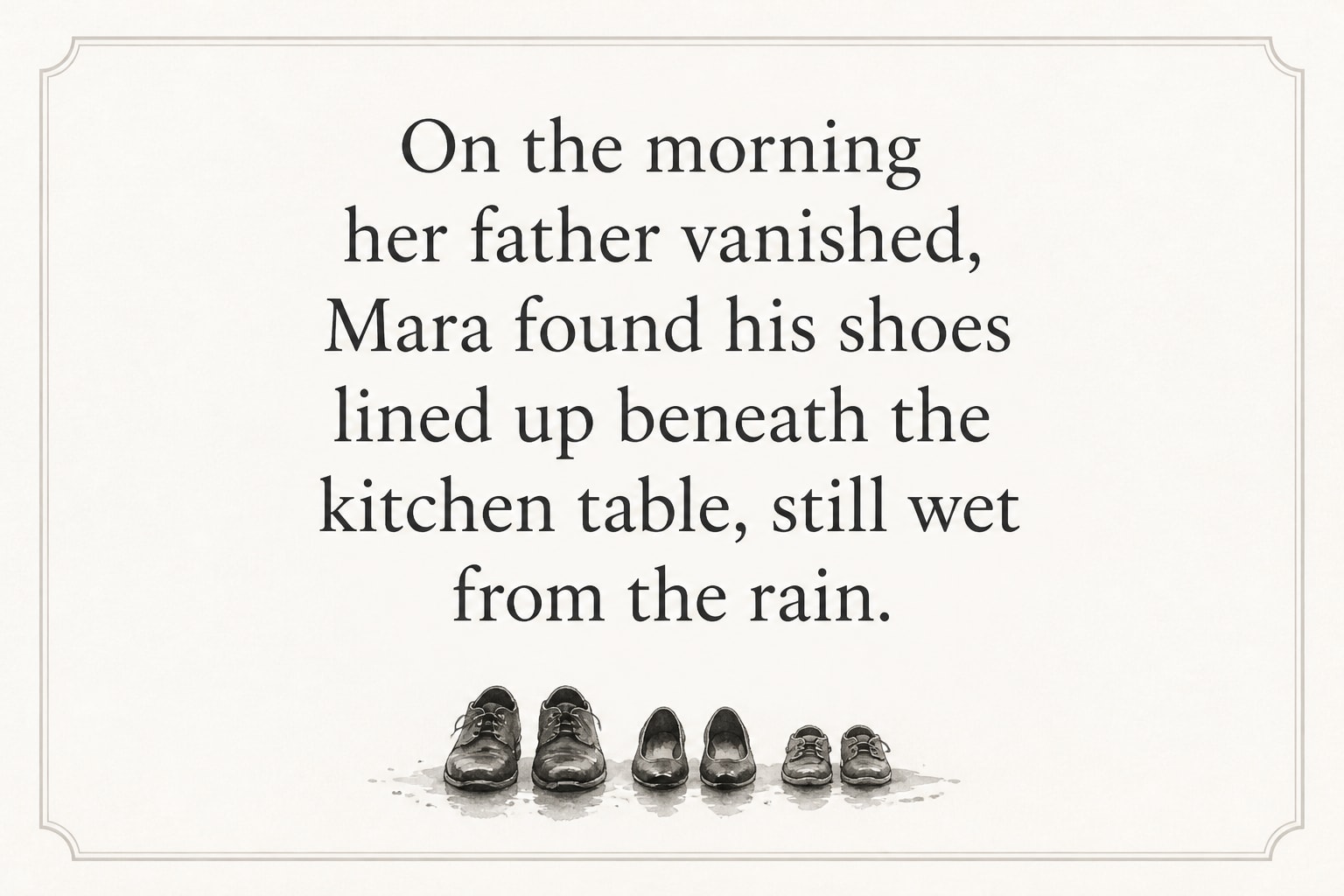
In a single line, the reader meets Mara, the disappearance, and a physical detail stirring doubt. Why are the shoes wet? And what made him leave them behind? Did he vanish by choice, or did someone bring the shoes back? By the end of the line, the reader holds enough information to form a picture and enough uncertainty to keep reading.
Weak openings work the opposite way, starting before the story has begun. They explain the character’s childhood, describe the weather for its own sake, or offer a general statement about life. However polished their sentences, those paragraphs delay the event making the story worth reading.
When I edit an opening, I hunt for the first moment of change. Find where the character learns, sees, loses, chooses, or grasps something, and test this moment as the first paragraph. You may discover several pages of preparation belong later, after the reader has a reason to care.
The Character Under Pressure
Pressure can be far smaller than a corpse or a burning house. It might arrive through a quiet social threat, a private discovery, or an impossible choice. The next opening finds it at a school meeting.
At the parent-teacher conference, Luis discovered his daughter was teaching the other children to lie.
Friction arrives at once. Luis carries a parent’s responsibility, his daughter guards an unusual secret, and the conference puts the scene in public. You can build the rest of the story around what the lies protect.
The Mystery Beneath the Detail
Specific details do more work than broad suspense. A locked room raises a familiar puzzle, and a child clutching an adult’s wedding ring raises a stranger mystery. An odd number can do the same work.
Every night at 2:13, the elevator stopped on the ninth floor, although the building held only eight.
Choose a consequential detail, and let the character react. A mysterious object becomes a story when a character craves it or fears what it reveals.

Short Story Introduction Examples by Opening Method
Momentum can come through action, dialogue, setting, or a startling observation. Your choice among them depends on the promise your story makes.
Action and Immediate Consequences
An action opening drops the character into a problem already in motion. Thrillers, crime stories, horror, and comic fiction suit this approach, since the reader arrives after the trouble has started.
By the time Nia reached the bridge, the stolen ambulance was already across, and her brother sat behind the wheel.
This line hands Nia a goal and a deadline. She needs to catch the ambulance, figure out what her brother wants, or decide whether to expose him. For the action to stay legible, name the person, object, or consequence at stake, then add sensory detail once the reader grasps the basic movement.
Try building your first paragraph around a single physical action and its consequence. Then cut background information until the reader knows what the character stands to lose.
Dialogue with a Hidden Threat
Dialogue works when conflict sits beneath the spoken words. Greetings rarely earn the first line, since a demand, accusation, lie, or strange request does far more to give the exchange a purpose.
“Your mother left me the house,” the stranger said, “and she told me where you buried the money.”
Several mysteries open at once, and the entire family history stays offstage. Who is the stranger? Did the mother truly leave the house to someone outside the family? And what money is at stake? The scene crackles because the protagonist must reply before learning the full story.
To keep the evasions believable, read your dialogue aloud. People rarely state their complete motives in a clean paragraph. Let a character dodge an accusation, change the subject, or answer through a detail opening a larger problem.
Setting with a Human Cost
Description earns its place when the setting affects a person’s choices. A flooded town, an empty hospital, or a crowded train becomes meaningful through the character moving inside it.
The city built a wall around the river, and by spring, each apartment below the fourth floor stood empty.
History and conflict sit inside the image. Follow it with a character living on the third floor, returning for a keepsake, or distrusting the official explanation. Whatever comes next, give the place a consequence before adding decorative detail.
Genre-Specific Opening Models
Genre shapes the reader’s expectations right at the first sentence. For example, a romance opening usually introduces attraction, resistance, or emotional risk. In contrast, a horror opening breaks the rules of ordinary reality. Mystery openings tend to start with a clue nobody can explain yet.
Three original models show these promises at work:
- Romance: Eva agreed to sell the bakery, and then the man who broke her heart arrived to buy it.
- Horror: The voice in the baby monitor belonged to a woman who died before the child was born.
- Mystery: The victim’s phone sent a photograph twelve minutes after the police found his body.
Each example establishes a genre promise and a particular story problem. The romance pits a cash sale against an old heartbreak. In the horror line, an ordinary household object becomes evidence of a breach, and the mystery hands the investigator a contradiction demanding a timeline.
Those genre signals should guide the reader without trapping you. Literary fiction can begin in a crime, and a fantasy story can open in a laundromat. What matters is a compelling problem told in the language and emotional register your story can sustain.
To train your eye, study books near your project and note the first disturbance in each opening. Leave their sentences alone and identify the promise they make, then craft an equally clear promise for your story.
Romance and Emotional Friction
Romance depends on desire meeting resistance. Give the reader a reason these people might connect and a reason connection would cause trouble.
Jonah kept a single rule for the new tenant: never fall in love with anyone who knew the truth about his name.
Desire, secrecy, and a future complication all arrive in this line. A concrete scene should follow soon after. Put Jonah and the tenant in a room, give them a practical task, and let the secret steer their conversation.
Horror and Broken Normality
Horror gains force when the ordinary world remains recognizable. A familiar routine becomes disturbing through a single precise violation.
Each morning, the family dog scratched at the nursery door, and each morning, something scratched back.
Once the scratching starts, resist the urge to explain the threat. Give the character a rational interpretation first, then add evidence defeating it. Suspense grows through delayed recognition.
Revision Tests for Your First Paragraph
Your opening sentence deserves attention. The next paragraph decides whether readers stay. I check both against three revision tests.
The Information Test
Circle each detail in the first paragraph and label it character, setting, conflict, or mystery. Some details serve several purposes at once. Consider the wet shoes in Mara’s kitchen, a detail establishing setting, implying conflict, and raising doubt.
A detail without a clear function may belong later, since description gains power once the reader already has a reason to notice it.
The Pressure Test
At the end of the first paragraph, identify what the character needs to do. Even an unstated goal works when the situation exerts pressure. Picture a character discovering a body, now forced to decide whether to call the police. Hand someone else an old lover’s letter, and the decision shrinks to whether to open it.
Keep rewriting the paragraph until the character faces a choice, a problem, or a discovery, since passive observation rarely carries a short story for long.
The Promise Test
Consider the reading experience your opening promises. For instance, a comic opening should open the door to complication or embarrassment. A mystery owes the reader an unsolved puzzle. Literary openings can build emotional or moral tension through a small event.
Once you can name the promise, read the next two pages. When the story shifts to a different promise, revise either the opening or the story’s direction. Readers accept surprise when the emotional contract remains intact.
For a final pass, read the paragraph at normal volume and listen for abstract language, then swap general statements for objects, gestures, and choices. When you need alternatives, Adazing’s writing tools can suggest alternate names, descriptions, and phrasing to compare against your draft.
From Opening Hook to Complete Story
A striking first paragraph cannot carry a story alone. Once you spark curiosity, resolve a single mystery and open another. Each step deeper into trouble should teach the reader something new.
Suppose your opening shows a woman finding her father’s wet shoes after his disappearance. A second scene might reveal his plan to leave, and a third could place a second pair of shoes at the train station. Each answer reshapes the previous detail.
Narrative movement grows when each discovery overturns what the reader thought they knew. Short stories thrive on this tight pattern, since each paragraph can shift a reader’s interpretation.
Throughout revision, keep your ending in view. Build an opening around a secret, and the ending must recast it. An opening choice demands consequences, and a vivid image should resurface altered in significance or stay firmly tied to the character’s transformation.
After drafting, sum up the story’s central change in a single sentence and compare it against the opening paragraph. The seed of the change belongs in those first lines, even when the reader cannot see its full shape yet.
FAQs About The Short Story Introduction Examples
How long should a short story introduction be?
Give the opening enough space to establish a character, a disturbance, and an open mystery. In many short stories, the first paragraph or first page handles this work. Cut any background delaying the first meaningful change.
Can I begin a short story with dialogue?
Yes. Open on dialogue when the line packs conflict, a demand, an accusation, or information the character cannot ignore. Then add enough context around the exchange for the reader to follow who speaks and what the conversation risks.
How do I avoid a predictable opening?
Start on a specific consequence and skip the familiar setup. A breakup, funeral, or theft feels fresher when the first detail reveals an unusual complication. Give the character a goal causing personal trouble, then remove the easiest solution.
Build the Story Around the Disturbance
Your first paragraph only has to set a person in motion, introduce a weighty problem, and leave the reader wanting answers. Start at the moment ordinary life changes, choose consequential details, and revise until each sentence serves the story’s deeper conflict.
Today, read your opening aloud, circle the first real disturbance, and test whether it belongs in the first paragraph. When a stronger moment surfaces later, move it forward and let the rest of the story earn its place behind it.
