
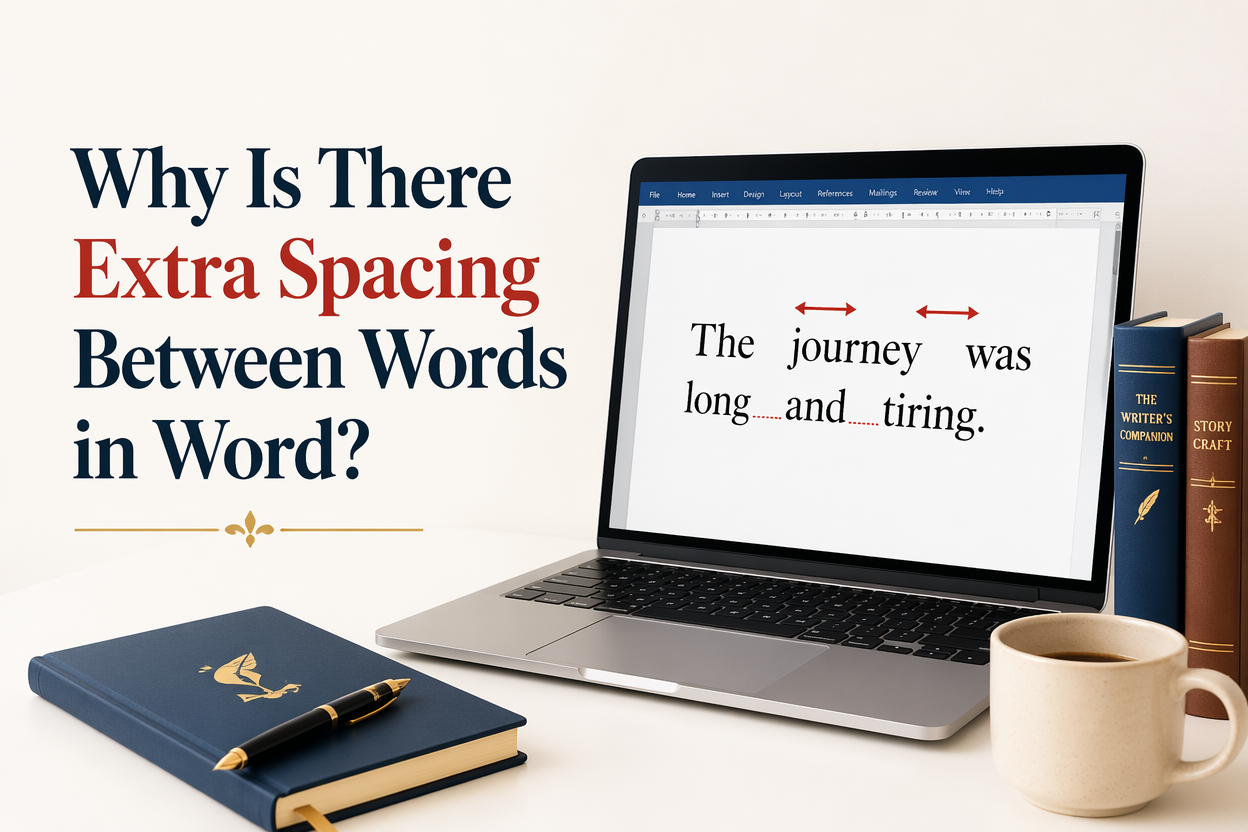
Why is there extra spacing between words in Word? When faced with this dilemma, you are almost always looking at justification, hidden formatting, or a line-break problem, not some mysterious font curse. For authors, this matters because a manuscript that looks “off” makes you second-guess your draft, slows down revision, and can create ugly layout artifacts later when you hand files to an editor, a formatter, or Amazon KDP.
I treat this issue like I treat a plot hole: I do not guess. I identify the exact cause, fix it once, and then lock in clean defaults so the problem does not creep back across 90,000 words.
Table of Contents
Justification and Why It Creates Ugly Rivers
The most common reason Word stretches spaces is simple. Your paragraph alignment is set to Justify. Justification forces the text to hit both the left and right margins, and Word does that by stretching the spaces between words on each line. In narrow columns, short lines, or paragraphs with long words, it can look like someone hit the spacebar five extra times.
How To Confirm It In Ten Seconds
Click inside the paragraph that looks wrong. Go to Home and look at the alignment buttons. If Justify is highlighted, that is your culprit. Switch to Align Left. If the gaps collapse immediately, you have your answer.
When Justification Is Fine
Justified text can look good in a professionally typeset book because the software also handles hyphenation and spacing rules with more control than a default Word document. Word can do hyphenation, but most drafting templates do not have it turned on, and most authors do not want hyphenation marks showing up while they are writing. For drafting and editorial work, I keep alignment left. It is predictable, it reads cleanly on screens, and it prevents the “rivers” effect that makes a page look like it has pale vertical channels running through it.
What To Do If You Need Justification Later
If you are preparing an interior for print and you want justified text, do it at the formatting stage, not in your drafting file. That is exactly why I separate “writing Word doc” and “layout file.” Your writing file should be boring. Boring files survive edits.

Manual Line Breaks and Soft Returns That Break Spacing
The second big cause is hidden line breaks. Authors pick up this habit when they are trying to control where lines wrap on the page, often after pasting from an email, Scrivener, Google Docs, or a PDF. Word then treats each line as its own mini-paragraph line, and justification or spacing rules get applied in weird ways.
Show The Nonprinting Marks
On the Home tab, click the pilcrow symbol, the paragraph mark button. I keep it on whenever I am doing a clean-up pass. You will see:
- ¶ for paragraph breaks
- ↵ for manual line breaks
- · for spaces
If you see a lot of ↵ at the end of lines in the middle of a paragraph, that paragraph is not really a paragraph. It is a stack of forced line breaks.
Fixing It Without Destroying The Paragraphs
Use Find and Replace carefully. Press Ctrl + H.
- Find: ^l (that is a lowercase L, the code for a manual line break)
- Replace with: a single space
Run it on a copy first if your manuscript is messy. If you actually need some line breaks, such as in poetry, you will want to confine the replacement to a selection rather than the entire document.
The Special Case That Trips Up Authors
If you are writing with a lot of short dialogue lines and you manually break lines to “make the page look right,” you are solving the wrong problem. Word will reflow text depending on font, window size, printer, and margin settings. Clean paragraphing is what travels well across editors, beta readers, and devices.
Spacing That Is Not Spaces at All
Sometimes what looks like extra spaces is actually tabs, nonbreaking spaces, or a formatting rule like distributed alignment. This is why turning on nonprinting marks is so useful. You cannot fix what you cannot see.
Multiple Spaces From Habit
Yes, some of us were taught to type two spaces after a period. Word and modern typesetting do not need it, and it can create odd-looking gaps when combined with justification. If you want to normalize it:
- Find: two spaces
- Replace: one space
Then repeat until Word reports zero replacements. Do this after you are done drafting, or you will keep reintroducing it.
Tabs Used for Indents
If you used the Tab key to indent paragraphs, you might see uneven spacing when lines wrap. Tabs belong in tables and structured layouts, not manuscript paragraph indents. Set indents through paragraph formatting instead.
Select your text, right-click, choose Paragraph, then set a First line indent, often 0.3 to 0.5 inches depending on your style. Your editor and formatter will thank you.
Nonbreaking Spaces and Weird Paste Artifacts
Copying from web pages can introduce nonbreaking spaces and other invisible characters. They behave differently than normal spaces, especially around punctuation. If you suspect this, paste future text using Paste Special and choose Unformatted Text. For existing text, run Word’s built-in “keep text only” paste option to prevent the issue from returning.
Character Spacing, Kerning, and Font Issues That Masquerade as Word Gaps
Now and then, the “extra spacing” is not between words; it is the letter spacing inside words, which makes the spaces feel exaggerated. This can happen if character spacing has been expanded, if a font is misbehaving, or if compatibility settings were imported from another document.
Check Character Spacing
Select a suspicious word. Press Ctrl + D to open the Font dialog. Go to the Advanced tab and look for Spacing. If it is set to Expanded, change it back to Normal. Also check that the scale is 100%.
Turn Off Formatting That Came From Somewhere Else
If the document has been through a lot, it might have direct formatting layered over styles. That is how you get one paragraph that behaves and another that looks like it was typed on a malfunctioning typewriter. The clean fix is to reapply a style.
Click in the paragraph, then choose your body style in the Styles gallery. If you do not have styles set up, this is a good moment to start. I know that sounds like “admin work,” but styles are what keep a 300-page manuscript from turning into a formatting landfill.
Font Substitution and Missing Fonts
If you open a Word document that used a font you do not have, Word substitutes another font. Different fonts have different word-spacing metrics, and the result can look wrong even when the settings are fine. Under File and then Options, check for font substitution warnings, or switch your manuscript to a standard drafting font like Times New Roman, Garamond, or Calibri while you troubleshoot.
Preventing The Problem Across A Whole Manuscript
Fixing one paragraph is easy. Fixing it across a novel is where authors lose an afternoon and start questioning their life choices. I prevent that by setting sane defaults, using styles, and keeping the writing file clean.
Use Styles Like You Mean It
If you only do one “professional” thing in Word, let it be this. Define a body text style with:
- Align Left
- First line indent set in Paragraph settings, not tabs
- Line spacing set consistently, often 1.15 or double for submissions, depending on your workflow
- No extra space before or after paragraphs unless you deliberately want it
Then apply that style to all body paragraphs. Once everything is on the same rails, random spacing problems become rare.
Clean Up With Find and Replace and Then Stop Touching It
My order of operations looks like this:
- Turn on nonprinting marks.
- Fix manual line breaks (^l) if they are present.
- Switch any justified paragraphs back to Align Left for drafting and editing.
- Normalize double spaces if your house style requires it.
- Reapply styles to remove direct formatting.
After that, I stop fussing. Your job is to write and revise. The manuscript should be a stable container, not a constant DIY renovation.
Keep Drafting and Publishing Files Separate
Authors get into trouble when they try to make their Word manuscript look like a printed paperback. That is a separate skill and a separate step. If you are doing your own formatting, use a dedicated layout tool or a dedicated layout document. If you are outsourcing, give your formatter a clean manuscript and let them do their job.
At Adazing, I build tools for authors because the boring parts of publishing steal time from the work that sells books. If you are spending hours fighting Word spacing, that is time you could be using to tighten your opening chapter, write your blurb, or plan your launch assets.
FAQs for Why Is There Extra Spacing Between Words in Word?
Why does Word add huge gaps only on some lines?
Those lines usually have less text to work with, so justification stretches spaces more aggressively to reach the right margin. It gets worse when there are long words, few opportunities for hyphenation, or manual line breaks forcing short lines.
Will extra word spacing affect how my book looks on Kindle or in print?
Your Word file is not your final book file, but messy spacing often signals messy formatting in the document. If you export to PDF from Word for print, justified paragraphs and forced line breaks can absolutely appear as ugly spacing in the PDF. For Kindle, conversion tools may reflow and ignore some spacing, but you do not want to rely on that. Clean paragraphs and styles are the safer path.
What is the fastest way to see what is causing the spacing?
Turn on nonprinting marks and click in the problem paragraph. If you see the justification button selected, fix alignment first. If you see manual line breaks (↵) at line ends, replace ^l with a space. If neither is true, check Font Advanced character spacing and reapply your body style to remove stray direct formatting.
A Clean Manuscript Keeps You Writing
Extra word spacing is Word telling you that your formatting rules are fighting your text. Fix the cause, not the symptom, and then lock your manuscript into styles so it stays clean through edits, betas, and production. Your future self, and whoever has to format your book, will feel the difference immediately.
