
Why is there a space between paragraphs in Google Docs? For authors, this question is not just a hint of random annoyance. It is a formatting choice that affects how your draft reads on-screen, how it converts to ebook and print, and how professional your submission looks when you send pages to an editor or agent.
I see writers fight this in two opposite ways. Some get double spaces they did not ask for and assume Google Docs is broken. Others remove every gap, resulting in pages that look like a 1999 forum post. Your job is to choose one paragraph style on purpose, then set it once so your manuscript behaves.
I am going to explain where the space comes from, how to control it in about a minute, and which setting to use for the three contexts that matter to you: drafting, sharing with editors, and producing files for KDP or a designer.
Table of Contents
The Real Reason Google Docs Adds Space
Google Docs is built for documents people read on screens, not for book manuscripts by default. Modern web and business writing often uses “block paragraphs,” which means paragraphs are separated by spaces rather than indenting the first line. Docs leans into that because it improves scanability on screens and plays nicely with collaborative comments, headings, and lists.
The spacing you are seeing is usually “space after paragraph,” not an extra blank line you typed. That distinction matters because it changes how the document reflows, how styles behave, and how your text exports to Word or PDF.
Paragraph Spacing Versus Blank Lines
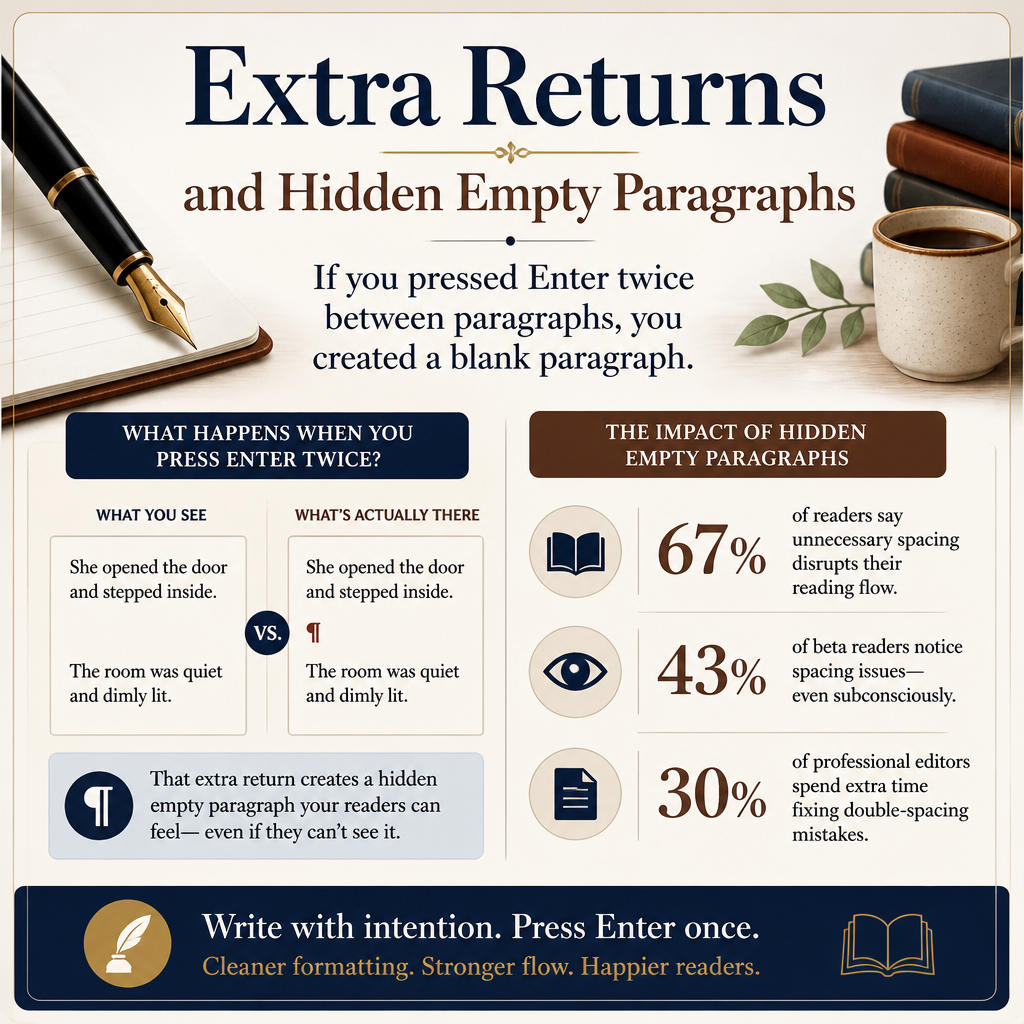
A blank line is literally an extra paragraph. If you press Enter twice, you created an empty paragraph between two real paragraphs. That empty paragraph can carry formatting you do not see at first, and it often turns into weird gaps when you convert formats.
Paragraph spacing is a property of the paragraph itself. You can set “space after” to 8 pt or 10 pt, and every paragraph will consistently breathe without adding phantom paragraphs.
Why Writers Notice It More Than Everyone Else
Authors draft in long runs. You are building chapters, scene breaks, and dialogue-heavy pages where rhythm matters. When spacing is inconsistent, it pulls you out of the story the same way a typo does, and it signals “drafty” to anyone you share it with.
It also collides with the most common manuscript convention in publishing: first-line indents with no extra space between paragraphs. A lot of editors still prefer that look because it is easy to mark up and it matches how books are typeset.
Google’s Default Styling Culture
Docs applies paragraph-level settings by styles such as “Normal text.” If that style has space after, every new paragraph inherits it. This is why the spacing feels like it appears “by itself.” It is a style doing its job.

Where That Space Actually Comes From in Your File
There are three usual culprits. I can often diagnose which one you have by asking a single question: does the gap change when you backspace at the start of the next paragraph?
Space After in Paragraph Settings
This is the most common. Google Docs can set the spacing as “Before” and “After” a paragraph. A typical default is 8 pt after. That is enough to look like an extra line to a writer who expects indents.
You can confirm it by clicking in a paragraph and checking Format > Line & paragraph spacing. If “Add space after paragraph” is checked, that is your gap.
Extra Returns and Hidden Empty Paragraphs
If you pressed Enter twice between paragraphs, you created a blank paragraph. It behaves differently than spacing because it can break across pages, get caught by page breaks, and import into other tools as a real paragraph. When writers complain that spacing is “uneven,” this is often why.
One fast test is to click at the start of a paragraph and hit Backspace once. If the paragraph jumps up but the gap remains, you are looking at paragraph spacing. If the gap disappears, you had an empty paragraph.
Imported Styles From Word and Templates
If you pasted from Word, Scrivener, Reedsy, or a web page, you may have imported their style rules. Google Docs tries to preserve formatting on paste, and that can carry over odd spacing values or mixed styles within the same chapter.
When I see a chapter where some paragraphs have a gap, and others do not, I assume the author is mixing “Normal text” with something else, usually without realizing it.
How I Fix Paragraph Spacing in Google Docs in Under Two Minutes
The goal is consistency. You do not want to be manually fiddling with individual paragraphs for a 90,000-word novel. Set a style once, then let the document behave.
Remove the Extra Space the Right Way
Select the text you want to standardize. If you are early in the draft, press Ctrl+A or Cmd+A and do the whole document.
Go to Format > Line & paragraph spacing, then click “Remove space after paragraph.” If your problem is space before paragraphs, choose “Remove space before paragraph” too.
Then set your line spacing. For a typical manuscript, I use 2.0 while drafting and sharing with editors because comments have room to breathe and line numbers are easier to reference.
Set an Indent That Behaves Like a Book
If you want classic manuscript formatting, add a first-line indent and keep paragraph spacing at zero. Highlight your body text, go to Format > Align & indent > Indentation options, and set “Special indent” to “First line.” A common value is 0.5 inches.
Do not use the Tab key at the start of each paragraph for a book-length draft. Tabs are manual characters, and they will betray you the moment you reflow text, change margins, or export the file.
Update the Style So It Stays Fixed
This is the step writers skip; then they wonder why the spacing comes back. After you format a paragraph the way you want, place your cursor in it. Open the Styles dropdown, hover over “Normal text,” and choose “Update ‘Normal text’ to match.”
If you are working from a template, save yourself future hassle by setting this once in a clean doc, then copying your chapters into it.
The Best Spacing Choice Depends on What You Are Producing
There is no single “correct” look because you are writing in one tool and publishing in another. Your draft has one job, and your final book file has another. The mistake is forcing one format to do everything.
Drafting and Revision in Google Docs
For drafting, I care about readability on-screen and fast navigation. I usually keep either a small space after paragraphs with no indents, or I use indents with no extra space and stick to that for the whole project. If you write dialogue-heavy fiction, the light spacing can make revision less fatiguing because you see the beats between exchanges.
If you are using tools like Adazing’s QuickWrite to push out messy first drafts, you already know speed beats perfection early on. Still, a stable paragraph style is worth setting because it prevents you from wasting brainpower on formatting every time you open the doc.
Sharing With Editors, Agents, and Beta Readers
If you are submitting pages, follow the expected manuscript convention unless guidelines tell you otherwise. For most novel submissions, that means double-spaced, Times New Roman 12, one-inch margins, first-line indents, and no extra space between paragraphs. William Shunn’s classic formatting guide lays out the standard many editors still reference, especially in short fiction markets, and it explains the logic behind the choices in a way writers appreciate.
Beta readers are different. If your betas read on phones or in a browser, block paragraphs with spacing can be easier on their eyes. The trade-off is that it looks less like a “manuscript.” Decide what feedback you are trying to get. If you want line-level edits, stick with manuscript format. If you want story-level reactions, prioritize comfort.
Preparing for Ebook and Print Layout
For ebook, extra blank lines are risky because different ereaders handle them differently. Many platforms and conversion pipelines interpret empty paragraphs as intentional spacing, and you can end up with huge gaps on some devices. That is one reason professionals prefer paragraph spacing rules or clean structural breaks rather than repeated returns.
For print, first-line indents with no extra space are the most common body style, except immediately after scene breaks, chapter headings, or section ornaments. If you are handing the file to a formatter, clean, consistently styled paragraphs make their job faster and cheaper.
If you are publishing through KDP, you will eventually run into the issue where Word files and exported PDFs can behave differently depending on how you built the spacing. Amazon KDP’s formatting guidelines emphasize clean, consistent formatting and warn that messy spacing can create layout problems. The specifics change over time, so I check the current documentation before I lock a file.
A Practical Workflow for Authors Who Hate Formatting
You need a repeatable workflow that keeps your draft clean enough to edit and flexible enough to export.
Pick One Paragraph System Per Document
Choose either indents with no extra space, or no indents with a little space after. Mixing them makes your pages look sloppy, and it makes later conversion harder.
If you plan to submit to agents or work with editors, I recommend indents and no extra space in your manuscript file. That look is still the path of least resistance in publishing.
Use Styles, Not Manual Fixes
Styles feel like office-software nonsense until you are 40 chapters deep. Then they feel like oxygen. Set “Normal text” once. Set your “Heading 1” for chapter titles once. Stop hand-formatting every paragraph and let the document stay stable while you revise.
If you already have a messy doc, the fastest cleanup is: Ctrl+A or Cmd+A, set line spacing, remove space after, set first-line indent, then update “Normal text” to match. After that, fix the handful of exceptions such as scene breaks and chapter headings.
Handle Scene Breaks Like a Professional
The worst scene-break habit I see is stacking multiple blank lines to force a visual gap. It works until it does not, and then your ebook has random craters of whitespace.
Use a centered marker instead, such as “* * *”, or a dedicated scene-break line. If you later move the book into Vellum, Atticus, InDesign, or a formatter’s workflow, that marker is easy to search and replace.
And if you are drafting quickly and want a consistent scene-break marker without stopping your flow, this is exactly the kind of small automation I like building into an author’s process. Adazing’s tools focus on keeping you writing, but the clean input still matters because it saves pain when you publish.
FAQs for Why Is There a Space Between Paragraphs in Google Docs
How do I remove the space between paragraphs in Google Docs?
Select the text, go to Format > Line & paragraph spacing, then click “Remove space after paragraph.” If the gap is coming from extra blank lines, delete the empty paragraphs by placing your cursor at the start of the next paragraph and pressing Backspace.
Is it better to indent paragraphs or add space between them for a novel manuscript?
For a manuscript you will share with editors or submit, I recommend first-line indents and no extra space between paragraphs because it matches common publishing expectations. For a draft you are reading on a screen, spacing between paragraphs can be easier on the eyes. Pick one per document and keep it consistent.
Why does the spacing come back when I hit Enter?
Your “Normal text” style still has a built-in paragraph spacing. Format a paragraph the way you want, then update the style by opening the Styles menu, hovering over “Normal text,” and choosing “Update ‘Normal text’ to match.” After that, new paragraphs inherit the corrected settings.
The Choice That Keeps Your Manuscript Sane
That extra space in Google Docs is usually a style setting, and the fix is to take control of “Normal text” once rather than fighting the document forever. Decide which format you need for the stage you are in, set paragraph spacing and indents accordingly, and use styles so your book stays clean as it grows. Your future self, the one exporting files for KDP or handing pages to an editor, will thank you.
