
If you are staring at a multiple-choice question that asks, “Which of the following is not a way to create a new document in Word?”, the trick is simple. Word has several valid entry points that all end in the same place: a blank document or a template, and the wrong answer is usually a command that edits an existing file rather than creating a new one.
As an author, this matters more than it sounds. If you start in the wrong place, you waste time, you risk overwriting a draft, and you break the habit of keeping clean versions, clean files, and clean backups. That is not busywork. That is how you protect months of writing from one sleepy click.
I will show you the real ways Word creates a new document, the common trap answers, and the workflow I recommend so you can move from idea to draft without playing file roulette.
Table of Contents
What Word Actually Means By New Document
In Microsoft Word, a “new document” means Word creates a new file object in memory, assigns it a default name like Document1, and treats it as unsaved until you choose a location and filename. The important detail is that the new document does not have to be blank. A template-based document is still a new document because Word generates a fresh file based on that template.
This definition is why many different clicks are all valid ways to create a new document. Word is happy as long as you are initiating a new file, not opening or modifying an existing one.
Blank Documents And Templates Both Count
Authors often think “new” equals “blank page.” Word does not. If you start from a template, Word still creates a new file. You can see this behavior clearly in Microsoft’s own documentation on creating documents from templates and the New experience. Read Microsoft’s guidance on creating a document, and you will notice how blank documents and templates live side by side under the New command.
Opening A File Is Different From Creating One
Open is about loading an existing file from disk or the cloud. New is about generating a fresh file. Many quiz questions try to blur this by listing options like “Open” or “Open Recent”. Those are not new-document actions, even if you plan to Save As immediately.
Why Authors Should Care About The Difference
When you have multiple drafts, beta edits, line edits, and proof passes, your file discipline becomes part of your craft. A clean new document is how you build a new chapter file, a new revision copy, a submission format copy, or a paperback interior copy without contaminating your working draft.

The Reliable Ways To Create A New Document In Word
Word gives you several correct routes. On a test, these will all be right answers if phrased correctly. In real life, you should pick one route and make it muscle memory so you stop thinking about the software and start thinking about your sentence.
File Tab And New
The most explicit path is File, New, then either Blank document or a template. This is the path Word trainers teach because it is visible and consistent across versions.
If you are switching between projects, this path also reduces the risk of mistakes. You are less likely to accidentally keep typing into a previous chapter or an editor’s marked-up file when you deliberately choose New from File.
Keyboard Shortcut Ctrl Plus N Or Command Plus N
On Windows, Ctrl+N creates a new document. On Mac, Command+N does the same. If you draft heavily, this is the fastest clean start you have.
I recommend using the shortcut when you are starting a brand-new drafting session, and use File then New when you are starting from a template. That split keeps your hands fast and your formatting stable.
New Document From A Template
Templates are underrated for authors because they remove a bunch of quiet friction. A proper manuscript template handles page size, margins, paragraph indents, spacing, and heading styles so you do not spend your writing time fiddling with layout. Word treats this as a new document every time you create a document from a template.
Microsoft’s template system is also the foundation for house-style consistency. If you collaborate with a co-author or you hand files to an editor, template-driven consistency prevents the slow creep of formatting chaos across chapters.
New Window Versus New Document
Word also has commands such as “New Window” that open a separate view of the same document. This is a classic trap in quizzes. A new window is not a new document. It is the same file shown twice, which can be useful for referencing chapter notes while revising a later scene, but it does not create a new file.
The Common Wrong Answers In Word Quizzes
Most “which is not a way” questions rely on options that sound plausible to non-technical users. As a writer, you can train yourself to spot the difference by asking one question. Does this action create a separate new file, or does it open, view, or modify an existing one?
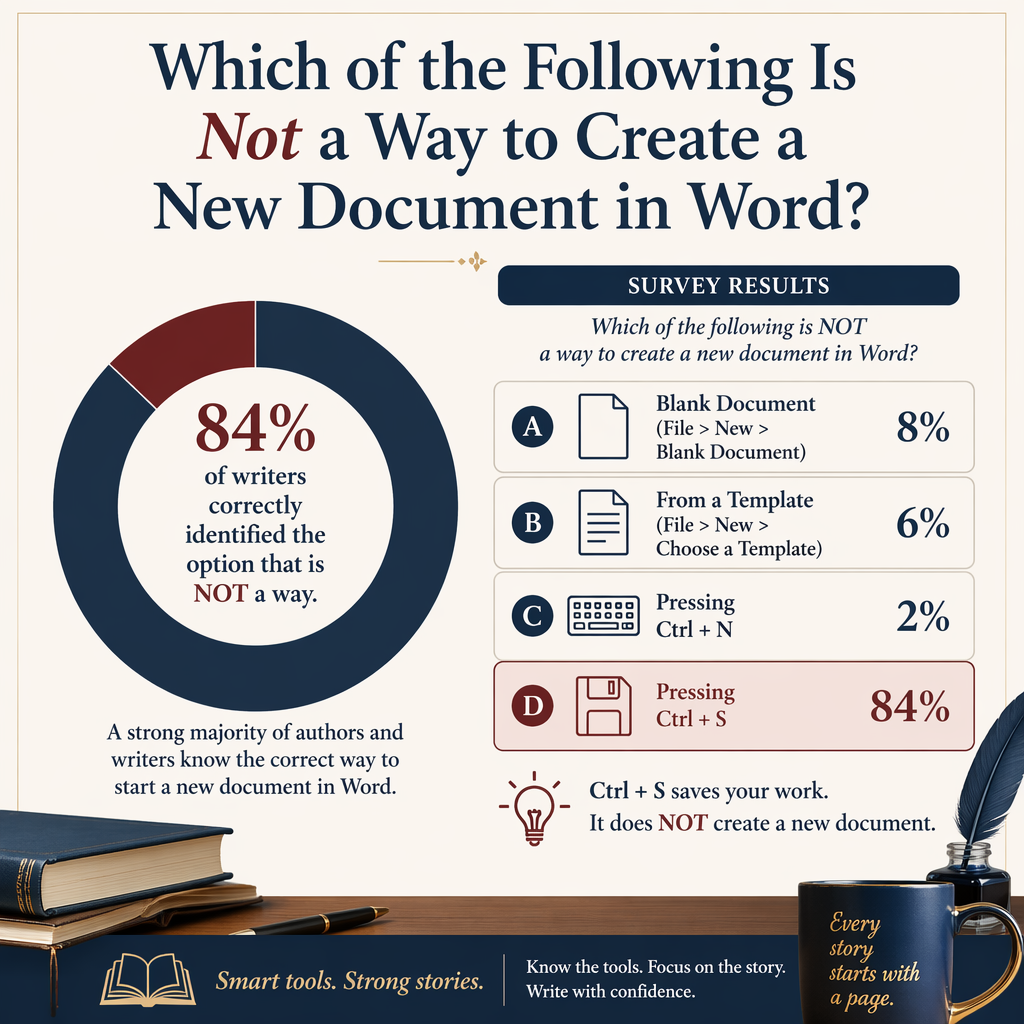
Open And Open Recent
Open loads an existing document. Open Recent does the same from a list. Neither creates a new document, even if you plan to Save As afterward. If one of the answer choices is “Open an existing document,” that is usually the correct choice when identifying which option is not a way to create a new document.
Save And Save As
This one is subtle. Save does not create a new document. It writes the current document to storage. Save As can create a new file on disk, but it is still an operation performed on an existing document object. Many instructors and quizzes treat Save As as file creation, yet it is not the same as creating a new document via Word’s New command.
If the question is strict about Word commands, Save As is usually the wrong answer. If the question is vague about file creation in general, Save As might be treated as a way to create a copy of a file. This ambiguity is why I tell authors to use Save As as a versioning tool, not as their main method for starting new work.
New Window Or Split View
As I said earlier, a new window is not a new document. The same goes for view controls like split view or side-by-side view. They help you see more of the same file. They do not generate a fresh draft file.
Author Workflows That Keep Drafts Safe And Clean
The software trivia matters less than the habit. Your goal is to avoid accidental overwrites, formatting drift, and version confusion, because those are the three problems that tend to hit authors right when deadlines and edits pile up.
Version Naming That Never Confuses You
I recommend a simple, boring naming system that survives stress. Use the pattern: BookTitle_Stage_Date. For example: StormGlass_Draft2_2026-07-08.docx. If you are working with an editor, add initials: StormGlass_LineEdits_JR_2026-07-08.docx.
The date format matters. YYYY-MM-DD sorts correctly in folders and in cloud drives. That one decision saves you from hunting through a pile of files named Final, Final2, and FinalReallyThisTime.
When To Start With New Versus Duplicate
If you are starting a fresh chapter document, a bonus scene, a reader magnet, or a press kit page, use New. If you are creating a new revision pass for an existing manuscript, duplicate the file at the system level, or use Save As once, then never touch the old file during that session.
This practice keeps your draft history intact. It also protects you when you later realize a change was wrong, because you can pull a paragraph from Draft2 without guessing what you changed.
Formatting Control With Styles
Most authors lose hours to manual formatting because they treat Word like a typewriter. Styles are the difference between a manuscript that stays stable and a manuscript that slowly becomes a patchwork of slightly different fonts and spacing.
When you create a new document from a manuscript template, your styles come along cleanly. When you paste text from random sources, your styles get contaminated. If you have ever pasted research notes into a chapter and watched Word explode your spacing, you have seen this happen.
I recommend pasting using Keep Text Only, then reapplying your styles. This habit prevents a single copy-paste from turning your print layout into a week of cleanup.
How This Connects To Publishing And Your Tool Stack
Word is often the drafting tool even for authors who later format in Vellum, Atticus, InDesign, or Scrivener. The condition of your Word file affects everything downstream, from the ease of converting to EPUB to how painful it is to build a clean paperback interior.
When I work with authors on production, the best manuscripts are consistently structured. Clean headings, consistent paragraph styles, and predictable scene breaks transfer cleanly to layout tools. Messy formatting carries forward like grit in a gearbox.
If you are building your writing and publishing toolkit, I also suggest you separate drafting from generation and marketing tasks. Draft in the environment you can sustain every day, then use purpose-built tools for the supporting work. At Adazing, I have seen authors save real time by using tools like QuickWrite for focused drafting sessions, then switching to Adazing generators for names, titles, and world details during planning. The point is not to collect tools. The point is to stop breaking your writing flow to solve a side problem that software can solve in seconds.
One practical habit I like is keeping a separate “scratch” document created with New for notes, cut lines, and research paste. That one file protects your manuscript from the formatting junk that sneaks in when you treat your chapter file as a clipboard.
FAQs for Which of the Following Is Not a Way to Create a New Document in Word?
Is “Save As” a way to create a new document in Word?
Save As creates a new file copy on disk, but it starts from an existing open document. In most Word quizzes, the New command and Ctrl+N count as creating a new document, and Save As does not. In real author workflows, Save As is still useful for versioning, but I would not rely on it as your primary method for starting new work.
Is “New Window” the same as creating a new document?
No. New Window gives you a second view of the same document. It is useful for comparing two parts of a long manuscript, yet it does not create a separate file.
What is the safest way to start a new revision without losing my old draft?
Duplicate the file or use Save As once to create a dated copy, then close the original so you cannot accidentally type into it. I also recommend storing drafts in a folder structure by project and stage, with dates in the filenames so you can roll back without guessing.
A Clean Start Beats A Clever One
The wrong answer in these Word questions is usually Open, Open Recent, or New Window, because those actions do not create a new document. In your day-to-day writing life, the bigger win is choosing one repeatable method to start fresh, then pairing it with version naming and style discipline so your manuscript stays safe from draft chaos.
