
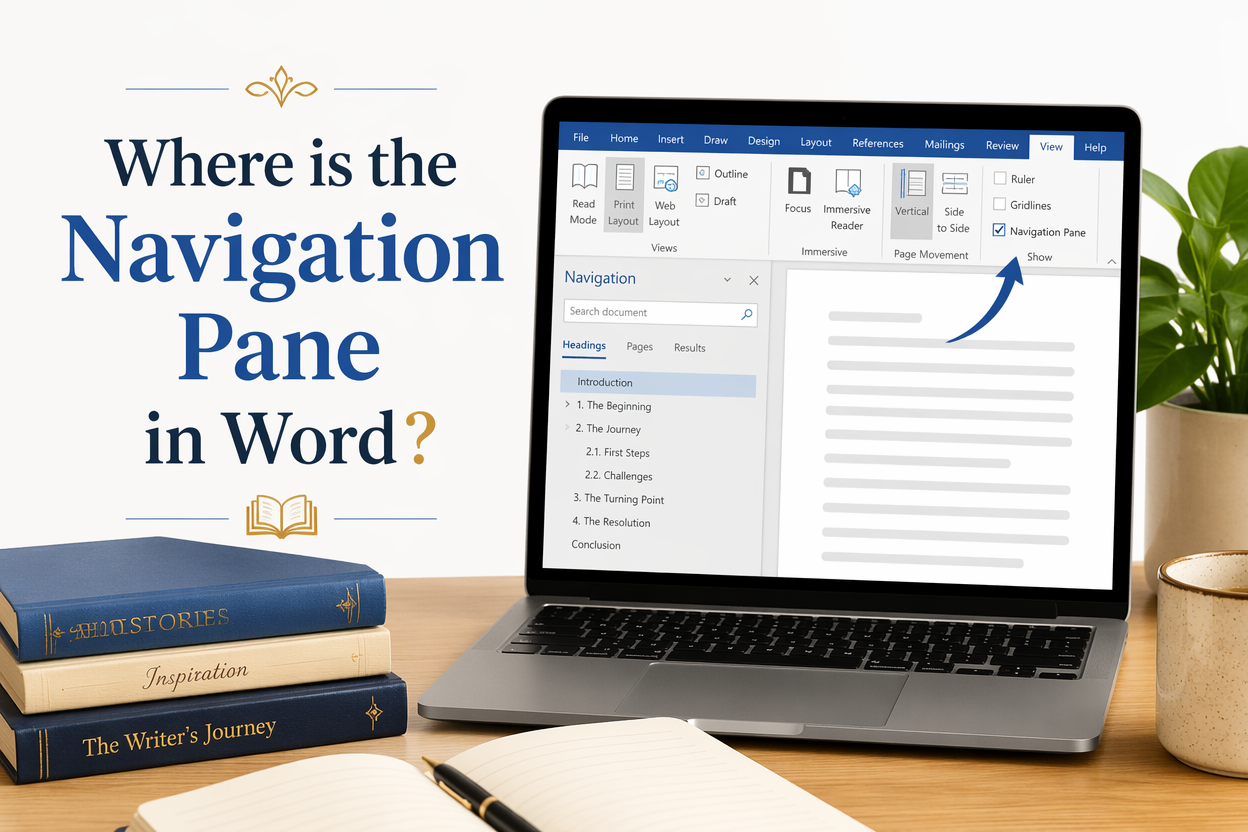
The Word Navigation Pane is the fastest way to move through a long manuscript without losing your place. If you are scrolling through Chapter 27 hunting for that one scene you need to revise before your editor deadline, the Navigation Pane is the tool that stops the time bleed. However, “Where is the Navigation Pane in Word?”
Below, you’ll find where it is in modern versions of Word, what to do if it is missing, and how to set up your manuscript so the pane actually becomes useful for book-length work.

Table of Contents
Where To Find The Navigation Pane In Word
In most current versions of Microsoft Word for Windows, the Navigation Pane is on the Ribbon under the View tab. You turn it on by checking the box labeled “Navigation Pane” in the Show group. The moment you check it, the pane appears on the left side of your document window.
On Word for Mac, the feature exists, but Microsoft has shifted UI labels over the years. In many builds, you still go to View and look for “Navigation Pane” or a similar toggle. If you do not see it on the Ribbon, you can also use Word search to find the command.
The Keyboard Shortcut I Use When My Hands Are Already On The Keys
On Windows, Ctrl+F opens the Navigation Pane directly to Search. If you are in revision mode and you keep having to find character names, recurring objects, or your own placeholder text like “TK” or “[fix later],” this shortcut pays for itself in the first hour.
How The Pane Is Organized Once It Opens
The pane typically has three tabs. Headings shows your document outline if you used heading styles. Pages shows thumbnails of each page. Results shows search hits when you search for a term. For authors, Headings and Results do most of the heavy lifting.
The One Setting That Confuses Writers
If you turn the pane on and see nothing under Headings, Word is telling you that your chapter titles and section breaks are not formatted as headings rather than a faulty pane.
Why Authors Should Care About The Navigation Pane
A book manuscript is a system, not a pile of pages. The Navigation Pane turns Word from a big text box into something closer to Scrivener’s binder, which is why I consider it mandatory if you draft or revise in Word.
Structural Revision Gets Easier When You Can See The Spine
When you look at a 90,000-word draft as one continuous scroll, your brain cannot hold the structure. When you see the chapter list in the Navigation Pane, you can spot pacing problems and lopsided sections. That visual outline gives you a fast reality check. If Act Two looks like a wall of identical chapter labels, it probably reads that way too.
Search Becomes A Continuity Tool, Not A Panic Button
I see authors treat Find like a last resort. Used well, it is a continuity engine. You can search for a character’s eye color mention, a magic system term, a nonfiction concept you define once and then forget to reinforce, and you can jump hit-to-hit without losing your place. Word documents can handle big books, but only if you stop relying on scrolling for navigation.
Reordering Chapters Without Breaking Your Draft
If your headings are set up correctly, you can drag headings up and down in the Navigation Pane. Word will move that whole section. For a novelist, this is how you test a different scene order. For a nonfiction writer, this is how you reshuffle a chapter sequence to match the promise of your subtitle and the reader’s learning curve.
The trade-off is that messy formatting can create surprises. I always do a quick check after moving sections, especially around page breaks, section breaks, and tables.
Setting Up Headings So The Pane Actually Works
The Navigation Pane rises or falls with your use of Word styles. If you hand-format chapter titles by changing the font size and bolding the text, Word has no idea those lines are chapters. You have to apply Heading styles.
Chapter Titles As Heading 1
I recommend formatting each chapter title as Heading 1. Put your cursor in the chapter title line, go to Home, and click Heading 1 in the Styles gallery. Do that consistently. Your chapter list will immediately appear in the Navigation Pane.
If you are writing nonfiction with major parts and chapters, use Heading 1 for parts and Heading 2 for chapters. For fiction, I keep it simpler unless the book has named parts.
Scene Breaks And Subsections As Heading 2 Or Heading 3
If you write short chapters with multiple titled sections, set those as Heading 2 under each Heading 1 chapter. If you have subsections under those, use Heading 3. The point is hierarchy. When your hierarchy is clean, the Navigation Pane becomes an outline you can trust.
If you do not want section titles to print big and bold in your manuscript, change the style definition. Right-click the style, choose Modify, and set the font, spacing, and numbering the way you want. Keep the style label because that is what Word uses to build the outline.
Numbering Chapters Without Manual Typing
Manual chapter numbers create errors when you reorder. Word can number headings automatically. Microsoft documents how to set up multilevel lists tied to heading styles in their support content, and it is worth doing once so you stop fixing numbering by hand.
For novels, I usually keep numbering simple and resist elaborate outline numbering. For nonfiction, especially business and how-to, clean numbering improves readability and makes beta feedback easier because readers can reference sections precisely.
When The Navigation Pane Is Missing Or Not Showing What You Expect
If you cannot find the toggle, or the pane appears empty, the fix is almost always boring. Boring fixes are still fixes.
Word Version Differences And Where Microsoft Hides Commands
Microsoft changes the Ribbon more often than authors think, especially between Word for Windows, Word for Mac, and Word for the web. If View does not show “Navigation Pane,” use the built-in search for commands. In newer versions, there is a search box near the top that lets you type a command name and run it. Type “Navigation Pane” and select it.
Word for the web has fewer features than the desktop app. When I have a manuscript that needs serious structural work, I do it in the desktop app where headings, search, and section moves behave predictably.
The Pane Opens, But Headings Are Blank
This happens when your chapter titles are plain text. Apply Heading styles, and they appear. It also happens when headings exist but are set to a body style due to pasted formatting from another file. If you compiled chapters from separate documents, select each chapter title and reapply Heading 1. Ten minutes here saves hours later.
Dragging Headings Moves The Wrong Text
That is a formatting boundary problem. Word moves content from one heading until it hits the next heading of the same level. If you accidentally labeled a mid-chapter line as Heading 1, Word thinks a new chapter starts there. Fix the mis-leveled headings first, then drag.
Search Results Feel Incomplete
Search can miss what you think is the same word if you have smart formatting issues, hidden characters, or different spellings. I often search for the root, like “tele” for “teleport” variants, or I search for double spaces, two paragraph breaks, and my own placeholders. If you want Word’s Find and Replace options, Microsoft documents them on its support pages, and their overview of Find and Replace in Word is a reliable reference.
How I Use The Navigation Pane For Drafting, Revision, And Publishing
The Navigation Pane is a drafting, revision, and production tool. I use it differently at each stage because the problems change.
Drafting: Keeping Momentum Without Losing Context
During drafting, I use the pane to jump back to earlier setup lines. If I introduce a relic in Chapter 3, I can snap back and check its description when I am writing Chapter 18. That prevents continuity errors that show up later in edits as expensive fixes.
If you write with a separate writing tool, like Adazing QuickWrite, you might draft in a cleaner interface and then revise in Word for a solid workflow. Draft where you move fast, revise where you can see structure and track changes with collaborators.
Revision: Scene Order And Pacing Checks
When I revise, I collapse the Navigation Pane outline and scan for rhythm. If my chapters are all the same length and named the same way, the book often reads flat. If I see a long stretch of heavy exposition chapters in nonfiction, I know I need more examples, case studies, or application sections to keep readers moving.
I also use Search to audit repeated words. Authors love a few favorite verbs and tics. Search for them. Cut half. Your prose gets cleaner, and you do it with evidence rather than vibes.
Publishing Prep: Cleaner Exports And Cleaner Collaboration
If you send your manuscript to an editor, a formatter, or a proofreader, headings matter because they anchor comments and structure. Clean headings also help when exporting or converting, even if you eventually move the file into Vellum, Atticus, or InDesign. Your headings become a map other professionals can follow.
If you are building companion assets, like reader magnets, workbooks, or bonus chapters, the Navigation Pane makes it easy to isolate a section and copy it out without accidentally grabbing half a chapter. That reduces the kind of little mistakes that create big formatting messes later.
FAQs for Where is the Navigation Pane in Word?
How do I open the Navigation Pane fast?
On Word for Windows, press Ctrl + F to open the Navigation Pane focused on the Search feature. If you already have the pane open, Ctrl + F still puts your cursor in the search box so you can run the next find without touching the mouse.
Why does my Navigation Pane show only pages, not chapters?
Your document has missing headings, or your headings are set to the wrong level. Apply Heading 1 to chapter titles and Heading 2 to subsections. Once those styles are in place, switch to the Headings tab in the pane and your outline appears.
Can I reorder chapters using the Navigation Pane without breaking my document?
Yes, if your headings are consistent. Drag a Heading 1 up or down to move the whole chapter. Then check any section breaks, page breaks, and numbering. If Word moves an unexpected chunk, look for a misformatted line labeled as Heading 1 or a missing chapter heading that causes Word to treat two chapters as one section.
A Better Way To Control A Long Word Manuscript
If you write books, you need a navigation system that matches the size of the project. Turn on the Navigation Pane, format your chapter titles with real heading styles, and use the outline view as a structural dashboard during revision. When you do, Word stops feeling like a fragile scroll and starts behaving like a tool built for long-form work.
