
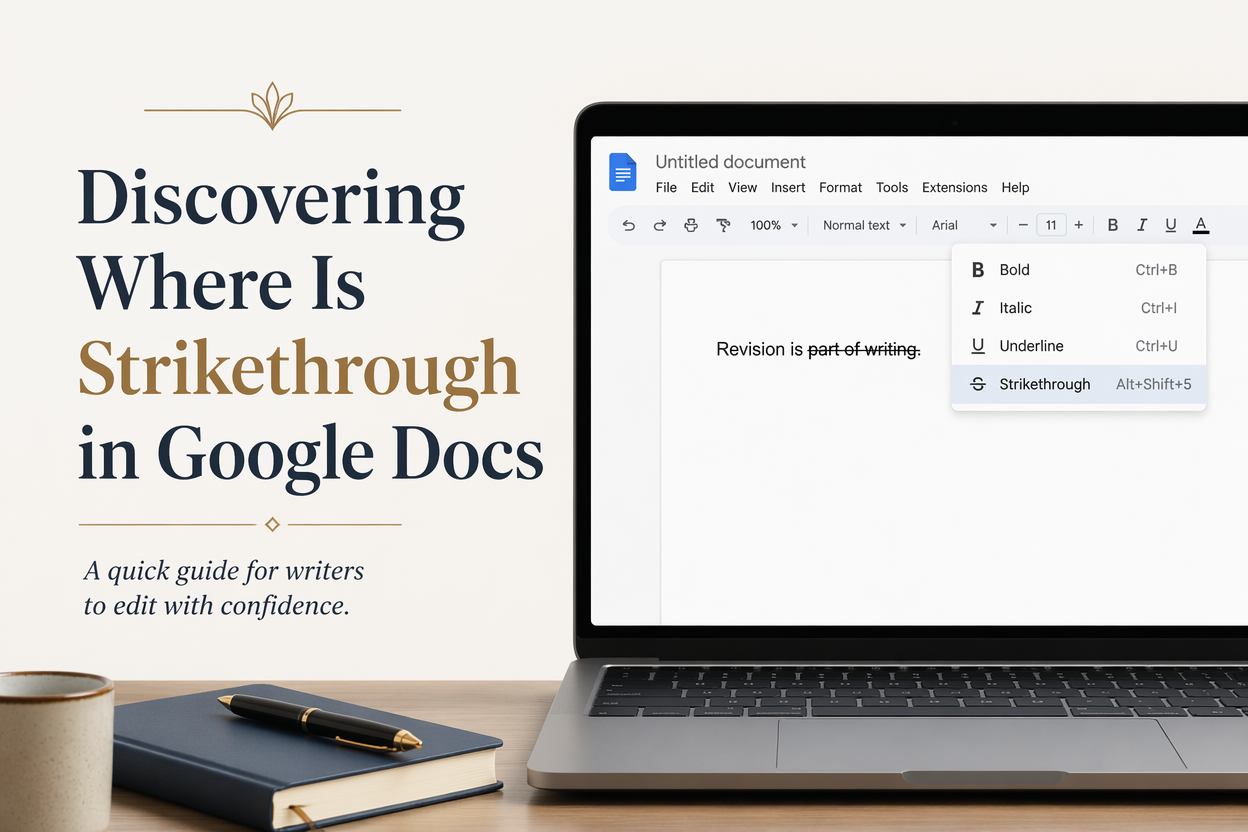
Most of the time, you only notice you need to know where is strikethrough in Google Docs when you are already in the weeds. You are line-editing a chapter, tracking revisions from an editor, or cleaning up a draft for an ARC team, and suddenly you are hunting through menus like you have forgotten how computers work.
Strikethrough is not a fancy feature, but it is a high-leverage one for writers. It lets you mark cuts without deleting them, preserve alternate phrasings, and negotiate changes with a collaborator without turning your document into a battlefield of comments. I see authors waste hours because they do not know where it lives, how to bind it to muscle memory, or when strikethrough is the wrong tool and Suggesting mode is the right one.
I’ll give you the exact locations, the fastest workflows, and the common traps that show up in real book drafts, from developmental passes to final proof.
Table of Contents
Where Strikethrough Lives in Google Docs
If you want the plain answer, strikethrough is in the Format menu. In a Google Doc, highlight the text you want to cross out, then go to Format > Text > Strikethrough. It is three clicks, which is fine once, and maddening the 200th time you are tightening dialogue.
Finding It on Desktop
On a computer browser, this is the most reliable path:
- Select text you want struck through.
- Open Format in the top menu.
- Choose Text.
- Click Strikethrough.
If you are editing fast, do not rely on the toolbar. Google Docs does not place strikethrough as a default button, so the menu is the official home base.
Finding It on Mobile
On the Google Docs app (iOS or Android), the location shifts because the top menu is gone. The pattern is still consistent:
- Select the text.
- Tap the Format icon (usually an “A” with lines or sliders).
- Look under Text formatting options for Strikethrough.
Mobile is fine for quick triage, but serious line edits are slower there because selection precision is harder. If you are in the middle of a heavy revision pass, I would rather you switch to desktop than fight the app.
Using Keyboard Shortcuts Like a Working Editor
The shortcut is the difference between a clean editing flow and a stop-start slog. Google documents the strikethrough shortcut, and once you use it for a week, you will not go back to menus. According to Google Docs keyboard shortcuts, you can toggle strikethrough with:
- Windows or ChromeOS: Alt + Shift + 5
- Mac: Command + Shift + X
I recommend you practice it on a throwaway paragraph until it becomes automatic. Editing is physical. If your hands keep leaving the keyboard, your attention breaks, and you start accepting mediocre phrasing because you are tired.

When Strikethrough Helps Your Draft and When It Hurts
Strikethrough is best when you want to preserve intent while still showing a cut. That sounds abstract, so here is what it looks like on the page.
Good Uses During Drafting and Revision
I like strikethrough for three common situations:
- Micro-cuts while line editing: You are trimming flab in a paragraph and want to keep the original phrase visible until you reread the scene in context.
- Alternate word choice: You are torn between “snapped” and “barked” and want both visible while you evaluate voice consistency across the chapter.
- Collaborative negotiation: You and a coauthor disagree on a sentence, and striking it shows you are willing to remove it without erasing it from the record.
In these cases, strikethrough is a low-friction mark that keeps you moving.
Bad Uses That Create Editorial Debt
Strikethrough causes problems when it becomes a substitute for decisions. If you leave whole pages struck through, you are storing clutter inside the actual manuscript. That clutter will get copied into email excerpts, beta reader quotes, and sometimes even the wrong export.
It also becomes dangerous when you are working with an editor who expects clean acceptance or rejection of changes. A doc full of crossed-out paragraphs can read like uncertainty, and uncertainty slows every round of edits.
Strikethrough Versus Suggesting Mode
If you are doing a serious revision with someone else, Suggesting mode usually beats strikethrough. Suggesting mode keeps a clean audit trail, shows insertions and deletions in a standardized way, and reduces ambiguity when you accept or reject changes. Google Docs explains how this works in its own help page.
My rule is simple. If the changes need a paper trail, use Suggesting. If the changes are private thinking marks inside your own draft, strikethrough is fine, as long as you clean it up before you hand the manuscript to anyone else.
Fast Workflows Authors Actually Use
Most authors do not need more features. You need a repeatable workflow that fits how manuscripts move from draft to edits to production.
The “Cut Without Losing It” Pass
When I am tightening a chapter, I do one pass where I only cut. I do not rewrite in that pass. Strikethrough is perfect there because it lets you remove words while preserving rhythm and intent for a later rewrite pass.
- Read the scene out loud.
- Strike anything that slows pacing, repeats information, or states the obvious.
- Do not delete yet.
- After the pass, reread once for coherence, then delete or accept the cut.
This workflow keeps your brain in one gear. Switching between cutting and rewriting every sentence is how you burn out and still miss the big problems.
Color Plus Strikethrough for Self-Edits
When you are editing your own draft, it is easy to lose track of what is a firm decision as opposed to a tentative change. One trick I use is to pair strikethrough with a text color for temporary cuts. For example, I strike and color the text gray for “probable cut” and leave normal strikethrough for “definite cut.”
This approach is not for final drafts. It is a thinking tool that keeps you from deleting something you may want back, like a line of subtext that looks unnecessary until you realize it foreshadows a later reveal.
Comment Anchors for Editorial Questions
If you are striking something because you are unsure, add a comment that states the decision you need. “Cut this joke? It undercuts the threat.” or “Keep this line for voice, even if it repeats.” That comment turns a vague hesitation into a clear question you can answer later.
With collaboration, this also keeps your editor from guessing what you meant. Editors are good, but they are not mind-readers, and guessing costs billable hours.
Common Problems and How to Fix Them
Strikethrough is simple, yet I still see the same issues pop up in author drafts, especially when a book is bouncing between devices and collaborators.
Strikethrough Will Not Toggle
If the shortcut does nothing, check three things:
- You are in the right app: The shortcut works in Google Docs in a browser, but system-level shortcuts and extensions can interfere.
- Your cursor is not in a link or special element: Some formatting behaves oddly inside links or certain pasted content.
- You actually selected text: Strikethrough toggles at the cursor, but you will not see it if you expect it to apply to previously typed words.
If you are on a managed Chromebook or a locked-down work computer, some shortcuts get remapped. In that case, I fall back to the menu path and keep editing rather than losing momentum to troubleshooting.
Strikethrough Appears in Exports
This one bites authors late in the process. If you export a doc to PDF or DOCX, crossed-out text usually exports as crossed-out text. That sounds obvious until you remember you might be sending a PDF proof to a formatter, an audiobook narrator, or an ARC reader.
Before you export anything, run a cleanup pass. Use Find to jump through problem areas, or scroll the document with a deliberate eye for formatting artifacts. I treat this like checking a back-cover blurb for typos. It is boring, and the cost of skipping it shows up at the worst possible time.
Too Much Strikethrough Creates Visual Noise
When half a page is crossed out, the page becomes unreadable, and you stop evaluating the prose as prose. That matters for writers because voice and cadence require clean reading. If you have large cuts, move them into a separate “Cuts” section at the bottom of the doc or into a separate file called something like “Chapter 12 Cut Material.”
This habit also protects you from the classic mistake of resurrecting dead paragraphs because you saw them again during a later revision and got sentimental.
How I Fit Google Docs Editing Into a Publishing Workflow
Google Docs is great for drafting and collaboration, but publishing is a pipeline. If you treat your manuscript file like a junk drawer, production will punish you.
Draft in Docs, Then Lock a Clean Version
When I finish a revision round, I create a clean copy of the doc with all strikethrough removed, suggestions resolved, and comments cleared. That clean file is what I treat as the source of truth for exporting to Word, sending to a formatter, or importing into layout software.
If you need to preserve the cut material for safety, save a separate “dirty” version. Do not leave it mixed into the file you plan to publish from.
Use Tools That Match the Stage
Google Docs is a drafting and collaboration environment. For deeper writing work, I also like dedicated tools that reduce distraction and keep you writing forward. At Adazing, tools like QuickWrite are built around the reality that authors do not need more tabs, more alerts, and more reasons to tinker. You need a place where the words pile up.
Then, when you shift into editing mode, you can bring the manuscript back into Docs for collaboration and version tracking. Treat writing and editing as two separate crafts that call for their own tools.
Keep Your Formatting Intentional for Production
Strikethrough is formatting, and formatting has consequences. If you plan to publish through Amazon KDP, you will almost always convert files. Every conversion step is a chance for artifacts to slip through. Amazon warns authors about conversion and formatting requirements in its documentation, including file handling and common issues, so I suggest you start with KDP manuscript formatting guidance as you near production.
FAQs for Discovering Where is Strikethrough in Google Docs
What is the fastest way to apply strikethrough while editing a chapter?
Use the keyboard shortcut. On Windows or ChromeOS, press Alt + Shift + 5. On Mac, press Command + Shift + X. If you use strikethrough more than a few times per session, the shortcut saves real time and keeps your attention on the prose.
Should I use strikethrough or Suggesting mode when working with an editor?
Use Suggesting mode when changes need a clear record that your editor can accept or reject, especially for line edits across many pages. I reserve strikethrough for my own thinking marks or for small, local cuts in a doc where I am the only decision-maker.
Why does strikethrough sometimes show up when I export a PDF or Word file?
Exports retain formatting, so if the text is still struck through in the doc, the export will likely preserve it. Do a cleanup pass before you export anything you plan to send to readers, editors, narrators, or formatters.
Clean Drafts Move Faster
Strikethrough is easy to find and even easier to misuse. If you put it on a shortcut, use it for small, reversible cuts, and then remove it before you export, your drafts stay readable, and your production files stay clean. That is the difference between a revision process that feels controlled and one that feels like you are chasing your own pages around the room.
