
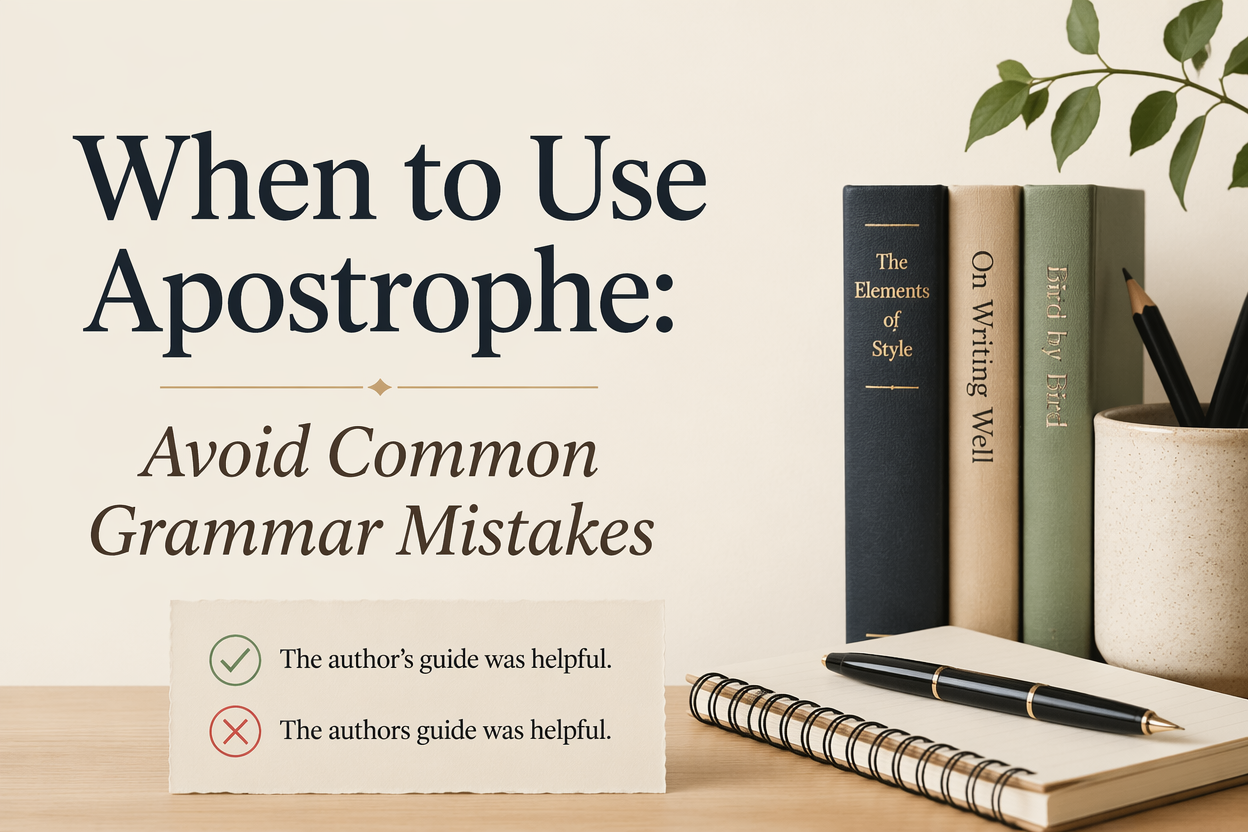
The fastest way to look amateurish on the page is not knowing when to use apostrophe in your dialogue, your marketing copy, or your front matter. Readers might not be able to name the mistake, but they feel it. And once they feel it, they start trusting you less, sentence by sentence.
I care about apostrophes for one reason. They are tiny signals of control. When they are correct, your prose disappears, and your story stays. When they are wrong, your prose steps in front of the story and waves.
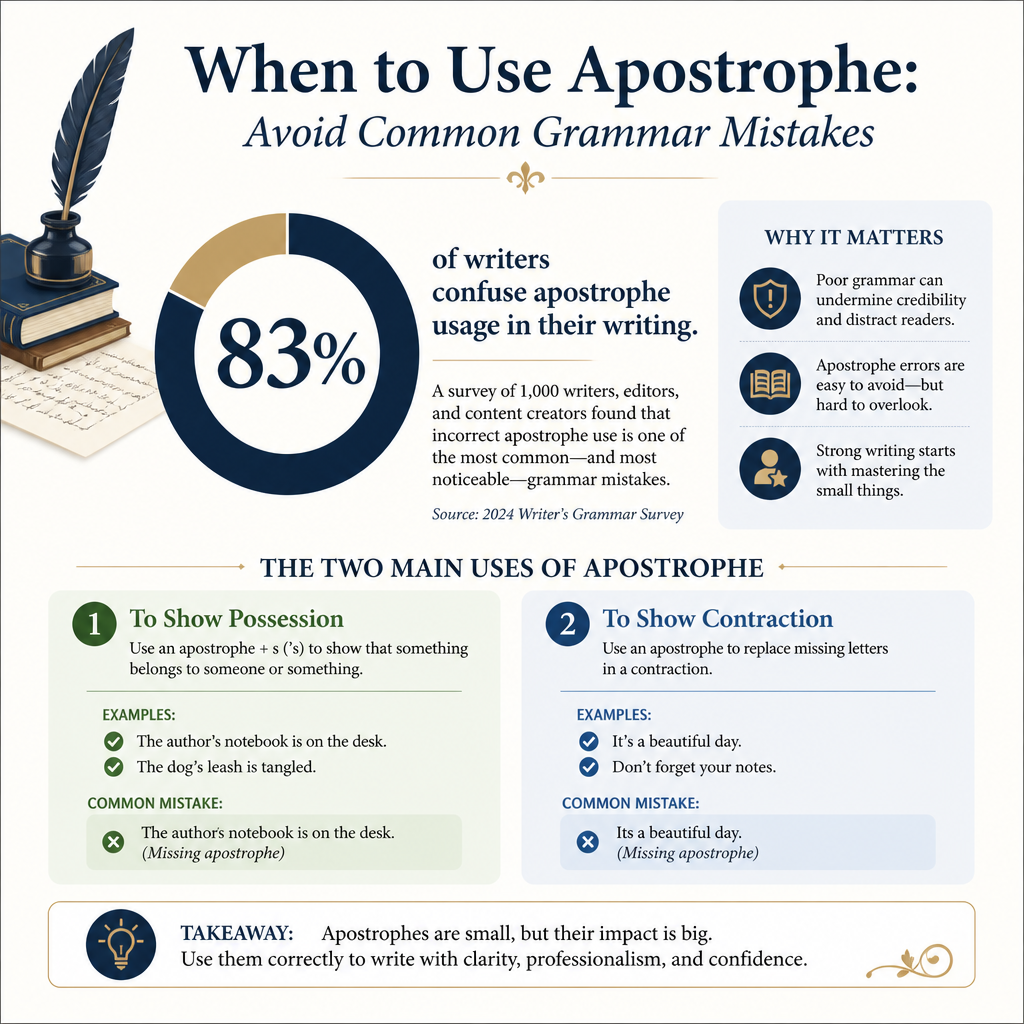
Apostrophes do only two jobs: they mark possession and show missing letters in a contraction. Everything else is you guessing, and guessing is where the errors breed.
Table of Contents
The Two Jobs Apostrophes Actually Do
When I edit manuscripts, I see writers treat apostrophes like decoration, the way people sprinkle italics on words that are already doing their job. You will write faster and revise cleaner if you lock in the two real functions and stop asking apostrophes to do anything else.
Possession
Possession means ownership or association. You add an apostrophe to show that something belongs to someone or something. The simplest pattern is singular noun + apostrophe + s.
Examples you will use in almost any novel:
- the detective’s badge
- the dragon’s hoard
- your protagonist’s flaw
Where authors get into trouble is when the noun is plural, irregular, a name ending in s, or a joint possession. I will cover those in a dedicated section because the edge cases are where copyeditors earn their money.
Contractions
Contractions are missing letters. The apostrophe marks what got removed. That is it. You are literally leaving a breadcrumb for the reader.
- do not becomes don’t
- it is becomes it’s
- they are becomes they’re
If you want a quick reality check, Merriam-Webster’s definition of apostrophe says the mark is used to show the omission of letters or figures and to mark possessive cases. That is the whole game.
What Apostrophes Do Not Do
Apostrophes do not make a word plural. You do not use them for decades, acronyms, or normal plurals. These show up constantly in book marketing copy because authors type fast in launch week and nobody wants to be the person proofreading their own adrenaline.
- Correct: 1990s. Incorrect: 1990’s.
- Correct: PDFs. Incorrect: PDF’s.
- Correct: three ARCs. Incorrect: three ARC’s.
If you publish wide and you write blurbs, ads, and newsletter copy, this matters. Errors in a blurb read as if you rushed. And you probably did.

Possessives Without Regret
Possessives are where most writers lose time. You know the rule in theory, then you hit a plural ending in s, or a character name like James, and you start second-guessing every sentence. I do not want you to memorize trivia. Pick a house style and apply it consistently.
Singular Nouns
Singular possession is the friendly one.
- the editor’s notes
- the cover’s typography
- the book’s pacing
Even if the thing being possessed is abstract, the form stays the same. “The book’s pacing” reads clean and lets you keep moving.
Plural Nouns Ending In S
Plural nouns that already end in s take an apostrophe after the s. No extra s.
- the authors’ conference
- the agents’ emails
- the dragons’ cave
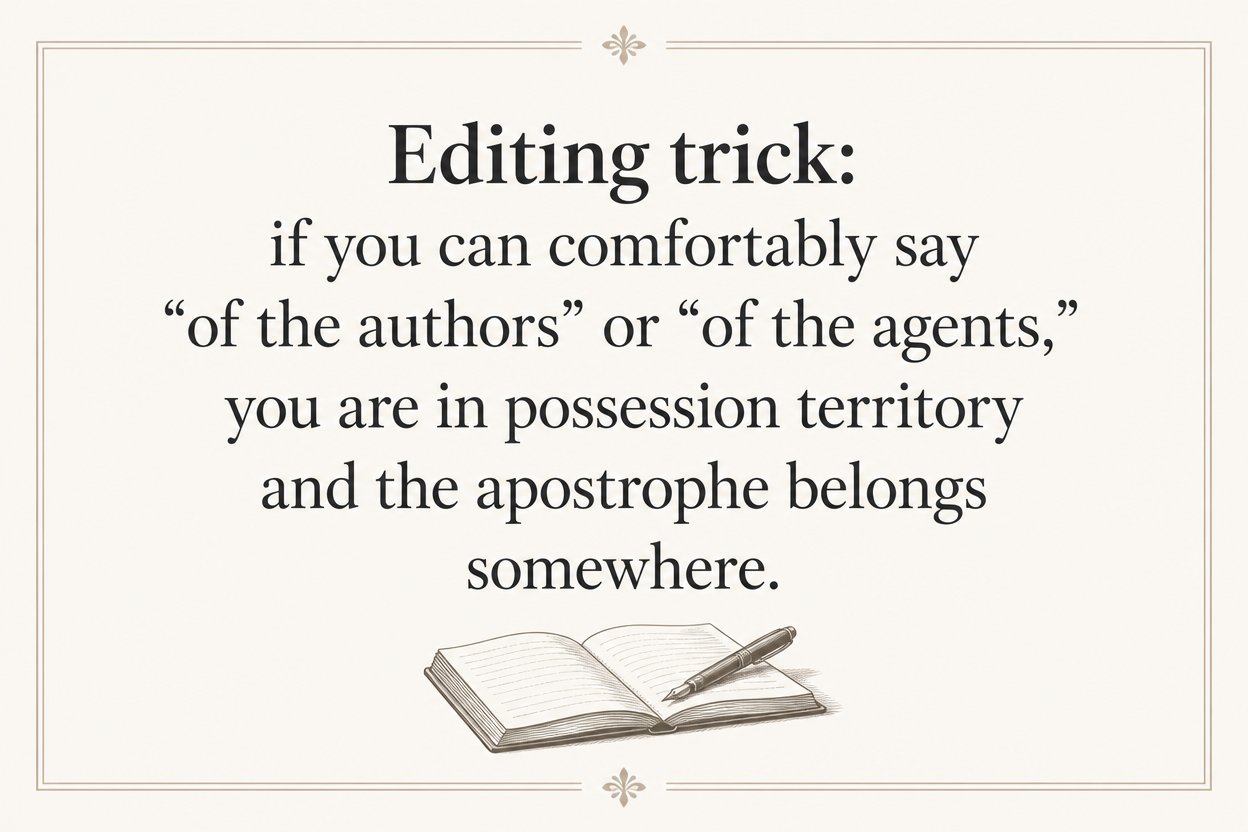
If you can comfortably say “of the authors” or “of the agents,” you are in possession territory, and the apostrophe belongs somewhere.
Irregular Plurals
Irregular plurals do not end in s, so they take apostrophe + s like a singular noun.
- children’s books
- men’s room
- people’s choice
This one is common in many nonfiction manuscripts, especially for authors writing about “women’s health” or “children’s education.” Get it right, and you stop looking like you copied the phrase from a random Facebook post.
Names Ending In S
This is the spot where style guides disagree, and I am not going to pretend there is one sacred answer. The Associated Press style typically drops the extra s for singular names ending in s, while Chicago style generally adds it. If you are writing books, you are usually closer to Chicago.
Chicago says add apostrophe + s to most singular nouns, including those ending in s. You can read more of it at the Chicago Manual of Style guidance on possessives.
- James’s notebook
- Lois’s apartment
- the boss’s office
If you write genre fiction and have a recurring character with a name ending in s, consistency matters more than which style you pick. Choose one form for your book and stick with it. Your reader will never reward you for switching halfway through chapter twelve.
Joint Possession And Separate Possession
This one is sneaky because it changes meaning.
- Anna and Marco’s book deal means they share one deal.
- Anna’s and Marco’s book deals mean each has their own deal.
When you write co-author bios, collaboration agreements, or even a romance scene where two characters share something, this is the difference between clean meaning and accidental comedy.
Contractions In Fiction, Nonfiction, And Book Marketing
Apostrophes in contractions should be easy, yet this is where I catch the most high-visibility errors. The reason is simple. Contractions live in high-frequency words, and your brain autocorrects what it expects to see.
The Famous Set You Must Master
If you want one short list to drill, it is this set. Each mistake is common, each one is jarring, and every one shows up in manuscripts I see from smart writers.
- it’s = it is or it has
- its = possessive
- you’re = you are
- your = possessive
- they’re = they are
- their = possessive
- there = location
- who’s = who is or who has
- whose = possessive
For reference, Merriam-Webster’s explanation of its vs. it’s is clear and practical. I have sent that link to more than one author who swore they “already knew” the rule.
Dialogue Versus Narrative Voice
Contractions carry tone. In most contemporary fiction, characters use contractions in speech because it sounds human. In formal narration or academic nonfiction, you may reduce contractions to match expectations. Trade-offs exist. Too many contractions in a scholarly book can feel casual. Too few in a fast-paced thriller can feel stiff.
I edit for consistency with the voice you have chosen. If your narrator sounds like a professor in chapter one, do not let them drift into breezy blog-speak in chapter nine unless you are doing it on purpose.
Negative Contractions And Rhythm
Small choices like “can’t versus cannot” are rhythm tools. “I can’t” hits faster. “I cannot” lands heavier and can sound more formal or more intense, depending on context.
When you revise, read the sentence out loud. If the beat is wrong, that is often where the fix lives. Apostrophes matter here because they are tied to the exact word you pick.
Plurals, Decades, And Acronyms That Tempt You
I see apostrophe errors spike in two places: back cover copy and nonfiction lists. You are usually tired, usually rushing, and usually formatting on a deadline. Your hands type “‘s” because it feels like how English works, even when it does not.
Plain Plurals
A plural does not take an apostrophe. It takes an s or es.
- beta readers
- comp titles
- paperbacks
If you find yourself typing “reader’s” when you mean multiple readers, you are going to confuse your reader. Moreover, you are going to confuse Amazon customers who already skim blurbs like they were scanning a menu from across the street.
Decades
Decades are plural, so they take no apostrophe.
- the 1980s
- the ’80s
Notice the apostrophe in ’80s. That one marks omitted digits. That apostrophe earns its keep.
Acronyms And Initialisms
Most acronyms form plurals with a simple s.
- ARCs
- ISBNs
- URLs
You only need an apostrophe for possession. “The ISBN’s last digit” is possession. “Three ISBNs” is plural.
Single Letters
Single letters are the one place I will tolerate an apostrophe for clarity in many contexts. “Mind your p’s and q’s” is a classic example. For writing and publishing, you might write “Three A’s in a row” when discussing typography or grading. The apostrophe prevents the ugly look of “As” when you actually mean the letter A repeated.
If you can rephrase cleanly, do it. “Three letter A characters” is clearer and dodges the issue.
Apostrophes In Your Editing Workflow
Apostrophes are not hard because the rules are deep. They are hard because they hide inside words you see a thousand times, and your brain stops looking. You fix that problem with a repeatable pass, not with willpower.
A One-Pass Search List That Catches Most Errors
When I copyedit my own drafts, I do a targeted search pass for the high-frequency problem spots. You can do this in Word, Google Docs, Scrivener, or whatever you write in.
- Search for “its” and “it’s” and confirm each one.
- Search for “your” and “you’re” and confirm each one.
- Search for “theyre” because typos happen, then check “they’re” and “their” if needed.
- Search for “s'” to inspect plural possessives, then search for “‘s” to inspect singular possessives.
- Search for “0’s” and “90’s” style patterns if you write decades.
This editing pass feels boring, which is how you know it works. It catches mistakes that survive three rounds of normal revision.
House Style Notes For Series And Pen Names
If you write a series, apostrophe choices become part of your series voice. Decide how you handle names ending in s. Decide how formal your narration is about contractions. Write that down in a one-page style sheet and keep it with the project files.
I keep mine alongside my series bible and my marketing notes, the same place I track category choices and comp titles. It saves me from re-litigating the same decisions every book.
Tool Support Without Pretending Tools Are Editors
Spelling and grammar tools catch some apostrophe errors, and they miss others. That is normal. They struggle with context, especially in dialogue and stylized narration.
If you are drafting fast, tools can still help. In Adazing’s QuickWrite, for example, I like to draft with momentum, then do a clean-up pass where I slow down and run focused searches. A tool can flag likely issues, but you still have to decide whether “its” is possession or “it’s” is a contraction in that particular sentence.
FAQs for When to Use Apostrophe: Avoid Common Grammar Mistakes
Should I write “its” or “it’s” in narration?
Write “it’s” only when you mean “it is” or “it has.” Write “its” when you mean possession, like “the ship lost its engine.” I recommend a dedicated search pass for both forms since this error survives normal proofreading.
Is “James’s” correct, or should it be “James'”?
Both appear in published work because style guides differ. For most books, I prefer “James’s” because it reads naturally when spoken and aligns with Chicago style for singular possessives. Pick one approach for your manuscript and keep it consistent across the series.
Do I use an apostrophe to pluralize acronyms like ARC or ISBN?
No. Plurals take a plain s, so write ARCs and ISBNs. Use an apostrophe only for possession, like “the ISBN’s check digit” if you are talking about a digit belonging to that ISBN.
Apostrophes As Trust Signals
Apostrophes are small, but they sit in the exact words you use most, so errors repeat and compound. If you keep their job description tight (possession and missing letters), you will stop second-guessing and stop leaking reader confidence.
Run the targeted search pass, set your house style for the contested cases, and move on to the edits that actually change your book. Apostrophes should never be the reason your revision drags into another month.
