
Every time you ask “What is literary nonfiction?”, you are really asking how far you can push story craft without breaking faith with the reader. Literary nonfiction lives or dies on that faith. If you give me a scene that feels real, sounds real, and lands with the emotional weight of reality, I will follow you. If you give me a scene that reads like a novel and later turns out to be stitched together from guesses, I will not just doubt that page; I will doubt your name on the cover.
For you as a writer, this category is a professional dare. You get access to the full toolkit of narrative, voice, imagery, pacing, and structure, and you have to apply it under constraints fiction writers do not carry. The reward is big. Literary nonfiction earns deep reader trust, strong word-of-mouth, and a kind of authority that marketing copy cannot fake.
This piece should leave you with two things: a clear definition you can use to position your book, and a practical method for drafting scenes and facts that stand up to scrutiny without reading like a report.
Table of Contents
Literary Nonfiction as a Contract With the Reader
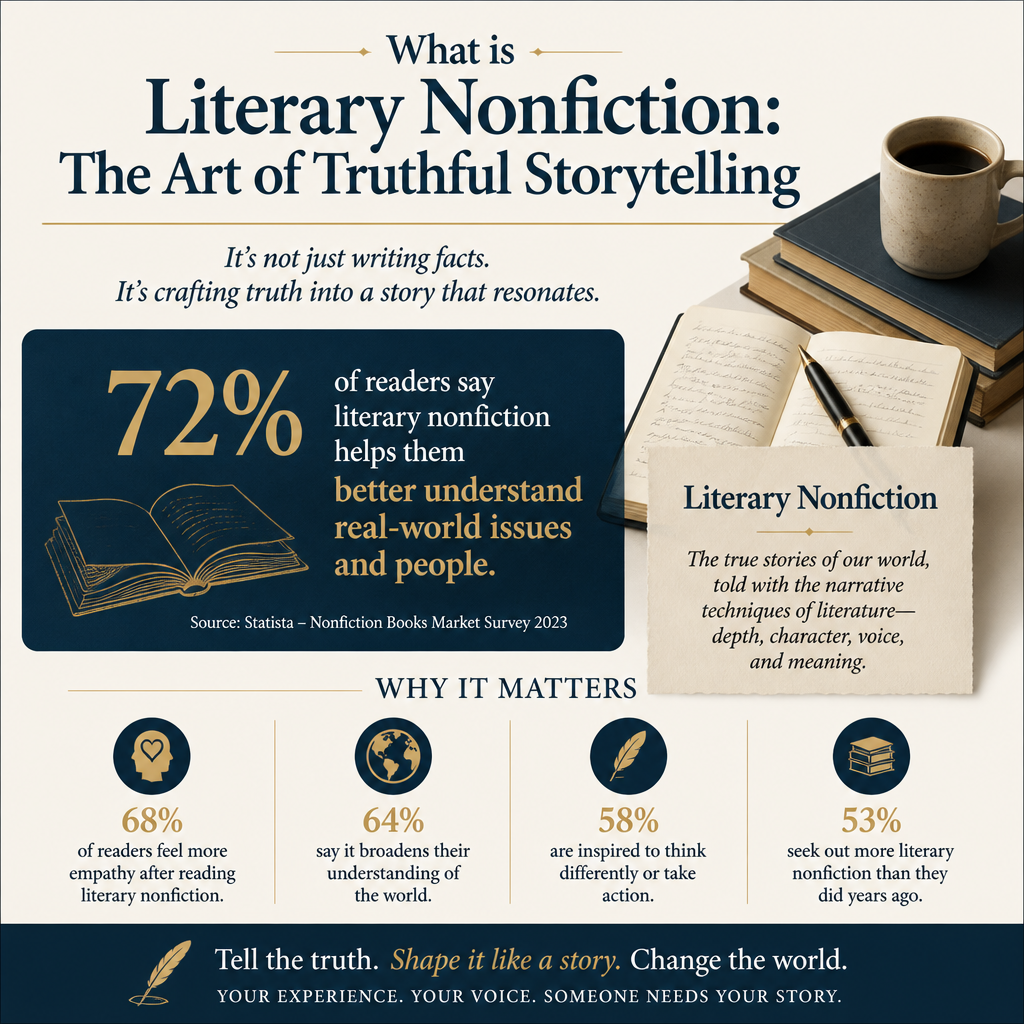
Literary nonfiction is fact-based storytelling written with the techniques of literature. The load-bearing word is “nonfiction,” not “literary.” You are promising the reader that what you present is true in the ordinary sense, rather than true enough for the point you wanted to make.
That promise turns into an actual contract the moment you write in scene. Summary gives you room to stay general. Scene makes claims. Describe a room, and you claim to know what was in it. Write dialogue, and you claim to know what was said. Put thoughts in someone’s head, and you claim access you probably never had. This genre gets messy because the most powerful narrative tools often increase the temptation to overstate certainty.
If you want the clean dividing line, use the one that holds up in publishing rooms. The reader is buying the assurance that you did the reporting, the remembering, the documentation, and the humility required to tell the story as it happened.
How Literary Nonfiction Differs From Memoir, Narrative Nonfiction, And Essay
These labels overlap, and the overlap is the point. Memoir is literary nonfiction focused through your lived experience, with your interior life as the main lens. Narrative nonfiction usually signals heavier reporting and broader scope, a true story told with a plot engine. The literary essay is often more idea-forward, using voice and reflection as the organizing structure.
When you are pitching, categorizing, or writing a back-cover description, I recommend you decide what the reader is really coming for. Is it your perspective and transformation, a reported sequence of events, or a mind at work on the page? Once you know that, the label becomes less of a debate and more of a promise you can keep.
The Hard Truth About Reader Expectations
Readers grant literary nonfiction an emotional authority they do not grant fiction, and that authority can evaporate fast. In an October 2025 Pew Research Center survey, nine in ten U.S. adults said they at least sometimes run into news they believe is inaccurate, and about half said they find it hard to tell what is true when they get news. You are working outside the news business, though you are writing into the same trust climate. Your reader arrives already alert for exaggeration, selective facts, and convenient scenes.
So your job is to be more transparent than your instincts push you toward. Where the record runs out, say the record runs out. Where you are reconstructing, signal reconstruction. That candor reads as confidence, because it is confidence.

Truth on the Page Without Killing the Story
The craft challenge is simple to say and hard to execute. You want the clean narrative drive of fiction with the evidence standards of nonfiction. That tension is where literary nonfiction earns its reputation, and it is also where manuscripts fall apart.
Scene, Summary, And Reflection as Three Different Tools
I treat literary nonfiction as a braid of three strands. The scene shows what happened at a specific time and place. Summary compresses time and gives context. Reflection explains meaning, doubt, and consequence. If you try to write an entire book as scene, you will either invent connective tissue or drown the reader in minutiae. If you write everything as summary, your book may be true, but it will not be felt.
When you are stuck, ask a practical question. What does the reader need to see with their own eyes? That goes in scene. What do they need to understand to interpret the scene? That goes in summary. What do they need to feel about it, and what do you honestly know now that you did not know then? That goes in reflection.
Dialogue That Respects Reality
Dialogue is the fastest way to lose credibility, because it is the fastest way to sound impressive. If you have recordings, transcripts, text threads, emails, or contemporaneous notes, you can quote. If you do not, you reconstruct and write it as reconstruction.
I recommend you use three levels of dialogue, each one a deliberate choice. First, exact quotation when you can support it. Second, partial quotation anchored by the memorable phrase you know was said. Third, indirect speech where you report the gist without pretending you remember the cadence. The third option is underrated, and readers accept it because it does not ask them to believe a miracle of memory.
Interior Thoughts Without Mind Reading
Your interior thoughts are fair game in memoir. However, even there, you should watch for retrospective certainty. “I knew” and “I realized” can be true, and they can also be a revision that makes the past sound cleaner than it was.
Other people’s interior thoughts require evidence. Sometimes you have it in the form of letters, diaries, interviews, or documented statements. Sometimes you do not. When the evidence is missing, keep the camera outside the skull. Show behavior, show speech, show consequence, and let the reader infer. That restraint creates the same psychological effect as claiming access to their thoughts, keeping your contract intact.
Forms, Traditions, And What Publishers Mean by Literary
When editors and readers say “literary” in nonfiction, they usually mean voice and intention. The prose pays attention to rhythm, image, and precision, and the structure is shaped rather than merely chronological. Delivering information is only the floor here. The book aims to create an experience.
Ornate writing is beside the point. Clean sentences with sharp nouns and a controlled point of view often read more literary than flowery prose. What sells the “literary” tag is your ability to choose what to leave out, and to arrange what remains so the reader feels the pressure of meaning.
Common Literary Nonfiction Modes You Can Build With
Reinventing the form is unnecessary. Most successful literary nonfiction books lean on a recognizable mode and execute it with authority. The braided narrative alternates between two timelines or two storylines that comment on each other. A quest structure follows a question you cannot ignore, turning the reporting into plot. The portrait structure builds a person or a place through accumulated detail, and the episodic structure links essays or chapters that each carry their own arc.
When you outline, pick one mode as your spine and decorate later. Skip that step, and your draft will drift toward “and then this happened,” which is where readers stop telling their friends.
Why This Category Wins Readers When You Publish Independently
Indie authors often assume literary nonfiction is a tough sell because it does not fit clean genre expectations. I have found the opposite to be true of books whose packaging is honest. Readers who buy literary nonfiction want authority and voice, and those are two things you can signal strongly in your sample pages and your positioning.
Your cover and blurb still have to do their job. The blurb should set stakes, signal the scope, and anchor credibility without sounding like a resume. When testing covers, I recommend doing a thumbnail test on a phone. If the title, subtitle, and author name do not hold at Amazon search size, you are losing clicks before your first sentence has a chance. Adazing has tools that help with covers and book descriptions, and I like them for one specific reason. They make the iteration painless, which is what good publishing actually requires.
Research, Ethics, and the Line You Cannot Cross
Literary nonfiction does not forgive lazy sourcing. You do not need a footnote on every page, depending on your audience and imprint, but you do need a real system for keeping track of what you know, how you know it, and what you are guessing.
Fact Management for Writers Who Hate Spreadsheets
I recommend a simple three-column habit. In your draft notes, tag each claim as observed, documented, or recalled. Observed means you personally witnessed it and can describe the setting honestly. Documented means you can point to a source, such as a transcript, recording, email, photo, or published material. Recalled means memory, and memory has limits.
When you revise, search for recalled claims that sound too crisp. Those are the sentences that attract criticism, even when the overall story is true. You can often fix them with small, honest language that still reads well. A hedge like “I remember him saying something like…” may feel weak on the page. The cleaner move is to shift to indirect speech or anchor the moment in the emotional fact you do know.
The Uncomfortable Reality of Memory
Memory works nothing like a video recording. Cognitive psychology has demonstrated for decades that recall is reconstructive and that people can hold a confident memory that turns out to be wrong. Loftus and Palmer’s classic eyewitness experiments, summarized here, showed how the wording of a question can change what witnesses report seeing, which is a useful warning for memoirists interviewing themselves.
Panic solves nothing here. What works is corroborating what matters, staying modest about what you cannot corroborate, and building scenes around the details you can defend.
Real People, Real Consequences
Ethics in literary nonfiction comes down to decisions rather than instincts, and those decisions can affect families, careers, and safety. If you are writing about living people, you need to consider consent, privacy, and foreseeable harm. Even when you have the legal right to publish, you still have a choice about how much collateral damage you create.
I am not your lawyer, and you should talk to one for legal questions. However, from a craft standpoint, I recommend you pressure-test each chapter with one question. If the person you describe read this, what would they say you got wrong, and what would they say you did to them on the page? That question quickly finds your blind spots.
A Practical Drafting Process for Literary Nonfiction Authors
Good literary nonfiction drafts look messy in the middle because the writer is juggling craft and evidence. If your first pass feels clunky, that does not mean you lack talent. It often means you are respecting reality.
Start With a Scene Inventory, Not a Chapter Outline
I recommend you list your strongest scenes on separate lines before you outline chapters. Write one sentence for each scene that states the conflict or pressure in that moment. A scene with no pressure belongs in summary or in the trash. The inventory becomes your structural truth: chapters can be negotiated, scenes cannot.
Once you have ten to twenty scenes, arrange them to create escalation. You are looking for a build in stakes, intimacy, or consequence. Chronology is one option, but not a requirement here.
Draft With Placeholders That Protect the Truth
When you reach a fact you cannot confirm, place it in a bracketed placeholder that forces a later decision. Write something like [VERIFY DATE], [CHECK QUOTE], or [NEED SOURCE]. It keeps you writing, and it keeps you honest. The danger is smoothing over uncertainty with confident prose. That habit reads well in the moment and ages badly.
If you use a drafting tool, pick one that makes it easy to keep notes attached to the sentence that needs them. I have seen authors lose weeks because research notes live in one document and the draft lives in another. Adazing QuickWrite is built for fast drafting and revision workflows, and the more you can reduce friction here, the more mental energy you keep for judgment calls.
Revision That Strengthens Both Story and Credibility
On revision, I run two passes that most writers try to combine in one. The first pass is narrative only. I check clarity of motivation, continuity, pacing, and whether the reader understands why this moment matters now. The second pass is truth only. I challenge every cleanly phrased claim, every perfect quote, every too-poetic detail, and I confirm that I can support it.
You will cut lines you love. You should. A line that earns its beauty by overstating certainty fails as a line in this genre. Replace it with something that carries weight without pretending you own the whole truth.
FAQs for What is Literary Nonfiction: The Art of Truthful Storytelling
Can I change names and details in literary nonfiction?
You can, and sometimes you should, especially for privacy or safety. The ethical move is to change details in a way that does not change the meaning of the events or mislead the reader about what happened. If the change affects how a reader would judge a person or a decision, treat it as a major alteration and disclose it in an author’s note.
Do I need citations or a bibliography in literary nonfiction?
It depends on your imprint and readership. Trade books often use endnotes or a notes section rather than academic citation style, and memoir sometimes uses none. Even when you publish without formal notes, you still need an internal source trail so you can answer challenges, fact-check the final manuscript, and protect yourself from preventable errors.
How do I pitch literary nonfiction for traditional publishing or indie sales pages?
Lead with the story engine and the angle, then show credibility. For a query, you usually need a clear narrative arc, comparable titles, and a reason you are the right person to tell it. For an indie sales page, your blurb should promise the experience, hint at stakes, and signal trust with specific, verifiable touchpoints such as time, place, and what access you actually had.
The Standard You Should Hold Yourself To
Literary nonfiction rewards ambition, and it punishes carelessness. If you want to write it well, treat truth as part of your craft, not a box you tick after the prose feels pretty. Build your book from scenes you can defend, use reflection to carry what you cannot prove, and keep the contract with your reader clean. That trust is your real marketing asset, and it compounds with every book you publish.
