
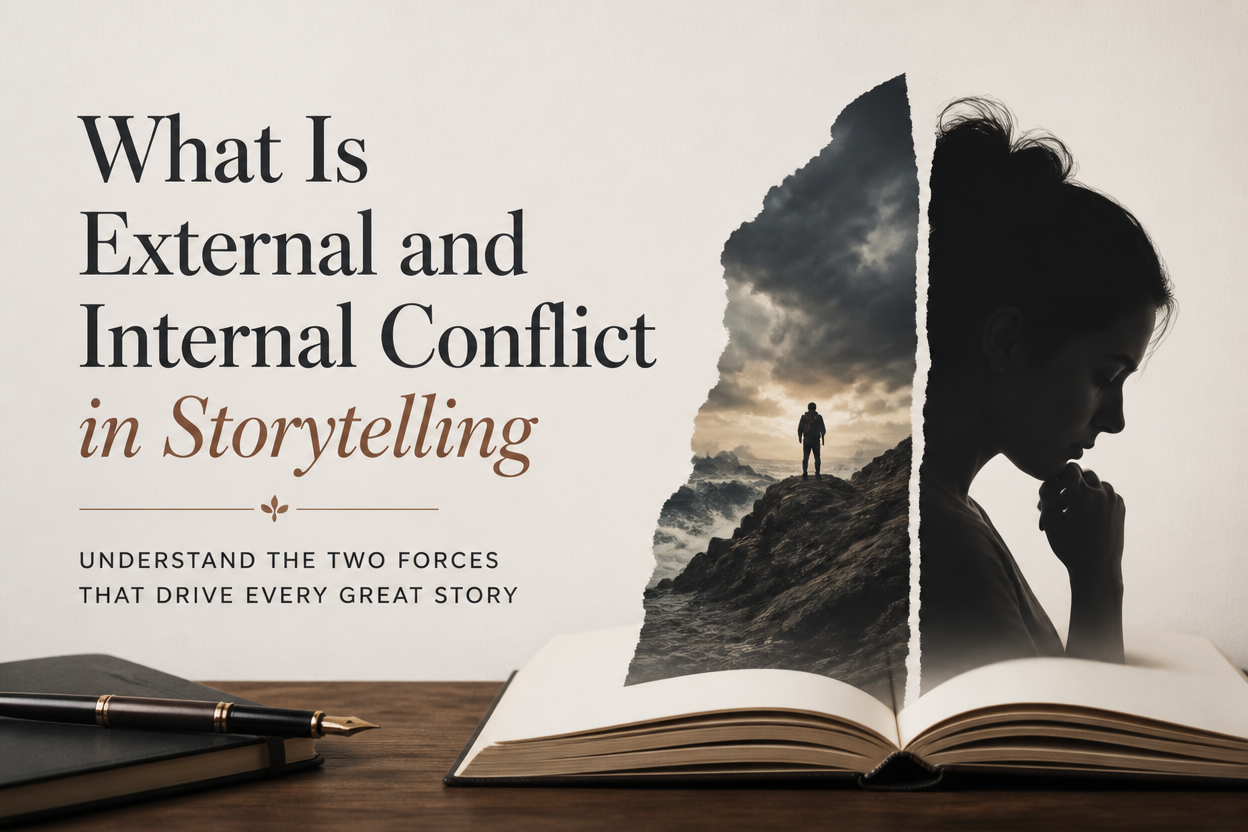
When you understand “What is external and internal conflict?” in storytelling, you can diagnose why a scene feels flat, why a character seems passive, and why a plot refuses to move. External conflict gives your character a visible problem to fight. Internal conflict gives that fight personal meaning. Strong fiction usually needs both pressures working together.
I see writers treat conflict as a synonym for violence, argument, or a villain’s scheme. Conflict reaches much further. For example, a woman deciding whether to expose her brother’s crime is in conflict even when she sits alone at a kitchen table. Meanwhile, a detective chasing a kidnapper faces external danger, and his guilt over abandoning his own child shapes every choice he makes.
Your job is to connect the outer problem to the inner wound, belief, desire, or fear. Once those elements pull against each other, your plot gains pressure. The reader cares about the event because the event threatens the character’s identity.
Table of Contents
External Conflict On The Page
External conflict arises from a force outside the protagonist that stands in the way of a concrete goal. The force may be another person, a group, a system, nature, technology, or a dangerous situation. Your character wants something, and the outside world creates resistance.
In a mystery, the protagonist seeks to identify the killer as the murderer hides evidence and targets witnesses. In a romance, the protagonist wants a relationship. However, distance, family obligations, professional rivalry, or a damaging secret keeps the couple apart. In science fiction, a pilot may need to reach a colony before its oxygen supply fails.
Each example gives you three useful pieces: a goal, an opposing force, and consequences. Remove any one of them and the story loses pressure: a character who wants nothing creates no pursuit, a goal with no resistance creates no plot, and resistance without consequences creates a problem the reader has no reason to fear.
Character Versus Character
Person-against-person conflict is the form most writers recognize first. The antagonist may want the same object, pursue an opposing outcome, or hold power over the protagonist. In a political thriller, a journalist wants to publish evidence of corruption. However, a senator uses legal threats and public influence to suppress it.
Give both sides a reason to act. For example, a villain who causes trouble only because the plot requires trouble will feel mechanical. Build an opposing goal that makes sense from the antagonist’s perspective, then force your protagonist to respond through choices rather than passive suffering.
Character Versus Society
Social conflict places an individual against a law, custom, institution, class structure, or public belief. Margaret Atwood’s The Handmaid’s Tale uses an authoritarian religious state as the force constraining Offred’s body, movement, language, and memory. Your own version may involve a town protecting an abusive family, a workplace punishing whistleblowers, or a community rejecting a character’s identity.
Systemic opposition works best when you show its ordinary machinery. A character may face a locked office, a missing permit, a hostile hearing, or a policy that sounds reasonable until it destroys someone’s life. Concrete barriers give large social forces a human shape.
Character Versus Nature And Circumstance
Storms, illness, isolation, poverty, fire, and mechanical failure create external conflict through conditions rather than a conscious opponent. These forces still need to interfere with a goal. A blizzard matters because the protagonist must reach a cabin before nightfall, carrying the medication that will keep a child alive.
Write down the protagonist’s immediate objective in every high-pressure scene. Then list the outside force that blocks it. If you cannot name both in one sentence, the scene may contain atmosphere or backstory without enough dramatic movement.

Internal Conflict Inside The Character
Internal conflict happens when a character’s desires, values, fears, memories, and beliefs pull in different directions. The struggle occurs inside the character, although the reader usually sees it through behavior, hesitation, rationalization, and choice.
For example, a firefighter may want to rescue a trapped stranger while fearing another building collapse. A widower may want companionship while believing that loving again betrays his dead spouse, and a young lawyer may want justice for a client while craving the promotion that depends on abandoning the case.
Internal conflict gives the reader access to stakes that an outline cannot capture. A scene becomes personal when the character stands to lose a piece of the self they have built. The external event provides the pressure. The internal contradiction determines how the character reacts.
Desire Against Fear
This pattern gives you a clean engine for character behavior. The character wants a result and fears the cost of pursuing it. For example, a shy novelist wants to publish a memoir. However, she might fear recognition from the family members described in the manuscript.
Do not explain the fear in a paragraph of diagnosis. Let it shape the character’s conduct. She revises the dedication for three hours, deletes an email to her agent, changes the names of people who will recognize themselves, and finally submits the manuscript with a false sense of safety. Those choices reveal the conflict more effectively than a sentence announcing that she struggles with exposure.
Duty Against Desire
A character may know what duty demands and still want something else. For example, a prince owes his country a political marriage but also loves a commoner. A doctor must follow quarantine rules while her child remains inside the restricted area, and a detective has to arrest a friend who saved his life years earlier.
Duty becomes dramatic when obeying it carries a real emotional price. Give the character two defensible options, then make each option damage something they value. Internal conflict grows from an impossible decision, not from vague indecision.
Belief Against Evidence
Characters often cling to an old belief even as events begin to disprove it. For example, a man who believes dependence equals weakness refuses help during a financial crisis. Meanwhile, a woman who believes people always leave sabotages a relationship that has remained steady for years.
Track the belief as a working rule. Write a sentence such as “people leave when I need them” or “power belongs to whoever controls the story.” Then create scenes that challenge the rule. The character may reject the evidence for several chapters. However, each rejection should become harder to sustain.
The Connection Between Outer And Inner Pressure
External and internal conflict become most effective when the same event presses on both levels. The outside problem forces a decision, and the decision exposes the character’s private struggle.
Suppose your protagonist is a freelance journalist who discovers that a beloved local charity has falsified its accounts. The external conflict involves the charity director, a threatened lawsuit, and the risk of losing access to sources. The internal conflict comes from the journalist’s fear of harming the neighborhood that supported her after her father’s death.
Every attempt to publish the story now carries two costs. Silence protects the community and betrays the journalist’s principles. Publication honors the truth and may destroy a place she loves. The plot can move through interviews, leaked documents, and legal threats. At the same time, the character arc moves through loyalty, grief, and moral courage.
When I revise a manuscript, I draw two lines for the protagonist. One line tracks the external obstacle from scene to scene. The other tracks the internal belief under pressure. The strongest scenes touch both lines: a scene that advances only the investigation may inform the reader. Meanwhile, one that advances the investigation and threatens the protagonist’s self-image creates drama.
Scene-Level Pressure
Build each important scene around a specific collision. For example, the protagonist wants an answer from a witness. The witness, however, wants protection. Elsewhere, the protagonist wants to leave the marriage. The spouse, however, offers the apology she has waited ten years to hear. In another case, the protagonist wants to steal the map. The map, however, contains a letter from the parent she believes abandoned her.
Give the character a tactic, an obstacle, and a result. The tactic shows agency. The obstacle creates resistance. The result changes the situation, even if the character fails. A scene where nothing changes usually belongs in your notes, not your final draft.
Pressure Through Choice
Conflict becomes visible through decisions. A character who keeps receiving problems without choosing a response becomes cargo in the story. You can write a quiet protagonist, a trapped protagonist, or a reluctant protagonist. Each one still needs to decide how to respond to the pressure.
Use escalating choices. The first choice costs time, the second costs trust, and the third costs safety. Near the climax, the character faces a choice that threatens the belief governing the entire story. The decision then carries emotional weight because the reader has watched that belief shape earlier behavior.
Conflict Across A Character Arc
Conflict should change as the story progresses. Early obstacles test the character’s habits. Middle obstacles expose the limits of those habits. The climax forces a response that demonstrates growth, collapse, or a deliberate refusal to change.
Consider a fantasy protagonist who believes survival requires betraying everyone first. In the opening chapters, she steals from an ally to escape a military patrol. Later, she withholds information from a rebel group, producing a tactical victory and a personal rift. Near the climax, she must reveal her location to save the ally she betrayed.
The external events can grow in scale. However, scale alone does not create an arc. A larger explosion cannot replace a harder choice. The final obstacle should attack the character’s governing belief with greater force than earlier events did.
The First Act Contract
Early conflict establishes the book’s promise. Show the ordinary pattern that the protagonist follows, then introduce the pressure that makes the pattern impossible to maintain. For example, in a thriller, the first threat may expose the detective’s dependence on a disgraced partner. In a family drama, a funeral may force estranged siblings under the same roof.
Give the reader enough context to understand what the character wants before the major complications multiply. You do not need a biography. A few purposeful details can reveal the desire, the fear, and the cost of disruption.
The Middle Act Squeeze
The middle of a novel needs pressure with memory. Each setback should grow from an earlier choice or alter a later option. Random obstacles make a manuscript feel stitched together from events. Consequences make it feel caused.
Increase the cost of the protagonist’s familiar solution. If she lies whenever she feels threatened, let one lie protect her in chapter five and ruin an alliance in chapter twelve. If he relies on force, place him in a situation where force endangers the person he wants to protect. The reader then sees the arc through cause and effect.
The Climax And The Choice
The climax brings the outer problem and inner struggle into a single decision. The protagonist may defeat the antagonist, expose the truth, escape the disaster, or accept defeat. The event matters because of what the character chooses to value.
In Jane Eyre, Jane’s romantic desire conflicts with her moral convictions and need for self-respect. In The Lord of the Rings, Frodo’s external journey toward Mount Doom carries an internal burden shaped by temptation, duty, and exhaustion. These stories differ in genre and scale. However, their climaxes work because the outward action carries inward consequence.
Revision Methods For Stronger Conflict
Conflict often appears in a first draft as general trouble. Revision gives it shape. I start by marking every scene where the protagonist wants something. Then, I ask what blocks that desire and what the character risks emotionally.
A useful test comes from narrative transportation research. In a 2000 study in the Journal of Personality and Social Psychology, Melanie Green and Timothy Brock examined how readers become absorbed in narrative worlds and found that transportation relates to story-consistent beliefs and evaluations. Craft advice cannot reduce reader engagement to a single formula. However, the finding supports a practical principle: specific stakes and sustained pressure give readers reasons to remain inside the story.
The Conflict Audit
Create a table with five columns: scene, external goal, external obstacle, internal fear, and result. Fill it in for every scene that carries plot weight. Empty cells show you where the draft needs work.
Watch for repeated obstacles. If the protagonist has three arguments with the same person and each argument reveals the same information, combine them or change the cost. Conflict should develop. Repetition only counts as escalation when the relationship, knowledge, or danger changes.
The Dialogue Test
Read your dialogue and circle every line that states exactly what a character wants. Several direct statements may flatten the scene. People protect themselves in conversation. They dodge, bargain, accuse, flatter, change the subject, and answer a different question.
Give each speaker a private objective. For example, a mother asks about her son’s new job to know whether he plans to leave town. The son jokes about the salary to avoid admitting he was fired. The surface exchange remains ordinary while the internal conflict gives every line weight.
The Stakes Ladder
List what the protagonist can lose at three levels. The external level may involve money, safety, reputation, freedom, or a relationship. The internal level may involve identity, dignity, forgiveness, or a cherished belief. The story level may involve the future of a family, community, or institution.
You do not need all three levels in every scene. You do need a clear reason for escalation. Add pressure by removing options, shortening time, exposing information, or forcing the character to depend on someone they distrust.
Common Conflict Problems In Manuscripts
The most common problem I see is conflict without agency. A villain attacks, a storm arrives, a publisher rejects the manuscript, and the protagonist spends several chapters absorbing consequences. Give the character a plan, even a flawed one, so the plot responds to their behavior.
Another problem is an antagonist who exists as a cardboard obstacle. Give the opposing force a specific objective and a method. For example, a landlord who wants to sell a building creates different scenes from one who wants to punish the tenant for exposing unsafe conditions. Motive changes behavior, and behavior creates usable scenes.
Writers also confuse emotional pain with internal conflict. A character can be sad, angry, or frightened without facing an inner choice. Internal conflict emerges when an emotion clashes with a desire or belief, affecting the behavior. Show the character choosing avoidance after promising honesty, or choosing honesty after learning that it will cost a relationship.
A final issue appears in manuscripts with several plotlines competing for attention. Subplots can carry their own conflicts. However, they should press on the protagonist’s central struggle or complicate the main choice. For instance, a romance subplot in a murder mystery gains force when intimacy threatens the detective’s secrecy or changes whom the detective trusts.
During revision, cut scenes that repeat the same conflict at the same intensity. Keep the scene that reveals the most, costs the most, or forces the clearest choice. Adazing’s writing tools, including QuickWrite, can help you generate alternate obstacles, character motives, or scene possibilities when a draft has reached a dead end. Use the tool to create options, then apply your judgment to select the choice that belongs to your story.
FAQs for What Is External and Internal Conflict in Storytelling
What Is The Difference Between External And Internal Conflict?
External conflict arises from an outside force that blocks the protagonist’s goal. Internal conflict stems from competing desires, fears, values, memories, or beliefs inside the protagonist. A character can face both at once, such as a journalist fighting a corrupt institution while fearing the damage publication will cause to her family.
Can A Story Have Internal Conflict Without An Antagonist?
Yes. A story can center on grief, addiction, guilt, ambition, identity, or a moral decision without giving the protagonist a conventional villain. The character still needs an active goal and meaningful consequences. External circumstances such as a deadline, illness, financial pressure, or family responsibility can give the inner struggle visible form.
How Do I Add Conflict To A Quiet Literary Scene?
Give each character a private objective and a reason to conceal it. A quiet dinner can carry conflict when one person plans to announce a divorce and the other plans to reveal a pregnancy. Let the characters use tactics, avoid direct answers, and make a choice that changes their relationship before the scene ends.
Make Every Conflict Change Something
External conflict moves the plot through obstacles. Internal conflict makes those obstacles matter to a particular human being. When the two forms meet, your protagonist’s choices create consequences that carry the reader from the first chapter to the final page.
Audit your manuscript scene by scene. Name the goal, identify the opposing force, write down the inner fear or belief under pressure, and record the choice that changes the situation. Then revise the scenes with empty columns. Your story will gain direction because every important moment will have something to fight for and something personal to lose.
