
Every author eventually needs to understand “What is an object pronoun”, because a small case error can make polished prose sound careless. Words such as “me,” “him,” “her,” “us,” and “them” tell readers who receives an action, and that job matters in dialogue, narration, blurbs, and every sentence where one character affects another.
Grammar rarely ruins a strong story by itself. It does, however, create friction. A reader who pauses over “between you and I” has briefly left the scene to judge the sentence. In a manuscript full of those interruptions, the prose loses authority, even with a strong plot and well-drawn characters.
I use object pronouns as an editing checkpoint. Once you can identify the verb, the receiver of the action, and the preposition governing the phrase, you can correct many common errors without relying on instinct. The same skill helps you write cleaner marketing copy for a book description, author website, or launch email.
Table of Contents
Object Pronoun Meaning And Function
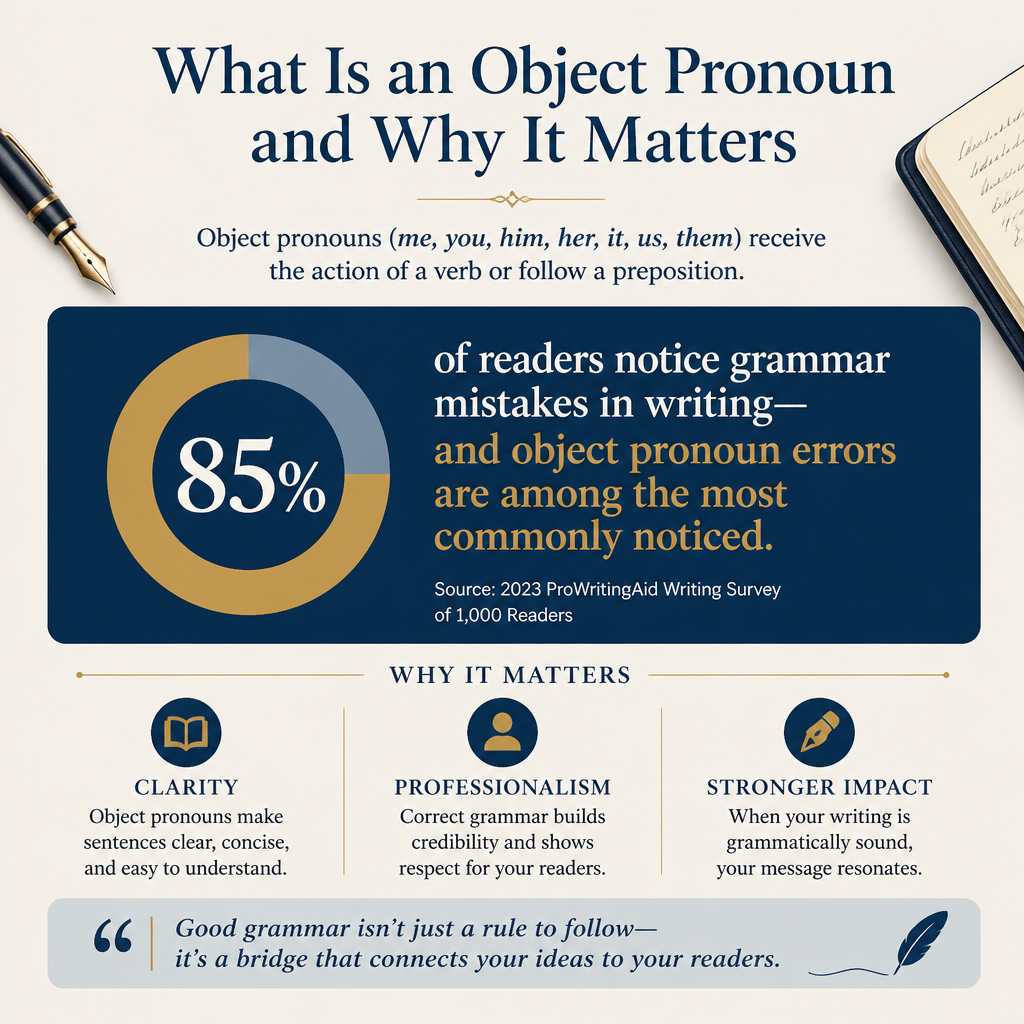
An object pronoun replaces a noun that receives an action or follows a preposition. The common English object pronouns include me, you, him, her, it, us, and them. Whom also belongs to this group in formal usage, although many speakers use who in ordinary conversation.
Consider the sentence “Mara trusted Jonas.” Mara performs the action of trusting, so Mara is the subject. Jonas receives that action, so Jonas is the object. Replace “Jonas” with a pronoun, and the sentence becomes “Mara trusted him.”
“Him” carries the same grammatical role Jonas held. It also keeps the sentence from repeating the character’s name. That combination of clarity and economy matters in fiction, where readers may encounter the same character in several consecutive sentences.
Direct Objects In Manuscript Prose
A direct object answers the question “whom?” or “what?” after an action verb. In “The detective followed the suspect,” the detective followed whom? The suspect. In “The detective followed him,” him functions as the direct object.
Here are several examples that fit scenes authors commonly write:
- “I called her after the hearing.”
- “The editor praised them for the revision.”
- “We invited him to the reading.”
- “The storm pushed us toward the harbor.”
To test a sentence, locate the action verb and ask who receives its action. Replace the noun with me, you, him, her, it, us, or them. Read the result aloud. While your ear may catch a problem, the question-and-replacement method gives you a firmer answer.
Objects After Prepositions
A pronoun also takes object case after a preposition such as to, for, with, from, between, beside, and against. You write “The letter came from him” and “The decision stayed between her and me.”
Authors often make mistakes in phrases with two people. Temporarily remove the first person and read the remaining phrase. “The agent spoke with Jordan and I” becomes “The agent spoke with I,” which exposes the error. The correct sentence should read “The agent spoke with Jordan and me.”
For your own revision, circle each preposition in the scene you wrote. Check the pronoun that follows it. This takes seconds and catches errors that spellcheckers often miss.

Subject And Object Pronoun Forms
English pronouns change form according to their role. Subject pronouns perform the action: I, you, he, she, it, we, and they. Object pronouns receive the action or follow a preposition: me, you, him, her, it, us, and them.
| Subject Form | Object Form | Example |
| I | me | “I sent the chapter to myself” carries a different meaning, while “The editor sent the chapter to me” uses the correct object form. |
| he | him | “He called him” gives each pronoun a separate role. |
| she | her | “She thanked her” follows the same pattern. |
| we | us | “We invited us” can be grammatical in a special context, while “They invited us” is the ordinary example. |
| they | them | “They welcomed them” clearly assigns subject and object roles. |
The Purdue Online Writing Lab’s pronoun case page explains subject and object forms and why case matters in standard edited English. I recommend keeping the chart nearby during a line edit, especially if your manuscript contains first-person narration or several characters in the same scene.
The Compound Pronoun Test
Compound phrases produce the familiar problem in sentences such as “The publisher sent the contract to Lee and I.” Writers sometimes choose I because it sounds more formal. However, formality has no power to change the pronoun’s job. The preposition to still requires an object, so the sentence needs “Lee and me.”
Use the removal test:
- Remove the other person from the phrase.
- Read the remaining sentence.
- Choose the form that works alone.
“The publicist interviewed Sam and me” becomes “The publicist interviewed me.”
This version holds up.
“The publicist interviewed Sam and I” becomes “The publicist interviewed I,” which fails.
Pronouns In Dialogue
Dialogue deserves a little flexibility because people speak in fragments, dialect, and informal patterns. A character may say “Me and Carlos went to the bookstore” as part of a deliberate voice. Narration and exposition carry a different burden, since readers expect those passages to follow the grammatical standard associated with your genre and audience.
I edit dialogue by asking whether the form reveals character or merely reflects an accidental mistake. For example, a rural teenager might use pronouns one way, an anxious professor another, and a sarcastic detective yet another. Preserve a pattern that tells us something. Correct an isolated slip that tells us nothing.
Object Pronouns In Fiction And Nonfiction
Object pronouns do more than satisfy a grammar rule. They control focus. Compare “Elena watched Marcus” with “Elena watched him.” The first version names Marcus by giving the moment slightly more weight, while the second keeps attention on Elena’s ongoing observation.
That choice becomes useful during revision. Repeated names can slow a paragraph, but too many pronouns can blur the action. You need enough nouns for orientation and enough pronouns for flow.
Pronoun Clarity In Action Scenes
Action scenes expose unclear pronoun references because several characters may perform similar actions. Read this example:
“Davis grabbed the lantern from Cole and handed it to him.”
The sentence leaves two questions open. Does it refer to the lantern? Does him refer to Cole or another man? A reader can infer the meaning from context, but inference consumes attention. Name the character or object again when the reference could reasonably point in two directions.
Try this revision: “Davis grabbed the lantern from Cole and handed the lantern to him.” Better still, if Cole receives it, write “Davis grabbed the lantern from Cole and handed it back to him.” If another character receives it, name that character. Pronouns save repetition only when their references remain obvious.
Pronouns In First-Person Narration
First-person fiction creates a special pressure because “I” appears constantly as the subject. Writers sometimes force a sentence into an unnatural shape to avoid repetition, or choose “myself” where me belongs.
Use “me” after a verb or preposition: “The noise startled me” and “She sat beside me.” Use “myself” when it refers back to the subject, as in “I reminded myself to send the pages.” The reflexive form also adds emphasis in a sentence such as “I wrote the dedication myself.”
During a first-person edit, search for every instance of myself. Check whether the narrator also performs the action and receives it. When the narrator lacks one of those roles, “me” or “I” is likely the correct choice.
Pronouns In Author Marketing
Your book description, newsletter, and social posts need the same grammatical control as your manuscript. A sentence such as “Readers trusted her” tells you who earned trust. Meanwhile, a sentence such as “Readers recommended her to their friends” gives her the object role after the verb recommended.
Marketing copy often uses direct address, so you will see fewer visible changes since you function as both subject and as object. Compare “You found the book” with “The book found you.” The form stays the same even as the sentence structure changes. Keep the role clear through word order and surrounding nouns.
Adazing’s writing tools can help you generate ideas and vary promotional language. However, I still recommend a human grammar pass before you publish copy. A generator can produce a lively line. You remain responsible for deciding whether the pronoun points to the right person.
Common Object Pronoun Errors
The mistakes below appear often in manuscripts, query letters, author bios, and sales copy. I check them with a simple grammatical test rather than trusting what sounds prestigious.
I And Me In Compound Phrases
“Between you and I” should read “between you and me.” The preposition between takes object forms. The same rule applies to “for him and her,” “with us,” and “from them.”
Writers also reverse the pattern in sentences such as “Me and Priya reviewed the proofs.” Standard edited prose uses “Priya and I reviewed the proofs.” The pronoun performs the action, so subject case is needed. Run the removal test and the answer becomes clear: “I reviewed the proofs.”
Who And Whom
Whom functions as an object in formal grammar. You can test it with “he” or “him”. If him fits, use whom. “Whom did the editor call?” corresponds to “The editor called him.” If he fits, use who. “Who approved the cover?” corresponds to “He approved the cover.”
Contemporary English often uses who in speech and informal writing, so the choice depends on tone and publication style. In a formal essay or academic book, the traditional distinction carries more weight. In natural dialogue, the character’s voice takes precedence.
Pronoun Agreement And Reference
A pronoun should agree with its antecedent in number and, where relevant, gender. “The readers finished her book” creates a mismatch unless the sentence refers to one female reader. “The reader finished their book” follows singular they, a standard choice in current English for a person whose gender remains unknown or irrelevant.
Reference matters as much as agreement. Consider “The manuscript sat beside the laptop, and it needed revision,” where it could refer to either noun. Replace it with the exact noun if the reader has to stop and solve the puzzle.
Search your manuscript for pronouns near two or more possible antecedents. Read each sentence with fresh eyes. If you cannot identify the referent immediately, revise the sentence before your reader reaches it.
Editing Object Pronouns In Your Draft
Pronoun editing works best as a separate pass. During a developmental edit, you are judging structure, character, and pacing. Meanwhile, during a line edit, you can inspect case, reference, and rhythm without losing sight of the larger story.
A Focused Pronoun Pass
I use this sequence:
- Search for me, him, her, us, them, myself, who, and whom.
- Identify the verb or preposition connected to each pronoun.
- Ask whether the pronoun performs the action, receives it, or follows the preposition.
- Check the antecedent for clear meaning and agreement.
- Read the revised paragraph aloud.
Search tools in Word, Google Docs, and many manuscript programs make this pass practical. You can also paste a short section into a writing assistant, such as QuickWrite, for different phrasing, then verify each suggestion against your intended meaning. Software can flag patterns. It cannot decide whether a deliberate dialect belongs in the mouth of your character.
A Before-And-After Revision
Weak sentence: “The agent spoke to Clara and I before sending the proposal to him.”
First, “to Clara and I” needs object case, so it becomes “to Clara and me.” Next, him has an unclear antecedent. The reader may wonder whether him refers to the agent, a person in the proposal, or someone already mentioned.
Clear revision: “The agent spoke to Clara and me before sending the proposal to her editor.”
The revision fixes case and names the recipient. It also gives the sentence a cleaner rhythm, so apply the same standard to your book’s back matter, dedication, acknowledgments, and retailer description, since readers judge the entire package as evidence of your care.
FAQs for What Is an Object Pronoun and Why It Matters
What Does An Object Pronoun Do?
An object pronoun receives the action of a verb or follows a preposition. “The reader recommended it” puts it in the receiving role after “recommended.” “The note came from her” places her after the preposition from.
How Can I Tell Whether To Use “I” Or “Me”?
Remove the other person from the phrase and read the sentence. “Jordan and I revised the chapter” becomes “I revised the chapter,” so I works. “The editor emailed Jordan and me” becomes “The editor emailed me,” so me works.
Should Fiction Writers Correct Every Pronoun Error In Dialogue?
Correct errors in narration and exposition, but preserve a nonstandard form in dialogue when it consistently reveals a character’s background, education, attitude, or community. An accidental error has no craft value, so remove it.
Clear Pronouns Protect Your Reader’s Attention
An object pronoun seems small beside a novel’s plot, voice, and structure. Yet its effect reaches further than its size suggests. The right form keeps the action legible, protects your narrative rhythm, and lets readers stay inside the scene.
Run a focused pronoun pass after your larger revisions. Test each form by role, check every reference for clarity, and preserve unusual usage only when it earns its place in the voice. Your readers may never mention the work you did. They will feel the difference in prose that moves without grammatical snags.
