
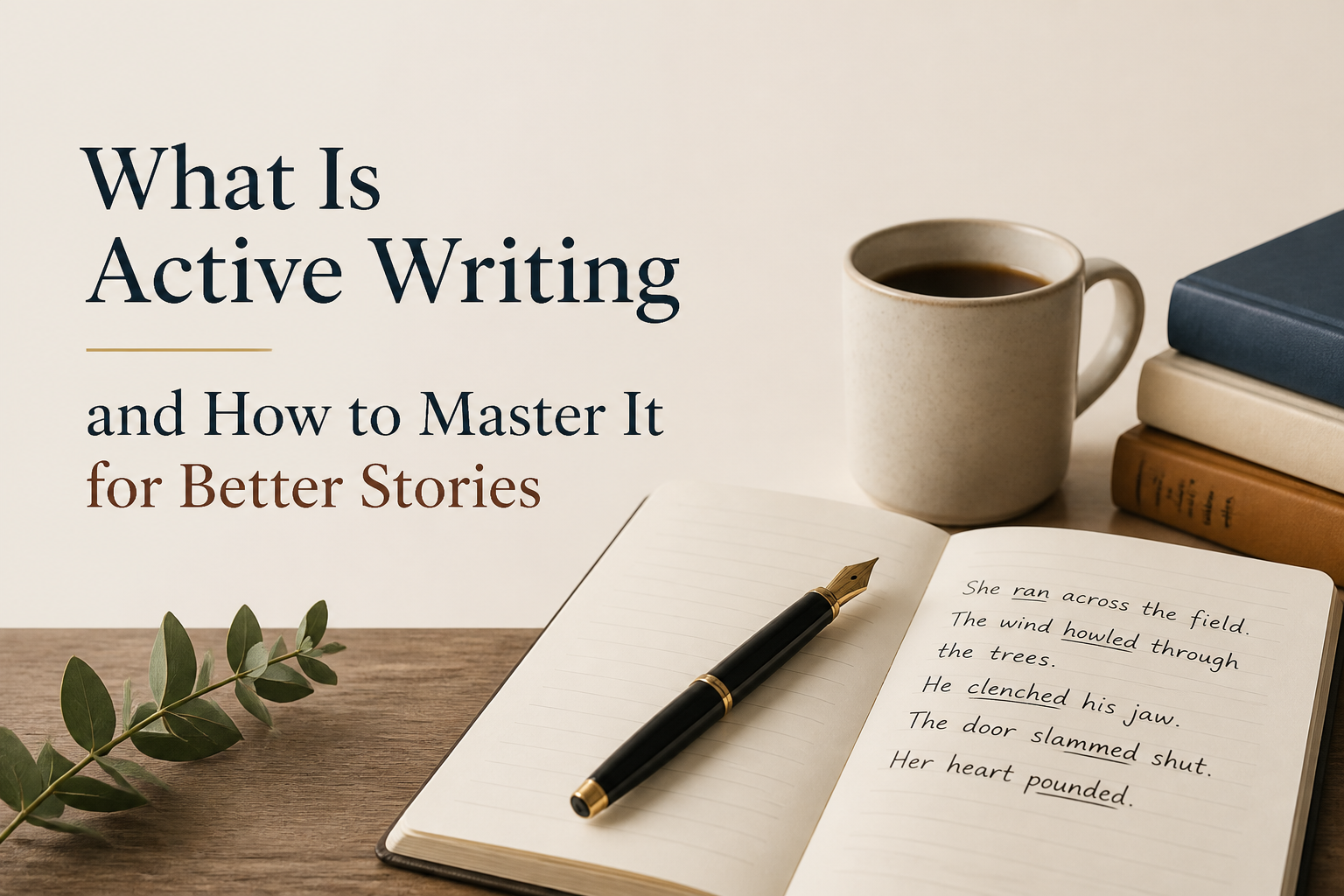
Good active writing gives your reader a clear actor, a strong verb, and a consequence worth following. When a sentence says, “Mara opened the cellar door,” you can picture the movement and anticipate danger. When it says, “The cellar door was opened,” the sentence conceals the person responsible and saps the momentum from the moment.
Authors often treat active writing as a grammar exercise, then wonder why their scenes still feel flat. Active voice helps. Even so, the larger craft principle reaches further. Your characters need to cause events, pursue specific wants, make choices, and suffer the results. A manuscript can contain grammatically active sentences and still feature a passive protagonist who waits for the plot to arrive.
I use active writing at three levels: sentence, scene, and story. You can revise each level with a repeatable process, and you can apply it to a literary novel, a thriller, a romance, a memoir, or a practical nonfiction book. The goal is clear prose that carries your reader forward without making every line sound like a car commercial.
Table of Contents
Active Writing At The Sentence Level
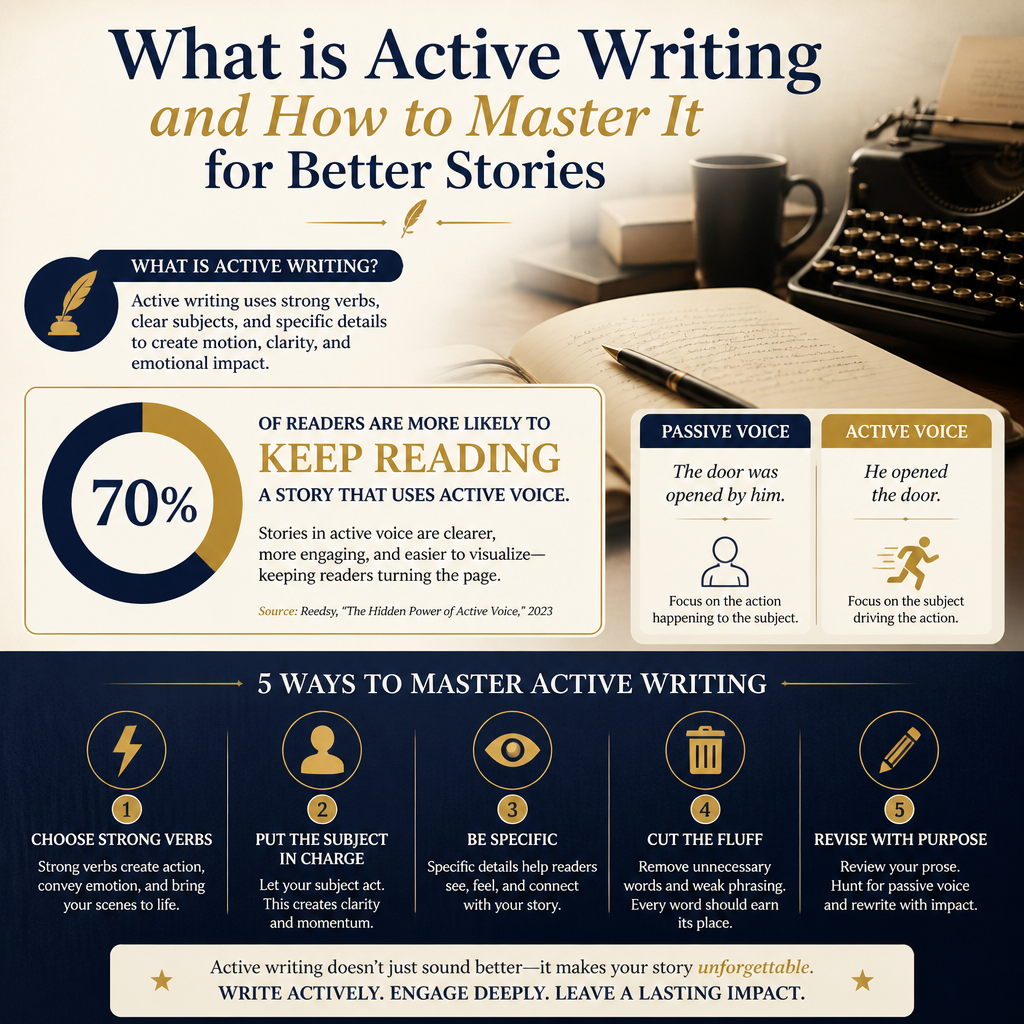
At the sentence level, active writing places the doer before the action. The subject performs the verb, and the object receives the action. Purdue University’s explanation of active voice uses the same basic distinction. Consider “The detective found the letter”: the detective acts. By contrast, in “The letter was found by the detective,” the letter occupies the subject position even though it performs no action.
Passive voice has legitimate uses. You might choose it when the actor remains unknown, when the result matters more than the person responsible, or when you need a deliberate change in emphasis. A mystery can begin with “The body was discovered at dawn” because the discovery matters more than the discoverer’s identity at that point. Problems arise when passive construction becomes your default.
Actors And Verbs
Start a revision by circling the main verb in each sentence. Ask who performs that verb. If you find a form of “was,” “were,” “has been,” or “had been” followed by a past participle, inspect the sentence closely. You may have a passive construction. Even so, the verb form alone doesn’t settle the question.
Compare these lines from a fictional suspense scene:
- The warning was ignored by Lena.
- Lena ignored the warning.
- The decision was made after several hours of discussion.
- After three hours, the partners chose to close the shop.
The revised sentences reveal responsibility and reduce verbal weight. They also give you useful character information. Lena’s decision now belongs to Lena. The partners choose, which gives the business conflict a human source.
Specific Verbs For Stronger Prose
Active voice cannot rescue a weak verb. “Jon moved across the room” places Jon in charge of the action. By contrast, “Jon limped across the room” reveals his condition. “Jon crossed the room” gives the movement a clean shape. “Jon stalked across the room” adds intention and threat.
During revision, replace vague verbs only when the sharper verb adds meaning. A thesaurus can produce a fancy word that sounds wrong for your narrator or genre. Read the sentence aloud and ask what the character physically does. A character who is angry might slam, shove, snap, or mutter. Select the verb that matches the emotion and the body’s behavior.
For your next pass, mark ten sentences from a chapter. Identify the actor, replace one vague verb in each sentence, and read the paragraph aloud. Keep the revision when it gives the reader a more precise image or emotional signal. Delete it when it merely decorates the line.

Active Characters Inside Active Scenes
A story feels active when characters make choices that alter the situation. A character can sit at a kitchen table and create intense movement through a decision. On the other hand, a character can run through six locations and create no real momentum if every event happens around them without changing what they want.
I diagnose scene passivity by asking four questions. Who wants something in this scene? What prevents that person from getting it? What choice changes the pressure? What new problem exists when the scene ends? Your answers should point to behavior, conflict, and consequence.
Desire Before Description
Begin scenes with a character pursuing something concrete. In a romance, Priya wants Daniel to admit he read her manuscript. In a fantasy, Tomas needs the gatekeeper to overlook the stolen map. In a memoir, you may want to reconstruct the moment you decided to leave your father’s business. Each desire gives the scene a direction before you add atmosphere.
Description works harder when the viewpoint character has a reason to notice it. Priya sees Daniel’s marked-up pages because she wants proof of his interest. Tomas studies the gatekeeper’s hands because he expects a search. You can still describe the rain, furniture, or city street. Even so, the character’s purpose should shape the details.
Choices That Change The Pressure
A scene becomes memorable when a choice creates a cost. Your protagonist might lie to protect a friend, open a door after hearing a child’s voice, or accept a promotion that requires betraying a colleague. The decision can be quiet. It needs to alter the available options.

Review a scene that feels slow and list every event in order. Circle the moments where your protagonist chooses an action. If you find several paragraphs of observation, explanation, or conversation without a decision, give the character a demand, threat, temptation, or deadline. The scene needs a force that requires a response.
For fiction, write one sentence that begins, “At the start of this scene, my character wants…” Write a second sentence that begins, “By the end, the character has chosen…” If the two sentences describe the same condition, revise the scene until the choice produces a new condition.
Active Writing Across The Story
Story-level activity comes from causation. Event A pushes your character into choice B, and choice B creates problem C. This chain gives readers a reason to keep reading because each consequence opens a question about what the character will do next.
Consider a thriller outline. A journalist receives an anonymous photograph. She traces the image to a closed hospital. She breaks into the records room and finds her own name in a patient file. Each event changes her situation because her response creates the next danger. A plot can contain information without movement if the protagonist only receives clues for 300 pages.
From Reaction To Decision
Characters must react emotionally. Reaction alone, however, cannot carry a full narrative. After a shocking discovery, give the character a beat of fear or denial, then force a decision. The detective can destroy the evidence, call a rival, or enter the house alone. Each option reveals character and points the story in a different direction.
Long stretches of reaction often appear in early drafts because the writer understands the character’s feelings and wants to honor them. I understand the impulse. Still, readers need the feeling to produce behavior. Let grief make your character cancel the wedding. Let shame drive the protagonist to steal the ledger. Let hope persuade a hardened captain to turn the ship around.
Cause And Effect In The Outline
Write a summary of every chapter using a verb that names the protagonist’s main move. “Elena investigates the missing funds” gives you a character-driven chapter. “Elena learns about the missing funds” describes passive information intake. The second chapter may be necessary. Even so, it needs a choice attached to the discovery.
Test your outline with this sequence: the character wants something, an obstacle blocks it, the character acts, and the action creates a consequence. You can repeat the sequence at the scene level and the chapter level. In a romance, a confession may create distance because the beloved fears commitment. In a business book, a recommendation may create resistance because readers need evidence before adopting it.
Use this test before you draft the next chapter. Write four lines for the chapter’s desire, obstacle, action, and consequence. When the consequence feels unrelated to the action, strengthen the causal link or change the action.
Active Voice For Dialogue And Point Of View
Dialogue becomes active when each speaker wants something from the other. People rarely talk only to exchange information. They evade, pressure, seduce, threaten, test, confess, and bargain. Give every important exchange a hidden objective, even when the character can’t name it.
Here is a flat exchange:
“Did you take the money?”
“No, I didn’t take the money.”
“Where were you last night?”
“I was at home.”
The facts may matter, yet the exchange has no changing pressure. A sharper version gives each line a tactic:
“You counted the drawer before I arrived.”
“I count every drawer.”
“You counted this one twice.”
“Then perhaps you should ask your brother where the money went.”
The second exchange moves because each answer shifts blame and increases suspicion. You can create that movement without adding exposition.
Concrete Speech Patterns
Cut dialogue tags and gestures that repeat the speech. A character can say something while rubbing a thumb over a cracked phone, folding a receipt, or positioning herself between another person and the exit. Choose a physical detail that reveals an objective or obstacle.
Point of view also controls active writing. In close third person, describe what the viewpoint character notices, assumes, and misreads. In first person, let the narrator’s choices shape the account. A passive description such as “The room was filled with portraits” gives you a fact. “Portraits watched Mara from every wall” gives you Mara’s fear and interpretation.
During a dialogue revision, label each speaker’s objective in the margin. Then underline the line where the objective changes or fails. If every line delivers information at the same emotional temperature, add a refusal, a lie, or a demand.
Revision Methods For Active Writing
Active writing improves through targeted revision. A general request to “make it more active” sends you into a swamp of word substitutions. Use separate passes so you can solve one problem at a time.
The Sentence Pass
Search your manuscript for passive patterns such as “was,” “were,” “been,” and “by.” Review each result in context. Change the construction when the actor matters and the passive form hides responsibility. Keep it when the result deserves emphasis or the actor remains unknown.
Then search for abstract nouns that conceal actions. “The implementation of the plan” turns into “the team implemented the plan.” “Her consideration of the offer” turns into “she considered the offer.” You don’t need to remove every abstract noun from nonfiction. Even so, action-based phrasing often gives instructions more force.
The Scene Pass
Write the viewpoint character’s goal at the top of each scene. Mark every place where the character acts, chooses, or changes tactics. A scene with no meaningful move may belong in summary, may need a stronger conflict, or may have entered the book too early.
Read the final paragraph of each scene and identify the new question it creates. “Will he take the job?” has forward pull. “They went to bed” closes the door without pressure. Add a discovery, decision, threat, or cost when the ending leaves the story unchanged.
The Read-Aloud Pass
Read a printed page or an exported manuscript aloud. Your ear catches repeated sentence openings, padded verbs, vague references, and dialogue that sounds like an interview transcript. Mark any sentence that makes you stop to identify who acted or why the moment matters.
Writing tools can help with this mechanical work. Adazing’s QuickWrite can help you generate alternate phrasings when a sentence refuses to cooperate. You remain responsible, even so, for tone, accuracy, and the final choice. I use software to widen the field of possibilities. I rely on my editorial judgment to decide which line belongs in the book.
Run these three passes after the draft has settled. Revising every sentence for energy before you understand the story often creates polished confusion. First secure the character’s choices and consequences, then sharpen the language that carries them.
FAQs for What is Active Writing and How to Master It for Better Stories
Is Active Writing The Same As Active Voice?
Active voice is a sentence structure in which the subject performs the action. Active writing includes active voice, yet it also covers character agency, scene movement, purposeful dialogue, and cause-and-effect plotting. A sentence can use active voice and still describe a character who makes no meaningful choice.
Should I Remove Every Passive Sentence From My Manuscript?
No. Keep passive voice when the actor remains unknown, the result carries more weight than the actor, or you want a deliberate shift in emphasis. Review repeated passive constructions when they hide responsibility, weaken a dramatic beat, or make instructions harder to follow.
How Can Active Writing Help A Nonfiction Book?
Active writing gives your nonfiction clearer instructions and stronger examples. Tell readers who performs the task, what they do, and what result follows. “Review your sales page after ten readers describe the same point of confusion” gives a writer a usable process. “The sales page should be reviewed” leaves the responsible person and the timing unclear.
Give Every Sentence A Responsible Actor
Active writing begins with grammar and reaches into the design of the whole story. Put the actor near the verb, give your viewpoint character a desire, connect choices to consequences, and let dialogue carry competing objectives. Then revise in separate passes to strengthen the sentence without losing the scene’s purpose.
Open your current chapter and mark the first ten sentences. Name the actor in each one, then identify the choice that changes the scene. Those two checks will show you where your prose has energy and where your story is waiting for a character to take responsibility.
