
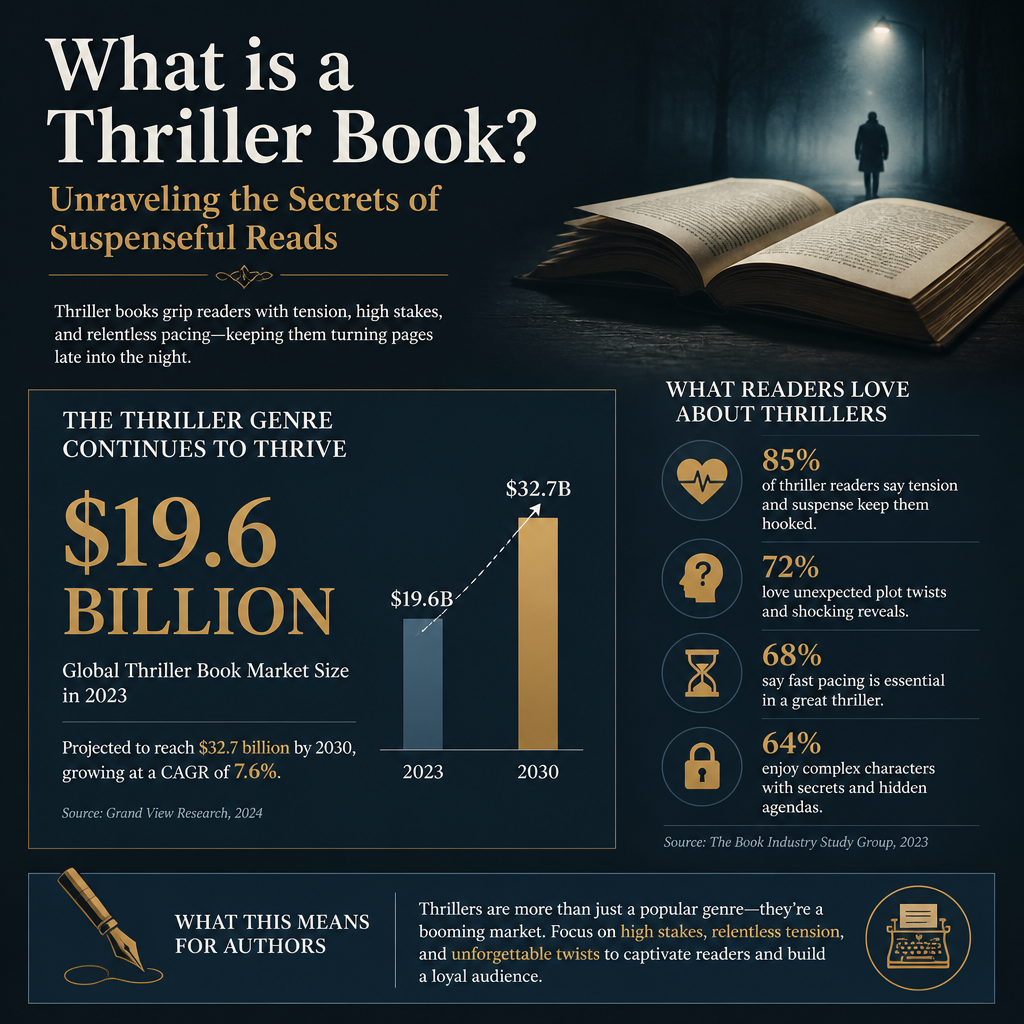
Every author who asks “What is a thriller book?” eventually confronts a harder craft question: what will make a reader keep turning pages after bedtime? A thriller creates forward pressure through danger, uncertainty, and decisions that carry a cost. The reader should feel that information matters because someone may live, escape, lose power, or expose the truth depending on who learns it first.
Genre labels help readers choose books. They also create a contract with them. A mystery promises a puzzle and an answer. Romance novels promise an emotional relationship driving the plot. Thrillers promise sustained tension as a character tries to survive, prevent harm, uncover a threat, or escape an enemy who keeps raising the stakes.
That contract affects every major decision you make, from your opening chapter to your cover copy. I’ll break down the thriller engine, the major subgenres, the role of character choice, and the publishing decisions that help the right readers recognize your book.
Table of Contents
What Thriller Books Promise
A thriller places a meaningful threat in motion and keeps reducing the character’s safe options. The threat can come from a murderer, a government agency, a corporation, a terrorist group, a family member, or a secret buried inside the protagonist’s own past. The source of danger changes across subgenres. By contrast, the reader’s need to know what happens next remains constant.
Thriller differs from mystery in the way the story distributes knowledge and urgency. A mystery usually centers on discovering who committed an act and how the evidence fits together. By contrast, a thriller can include that puzzle. Its primary force comes from immediate peril and escalating consequences instead. The reader may know the killer’s identity from page one and still keep reading because the protagonist has to survive the next encounter.
Encyclopaedia Britannica describes the thriller as a form built around excitement, suspense, and intense emotional tension. For a novelist, that definition points toward reader experience rather than a fixed plot formula. Your story can use a courtroom, a locked house, a missing child, a cyberattack, or a political conspiracy. The reading experience must keep danger active.
The Threat And The Question
A strong thriller gives the reader a concrete threat and a question with consequences. Can the detective stop the second murder? Will the whistleblower reach the journalist before the company finds her? Or can the father identify which of his neighbors has taken his daughter? These questions create motion because the answer affects a person we understand.
Vague danger produces vague tension. “Something terrible may happen” cannot carry three hundred pages. Name the threat, define what it wants, and give the protagonist a reason to act before the situation worsens.
The Cost Of Delay
Suspense depends on time, even in a story without a literal countdown. Every delay should allow the threat to gain ground, remove an ally, destroy evidence, or force a more dangerous choice. A protagonist who spends five chapters researching a villain without suffering any consequence creates a pause in the story’s pressure.
During revision, mark every chapter where the protagonist delays. Write down what changes because of that delay. If the answer is nothing, add a consequence or cut the scene.

The Engine Of Suspense
Suspense comes from controlled information. You decide what the reader knows, what the protagonist knows, and what the antagonist knows. The distance among those three viewpoints creates dramatic pressure.
Give the reader enough information to fear a specific outcome. Hold back enough information to keep the outcome uncertain. A character who hears footsteps outside a cabin creates a small question. A character who recognizes the footsteps as belonging to the person she watched die creates a larger one.
Information Gaps
Information gaps work best when they produce competing explanations. A bloody shirt could belong to the missing man, his brother, or an innocent stranger. A threatening message could come from the obvious suspect, an accomplice, or someone manipulating both sides. Each plausible explanation keeps the reader mentally active.
Use viewpoint with discipline. Head-hopping often drains suspense because it gives away reactions before the scene earns them. A close third-person viewpoint can keep the reader trapped inside the protagonist’s limited understanding. First person can create powerful intimacy. On the other hand, it also restricts what you can reveal directly.
Reversals With Preparation
A reversal changes the reader’s understanding of the situation. It works when earlier details support the new interpretation. The detective’s trusted partner can become a suspect. The shift needs a pattern of small choices, omissions, or contradictions that readers can recognize in retrospect.
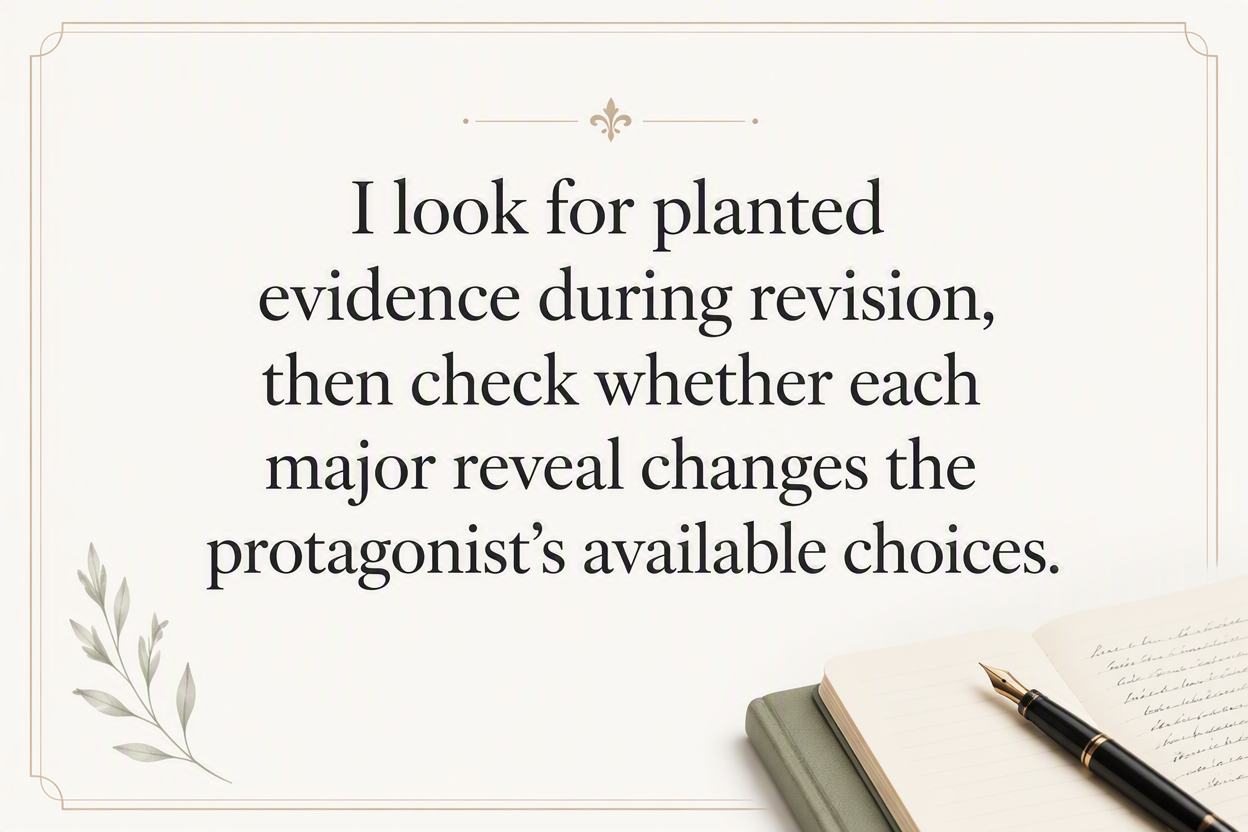
Surprise alone has a short shelf life. I look for planted evidence during revision, then check whether each major reveal changes the protagonist’s available choices. A twist that changes only the reader’s opinion has limited force. By contrast, a twist that forces the protagonist to abandon an ally, expose a secret, or enter a dangerous location moves the plot.
Scene-Level Pressure
Every thriller scene needs a local problem. The protagonist may need to leave a parking garage before security locks the gates, persuade a witness to speak, or search a hotel room before the person in the hallway reaches the door. The scene can contain reflection and description. Even so, the immediate problem should remain present.
End scenes at a point of changed knowledge, increased danger, or difficult choice. A chapter ending with the protagonist driving home rarely creates urgency. An ending in which she sees her own car parked outside her house gives the reader a reason to continue.
Thriller Subgenres And Reader Contracts
Subgenres help you make promises with greater precision. They also help retailers, librarians, reviewers, and readers place your book. A psychological thriller asks readers to question perception, memory, identity, or motive. Meanwhile, a domestic thriller brings danger into intimate spaces such as marriages, families, neighborhoods, or friendships.
Legal thrillers build tension through trials, investigations, evidence, and professional risk. Political thrillers expand the scope to institutions, elections, espionage, and national power. Crime thrillers, by contrast, may follow investigators, criminals, victims, or several connected viewpoints. Techno-thrillers, meanwhile, draw danger from systems, weapons, surveillance, artificial intelligence, or infrastructure.
These categories overlap. For example, a domestic thriller can contain a police investigation, and a psychological thriller can involve a courtroom. You still need a dominant reader expectation because that expectation shapes your cover, product description, categories, and comp titles.
Genre Signals In The Manuscript
Look at the first fifty pages and identify the strongest signal. Does the story introduce a crime, a dangerous relationship, a conspiracy, a professional investigation, or an attack on a system? The answer should align with the category you plan to use on Amazon KDP and other retailers.
Read three recent books in your chosen subgenre and list the promises they make in their first chapters. Track the type of protagonist, the pace of the opening, the amount of violence, and the size of the threat. Your book can break a convention after you establish that you understand it.
Comp Titles And Positioning
Comp titles give readers a shortcut to your book’s experience. Choose recent books with similar tone, audience, and premise. A famous classic may communicate quality. A current release, on the other hand, offers better information about today’s cover design, blurb language, and retailer placement.
Study the also-boughts for those books. You’ll see the neighboring promises readers accept. A book positioned alongside domestic suspense, psychological suspense, and crime fiction needs packaging that clarifies which audience it’s meant for.
Character Stakes And Escalation
Thrillers need more than danger. They need a character whose choices matter. The protagonist should have a specific goal, a personal reason to pursue it, and a weakness the threat can exploit.
Give your protagonist a skill that creates progress and a limitation that creates trouble. A forensic accountant can trace hidden money. Even so, she may trust documents more than people. A veteran detective can read a crime scene. Yet guilt keeps him from recognizing what his own partner has done. Competence makes the protagonist satisfying. Vulnerability keeps the story alive.
External And Internal Stakes
External stakes involve physical safety, freedom, reputation, money, evidence, or another person’s survival. Internal stakes involve shame, grief, loyalty, identity, or the fear of repeating an earlier failure. Connect the two so the external problem attacks the protagonist’s internal wound.
A journalist investigating a missing activist may risk imprisonment. The story gains depth when the journalist also has to face the fact that her earlier reporting exposed the activist to danger. The investigation then carries moral weight alongside physical risk.
The Escalation Ladder
Escalation should change the problem rather than repeat it at a louder volume. Begin with surveillance, move to a warning, then remove an ally, destroy a safe location, expose the protagonist’s secret, and force a public confrontation. Each stage should narrow the available choices.
I use a simple revision test for escalation. At the end of every quarter of the manuscript, ask what the protagonist has lost, what the antagonist has learned, and what new risk now exists. If the answers remain similar, the middle needs a sharper turn.
The Antagonist As Pressure
A compelling antagonist pursues a coherent objective with methods that expose the protagonist’s weaknesses. The antagonist does not need a tragic childhood or a speech explaining every motive. The reader needs to understand what this person wants and why the protagonist cannot solve the problem in a single sensible conversation.
Give the antagonist resources, limits, and a timetable. A threat with unlimited power creates an unfair story. A threat with a clear limitation, on the other hand, gives the protagonist a path to victory and gives the reader a reason to believe each decision matters.
Thriller Packaging And Marketing
Your manuscript can deliver excellent suspense and still disappear online if the package sends the wrong signal. Readers make fast judgments from a thumbnail, title, author name, and short description. Your cover needs to communicate the subgenre before the reader opens the sample.
Look at your cover at thumbnail size on an Amazon search page. Check whether the title remains readable, whether the central image carries a clear emotional promise, and whether the design resembles successful books in your category. A stock image is faster and cheaper. On the other hand, it can make your book look interchangeable with dozens of others. A custom cover costs more and gives you greater control over the exact signal it sends.
Adazing’s book cover tools can help you test concepts before you commission final design work. I use that kind of early testing to compare title placement, image strength, and genre signals before spending money on production.
The Thriller Blurb
A thriller blurb should introduce the protagonist, the threat, the personal stakes, and the question that drives the read. It should create urgency without explaining the entire plot. A synopsis tells an agent or editor what happens. By contrast, a blurb persuades a reader to begin.
Try this structure in your draft. Introduce the protagonist in a situation that reveals her ordinary world. Present the event that breaks it. Show the threat and what she stands to lose. End with the choice or question that makes delay impossible.
Launch Signals And Read-Through
Thriller marketing works best when every message reinforces the same promise. Your cover, retailer description, sample chapters, email copy, and social posts should all tell readers what kind of tension they’ll experience. ARC readers who enjoy psychological suspense may help you reach the right audience more effectively than a large list of general readers.
Track sales alongside read-through across the series. A strong first-book launch with weak second-book read-through usually points toward a mismatch in promise, pacing, or audience. Your promotion should attract readers who want the exact experience your book delivers.
FAQs for What is a Thriller Book? Unraveling the Secrets of Suspenseful Reads
What Makes A Book A Thriller?
A thriller centers on a serious threat, rising urgency, and difficult choices under pressure. The story can include romance, mystery, family drama, or literary depth. Suspense remains the dominant reading experience because the reader needs to know whether the protagonist can survive the danger or stop the consequences.
How Long Should A Thriller Be?
Length depends on the subgenre, audience, and the plot’s scope. A contained psychological thriller may work well at a shorter length than an international espionage novel with several locations and viewpoints. Read current comp titles and compare their word counts before setting a target. Then cut scenes that repeat information or leave the threat unchanged.
How Do I Start Writing A Thriller?
Begin with a disruption that creates a specific question and forces a response. You can open with a crime, a discovery, an apparent accident, a threat, or a decision that puts the protagonist in danger. Draft the first chapter so the reader understands who wants something, what stands in the way, and what happens if the character waits instead.
Writing A Thriller Readers Finish
A thriller succeeds when danger keeps changing the meaning of every choice. Build a clear threat, control information, escalate consequences, and give your protagonist a personal reason to continue after escape would be easier. Then package the book so the cover and blurb make the same promise as the manuscript.
Start your revision with a scene-by-scene tension audit. Record the threat, the information revealed, the decision made, and the consequence created in each scene. Any scene that leaves those four fields blank needs a stronger purpose, a sharper turn, or a place in another book.
