
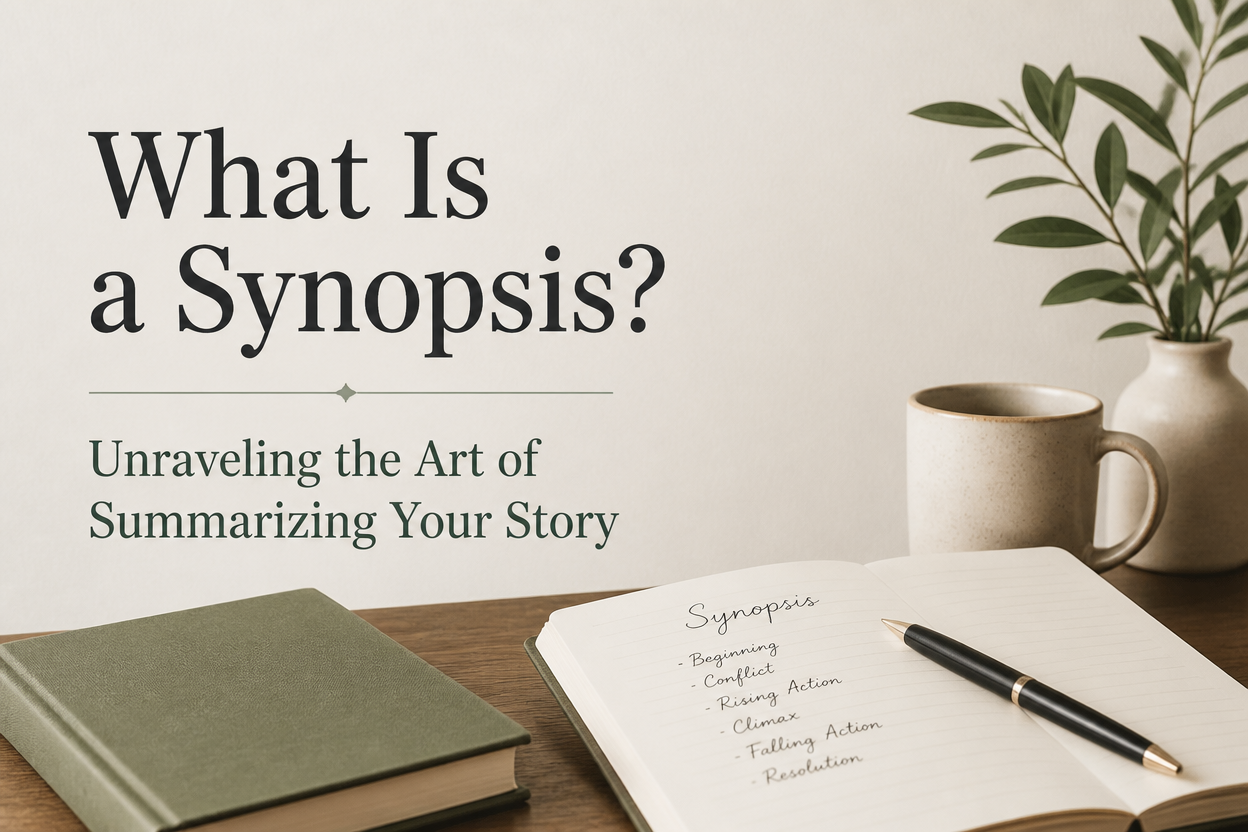
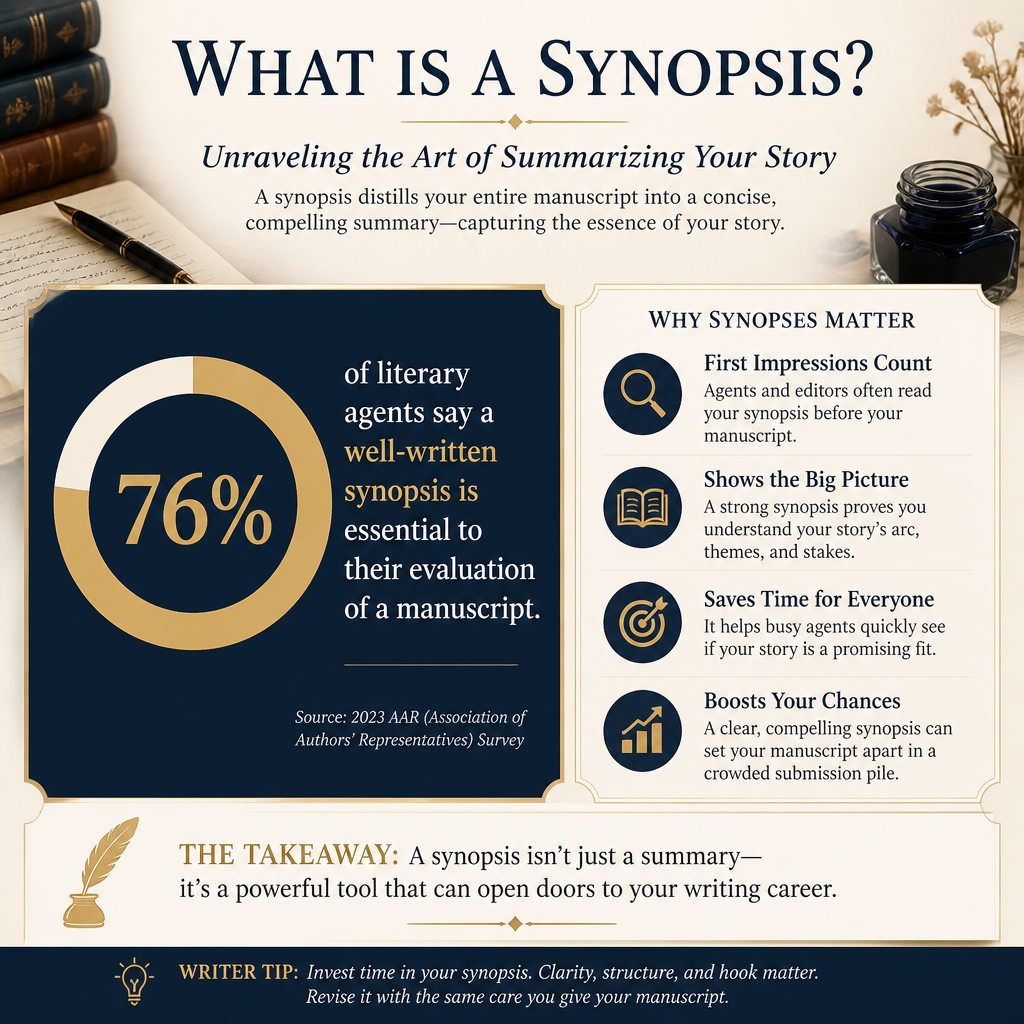
Before you send a query, a writing partner, or a proposal to an agent, you need to know “What is a synopsis?” and what the document must accomplish. A synopsis gives a publishing professional the full shape of your story, including the ending, in a compact form. It proves that your plot works beyond the first chapter and that each major turn leads somewhere deliberate.
Many writers resist the synopsis because it feels like reducing a 90,000-word novel to two or three pages. I understand that frustration. A synopsis asks you to remove the language, atmosphere, and scene-level pleasures that make the book feel alive, while keeping the choices, consequences, and emotional movement intact. That work is difficult because it exposes weak causality faster than almost any other editorial exercise.
A strong synopsis reads like a clear account of a complete book. It names the protagonist, establishes the central conflict, tracks the major reversals, and explains how the ending changes the meaning of what came before. You can use it for an agent submission, a traditional publishing proposal, a grant application, a collaboration, or your own revision plan.
Table of Contents
The Meaning And Purpose Of A Synopsis
A synopsis is a condensed account of your entire story, written in prose and usually organized around the main plot. Unlike a blurb, it reveals the ending. A blurb creates curiosity for a reader browsing Amazon or a bookstore shelf. A synopsis hands an agent, editor, or publishing partner enough information to assess the book’s structure, character arc, genre fit, and conclusion.
The Writers’ and Artists’ guide to writing a synopsis describes it as a concise overview of the main characters, plot, and resolution. That definition matters because writers often fill a synopsis with atmosphere, backstory, or minor subplots. Those details may matter in the manuscript, but they compete for space in the synopsis.
I treat the document as a map of cause and effect. Your protagonist wants something specific, and an opposing force blocks that desire. The protagonist makes choices under pressure, and those choices create new problems. From there, the climax tests the central value or desire, and the ending reveals the consequence. A synopsis should let a stranger follow that chain without asking you to explain what happens between every scene.
The Difference Between A Synopsis And A Blurb
A blurb withholds the resolution, giving the reader a reason to buy the book. By contrast, a synopsis states the resolution, letting a professional assess the book’s promise and delivery. A blurb might end with a question about whether a detective will expose the killer. A synopsis states who committed the murder, why, and how the detective proves it.
Use the blurb on your sales page, in your retailer description, or on the back cover. Use the synopsis when someone needs to understand the whole manuscript before reading it. Mixing these jobs produces a document that reads as promotional and leaves the reader without the information they requested.
The Difference Between A Synopsis And An Outline
An outline helps you plan or revise a manuscript. It can contain scene numbers, writing prompts, research reminders, and questions about missing material. A synopsis presents the finished story as a coherent narrative, usually written in present tense, third person, and paragraph-based prose, even when the manuscript uses first person or past tense.
That distinction gives you a useful revision test. Read each paragraph and ask whether it describes a major change in the story or merely records activity. A character driving across town, checking a phone, and making coffee may fill three scenes. In a synopsis, those details belong only when they trigger a discovery, decision, or reversal.

The Core Components Of A Strong Synopsis
A reliable synopsis contains four moving parts: the protagonist’s ordinary situation, the central disruption, the escalating choices and consequences, and the resolution. You can write those parts in several paragraphs. However, the story should still feel continuous rather than divided into a list of plot points.
Start with the protagonist and the problem that drives the book’s forward motion. “Mara is a botanist” gives me a profession. “After a drought destroys her family’s farm, botanist Mara discovers that the only surviving seed belongs to a corporation willing to buy the land” gives me a conflict with pressure, stakes, and a direction for the plot.
Follow the protagonist’s decisions rather than summarizing every event. A synopsis gains energy when each paragraph answers a useful question. What does the character learn? What choice follows? What new cost does that choice create? A sequence of events becomes a story when the reader can see why one event causes the next.
Character Desire And Stakes
Name the central desire early. In a romance, the protagonist may want a secure life after a public betrayal, then meet the person who threatens that plan. In a thriller, the protagonist may want to protect a child, expose a fraud, or survive a closing net. In narrative nonfiction, the central desire may belong to the subject, the author, or the community whose story you are investigating.
Stakes should grow from the character’s choices. A sentence such as “Everything is at stake” tells me very little. On the other hand, a sentence such as “After Mara sells the family’s last equipment to fund the seed trial, a failed harvest will leave her brother without the money needed for his surgery” gives the decision a human cost.
Turning Points And Escalation
Choose the turns that alter the protagonist’s options. The inciting incident starts the main problem. The first major turning point commits the protagonist to a difficult course. The midpoint changes the reader’s understanding or raises the cost. The crisis forces the hardest choice, and the climax resolves the central conflict. You may not need to label these beats. You still need to account for them.
Subplots deserve space when they affect the main story or reveal a major part of the protagonist’s change. A secondary romance belongs in the synopsis when it changes a decision in the central plot. In contrast, a subplot about a neighbor’s childhood belongs only when it creates pressure, supplies information, or deepens the book’s main argument.
The Ending And Its Meaning
Reveal the ending plainly. Agents and editors read synopses to assess the complete arc, so a dramatic omission creates a practical problem. The Reedsy guidance on book synopses also emphasizes covering the resolution rather than treating the final act as a teaser.
Explain the consequence of the climax in one or two sentences. Readers need to know who survives, what the protagonist chooses, which relationship changes, and what question the book answers. In a mystery synopsis, name the culprit and the detective’s proof. For a romance synopsis, show how the couple reaches its committed ending and what they have learned about trust or intimacy.
The Right Length And Level Of Detail
There is no universal synopsis length. Submission guidelines control the answer. An agent may request one page, two pages, five pages, or a short paragraph. A publisher’s proposal may ask for a chapter-by-chapter summary. Follow the requested format before following any general advice.
Page count also depends on formatting. A single-spaced page in 10-point type holds far more text than a double-spaced page in 12-point type. A practical guide from Jane Friedman on writing a novel synopsis discusses common length expectations and the need to prioritize the main plot. Treat those ranges as working conventions, not laws handed down by a publishing court.
For a one-page synopsis, aim for the story’s spine. Include the protagonist, inciting incident, major turns, climax, and ending. For a longer synopsis, add the major relationship changes, the central secondary plot, and the discoveries that alter the protagonist’s plan. Do not expand by describing every chapter. Expand by clarifying the consequences that make the story worth reading.
A Useful Space Test
Write a 250-word version first, even when the requested document is longer. This forces you to identify the book’s central movement. Then expand the draft to the required length by adding turns that change the plot, character decisions that carry a cost, and information the reader needs to understand the ending.
For a 500-word synopsis, give each major act a paragraph. For a two-page synopsis, give the opening, development, crisis, and resolution room to breathe. The exact paragraph count matters less than the balance. Your opening should establish the situation without consuming half the document, and your ending should receive enough space to feel earned.
Genre And Format Differences
Romance synopses need the emotional arc and the relationship’s turning points. Mystery and thriller synopses need the investigative chain, revelations, and solution. Fantasy and science fiction require enough world information to clarify the conflict. In contrast, a history lesson about your invented empire will push the story off the page.
Memoir synopses usually describe the narrative arc, the period covered, the author’s position in the story, and the insight that gives the book meaning. Prescriptive nonfiction synopses often explain the audience’s problem, the book’s promise, and the method used in each chapter. The same principle applies across forms: give the reader the information needed to understand what changes and why it matters.
The Drafting Process For Your Story
I start with a one-sentence premise, then write a paragraph for the beginning, one for the middle, and another for the ending. This rough version gives me a structure before I wrestle with phrasing. I keep the protagonist’s name visible in the first sentence of each major movement, so the narrative stays centered.
Write in present tense and third person unless the submission instructions require something else. Present tense creates a clean sense of forward motion. Use active verbs such as discovers, refuses, betrays, confronts, and chooses. A sentence such as “The truth is revealed to Lena” hides the person or force that reveals it. “Lena’s brother sends the photograph” gives the plot a visible action.
Draft From The Major Beats
Make a private list of ten to fifteen major beats. Include the opening situation, the disruption, the first committed choice, two or three escalating complications, the midpoint shift, the lowest point, the climax, and the aftermath. This list belongs in your working notes. The final synopsis should turn those beats into connected prose.
Next, add the emotional change beside each beat. Write a word or phrase such as hopeful, suspicious, ashamed, defiant, or reconciled. This prevents the synopsis from becoming a mechanical record of incidents. Plot movement and emotional movement need to travel together, especially in romance, literary fiction, memoir, and character-driven mysteries.
Cut The Material That Slows The Story
Delete minor names unless those characters return at the climax or control a major decision. Replace several sentences of backstory with one sentence that explains the pressure it creates. Remove scene description unless the setting creates the problem. A flooded tunnel matters because it traps the protagonist, not because the water is attractive.
I also cut promotional language. Words such as gripping, unforgettable, and powerful ask the reader to admire the book before understanding it. Clear plot information carries more authority than adjectives. Use the space to explain what the protagonist does when the obvious choice becomes impossible.
The Revision And Submission Check
A synopsis needs its own revision pass. Read it once for story logic, once for character motivation, and once for compliance with the request. Your manuscript can survive a sentence that gestures toward a mystery. Your synopsis cannot leave the central mystery unresolved.
Read the document aloud. I listen for paragraphs that sound like inventory, with one event stacked after another and no explanation of consequence. I also watch for vague verbs such as deals with, faces challenges, and learns about. Replace them with actions that reveal the story’s mechanics.
The Causality Test
Draw an arrow between each major sentence and the sentence after it. Ask whether the second event follows from the first. When the answer is no, add the missing choice or discovery. Sometimes the gap reveals a plot problem in the manuscript. That discovery may hurt for an afternoon. Finding it before publication saves far more time.
Check the protagonist’s agency. A character who only reacts can make a synopsis feel passive even when the manuscript contains strong scenes. Name the decisions that change the direction of the story. An accident can start the plot, and the protagonist’s response should carry it.
The Submission Test
Check the requested word count, file type, font, spacing, and naming convention. Remove your contact information from the synopsis when the submission form already contains it, unless the guidelines request it. Read the synopsis beside your query or book proposal. The premise, genre, character names, and ending should match across every document.
For self-publishing, you may never need to send a synopsis to an agent. I still recommend writing one before you finalize the manuscript. It can guide your cover brief, retailer copy, launch team materials, and advertising angles. Adazing’s writing and book marketing tools can help you generate early language or organize ideas. The final synopsis still needs your judgment about the story’s actual priorities.
FAQs For What Is A Synopsis? Unraveling The Art Of Summarizing Your Story
How Long Should A Synopsis Be?
Use the length requested by the agent, editor, contest, grant program, or publisher. When no length appears, prepare a one-page version and a longer version of roughly two to five pages. Keep the one-page draft focused on the central plot, major reversals, climax, and ending.
Should A Synopsis Reveal The Ending?
Yes. A synopsis gives the complete story, including the resolution. Save suspense for the blurb, query hook, or sample pages. A professional reader needs to judge whether the ending resolves the central conflict and completes the protagonist’s arc.
Can I Write A Synopsis In First Person?
You can when the submission instructions request it or when the first-person voice carries a clear purpose. Standard synopsis format uses third person and present tense, even for a first-person manuscript. Choose clarity over imitation of the novel’s narrative voice.
Give Your Story A Clear Shape
A synopsis succeeds when it makes the complete story easy to follow and difficult to dismiss. It names the desire, tracks the decisions, explains the rising cost, and gives the ending room to prove its value.
Write the short version first, cut events that create no change, and revise until every major turn has a cause. Your synopsis will then do more than satisfy a submission requirement. It will show you where your book holds together and where the manuscript still needs work.
