
Every serious revision leads you to consider “What is a premise in writing?” because a story can contain beautiful sentences and still lack a clear reason for existing. Your premise is the central story idea expressed as a cause-and-effect promise. It tells you who wants something, what stands in the way, and what might change if the character succeeds or fails.
I treat the premise as a working instrument rather than a slogan. It helps you choose scenes, test character decisions, shape a blurb, compare your book with successful titles, and explain the project to readers, agents, or editors. A strong premise won’t write the novel for you. It will, however, expose pages that belong to a different book.
That clarity matters at every stage in publishing. Your cover, title, categories, keywords, and sales description all need to point toward the same reader expectation. When those elements drift apart, discovery and conversion suffer because the reader can’t tell what experience your book offers.
Table of Contents
The Working Definition Of A Story Premise
A premise is the compressed engine of your story. It combines a protagonist, a desire or problem, an opposing force, and meaningful consequences. The best premises also contain an implied question that makes a reader want the answer.
Consider this premise: “A timid village cartographer must cross a war-torn country to redraw a border before an ancient treaty expires, or her own town will be handed to an enemy she once betrayed.” The sentence gives you a protagonist, a task, pressure, opposition, a deadline, and personal stakes. It also suggests the sort of choices the story will demand.
A premise can be one sentence, two sentences, or a short paragraph during early development. Function matters more than length. You should be able to use it to distinguish your book from another story in the same genre.
Premise Components
- Protagonist: Who carries the story?
- Desire: What does this person pursue?
- Opposition: Who or what blocks the pursuit?
- Stakes: What will be lost if the protagonist fails?
- Pressure: Why must the conflict develop now?
- Change: What internal or external shift does the struggle demand?
Every genre weighs these ingredients differently. For example, a romance usually needs a clear emotional obstacle and a credible path toward intimacy. In another case, a thriller depends heavily on danger, time pressure, and escalating consequences. Elsewhere, a memoir may center on a question of identity, meaning, or recovery rather than a conventional external mission.
Premise Versus Concept
A concept offers an intriguing possibility, and a premise turns that possibility into a story with direction. “A chef discovers that every meal predicts the future” is a concept. In contrast, “a disgraced chef uses her predictive recipes to prevent a murder, then sees her own name in the final dish” is a premise.
That distinction helps during planning. A concept can sustain a conversation at a party. A premise, in contrast, must generate scenes, complications, decisions, and an ending.
The Difference Between Premise, Plot, And Theme
Writers often use premise, plot, and theme interchangeably, and that confusion creates muddy pitches. Each serves a different purpose in your book.
Your premise describes the story’s central dramatic situation. Plot describes the chain of events that grows from that situation. Theme describes the deeper question or idea the events examine. Take a story about a journalist exposing corruption in her hometown. There, the premise might focus on the investigation and the danger it brings. The plot, meanwhile, includes the sources she interviews, the evidence she uncovers, and the retaliation that follows. The theme, in turn, might concern loyalty, truth, or the price of belonging.
The three elements should support one another. A revenge premise can produce a plot full of betrayals and reversals. Its theme, meanwhile, may examine whether justice can survive personal hatred. Your theme doesn’t have to appear in the premise sentence. Knowing it, however, can help you make sharper choices.
Premise And Synopsis
A premise creates curiosity through compression. A synopsis explains the entire narrative, including the ending. Writers often damage their book descriptions by treating them like miniature synopses. Readers shopping on Amazon need a reason to continue reading, so your premise should reveal the central tension without reciting every turn.
For example, a premise might say, “After a widowed botanist finds a plant that reverses cellular aging, she must protect it from the corporation funding her research.” A synopsis would explain who steals the plant, how the botanist responds, and whether the corporation succeeds. Both forms have value. They answer different publishing needs, however.
Premise And Theme
A theme rarely creates forward motion on its own. “Forgiveness heals families” gives you a subject for reflection. It doesn’t, however, tell you who needs forgiveness, what caused the wound, or what decision will test the idea. A premise supplies those dramatic facts.
Write your premise before you try to explain your theme. Then ask what the protagonist’s choices reveal about the larger question. That order keeps the story alive on the page.
The Job A Premise Performs During Drafting
A premise gives you a standard for judging scenes. I use it when a manuscript starts accumulating attractive material that doesn’t belong to the central conflict. A scene may contain sharp dialogue or a clever subplot. Every page, however, still needs a relationship to the story’s main pressure.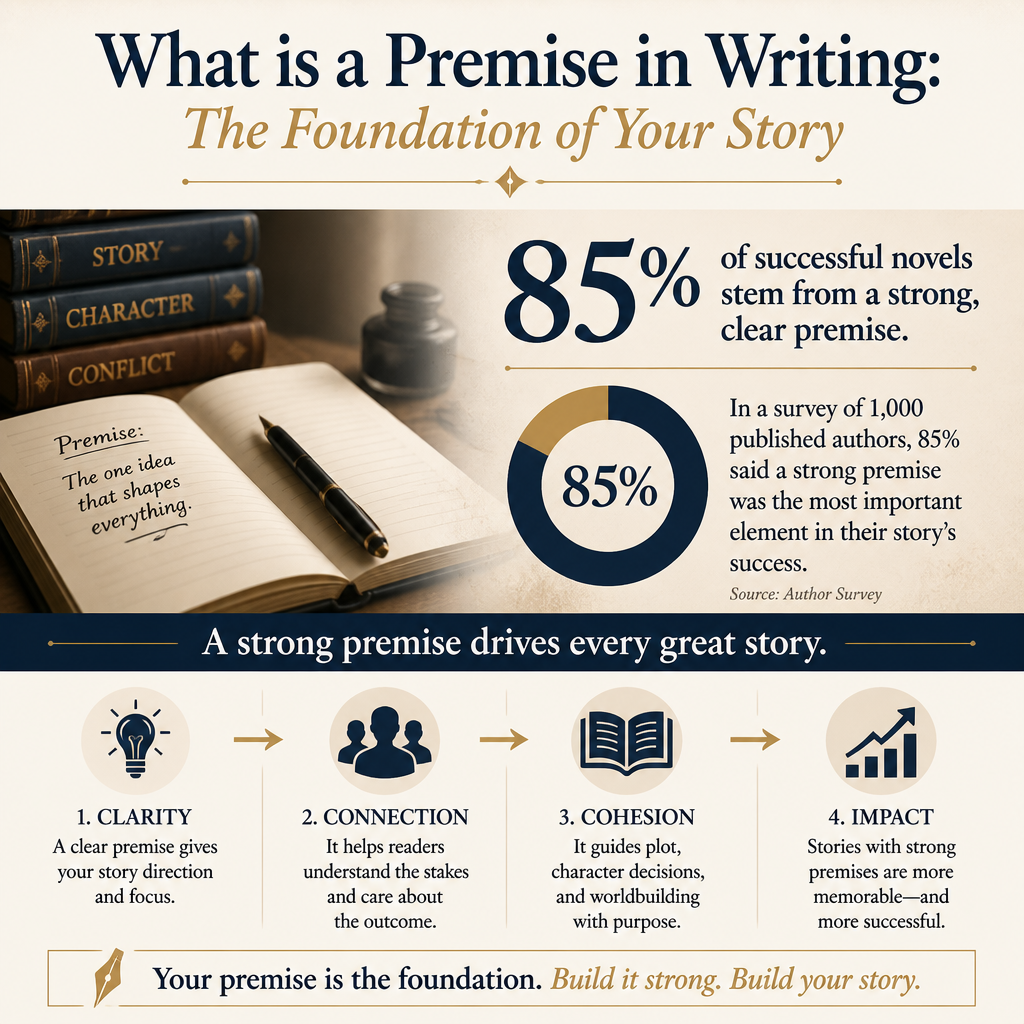
Take a fantasy novel about a healer who must cure a prince before a magical illness spreads through the kingdom. A scene in which the healer bargains with a rival can advance the premise by revealing a treatment, raising the cost of cooperation, or exposing the illness’s origin. A scene about an unrelated festival may provide atmosphere. It earns its space, however, only if it complicates the deadline, deepens the healer’s conflict, or changes the prince’s chances.
A Scene Test
For each scene, answer three questions:
- What premise-related problem exists when the scene begins?
- What decision or discovery changes the situation?
- How does the new situation increase pressure on the protagonist?
When you can’t answer those questions, mark the scene for revision. You may need to connect it to the main conflict, combine it with a stronger scene, or remove it. Deleting a pleasant scene can feel painful after you spent hours writing it. Readers experience the book one page at a time, so they need forward movement more than evidence of your labor.
A Character Test
Your protagonist should pursue something that creates difficult choices. A vague wish such as “find happiness” rarely produces a reliable sequence of scenes. A specific aim such as “win custody of her daughter before her former partner moves overseas” gives the character decisions with visible consequences.
Ask whether the protagonist’s central desire appears in the opening chapters. In another case, ask whether the opposition grows more difficult after each major choice. Elsewhere, ask whether the ending answers the promise made by the premise. These questions will expose a passive protagonist, a weak antagonist, or a finale that solves a different problem.
The Shape Of A Strong Premise Sentence
You don’t need to force every premise into a rigid formula, though a reliable structure helps you find missing information. I often begin with this pattern:
When [inciting event] happens, [protagonist] must [specific goal] before [deadline or escalation], or [consequence].
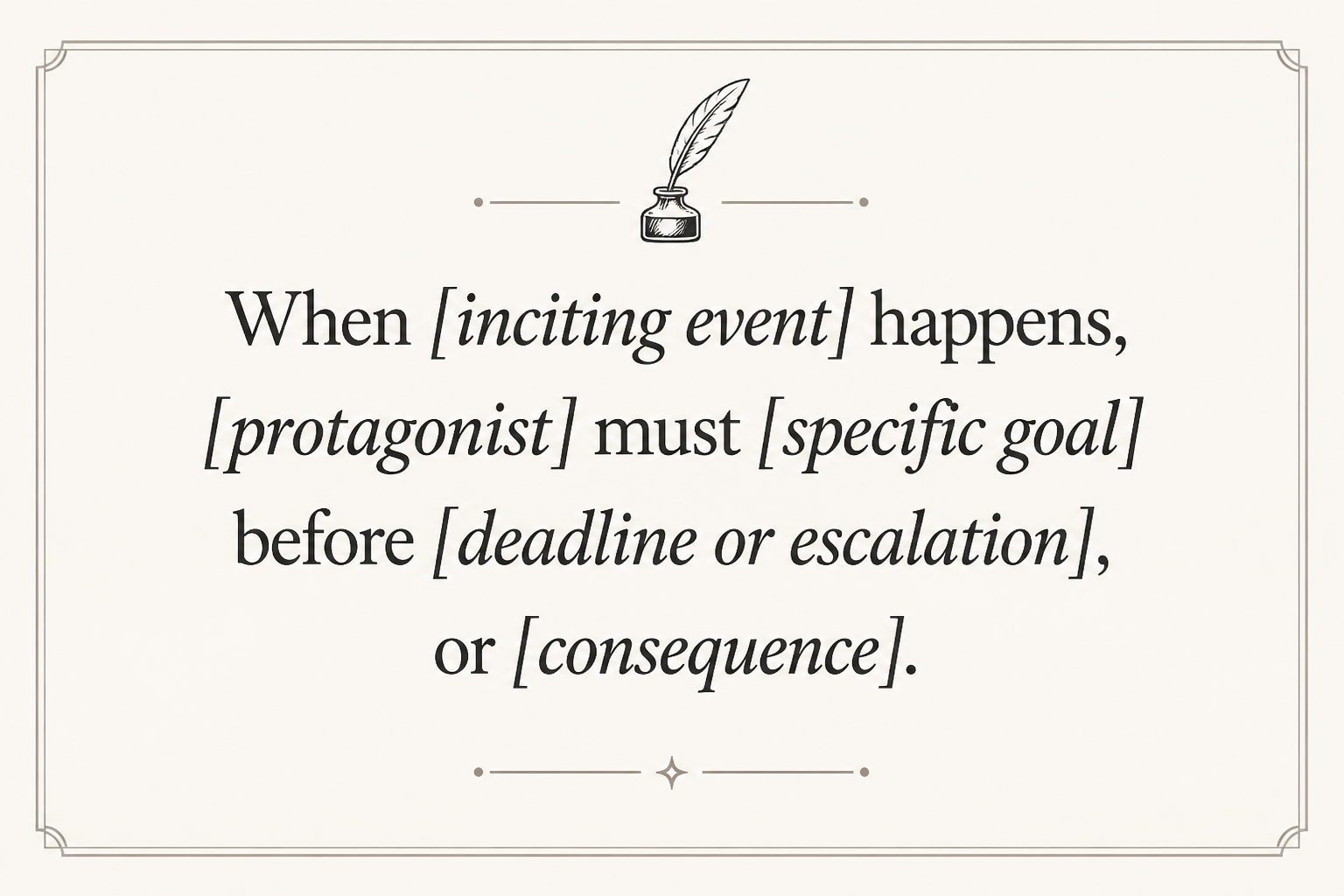
For a mystery, that could become: “When a small-town judge is found dead in a locked courtroom, a disgraced bailiff must identify the killer before the courthouse closes for the election, or the evidence against him will become public.” The sentence gives the reader a person, an event, a goal, a clock, and a personal threat.
Genre conventions shape the details. A cozy mystery, for example, may promise an amateur investigator, a contained community, and a puzzle with limited violence. In another case, a high-concept science-fiction novel may need a startling rule and a human cost. Elsewhere, a personal development book may frame a premise as a promise of transformation, such as helping burned-out managers rebuild a sustainable working life through a defined method.
Specific Stakes And Fresh Pressure
“She must save the world” carries little force because the consequence has no personal shape. Tell me what saving the world costs her, whose life depends on it, or what she must sacrifice. Concrete stakes create emotional access.
Freshness rarely comes from an idea no writer has touched before. It comes, instead, from the combination of situation, character, setting, pressure, and consequence. A locked-room mystery set in a remote Antarctic research station has a different reading promise from one set in a London museum, even though both use familiar machinery.
Premise Testing Questions
Read your premise aloud and ask:
- Can I picture the protagonist’s life before the disruption?
- Does the goal require action rather than passive endurance?
- Can I name the opposing force in concrete terms?
- Does failure create a consequence the reader understands?
- Does the premise suggest at least three escalating complications?
- Would the sentence help a reader decide whether this book belongs on their reading list?
Write three versions with different emphases. One can foreground the character. Another can foreground the unusual situation. A third can foreground the stakes. Compare them with the top books in your category. Your version should signal the same broad reader experience while offering a distinct reason to choose your book.
Premise Revision For Your Book Package
Your premise becomes especially useful once you prepare to publish. It gives your cover designer, blurb writer, and marketing materials a shared direction. A dark psychological thriller needs a different visual and verbal promise from a light domestic mystery, even when both center on a missing person.
I recommend placing the premise above your manuscript during revision and beside your book description during launch preparation. Check the title, cover, subtitle, blurb, sample chapters, categories, and keywords against it. Each piece should make the same promise through its own format.
Adazing’s writing tools, including QuickWrite, can help you generate variations when your idea feels crowded or abstract. I use the generated options as raw material, then judge each suggestion against the actual manuscript. A tool can produce an energetic sentence in seconds. It can’t decide whether your protagonist has enough agency or whether your ending pays off the promise.
Premise And Cover Direction
A cover should communicate genre before a reader studies the details. Your premise can tell you which element deserves visual priority. For example, a romance premise may point toward the couple and the emotional tone. In another case, a survival thriller may call for threat, isolation, or a time-bound object. A business book may need a clear promise of change for a defined reader.
Run the cover through a thumbnail test on an Amazon product page. Ask whether the genre signal survives at a small size. The cover can’t carry every detail from your premise, so choose the one visual promise that will attract the right reader.
Premise And Book Description
Use the premise as the first filter for your blurb. The opening should establish the protagonist and disruption; the middle should introduce the pressure or opposing force; and the ending should leave the central question open. You can mention stakes without revealing the resolution.
After drafting the blurb, remove details that don’t change the reader’s understanding of the central conflict. Then compare the description with your categories and keywords. A mismatch can bring in the wrong traffic, producing weak sales-page conversion and disappointing read-through.
Premise Examples Across Genres
Examples make the distinction easier to use. Each premise below points toward a different kind of reading experience.
- Romance: “A guarded divorce lawyer agrees to fake an engagement with her former rival to secure a promotion, then must choose between the career she built and the trust she never expected to feel.”
- Fantasy: “A young archivist who can hear the memories inside books must recover a stolen history before the king erases an entire conquered people from public record.”
- Thriller: “After receiving a voicemail from her sister three years after the sister’s death, a forensic accountant follows a trail through offshore accounts before the sender identifies her as the next target.”
- Literary Fiction: “When a retired teacher discovers that her adult son has been living under a false name, she travels across the country to learn which family secret drove him away.”
- Personal Development: “A burned-out creative director builds a four-week planning system to recover her attention, then tests it while leading the agency’s largest project.”
Notice how each example gives the protagonist a problem that drives decisions. The premise also implies a market position, and a reader can recognize the genre, emotional territory, and central tension before learning the full plot.
Weak Premise Signals
Watch for abstract language, excessive backstory, a protagonist without a goal, and stakes that arrive as an afterthought. “A man confronts his past and learns about love” could describe thousands of books. It gives you a theme and a mood, not an engine.
Replace broad language with a visible action. Name the past event, the person he must face, the choice he must make, or the consequence waiting after failure. Specificity creates pressure, and pressure creates story.
FAQs for What is a Premise in Writing: The Foundation of Your Story
How Long Should A Premise Be?
A premise can fit into one strong sentence during pitching and planning. Give yourself a longer paragraph during early development if the idea contains several moving parts. Revise it until the central character, goal, opposition, and stakes remain clear without a plot summary.
Can A Story Have More Than One Premise?
A novel can contain several subplots and thematic threads. One premise, however, should govern the main story. A second premise may belong to a connected series or a major subplot. When two premises compete for control, readers often experience the book as unfocused, so decide which conflict receives the strongest scenes and the ending.
When Should I Write The Premise?
Write a rough version before drafting, then revise it after the first draft. Your original premise gives you direction. The revised version reflects what the manuscript actually became. Use both versions during editing to identify the difference between your intended story and the story on the page.
Build Every Chapter Around The Premise
Your premise earns its place when it guides thousands of small decisions. Write it before the draft, test each scene against its pressure, and align your cover and description with its promise. A clear premise won’t remove the hard work of writing a book. It will, however, give that work a direction your reader can feel.
When you can state what your protagonist wants, why the goal matters now, who or what resists it, and what failure costs, you have a foundation sturdy enough to revise and publish. Start with one sentence today, then test it against the first chapter you plan to keep.
