
Writers eventually have to figure out “What is a plural possessive noun?” because one apostrophe can change who owns a manuscript, a deadline, or a character’s decision. The rule becomes manageable once you separate two questions: how many owners exist, and where the apostrophe belongs.
Plural possessive nouns show ownership or association involving more than one person, place, thing, or group. In a sentence about several editors, for example, you might write the editors’ notes. The notes belong to multiple editors, so the apostrophe follows the plural ending.
Grammar matters in your book at every level. A misplaced apostrophe can make a polished manuscript look careless. In another case, it can confuse a reader about who owns something. Elsewhere, it can change the meaning of a line of dialogue. I use a simple test during editing: identify the owner, count the owners, then check the noun’s final sound.
Table of Contents
Plural Possessive Noun Basics
A plural possessive noun names more than one owner and shows what those owners possess, control, create, or are connected to. The possessive relationship can involve a physical object, an idea, a decision, or a shared role.
Consider these examples:
- The authors’ contracts means the contracts belong to multiple authors.
- The characters’ secrets means several characters have secrets.
- The publishers’ guidelines mean that multiple publishers issued or own the guidelines.
- The readers’ questions means several readers asked the questions.
The plural possessive form usually comes from a regular plural noun ending in s. Add an apostrophe after the final s. Purdue OWL’s explanation of apostrophe use follows this same distinction between plural nouns and possessive nouns.
Ownership And Association
Possession doesn’t always mean physical ownership. For example, the detectives’ theory can describe a theory developed by several detectives. In another case, the novels’ themes describe the connected themes across several novels. Elsewhere, the chapters’ order describes the arrangement of multiple chapters.
Authors often encounter this form in editorial notes and publishing copy. You might write that the three beta readers’ comments revealed a pacing problem. Since the comments came from three readers, readers’ takes the plural possessive form.
Plural And Possessive As Separate Ideas
A plural noun shows there is more than one. A possessive noun shows a relationship between the noun and another word. Those jobs can appear together.
Authors means more than one author. Authors’ means something belongs to or relates to more than one author. The apostrophe carries the second meaning. The plural form alone doesn’t create it.
Compare these sentences:
- The editors reviewed the chapters. Editors and chapters are both plural.
- The editors’ comments changed the chapters. The comments belong to several editors.
- The editor’s comments changed the chapter. One editor owns or wrote the comments.
Read each sentence aloud and ask who supplied the comments. That question will often reveal the correct form before you consult a style guide.

Regular Plural Possessive Rules
Regular plural possessives follow a dependable pattern. First form the plural noun. Then place an apostrophe after the plural s. You don’t add another s after the apostrophe.
Here are common examples from a writer’s working life:
TABLE
The Final S Pattern
Start with the singular noun and make it plural before you add possession. For “reader,” you get “readers,” then “readers’“. For “reviewer,” you get “reviewer,” “reviewers,” then “reviewers’“.
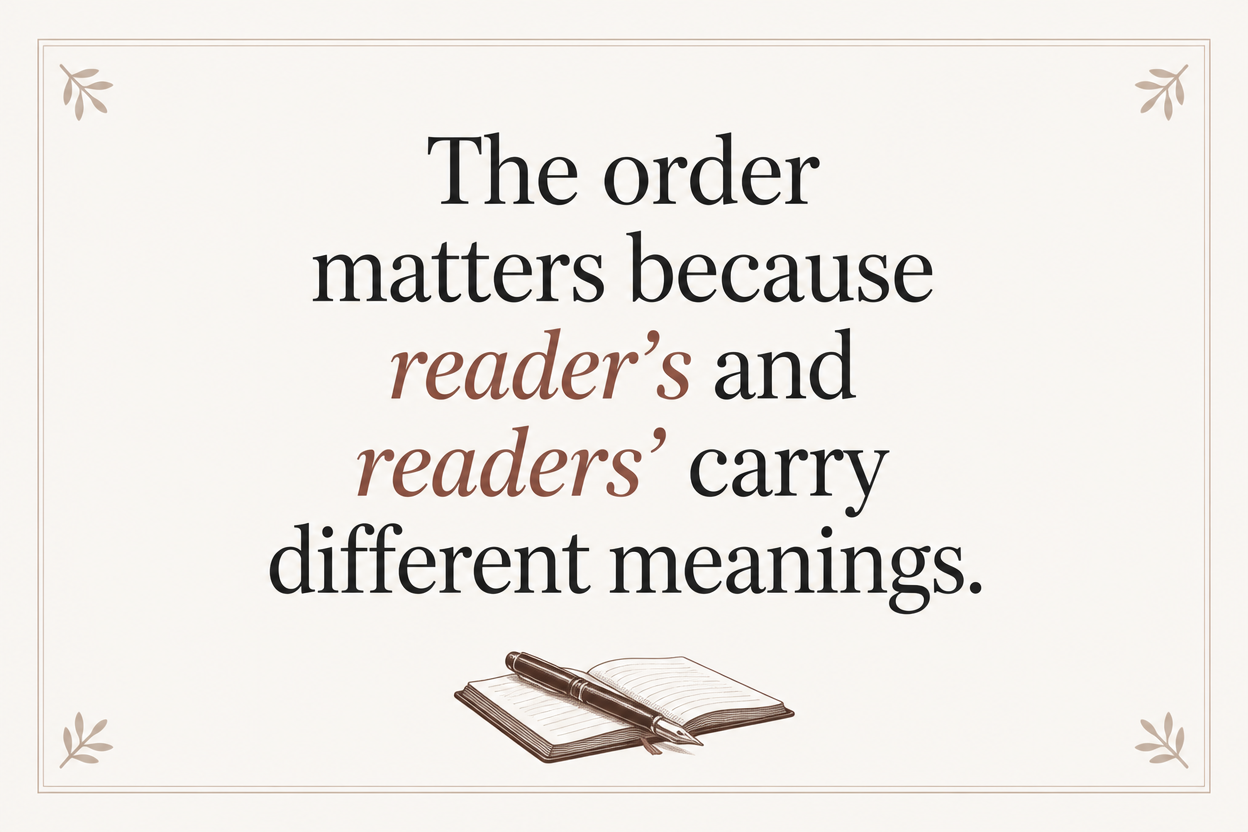
The order matters because “reader’s” and “readers'” carry different meanings. The first refers to one reader, and the second refers to several. A sentence such as The readers’ feedback shaped the second edition tells your audience that multiple people contributed feedback.
Shared And Separate Ownership
Two or more nouns can appear before one possessed noun. Your punctuation depends on whether the owners share the same thing.
For shared ownership, place the apostrophe after the final plural noun:
- Maya and Jordan’s writing group met on Tuesdays.
- The author and illustrator’s agreement covered the picture book.
These examples describe one writing group and one agreement shared by the named people. When each person owns a separate item, give each noun its own possessive form:
- Maya’s and Jordan’s manuscripts sat on different desks.
- The editor’s and illustrator’s invoices arrived together.
The distinction matters in contracts, acknowledgments, and credits. If each contributor receives a separate payment, the sentence should show separate ownership. Read the sentence for meaning before you place punctuation.
Irregular Plural Possessive Forms
Irregular plurals create the second major pattern. These nouns form plurals without ending in s, so you add apostrophe plus s to create the possessive.
- children becomes children’s.
- people becomes people’s.
- men becomes men’s.
- women becomes women’s.
- mice becomes mice’s.
Use children’s for something connected with multiple children: The children’s chapter books filled the display table. Use people’s for something connected with multiple people: The people’s testimony changed the trial. The apostrophe comes before the s because the plural form lacks a final s.
Words With Unusual Plurals
Some publishing terms can make this rule easy to miss. Person becomes people, so write people’s reading habits. Manuscript follows the regular pattern, so write manuscripts’ for several manuscripts.
Check the plural form before checking possession. Writers sometimes see a noun that refers to multiple people and automatically add an apostrophe after an imagined s. That approach produces forms such as childrens’, which has two errors. The correct form is children’s.
Singular Nouns Ending In S
A singular noun ending in s requires a separate decision. Many style guides accept James’s novel, and some styles permit James’ novel. The Chicago Manual of Style generally favors adding an apostrophe plus s to singular nouns, including proper names. House styles can still differ. The Chicago Manual of Style’s guidance on possessives confirms this general rule for singular nouns and names ending in s.
Plural possessives remain clearer when the plural already ends in s. Write the Jameses’ house for a house belonging to several members of the James family. Write the authors’ room for a room used by multiple authors.
Choose one style for singular names and apply it throughout your manuscript. Inconsistent treatment draws more attention than either of the accepted choices. If you’re preparing a book for publication, follow the style sheet from your editor, publisher, or intended market.
Plural Possessives In Manuscript Editing
Your manuscript offers dozens of chances to apply these rules in meaningful ways. Characters own objects, families share histories, and institutions issue policies. Correct punctuation keeps those relationships visible.
Take this sentence: The sisters diary contained three unsent letters. The sentence needs a possessive form. If one sister owns the diary, write The sister’s diary contained three unsent letters. If multiple sisters share it, write The sisters’ diary contained three unsent letters.
The grammar changes the story detail. One person’s private record comes through in a single diary. A shared diary suggests collaboration, conflict, or a family tradition. Apostrophe placement can carry narrative information, so treat it as part of your meaning rather than as surface cleanup.
Dialogue And Character Voice
Dialogue can contain possessives that reflect education, region, age, or deliberate informality. Preserve a character’s voice when the grammar is intentionally distinctive. Correct accidental errors in narration, exposition, chapter titles, and metadata.
Suppose a teenager says, The teachers lounge has the good coffee. In polished narration, write The teachers’ lounge had the good coffee if several teachers use it. In dialogue, you might retain the missing apostrophe if the omission serves a clear characterization purpose. I recommend making that choice deliberately, then applying the same logic to similar lines.
Titles, Captions, And Book Copy
Plural possessives appear in subtitles, back-cover copy, social posts, and advertising text. A phrase such as Readers’ Guide to Historical Fiction identifies a guide for multiple readers. A phrase such as Reader’s Guide usually suggests a guide for a single reader or a conventional name for a publication feature.
Run these short pieces through the same editorial check as your chapters. A polished cover can still lose credibility when a subtitle contains authors’ where author’s belongs, or the reverse. Adazing’s writing tools, including QuickWrite, can help you draft and revise copy. The final grammar decision should still be coming from the sentence’s intended meaning.
Editing Plural Possessives Step By Step
I edit possessives with a four-question check. It takes seconds once you practice, and it works across fiction, memoir, essays, and book marketing copy.
- Find the relationship. Ask what word describes the thing owned, created, controlled, or associated with the noun.
- Count the owners. Decide whether one person or multiple people have the relationship.
- Form the plural. Check whether the noun takes a regular plural ending in s or an irregular plural such as children.
- Place the apostrophe. Put it after the final s for a regular plural. Add apostrophe plus s for an irregular plural.
Apply the check to this sentence: The childrens books occupied the authors shelves. The first noun should be children’s if the books belong to or are intended for children. The second should be authors’ if several authors own the shelves. The edited sentence reads, The children’s books occupied the authors’ shelves.
A Quick Proofreading Pass
Use your word processor’s search function to find apostrophes. Review every match without automatically accepting the software’s suggestion. Grammar checkers can identify patterns. They cannot always tell whether one editor or several editors supplied a comment.
Search for common error forms such as childrens, childrens’, and author’s in passages that describe several authors. Then read the complete sentence aloud. The ear catches some meaning problems that a spelling checker misses.
A Style Sheet For Your Book
Record decisions that recur in your manuscript. Include treatment of singular names ending in s, family names, institutional names, and words that appear in headings or promotional copy. Your style sheet gives you a reference when you revise six months later or hand the manuscript to a proofreader.
Keep a second list for terms that your genre uses often. Historical fiction may contain family names and titles. Romance may use shared possessions in relationship scenes. Nonfiction may include organizations, agencies, and professional groups. A targeted list helps you review the words that carry the most meaning in your book.
FAQs for What Is a Plural Possessive Noun? Learn the Rules with Simple Examples
What Is The Difference Between Authors’ And Author’s?
Author’s shows possession by one author. Authors’ shows possession by multiple authors. Write the author’s contract for one contract held by one author, and the authors’ contracts for contracts held by several authors.
Do Plural Possessive Nouns Always End With An Apostrophe?
Regular plural possessives ending in s take an apostrophe after the s, as in editors’. Irregular plural possessives take an apostrophe plus s, as in children’s and people’s. The plural form determines the punctuation.
How Can I Check The Plural Possessive In My Manuscript?
Identify the owner, count the owners, form the plural, and place the apostrophe according to the plural ending. Read the whole sentence for meaning. A grammar tool can flag possible errors. Your judgment still decides whether the sentence refers to one owner, several owners, shared ownership, or separate ownership.
Clear Ownership Through Precise Punctuation
Plural possessives become straightforward when you separate number from ownership. Regular plurals ending in s take an apostrophe after the final letter. Irregular plurals take an apostrophe plus s. Shared and separate ownership require a close look at what the sentence means.
During your next proofread, search for every possessive in your manuscript and ask who owns the noun that follows it. That small editorial habit protects your meaning, sharpens your book copy, and gives readers one less reason to pause when they should be turning the page.
