
Writers might wonder, “What is a main verb?” when a sentence contains several verbs and only one verb carries the action or state. Find that verb, and you can usually diagnose a sentence that feels vague, overloaded, or grammatically unstable.
For a novelist, the main verb controls the movement of a scene. In nonfiction, it tells the reader what happened, what a person believes, or what an idea does. Weak main verbs force supporting words to carry the sentence, so your prose grows longer without becoming clearer.
I teach writers to locate the main verb before they cut adjectives, rearrange paragraphs, or polish punctuation. Once you can identify it, you can choose a stronger verb, control the sentence’s tense, and give each line a cleaner center of gravity.
Table of Contents
The Main Verb At The Center
A main verb expresses the primary action, occurrence, or state in a clause.
- In the sentence “Mara opened the manuscript,” “opened” is the main verb because it tells us what Mara did.
- She feels rather than acts in “Mara felt nervous,” where “felt” expresses her state.
A sentence may include a helping verb beside the main verb.
- In “Mara has opened the manuscript,” “has” helps establish the tense, and “opened” carries the main meaning.
- “Will” marks future time in “Mara will revise the chapter,” and “revise” remains the main verb.
The Purdue Online Writing Lab’s explanation of verb tenses shows why these combinations matter for writers. Auxiliary verbs can mark time, possibility, obligation, or completion. The main verb still tells the reader what the subject does or experiences.
Action, State, And Occurrence
Main verbs cover more ground than visible action.
- “Draft,” “whisper,” and “collapse” describe actions or events.
- States or conditions appear through verbs such as “believe,” “seem,” and “belong.”
- Occurrences arrive with “change,” “begin,” and “emerge.”
Consider these examples from a fictional scene:
- “The editor marked the opening pages.” The main verb is “marked.”
- “The opening pages were marked by the editor.” The main verb is “were marked,” a passive verb phrase.
- “The editor had been marking the pages for an hour.” The main verb is “marking,” supported by “had been.”
Read each sentence for its central meaning. Ask what the subject does, experiences, or is. The word or verb phrase that answers that question is usually your main verb.

Helping Verbs And Verb Phrases
Helping verbs, also called auxiliary verbs, work with a main verb to express tense, mood, voice, or aspect. Common primary auxiliaries include forms of “be,” “have,” and “do.” Modal auxiliaries include “can,” “could,” “may,” “might,” “must,” “shall,” “should,” “will,” and “would.”
- In “The protagonist is hiding,” “is” builds the progressive verb phrase, and “hiding” supplies its central action.
- A completed action appears in “The protagonist has hidden the letter,” where “has” marks the completion and “hidden” carries the meaning.
- Emphasis comes from “did” in “The protagonist did hide the letter,” and “hide” remains the main verb.
The Cambridge Dictionary guide to auxiliary verbs distinguishes helping verbs from lexical verbs by the work each one performs in a verb phrase. That distinction helps you edit with precision. Deleting every small verb can damage tense and meaning, so identify the main verb before you trim.
One Verb Phrase, One Main Verb
Writers sometimes count every verb in a phrase as a separate main verb. That creates confusion during revision. Treat the complete phrase as one unit when the verbs work together.
- In “The detective may have found the missing chapter,” “may have found” forms the verb phrase.
- “Found” is the main verb, and “may” plus “have” support it.
- The sentence says the detective possibly found the chapter, so removing “may” changes the writer’s level of certainty.
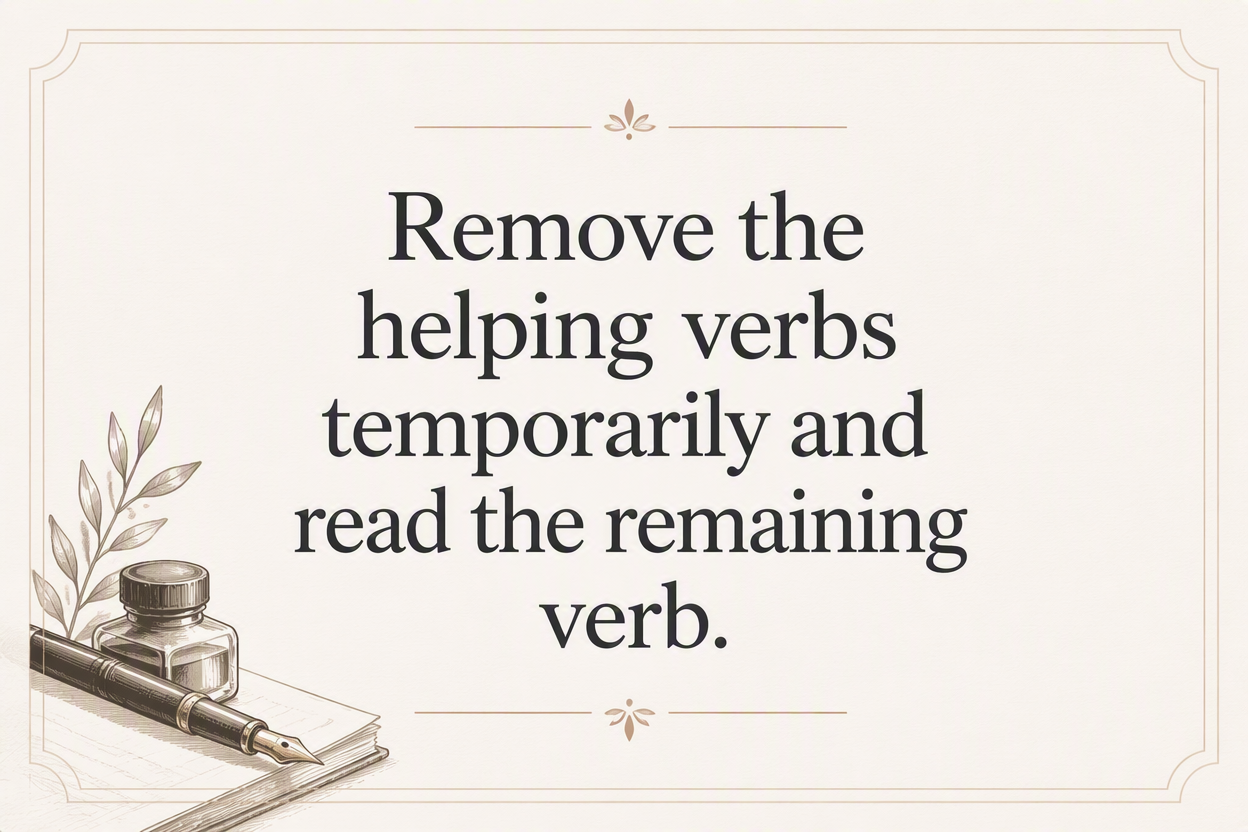
I use a simple test during line editing. Temporarily remove the helping verbs and read the remaining verb. If the sentence leaves you with “found,” “finished,” or “will revise,” you can see which word carries the main action and which words shape its time or mood.
Linking Verbs And Subject Complements
Linking verbs connect the subject to a word or phrase that describes or renames it.
- In “The first chapter is tense,” “is” links “chapter” to the adjective “tense.” A subject gets renamed in “The narrator became a suspect,” where “became” links “narrator” to “suspect.”
Forms of “be” can function as main verbs or helping verbs.
- In “The manuscript is ready,” “is” stands alone as the main verb. The word takes a supporting role in “The manuscript is waiting on the editor,” where it helps the main verb “waiting.”
That distinction matters in your fiction. A linking verb can state a condition cleanly. A scene may still gain force from a specific action.
- Compare “The room was silent” with “The room swallowed every sound.”
- The first sentence reports a condition.
- The second gives the setting an active role.
- Choose according to the moment and the book’s voice.
Main Verbs In Author Sentences
Grammar becomes useful when it changes the page. A sentence with a buried main verb often arrives through abstract nouns, passive constructions, or a weak verb such as “made,” “had,” or “was.” Those verbs can be perfectly correct. The problem begins when they hide the event your reader needs to see.
Compare “The discovery of the missing file was a cause of concern for the publisher” with “The publisher worried when the file disappeared.” The second sentence places the main verb, “worried,” close to the subject and gives the reader a visible event, “disappeared.” It also removes several layers of abstraction.
Verb Choice In Fiction
Fiction depends on verbs that carry character, pressure, and consequence.
- “She went across the room” gives you a basic movement.
- “She crossed the room” gives you a tighter sentence.
- “She stalked across the room” adds attitude and pace.
Each main verb creates a different reading experience.
Strong verbs still require judgment. A page filled with theatrical verbs can sound as artificial as a page filled with “was.” I recommend choosing the plainest verb that captures the exact action, then reserving a more vivid choice for moments that deserve emphasis.
During revision, circle the main verb in every sentence of a tense scene. Mark repeated verbs such as “looked,” “went,” “got,” and “felt.” Replace only the repetitions that flatten the scene. A character who always glared soon becomes a grammar exercise with a face.
Verb Choice In Nonfiction
In a craft book, memoir, or business manuscript, your main verbs tell readers how to interpret your claims.
- “The method provides an improvement in drafting speed” buries the point.
- “The method speeds up drafting” makes a direct claim a reader can check.
Strong nonfiction verbs also reduce the distance between you and your reader.
- “You can identify the main verb by scanning the clause” tells the reader what to do.
- “Identification of the main verb can be accomplished through clause analysis” sounds like a committee wrote it during a lunch break.
Read your nonfiction aloud after circling the main verbs. Listen for sentences whose main verbs arrive late, carry little meaning, or depend on a chain of nouns. Revise those lines first. You will often improve clarity without changing the idea.
Finite And Nonfinite Main Verbs
Advanced grammar adds a useful distinction. A finite verb carries tense or agrees with the subject.
- In “The author revises every morning,” “revises” is finite because it marks the present tense and agrees with the singular subject. The form shifts in “The authors revise every morning,” where “revise” matches the plural subject.
Nonfinite verb forms include infinitives, participles, and gerunds. They can contribute meaning inside a larger clause without carrying the clause’s tense on their own.
- In “To revise the ending takes courage,” “to revise” functions as the subject, and “takes” is the finite main verb.
- In “Revising the ending took courage,” “revising” functions as a gerund phrase, and “took” signals past tense.
- In “The author revised the ending to sharpen the final scene,” “revised” is the finite main verb, and “to sharpen” explains purpose.
Participles Inside A Clause
Participles often appear beside helping verbs or as modifiers.
- In “The editor was reading the proposal,” “was reading” forms the main verb phrase.
- In “Reading the proposal, the editor frowned,” “reading” begins a participial phrase, and “frowned” is the finite main verb.
Keep an eye on participial phrases at the beginning of your sentences. The phrase must logically modify the subject that follows it. “Reading the proposal, the deadline approached” turns the deadline into the reader. Your reader may understand your intention. The grammar still creates a distracting image.
Revise the line as “Reading the proposal, the editor watched the deadline approach.” The main verb is “watched,” and the sentence assigns the reading action to the editor.
Commands And Hidden Subjects
Imperative sentences give commands, so the subject “you” is understood.
- In “Revise the opening paragraph,” “revise” is the main verb, and the hidden subject is “you.”
- In “Cut the final sentence,” “cut” carries the command.
This form works well in author instructions, revision checklists, and direct marketing copy. Use it with care in a book’s narrative voice, since a string of commands can make the prose sound instructional even when the scene calls for intimacy.
A Revision Method For Main Verbs
I recommend a four-pass check when a sentence feels muddy.
- First, identify the subject.
- Second, circle the main verb or complete main verb phrase.
- Third, ask whether that verb expresses the event or idea you want the reader to receive.
- Fourth, replace or reposition the verb when the sentence hides its point.
Take the sentence “There was a sudden realization among the launch team that the cover lacked contrast.”
- The grammatical main verb is “was.”
- The meaningful event sits in “realization.”
- Rewrite it as “The launch team realized that the cover lacked contrast.”
- The new main verb, “realized,” gives the sentence a subject who acts and an idea that follows.
The Subject-Verb Test
Find the subject and ask what it does.
- In “The stack of rejected titles sat beside the keyboard,” the subject is “stack,” and the main verb is “sat.”
- The phrase “of rejected titles” adds information without changing the subject.
Writers often match the verb to a nearby noun.
- “The list of revisions were confusing” sounds plausible because “revisions” sits near the verb.
- The subject is “list,” so the sentence needs “The list of revisions was confusing.”
Read past prepositional phrases before you choose the verb form.
The Main-Verb Audit
Use this short audit on a paragraph from your manuscript:
- Underline every verb or verb phrase.
- Circle the main verb in each independent clause.
- Mark sentences whose main verbs are vague, buried, or repeated.
- Revise the three weakest sentences, then read the paragraph aloud.
Adazing’s writing tools, including QuickWrite, can help you generate alternate phrasing when a sentence keeps resisting revision. I still recommend making the final choice yourself. A tool can produce ten verbs in seconds. Only you know whether your character walks, drifts, marches, or retreats from the room.
FAQs for What Is a Main Verb? The Key to Clear and Effective Writing
What Is The Main Verb In A Sentence?
The main verb expresses the central action, event, or state in a clause.
- In “The author revised the chapter,” “revised” is the main verb.
- In “The author has revised the chapter,” “has revised” is the complete verb phrase, and “revised” carries the core meaning.
Can A Sentence Have Two Main Verbs?
A sentence can have two main verbs when it contains two independent clauses or a compound predicate.
- In “The author revised the chapter and submitted it,” “revised” and “submitted” are main verbs in a single compound predicate.
- In “The author revised the chapter, and the editor approved it,” each clause has its own main verb.
How Do Main Verbs Improve A Manuscript?
Main verbs give sentences movement and precision. They help readers identify who acts, what happens, and when the event occurs. Circle the main verbs in a difficult paragraph, then replace vague choices or move buried verbs closer to their subjects.
Put The Main Verb To Work
Your main verb carries the sentence’s central meaning, so give it the attention you already give character, scene, and structure. Find it, test it, and choose a verb that matches the action or state you want your reader to see.
During your next manuscript pass, audit one page rather than attempting the entire book at once. Stronger verbs will not solve every prose problem. They will still reveal where the real problems are, which gives you a cleaner revision path.
