
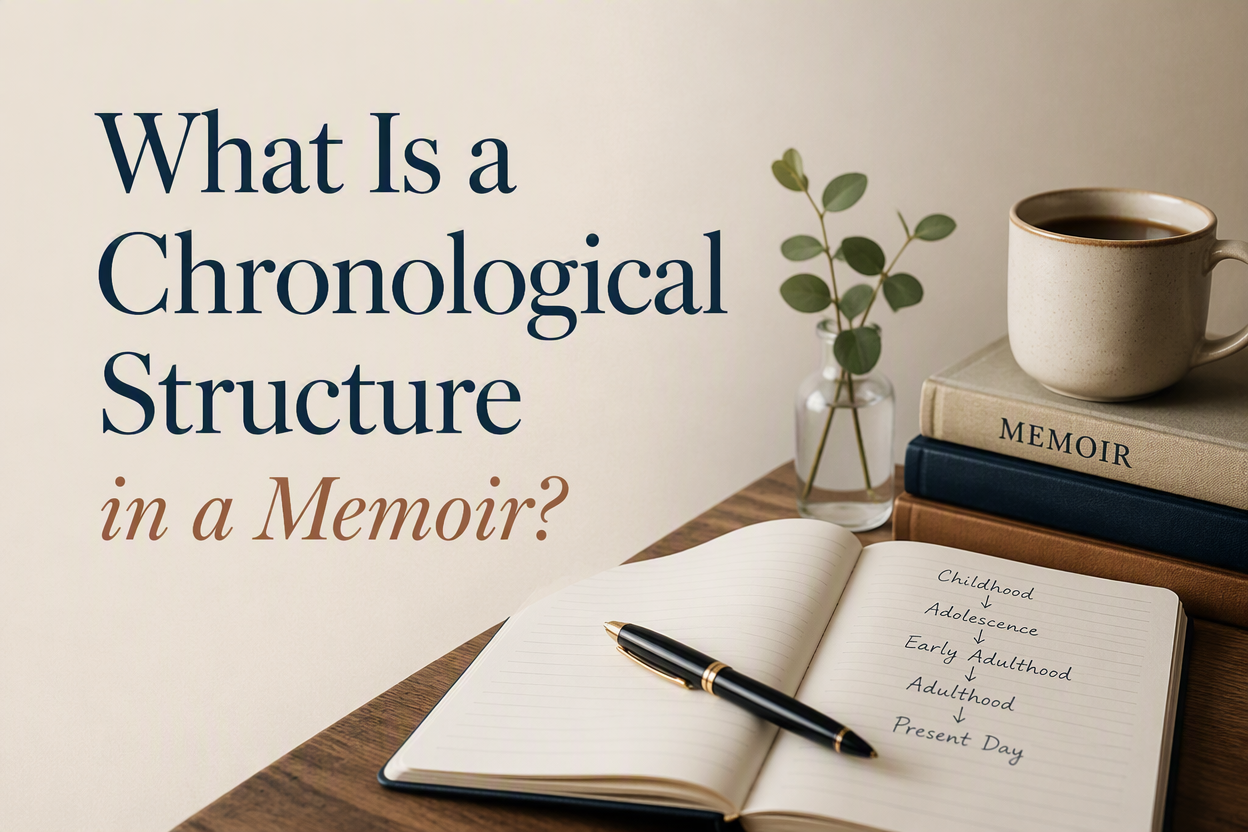
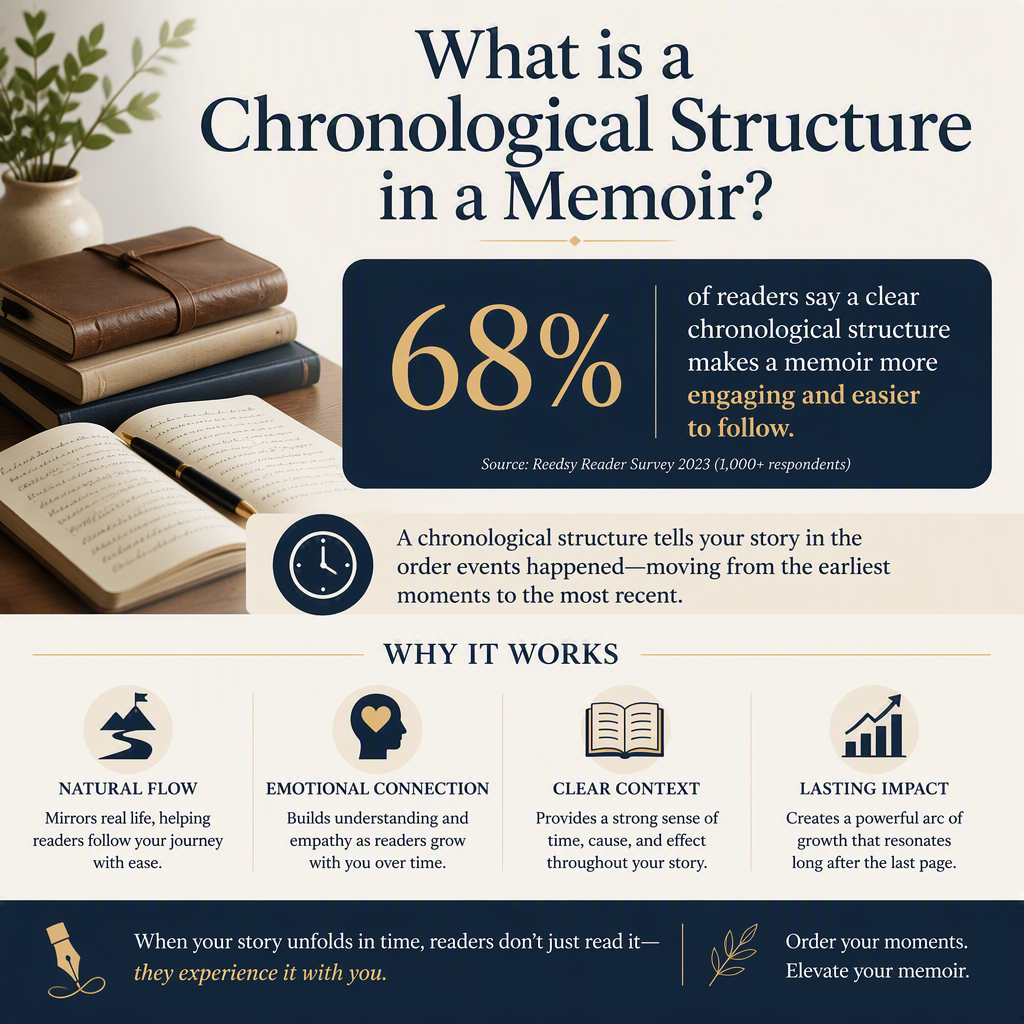
A memoir gains force from the order in which you reveal experience. Before you outline, it helps to answer the question, “What is a chronological structure in a memoir?” The short answer is a clear path through time: you begin with an earlier condition, move through the events that changed it, and arrive at a later understanding. That shape sounds simple. The craft lies in deciding which moments deserve space, where reflection belongs, and how to keep a life story from reading like a calendar.
Chronology works especially well when change is the heart of the book. Your reader can see who you were, what happened, how you responded, and what those events mean to you now. A strict timeline rarely produces the strongest memoir on its own. You need selection, pacing, tension, and reflection to turn a sequence of memories into a shaped narrative.
I recommend chronological structure for memoirists who want the reader to experience development through cause and effect. Begin with the earliest event the reader needs, move through the pressure points, and allow the meaning to gather as the story progresses. The order should serve the emotional journey rather than reproduce the sequence in which you happened to remember everything.
Table of Contents
Chronological Structure In Memoir
A chronological memoir presents events in time order. The narrative may begin with childhood, continue through adolescence and adulthood, and end at a meaningful point in the present. It can cover an entire life, though many successful memoirs focus on a defined season, relationship, crisis, journey, or transformation.
The structure gives your reader a stable sense of direction. Each chapter answers part of the question created by the previous chapter. For example, a move to a new city leads to a friendship that ends in betrayal, and that betrayal changes the narrator’s understanding of family. The reader keeps moving because each event alters what comes next.
Time Order And Story Order
Your life contains thousands of events. A memoir contains the small number that build a readable story. Chronological structure determines the order of those chosen events without requiring every breakfast, job, argument, or holiday that occurred between them.
Think of chronology as the road beneath the narrative. You can slow down at a turning point, pass over several uneventful months, or pause in the present to reflect on an earlier scene. The road remains clear because the reader understands where the story sits in time.
The Beginning Of A Chronological Memoir
The first chapter should begin at the earliest point that creates meaningful pressure. For example, that might be the day your mother left, the summer you discovered a family secret, or the morning you received a diagnosis. It might also be an ordinary scene that contains the first sign of a larger problem.
Birth is rarely the best opening unless birth itself creates the central conflict. Start where the memoir’s governing question begins. In a memoir about addiction, the opening may fall on the first drink, the first lie, or the moment the narrator recognizes the cost of continuing. An immigration story might open with the departure from home or with the child’s first day in a school where nobody shares their language.
Reasons Chronology Works For Memoir
Chronology makes transformation visible. Readers don’t need you to announce that you changed when they can watch the change happen across scenes. Early choices gain meaning from later consequences, and small details introduced near the beginning can gain weight as the memoir progresses.
The structure also helps you manage reader trust. Memoir asks readers to follow real experiences shaped through memory. A clear timeline gives them confidence that they understand the sequence of events, even when the narrator’s interpretation grows more complicated. That clarity matters when the subject includes trauma, family conflict, illness, or public events that other people may remember differently.
Cause And Consequence
A chronological structure lets you build consequences with patience. For example, suppose your memoir follows the collapse of a marriage. You can show the repeated absences, the conversations postponed, the financial strain, and the private story each spouse tells themselves before the separation occurs. The final rupture carries more weight because the reader has seen its pressure accumulate.
Use this structure to plant details early. In one memoir, a dismissive comment from a father may seem minor in chapter two. After years of similar comments, the detail becomes evidence of a pattern. Your reader experiences recognition at the same time the narrator does, or understands why the narrator remained confused for so long.
Reader Orientation
Readers can follow a long memoir more easily when you provide time markers. Chapter titles, ages, locations, seasons, school years, and changes in work can all orient the audience. Use these details with restraint. A date at the top of every scene can make the book feel like a case file.
Anchor time through lived details. Your narrator’s age, a sibling’s height, a new apartment, a particular job, or a song playing on the radio can establish a period without stopping the scene for explanation. During revision, check every chapter for the reader’s basic questions: When are we? Where are we? What has changed since the previous scene?
Building The Timeline Before Drafting
I recommend creating a private timeline before you draft the manuscript. This document can contain far more information than the book will use. Its job is to give you command of the material, expose gaps, and prevent accidental reversals in age, season, location, or relationship history.
Create one line for every event you remember. Add the date or approximate period, your age, the location, the people present, what happened, and why the event matters. Mark uncertain details with a question mark. Memory often supplies emotional truth before it supplies an exact date, so record uncertainty rather than inventing precision.
Sorting Scenes By Function
After you list the events, label each possible scene according to its function. A scene may introduce a desire, reveal a pattern, create a setback, change a relationship, supply necessary context, or force a decision. If an event performs no useful function, it probably belongs in your research file rather than your manuscript.
Pay special attention to repeated experiences. Three similar arguments rarely need three full scenes. Choose the argument that contains the clearest action and consequence, then summarize the pattern around it. Readers understand repetition through selected evidence. They don’t need an inventory.
Choosing The End Point
A chronological memoir needs a deliberate stopping place. For example, the end may arrive when you leave home, finish treatment, publish an investigation, reconcile with a sibling, or understand an inheritance. It doesn’t need to resolve every part of your life. It needs to complete the narrative question established at the beginning.
Consider a memoir about caring for a parent. It could end at the funeral, though the stronger ending may come months later when the narrator returns to the parent’s empty kitchen and makes a decision about the house. The later scene gives the book a final movement. It shows what the earlier experience changed.
Handling Reflection And Memory
Chronological memoir needs two time periods working together. The first is the time of the events. The second is the present-day mind that makes sense of them. Your younger self may misunderstand what is happening. Your present self can supply context, questions, and earned insight.
Reflection works best when it grows from a specific scene. For example, after describing the night your brother disappeared, you might explain what you believed at the time and what you understand now. Keep the reflection connected to the action. A page of general wisdom after every scene will slow the narrative and make the narrator sound like a lecturer.
Present Knowledge In Past Scenes
Decide how much the narrator knows at each moment. If you reveal the full meaning of an event before the scene unfolds, you may reduce suspense. If you conceal information the present-day narrator plainly understands, you may frustrate the reader. Both choices can work when used deliberately.
A useful test asks whether the reflection changes the reader’s interpretation of the scene. If it does, keep it. If it merely repeats the emotion already visible in the action, cut it or compress it. Your goal is a conversation between experience and present understanding.
Gaps, Compression, And Recollection
Every memoir contains gaps. You may remember one afternoon in vivid detail and have only a vague sense of the year around it. You can move across that gap with a sentence of summary, then slow down when the next meaningful scene begins.
Compression gives the book proportion. For example, a six-month period of routine may take one paragraph. A ten-minute confrontation can run to eight pages because every gesture, pause, and decision changes the relationship. Time in a memoir follows narrative importance, even when the broad sequence remains chronological.
Handle uncertain memory with honesty. Say that you remember the room as blue if the color remains uncertain. Reconstruct dialogue from reliable memory and mark the emotional truth through action rather than presenting invented wording as a recording. Your credibility depends on the reader trusting your handling of uncertainty.
Revising A Chronological Memoir
The first timeline you create will probably contain delays, missing bridges, and scenes that belong to a different book. Revision turns chronological order into narrative shape. I start by reading the manuscript for movement rather than sentences. I write the central change in one sentence, then mark where each chapter advances, complicates, or stalls that change.
Read the chapter endings closely. A chronological memoir can become passive when each chapter ends because the calendar has reached a new month. End on a decision, discovery, loss, question, or changed relationship. The next chapter should carry the consequence of that moment.
Checking Pacing Across Years
Look at the amount of space you give each period of your life. For example, ten years of childhood may occupy three chapters because those years establish the family pattern. A single week can take half the book when it contains the crisis. Uneven coverage is acceptable when the emotional pressure justifies it.
Watch for explanatory stretches that report what happened without dramatizing a meaningful moment. Replace selected summaries with scenes in which the reader has to witness a choice. Keep summary for transitions, repeated patterns, and information that supports a scene without competing with it.
Testing The Timeline
Build a second document that lists every chapter and scene in order. Record the date, the narrator’s age, the location, the characters, and the consequence. Compare it with your source material, journals, emails, photographs, calendars, and public records. Those documents can correct factual errors. What they cannot do is replace the work of shaping memory into narrative.
Ask a trusted beta reader to identify any moment of confusion. Don’t defend the manuscript immediately. Mark the place, then decide whether you need a clearer time marker, a stronger transition, or a reordered paragraph. A reader’s confusion often reveals a missing bridge that looked obvious to you because you lived the story.
Once the structure works, revise the language at scene level. Adazing’s writing tools, including QuickWrite, can help you generate prompts when a transition feels thin, or a scene lacks sensory detail. I use tools like that to open possibilities, then I choose the material that sounds like my narrator’s voice. Software can suggest a doorway into a memory. You still decide whether the scene earns its place.
FAQs for What is a Chronological Structure in a Memoir?
Does a Chronological Memoir Need to Begin with Childhood?
No. Begin with the earliest event that creates the memoir’s central pressure. Childhood works when it establishes the conflict or desire your book follows. A later opening may create stronger tension and make room to bring earlier history into the narrative when the reader needs it.
Can I Include Flashbacks In A Chronological Memoir?
Yes. A brief flashback can clarify a relationship, explain a fear, or deepen a present scene. Keep the return to the main timeline clear through transitions and time markers. Too many jumps can weaken the forward movement that makes chronology useful.
How Do I Keep A Timeline From Becoming Boring?
Choose scenes around change, conflict, desire, and consequence. Compress routine periods and slow down at decisions that alter the narrator’s life. A timeline becomes dull when it records everything at the same speed. Your pacing should follow emotional and narrative pressure.
Let Chronology Carry The Change
A chronological memoir offers a reliable structure for showing transformation. You choose the beginning, select the scenes that create pressure, and end when the book’s governing question reaches a meaningful point. Reflection then connects the person who lived the events with the person who understands them now.
Build the timeline first, draft with purposeful gaps, and revise every chapter for consequence. Your reader doesn’t need a complete record of your life. Your reader needs a shaped experience in which every event alters the meaning of the next.
