
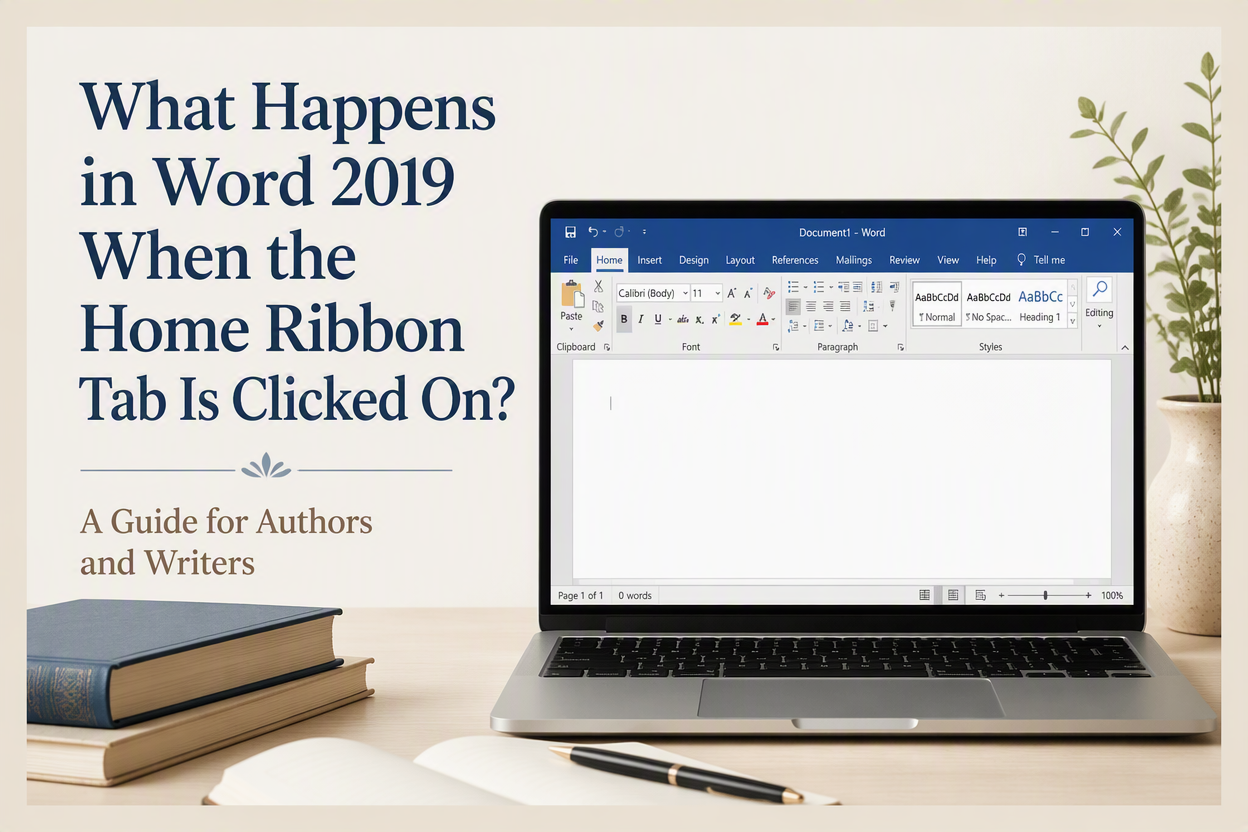
Authors often ask what happens in Word 2019 when the Home Ribbon Tab is Clicked On, because the answer affects nearly every task involved in preparing a manuscript. Word activates the Home tab and displays the commands you use most often for editing, formatting, applying styles, and searching through a document.
For a writer, the Home tab is the working desk of Word 2019. You can change a typeface, fix a paragraph, copy a passage, apply a chapter heading, or replace a repeated spelling mistake from this one area. The notable distinction is that clicking Home changes the commands visible on the Ribbon without changing your manuscript.
I recommend learning the Home tab through its command groups rather than memorizing every button. Once you understand what each group controls, you can format a chapter cleanly and return to writing without hunting through menus.
Table of Contents
The Commands Displayed On The Home Tab
When you click Home, Word 2019 activates the Home Ribbon tab across the top of the window. The Ribbon then displays several groups arranged from left to right: Clipboard, Font, Paragraph, Styles, and Editing. Depending on your window size, some commands may collapse into smaller icons or menus.
The Clipboard group contains Cut, Copy, Paste, and Format Painter.
- Cut removes selected text and places it on the Clipboard.
- Copy places a duplicate there.
- Paste inserts the stored material at your cursor.
- Format Painter copies visual formatting from one passage to another, which helps when two chapter headings need the same appearance.
Character-level formatting lives in the Font group. You can choose a font family, adjust size, apply bold or italics, underline text, change font color, add highlighting, and open the Font dialog box for more settings. The options affect selected characters or the words you type after placing the cursor at a particular location.
The Paragraph group controls the shape and position of a block of text. Its commands include alignment, line and paragraph spacing, indentation, bullets, numbering, borders, shading, and sorting. This group matters when you are cleaning a manuscript because inconsistent paragraph settings often create stray gaps, uneven indents, and awkward page breaks.
Built-in styles such as Normal, No Spacing, Title, Subtitle, Heading 1, and Heading 2 sit in the Styles group. Styles apply a coordinated set of formatting instructions to selected text. Microsoft describes styles in Word as reusable formatting combinations, which explains why they are more reliable than manually changing every heading one at a time.
The Editing group gives you Find, Replace, and Select.
- Find locates a word or phrase.
- Replace changes one occurrence or every matching occurrence, depending on the option you choose.
- Select helps you highlight text by rule, such as selecting all text with similar formatting.
The Ribbon Responds To Your Window Size
Word 2019 may show a full command label on a wide monitor and a compressed icon on a narrow laptop display. The function remains available even when the visual layout changes. Hover over an icon to see its name, then click the small launcher arrow in the group for advanced settings.
Microsoft’s documentation on the Office Ribbon explains that tabs organize commands by task. That design means the Home tab gathers everyday editing tools. Insert, Layout, References, and Review hold commands for different stages of document preparation.
The Difference Between Editing And Formatting
Clicking Home gives you access to both editing and formatting, and each one answers a different manuscript problem. Editing changes the words or their order. Formatting changes how readers see those words on the page.
Suppose you find the sentence “The door opened slowly” repeated twice in a chapter. You can use Find to locate each occurrence, then select one sentence and revise it. That work changes the manuscript’s content. In contrast, applying italics to a character’s private thought changes the presentation of content.
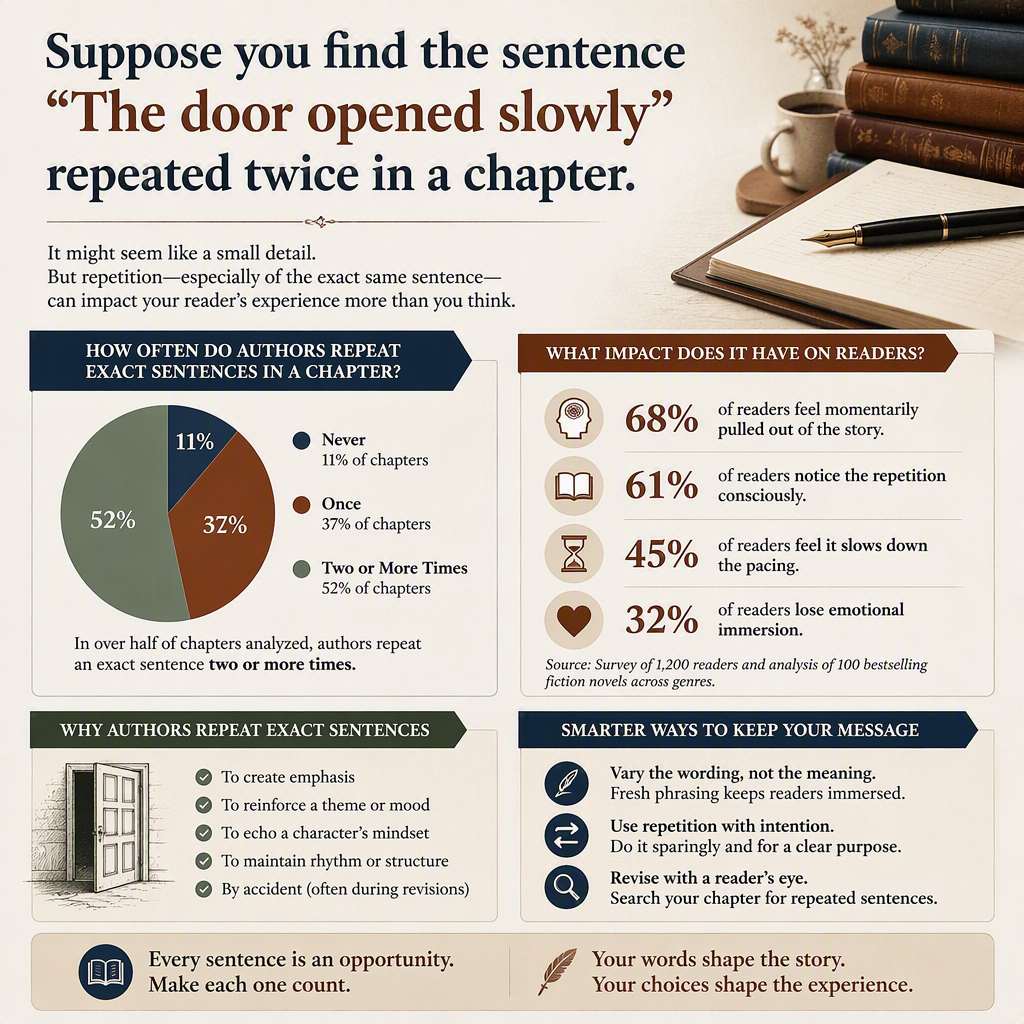
I handle those jobs separately during a revision pass. First, I read for meaning, continuity, pacing, and repetition. After the prose has settled, I use Home tab commands to clean headings, dialogue formatting, paragraph spacing, and emphasis. Mixing both kinds of work can pull your attention away from the scene you are trying to judge.
Clipboard Tools For Moving Manuscript Pages
Cut and paste help when a scene belongs earlier or later in a chapter. Select the complete scene, including its heading and paragraph breaks, then cut it. Place the cursor at the destination and paste. Read the surrounding pages afterward because moving material can leave duplicated transitions, missing references, or a chapter opening that no longer makes sense.
Format Painter has a narrower purpose. Select a correctly formatted heading, click Format Painter, and select another heading that needs the same treatment. Double-click Format Painter to apply the formatting repeatedly. Press Esc at the end of the pass to switch the tool off.
Find And Replace For Repeated Corrections
Find and Replace can save hours on a long novel. You can search for a character’s former name, an inconsistent spelling, or two spaces after a period. Use the expanded options to match capitalization, whole words, or specific formatting.
Read through the results before choosing Replace All. A character’s name may appear on the copyright page, inside a dedication, or within a discussion of an earlier draft. Word will follow your instruction literally, without any understanding of plot, irony, or the difference between a fictional name and a real historical reference.
The Home Tab For Manuscript Structure
The Styles group deserves special attention because it builds a reusable structure into your manuscript. A chapter title, a scene heading, and ordinary body text each need a defined treatment. Applying a style to each of these elements lets you revise the design globally later.
For a typical novel, I would start with Normal for body text, Heading 1 for chapter titles, and Heading 2 for internal section headings. A memoir or nonfiction book may need additional levels for parts, chapters, sidebars, exercises, and subheads. Keep the hierarchy simple enough that a reader can understand it at a glance.
Click a paragraph, choose a style from the Styles group, and then modify the style once you want a different font, size, spacing, or alignment. Word applies the updated definition wherever that style appears. This approach is particularly helpful when your manuscript will later appear as an ebook, paperback, or hardcover edition with different interior specifications.
Manual formatting still has a place. You may italicize a single foreign word, bold a temporary revision note, or change a phrase for a design proof. Styles handle recurring structures. Isolated details call for direct formatting.
Heading Styles And Navigation
Heading styles also support document navigation. Once you apply Heading 1 to chapter titles, Word can recognize those titles as navigational elements. You can use the Navigation Pane to move through a lengthy manuscript, which is much faster than dragging a scrollbar through 90,000 words.
That structure also helps when you create a table of contents. Word builds the table from heading levels, so a document with consistent Heading 1 and Heading 2 use requires less manual correction during production.
Before you send a manuscript to an editor or formatter, click through several chapter openings and confirm that each heading uses the same style. One manually enlarged paragraph can look harmless on screen and create a visible inconsistency in the finished book.
The Home Tab For Paragraph Control
Paragraph commands shape the reading experience at the sentence and page level. Alignment, indentation, spacing, lists, and line breaks determine whether your manuscript looks deliberate or improvised.
Fiction manuscripts usually use left alignment, first-line indents, and consistent double spacing for editorial review. A printed book may use justified alignment, smaller line spacing, and different paragraph indents. Your production format determines the final choices, so avoid treating the editing manuscript and the published interior as identical documents.
Use the paragraph dialog launcher for exact settings. There you can control before-and-after spacing, line spacing, indentation, pagination, and options such as keeping a heading with the following paragraph. Precise settings are safer than tapping Enter repeatedly to create visual gaps.
Extra paragraph marks cause trouble during book production. They can create blank pages, separate a heading from its text, and produce uneven spacing after conversion. Turn on the Show or Hide formatting marks button in the Paragraph group when the document behaves strangely. The marks reveal paragraph breaks, tabs, spaces, and manual page breaks that ordinary screen view hides.
Lists, Indents, And Dialogue
For nonfiction, the Paragraph group makes numbered procedures and bulleted lists readable. Apply a list command, then check the indentation level and spacing. A list that sits too close to the paragraph above can look like a formatting error even when every word is correct.
Dialogue requires a different kind of attention. Each new speaker generally receives a new paragraph, and the paragraph indentation should remain consistent throughout the scene. Home tab controls can repair a messy dialogue passage. The Ribbon cannot tell you who should speak next or whether the exchange has enough tension.
A Reliable Home Tab Workflow
Clicking Home gives you tools. A reliable workflow determines whether those tools help or scatter your attention. I use a short sequence whenever I prepare a chapter for review.
First, save a new version of the document. A file named Novel_Chapter_12_before_formatting.docx gives you a recovery point if a large Replace All command or a mistaken paste causes damage. Versioned files take seconds to create and can rescue an afternoon of work.
Next, turn on formatting marks and inspect the chapter from top to bottom. Look for empty paragraphs, repeated spaces, stray tabs, inconsistent indents, and manual line breaks. Remove those problems before adjusting fonts because hidden marks often explain the visual issue.
Then use Find to locate repeated errors. Search for double spaces, inconsistent character names, and common spelling mistakes. Handle one type of correction at a time, and review the surrounding text after a broad replacement.
After the text is stable, apply styles to chapter titles, section headings, body paragraphs, quotations, and lists. Modify the style definitions rather than repairing each passage individually. Finish by checking several pages in Print Layout view and, when relevant, exporting a PDF proof.
For a book project, I keep the editorial and the production files distinct. The editorial file supports collaboration and revision. The production file carries the page dimensions, fonts, headers, footers, and other specifications required for print or ebook conversion. Adazing’s writing and publishing tools can support parts of that broader process. Word’s Home tab remains the place where you control the manuscript’s everyday text and paragraph treatment.
FAQs for What Happens in Word 2019 When the Home Ribbon Tab is Clicked On?
What Does Clicking The Home Tab Do In Word 2019?
Clicking Home activates the Ribbon tab that contains Clipboard, Font, Paragraph, Styles, and Editing commands. Word does not automatically change your text. A formatting or editing change occurs only after you select a command.
Which Home Tab Tool Should I Use For Chapter Titles?
Use a heading style, usually Heading 1, for chapter titles. A style keeps chapter headings consistent and allows Word to use them for navigation and a table of contents. Modify the style definition to change all your chapter titles in one pass.
How Can I Repair Strange Spacing In My Manuscript?
Turn on formatting marks from the Paragraph group, then inspect empty paragraphs, extra spaces, tabs, and manual breaks. Correct the paragraph settings through the Paragraph dialog box. Pressing Enter repeatedly may hide the symptom for one page and create a larger problem elsewhere.
Use The Home Tab With A Clear Purpose
The Home tab is Word 2019’s central workspace for everyday manuscript editing and formatting. It gives you direct control over words, characters, paragraphs, styles, and document-wide searches.
Use it in a deliberate order. Revise the language, inspect hidden formatting marks, apply styles to recurring elements, correct paragraph settings, and review the result in the format your readers will receive. That habit keeps your attention on the book while giving the finished file the consistency a professional production process requires.
