
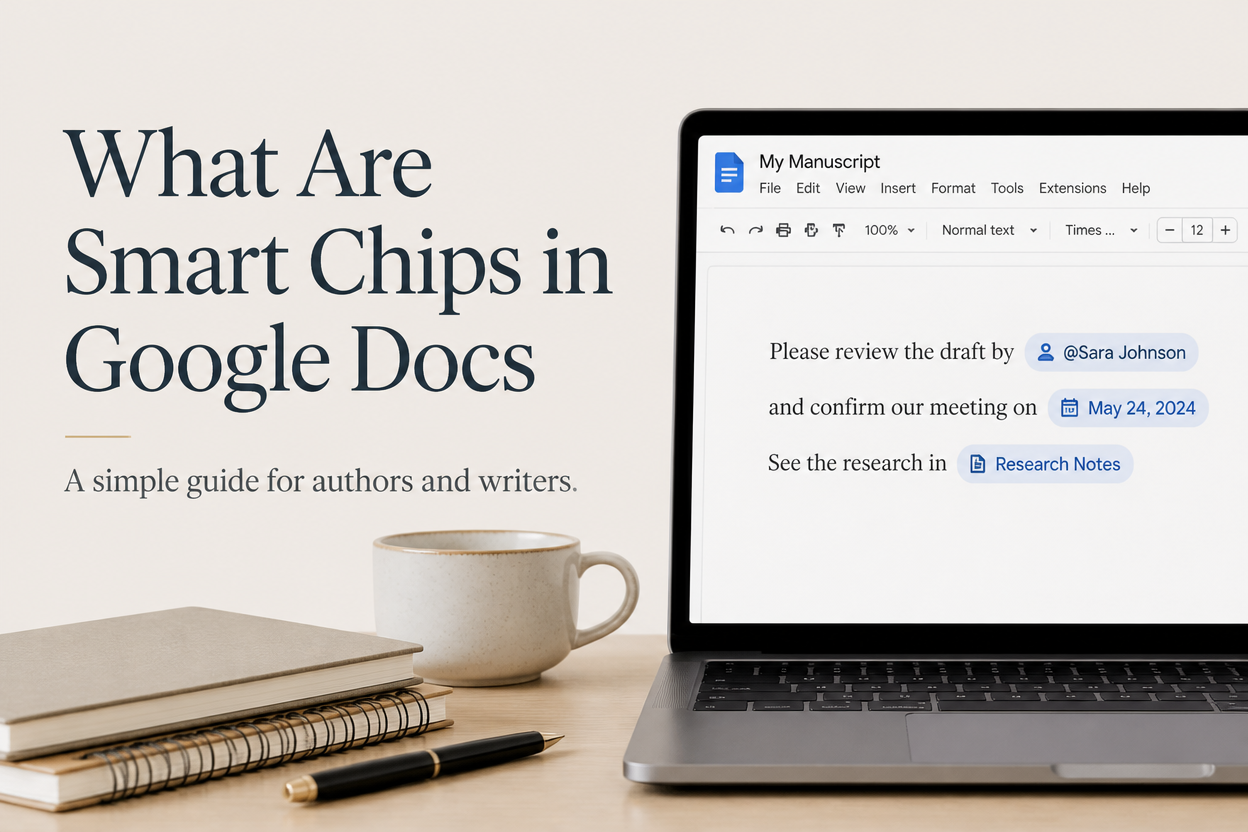
Formatting a manuscript means keeping the same handful of reference documents within reach. What are Smart Chips in Google Docs, and do they belong in your writing workflow? Smart Chips are interactive elements that place useful information inside a document, such as a person, file, date, location, calendar event, or task. You add one through the @ menu, then click it whenever you need the related details.
For an author, the value is practical. A manuscript folder can hold links to your character bible, cover brief, editorial letter, ARC schedule, and launch calendar without turning every reference into a long blue URL. Smart Chips give those references a recognizable shape, so you can see what a document contains before opening it.
I recommend treating Smart Chips as navigation and coordination tools. They won’t improve a weak scene or replace a proper project plan. They reduce the small bits of friction that cause writers to lose track of research, revisions, permissions, and publishing deadlines.
Table of Contents
What Smart Chips Do In Google Docs
A Smart Chip is a structured reference inside Google Docs. The reference can point to another person, a Google Drive file, a calendar event, a place in Google Maps, or a date. Some chips also support project details such as dropdown choices, task assignments, and building blocks that collect related information in a prepared layout.
Google describes Smart Chips as interactive components that let you add information and connect people, files, and events within Google Workspace. The Google Docs Help page on smart chips lists the available chip types and the commands used to insert them.
When you hover over a file chip, Google Docs can show the file name, owner, last modified information, and a link to open it, depending on your account permissions. A person chip can display contact information or profile details. Click a date chip to open a calendar view or create a new event. The details depend on the chip type and the Google account you use.
File Chips For Book Materials
File chips are the most useful type for solo authors. Place a file chip beside a chapter heading in your editorial document, link to the current cover brief, or connect a launch checklist to the spreadsheet that tracks retailers and promo dates.
To add one, type @ followed by the file name, then select the result from the menu. You can also type @file and search through your Drive files. Use a specific file name such as “The Glass Orchard Cover Brief” in place of a vague name such as “final version.” Vague names create confusion when you have six files with nearly identical labels.
People, Dates, And Events
Person chips can help you keep an editor, proofreader, cover designer, or narrator attached to a project document. A date chip can mark a developmental edit deadline, ARC delivery date, or audiobook recording session. Event chips connect a Google Calendar entry to the document, which gives you a direct path from your publishing plan to the scheduled appointment.
These chips work best when a document has several contributors or dates. A writer working alone may only need file chips and dates. You don’t need to turn every line into an interactive object. Extra structure creates maintenance work, and a book project already has plenty of that.

Smart Chips In An Author’s Workflow
Smart Chips earn their place when they answer a recurring question. Which version of the cover brief is current? Where is the sensitivity reader’s report? Who has the final proof? When does the preorder campaign begin? Put the answer inside the document where the question appears.
I use a simple rule: link the material when you refer to it. A publishing plan that says “send files to designer” leaves you hunting through Drive. A publishing plan with a file chip for the interior PDF and a person chip for the designer gives you a usable handoff.
Research And Worldbuilding
For fiction, create a research document with file chips leading to source notes, image references, maps, and historical timelines. A fantasy writer might connect a chapter outline to a map file and a character sheet. For a historical novelist, the same setup could tie a scene note to a museum collection, a location in Google Maps, and a bibliography document.
Keep the source material separate from the manuscript. A chip makes the source easy to reach without filling the draft with research commentary. During revision, you can check a detail, confirm a name, and return to the scene with fewer interruptions.
Revision And Editorial Handoffs
Create one editorial dashboard for each book. Add a file chip for the manuscript, a file chip for the style sheet, a date chip for the next review, and a person chip for each collaborator. Add a dropdown chip beside open issues with choices such as “Open,” “In Review,” and “Resolved.”
Dropdown chips can track decisions inside a chapter list. You can mark a chapter as drafted, revised, proofed, or ready for layout. The status tells you where a chapter stands. Whether the chapter works is another matter, so pair the status with a short note about the actual editorial problem.
Launch Planning And Promotion
Authors often scatter launch information across email, spreadsheets, calendar entries, and direct messages. A Google Doc can act as a readable front page for the project. Add a calendar chip for the release date, file chips for the cover assets and ad copy, and person chips for anyone handling newsletter swaps, podcast outreach, or ARC distribution.
Adazing authors can also use this kind of document alongside book cover tools, writing tools such as QuickWrite, and book promotion resources. The chip doesn’t replace those tools. It gives you one place to connect the working files and record the decision that matters, such as which cover version is approved for Amazon KDP.
How To Add And Use Smart Chips
Google keeps the insertion process simple. Open a Google Doc, place your cursor where the reference belongs, and type @. Search the menu for a person, file, date, event, place, dropdown, or another available chip. Select the result, then click the chip to view its options.
You can also insert some chips through the Insert menu. Google changes menu labels and available features over time, so the @ menu is usually the fastest route. Your account type, administrator settings, and access permissions can affect which options appear.
A Clean Insertion Method
- Open the document that contains the decision, deadline, or reference.
- Type a short label that tells you why the chip exists, such as “Current cover brief” or “Proofreading deadline.”
- Type @ after the label or on the next line, then search for the file, person, date, or event.
- Select the correct result and click the chip to test the link.
- Ask whether a future version of you will understand the reference without extra explanation.
The label matters. A raw chip beside three other file chips forces you to open each one. A clear label turns the document into a working index. I prefer labels that describe the file’s role rather than its format, such as “Approved ebook manuscript” in place of “DOCX file.”
Permissions And Shared Files
A chip doesn’t override Drive permissions. If your editor lacks access to a linked file, the chip won’t grant access. Google explains file access levels and sharing controls in its Google Drive help page on file access.
Before sending a project document to a collaborator, test each linked file from the collaborator’s account or ask that person to confirm access. This check matters when you work with a freelance editor, because a polished dashboard full of permission errors costs you working days.
Limits And Privacy Considerations
Smart Chips are useful within the Google ecosystem. They work best when your files, calendar, contacts, and collaboration already live in Google Workspace. A chip won’t create a reliable connection to every service you use, and it won’t replace a backup system for your manuscript.
Google Docs also depends on an internet connection for many collaborative features. A document may remain available offline through Google Drive settings, though linked information and live collaboration can behave differently. The Google Docs help page on working offline explains how offline access works and what you need to enable it.
Access Control For Sensitive Material
Think carefully before placing a chip on a document that contains private reader data, contract terms, payment details, or unreleased cover art. The chip makes the file easier to reach for people who already have permission. That convenience can make sensitive material easier to open in the wrong meeting or shared folder.
Sensitive information belongs in separate files. Keep your manuscript dashboard focused on links and decisions, and store contracts, tax records, and private ARC feedback in restricted folders with clear access settings. A tidy document is useful only when it exposes every project file to every collaborator. Past that, it creates avoidable risk.
Version Control And File Names
A file chip points to a file. It doesn’t tell you which draft counts as final. Google Docs version history lets you review changes inside a document, and Drive file organization points you toward the correct source file. Google explains document history in its help page on finding what’s changed in a file.
Use a naming convention before you add chips. I like a book title, material type, and status, such as “The Glass Orchard Interior Proofed” or “The Glass Orchard Launch Copy Approved.” Avoid names such as “final final 2.” A chip can get you to the wrong file with impressive efficiency.
A Practical Smart Chip System For Your Book
Start with one document called “Book Project Dashboard.” Put the book title, current stage, and release date at the top. Add a date chip for the release date, a file chip for the current manuscript, a file chip for the cover brief, and a file chip for the launch plan.
Below that, create four short sections called Manuscript, Production, Promotion, and Open Decisions. Use chips only where they remove a repeated search. The manuscript section might point to the editorial letter and style sheet. Production might link to the interior proof and print cover. Promotion might connect to the retailer copy, newsletter plan, and ad graphics folder.
The Weekly Review
Once a week, open the dashboard and test the items that affect the next seven days. Check the nearest date chip, open the current manuscript, review unresolved dropdown items, and confirm that collaborators can reach the files they need.
Delete stale chips once you stop using a file. Update labels when a project’s stage changes. A dashboard becomes less useful every time it keeps an old link for sentimental reasons.
The Manuscript Review
Keep Smart Chips out of your prose unless they belong to the document’s purpose. A novel draft should read like a novel. A chip in the middle of a scene breaks your reading rhythm and can survive into an export if you overlook it.
Use chips in the planning documents surrounding the manuscript. During a revision pass, move unresolved research notes, character questions, and continuity checks into a separate review file. Link that file from the dashboard, then return to the draft with a clear list of work.
Smart Chips work because they connect a decision to its source. They help you spend less time searching through Drive and more time editing the sentence, checking the proof, or writing the next chapter. Set up a small system, name your files clearly, and keep the document focused on decisions you actually revisit.
FAQs on What Are Smart Chips In Google Docs
Can Smart Chips Link To A Manuscript File?
Yes. You can add a file chip for a Google Doc manuscript, a spreadsheet, a presentation, or another file stored in Google Drive. The person opening the chip still needs permission to view the file. I recommend linking to the current working manuscript from your book dashboard and labeling the chip with the manuscript’s status.
Do Smart Chips Work In Microsoft Word?
Smart Chips are a Google Docs feature, so they depend on the Google Docs environment. Exporting a document to Word can change or remove interactive behavior. Keep your working dashboard in Google Docs when you rely on chips, and export a separate copy when you need to send a static file to an editor or printer.
Can I Use Smart Chips For A Self-Publishing Schedule?
Yes. Add date chips for editing, proofing, cover delivery, preorder setup, ARC distribution, and publication. Link each production task to its supporting file, then use dropdown chips to track status. A calendar or spreadsheet still handles detailed scheduling better, so use the Google Doc as a project’s readable control page.
Use Smart Chips With A Clear Book System
Smart Chips are small tools with a specific job. They connect the people, files, dates, and decisions that surround a book. I recommend starting with a single dashboard, adding only the references you revisit, and checking permissions before you share it. That approach gives you the convenience of linked information without turning your writing workspace into a maze of decorative features.
