
In most collections of syntax examples, sentences come tagged with grammar labels and little else. As a writer, you need more: a way to control pace, emphasis, clarity, and the reader’s attention across a manuscript. Syntax gives you that control because it governs how words and clauses relate inside each sentence.
That structure carries story pressure. For example, a long, layered sentence can follow a character’s anxious thoughts across several details. Cut the next sentence down to a short declaration, and it can close a scene with force. That choice between stretching and cutting matters in fiction, memoir, essays, and practical nonfiction because readers experience your argument through the movement of your sentences.
Since that movement shapes how a page feels, I use syntax as a diagnostic tool during revision. When a page feels dull, tangled, or strangely breathless, I examine sentence structure before I reach for more vivid adjectives. You can do the same by identifying the pattern on the page, testing a deliberate variation, and reading the passage aloud.
Table of Contents
Syntax And The Author’s Control
Syntax describes the order of words, phrases, and clauses in a sentence. Grammar gives you the rules for forming a sentence. Within those rules, syntax helps you decide how those pieces arrive for the reader.
Compare three versions of the same moment:
- The detective opened the letter at midnight.
- At midnight, the detective opened the letter.
- The letter waited on the desk until the detective opened it at midnight.
All three describe the same basic event. In the first, the subject and action follow a straightforward path. Moving the time phrase to the front, as the second version does, puts midnight in the foreground. The third version makes the letter the subject, giving it a stronger presence and holding the main action back until the final clause. One event, arranged three ways, produces three different points of emphasis.
Subject-Verb-Object Structure
The familiar subject-verb-object pattern gives readers a clean route through information. For example, in the sentence “Mara locked the studio,” Mara fills the subject slot, locked supplies the verb, and the studio takes the object position.
Because that route is so direct, the pattern works well when you need clarity. Use it for instructions, plot movement, scene transitions, and sentences that carry important information. In a self-published novel with a complicated timeline, plenty of direct sentences help because the reader already has enough work tracking events.
Front-Loaded And Delayed Information
You can move a phrase to the beginning of a sentence to shape how the rest of it lands. Take “After three years in exile, Tomas returned to the village.” That opening gives the exile weight before the return appears. Reverse the order, as in “Tomas returned to the village after three years in exile,” and the return takes priority.
To test that effect in your own work, move one phrase in a paragraph you are revising. Once you know what should register first, place that information near the beginning. Then read the paragraph aloud to test whether the emphasis feels intentional.

Core Syntax Examples For Manuscripts
Authors often learn sentence patterns through labels such as simple, compound, complex, and compound-complex. Once those labels reveal the machinery, your next task is to connect each pattern to a real job on the page.
Simple Sentences For Force
A simple sentence contains one independent clause. Its length can range from a few words to a full line packed with modifiers. For example, each of these three sentences qualifies:
- The train vanished.
- The old train vanished beyond the wet fields.
- Elena packed the manuscript.
That compact form gives an action a clean edge. Use it after a dense paragraph, at a moment of discovery, or near the end of a scene. Its impact sharpens when longer structures surround it.
Compound Sentences For Parallel Movement
A compound sentence joins two independent clauses with a coordinating conjunction or a semicolon. Consider these three examples:
- The rain started, and the market emptied.
- Jonah wanted to leave, yet his sister stayed.
- The room grew silent; everyone had read the message.
In each one, the two clauses carry equal grammatical weight. That balance suits paired actions, divided decisions, and cause-and-effect movement. Because every connector signals a different relationship, choose yours carefully. With “and,” events sit side by side. “Yet” introduces friction, and a semicolon creates a close relationship without naming it.
Complex Sentences For Cause And Tension
A complex sentence combines an independent clause with a dependent clause. The dependent clause can appear first or second, as these three examples show:
- Because the archive closed early, Nia copied the final page by hand.
- Nia copied the final page by hand because the archive closed early.
- Although the map looked authentic, someone had redrawn the coastline.
That flexibility lets you establish conditions, motives, concessions, and time. Placing the dependent clause first also delays the main clause. That delay can create suspense, as long as the opening clause stays clear.
To check that clarity during revision, underline the independent clause in a long sentence. If you lose track of it, the sentence probably carries too many ideas. In that case, divide it or remove a dependent clause that contributes little.
Syntax And Sentence Rhythm
Sentence rhythm comes from syntax, word length, punctuation, stress, and repetition. Repeat the same sentence pattern too many times, and even flawless grammar starts to read flat.
For example, read this five-sentence sequence:
She entered the kitchen. She saw the broken glass. She picked up the envelope. She read the name. She called her brother.
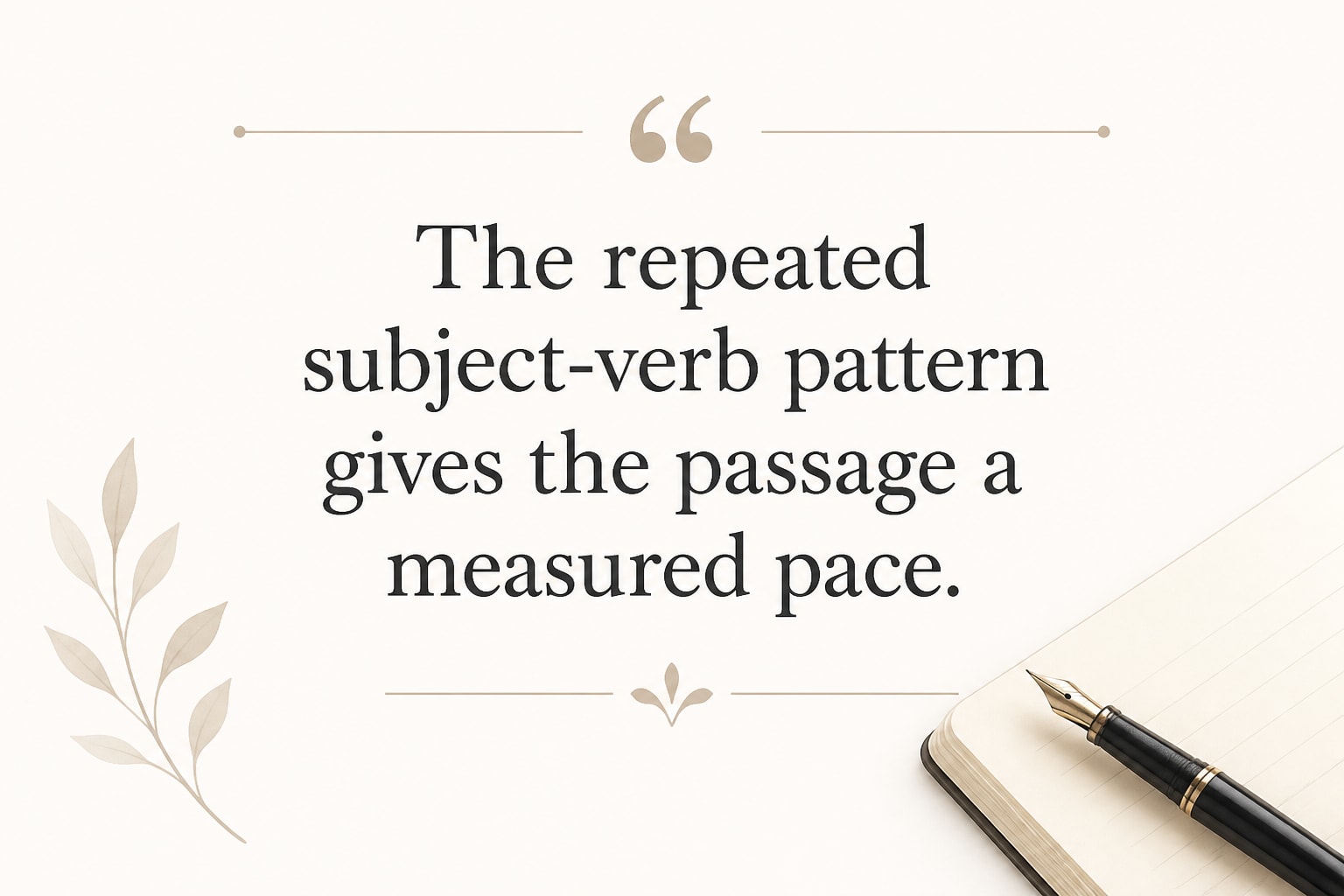
Opening every sentence with “She” and a verb gives the passage a measured pace. That steady beat could suit a procedural scene or a character operating in shock. In contrast, a reflective passage built from five sentences with the same shape may sound mechanical.
Varying the structure changes that effect:
She entered the kitchen and stopped. Broken glass covered the floor. On the table, beneath the overturned lamp, lay an envelope with her brother’s name on it. She picked it up before she called him.
Long Sentences For Thought And Accumulation
Long sentences can string observations together or let a character’s thought develop through several turns. That room for development suits literary fiction, personal essays, and passages that track perception.
Consider this sentence from a mystery:
By the time Daniel reached the station, the last commuters had disappeared, the ticket windows had closed, and the clock above the entrance had stopped at 11:17, the same minute recorded on his father’s final postcard.
Detail piles on detail until the clock connects the present moment to the family mystery. Because that final link carries the meaning, every earlier clause earns its place by building toward it. Remove the clock reference, and the sentence loses its turn toward significance.
Short Sentences For Pressure
Short sentences slow the reader’s eye because each one creates a separate beat. Stack several in a row during a burst of action, and that same separation pushes the scene forward faster.
That speed comes at a cost, so use this structure with care. Too many on one page start to sound like stage directions. I often fix that by combining two or three adjacent sentences, then preserving one short sentence where the emotional or plot pressure needs a hard stop.
To find those spots in your own manuscript, read a page aloud and mark every sentence that opens the same way. From there, change the structure of one or two of them rather than rewriting the entire passage. Those small adjustments restore movement without drawing attention to the technique.
Syntax Problems That Weaken Prose
Syntax problems rarely announce themselves as grammar errors. More often, a technically complete sentence buries the subject, blurs the timeline, or forces the reader to hold too many details at once.
Buried Subjects And Weak Verbs
The sentence “The discovery of the missing files was made by the assistant during the afternoon meeting” shows how easily a subject gets buried. Its grammatical subject, discovery, hides the real action. Move the assistant into the subject slot, and the sentence becomes “The assistant discovered the missing files during the afternoon meeting.”
Constructions like that one tend to hide behind phrases such as “was made,” “was conducted,” and “there were,” so watch for them during revision. When the context allows it, replace each one with a person or thing performing a clear action. That swap usually trims words and gives your prose more authority.
Overloaded Clauses
Beyond hidden actions, a sentence can also strain when every phrase adds a new time, place, character, or explanation. For example, the main action in the sentence below arrives only after several layers of context.
“After Lena found the key in the desk drawer that her father had kept locked since the summer when their neighbor disappeared, she remembered the conversation they had after dinner while the storm moved across the county.”
Every detail in it is useful. The trouble lies in the order, since the reader has to track several timelines before reaching the main action. Dividing it into three shorter sentences eases that load.
“Lena found the key in her father’s locked desk drawer. She remembered their conversation after dinner, during the summer their neighbor disappeared. Outside, a storm moved across the county.”
Split this way, each fact has room to register. The storm also becomes a separate image, and seeing it on its own may help you decide whether the detail belongs in the scene.
Dangling Modifiers And Confused Logic
A modifier should clearly attach to the word it describes. Take the sentence “Walking through the cemetery, the gravestones seemed to lean toward Ava,” where the gravestones appear to be walking. Placing Ava right after the comma fixes the problem. The revised sentence becomes “Walking through the cemetery, Ava felt that the gravestones leaned toward her.”
The same error often appears after opening participial phrases such as “Walking,” “After leaving,” and “Having finished,” so flag them during revision. For each one, check the noun immediately after the comma. That noun has to be the one doing whatever the opening phrase describes.
Syntax Revision For Fiction And Nonfiction
Syntax revision works best once you understand the passage’s purpose, since each form of writing demands something different. A suspense scene depends on controlled disclosure. Memoir may call for reflective distance, and a craft chapter needs clear explanation and a logical sequence.
Revision For Fiction
To match syntax to that purpose, start with the viewpoint character and ask whether the sentence structure reflects what that character notices first. For example, a frightened character may register fragments of sound before identifying their source. Give the same scene to a detective, and the details may fall into order as evidence. Through a romantic narrator’s eyes, gestures and physical proximity carry unusual weight.
That order of attention shapes even a single sentence, such as “The door opened, and Maya saw the man in the hallway, who held a knife that reflected the light from the porch.” Written this way, the event reaches the reader from outside Maya’s perception. A closer version reads, “The door opened. A knife caught the porch light. Maya saw the man holding it.” In that version, Maya’s attention controls discovery.
Revision For Memoir
Attention in memoir has a second layer, since the genre often moves between the past event and the present narrator’s understanding. Signal that movement through tense and syntax. Let a past-tense scene carry the action, then shift to a present-tense reflection to explain what you understand now.
Consider this pair of sentences. “I believed the letter would solve everything. Years later, I understand why I kept rereading it.” The opening sentence holds the reader within the past belief, and the next gives the present narrator room to reinterpret what came before. Keep each shift that deliberate so readers never wonder which version of you is speaking.
Revision For Practical Nonfiction
Instructional writing trades layering for order, since readers of a writing guide, business book, or instructional manual need a clear sequence. To give them one, assign each sentence one main job, keep the condition close to the action, and use examples that match the reader’s actual work.
When I revise an instructional paragraph, I begin by checking that sequence. Does the reader know what to do first? Beyond that, I ask whether each sentence answers the question the previous one leaves open. For example, when a paragraph explains how to revise a blurb, I put the draft instruction before the rationale, then show a before-and-after comparison.
When you’re stuck on a line, Adazing’s writing tools, including QuickWrite, can help you generate variations. I still recommend making the final syntax decision yourself. A tool can offer a fresh structure. Whether that structure belongs in the book depends on your knowledge of the character, argument, and reader.
Syntax Practice For Authors
You can improve sentence control through short, repeatable exercises. One of the most useful ways to start is with a paragraph from your manuscript, rewritten three ways. Draft the first version with mostly simple sentences, then combine the ideas into two complex sentences for the second. In the third, vary the structures to follow the emotional movement of the passage.
With all three versions in hand, compare them for emphasis, pace, and clarity. Keep whichever one serves the scene best, and let the most elaborate one go if it adds nothing.
Imitation builds the same judgment from a different direction. Pick a paragraph from a writer you admire and mark the subject, verb, dependent clauses, and sentence length. Using that map, write a new paragraph about your own material with a similar structural pattern. The goal is to study the author’s decisions and leave the language behind.
Those decisions face their real test during your final pass, when you read the manuscript aloud. Mark any sentence that makes you reread, loses the subject, or runs past the point of emphasis, and revise those first. Syntax becomes practical when you connect each grammatical choice to a reader experience.
FAQs about Syntax Examples Sentences
What Is Syntax In A Sentence?
Syntax is the order of words, phrases, and clauses inside a sentence. That order controls emphasis, clarity, pace, and how ideas connect. For example, in “The editor marked the paragraph,” the subject comes first, the verb sits in the middle, and the object completes the thought.
How Can Syntax Improve My Fiction?
Syntax can control how quickly readers take in information and whose perspective shapes a moment. To use that control, use direct sentences for clear action, complex sentences for thought and context, and deliberate changes in length when emotional pressure shifts.
How Do I Practice Sentence Structure?
Take one paragraph from your manuscript and rewrite it three times, moving from simple sentences to compound and complex ones and then to a mixed version. Read each draft aloud, then keep the structure that best supports the scene, argument, or explanation.
Make Sentence Structure Serve The Book
Strong syntax gives your reader a clear path through the page and keeps your voice intact. To build that path, study where each sentence places its subject, action, context, and emphasis. Then revise with the passage’s purpose in mind.
That purpose has little to do with displaying grammatical knowledge. What counts is making every sentence carry the right amount of meaning at the right speed. Read aloud, break up any pattern you’ve leaned on too often, and keep the structures that make your book easier to enter and harder to put down.
