
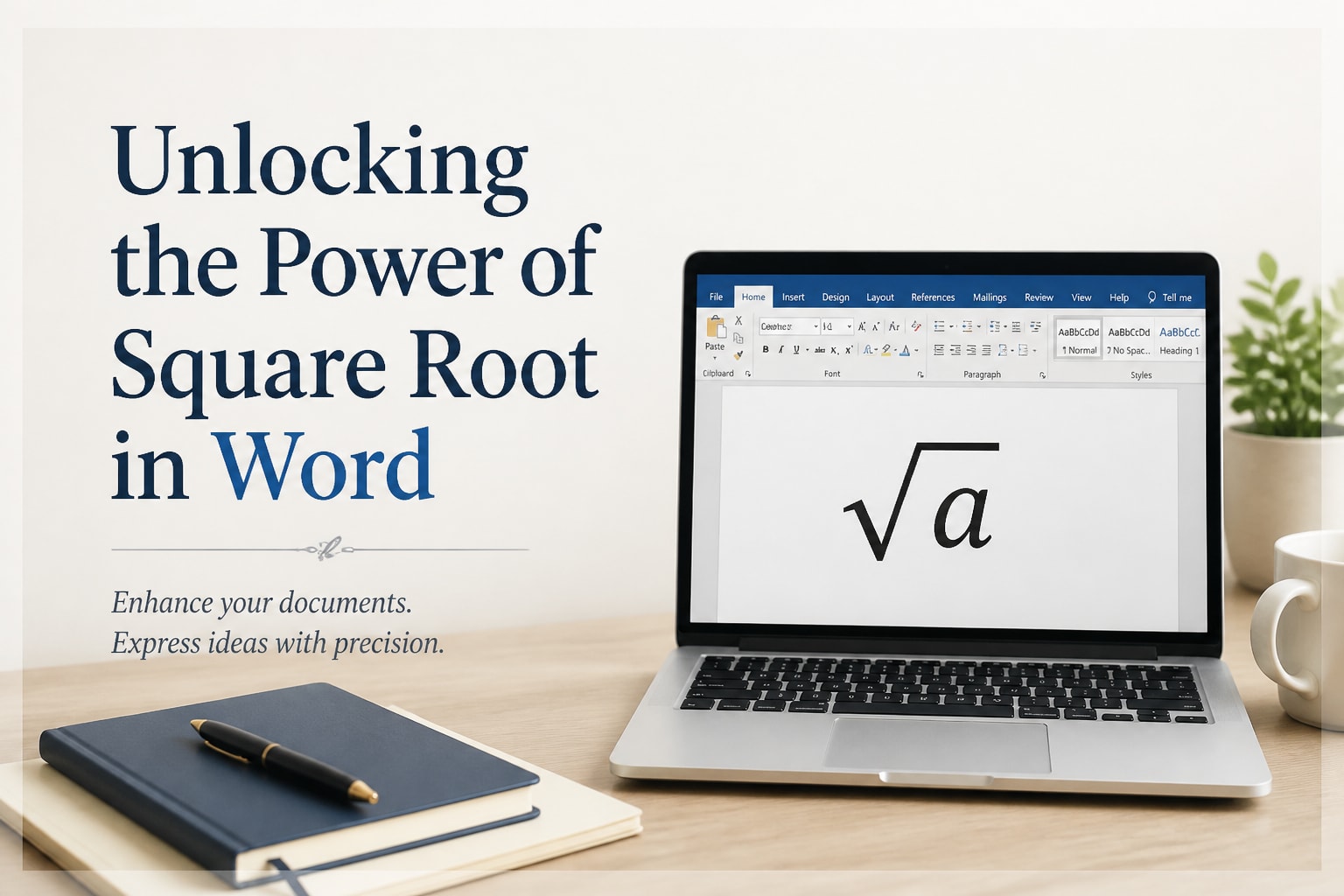
How you format a square root in Word can make a manuscript look polished or amateurish. Authors most often deal with square roots in workbooks, technical guides, measurement-heavy memoirs, and formula-driven nonfiction, where a plain-text shortcut can suddenly look out of place.
To avoid that mismatch, I recommend Word’s Equation tool whenever the expression needs to survive editing, conversion to PDF, or handoff to a designer. A quick symbol works for a simple reference. For anything more involved, a proper equation gives you consistent spacing, scalable type, and a cleaner result on the printed page. Microsoft’s support guide on writing equations in Word covers the Equation tool and its linear input commands.
Your manuscript determines the right approach. Take a sentence that mentions the square root of 49, where a readable symbol or the words “square root of 49” will do. On the other hand, a worked example with a radical over a fraction calls for a full equation. The sections below cover both cases, then turn to common formatting problems and ways to keep mathematical material readable for your audience.
Table of Contents
Choose the Right Square Root Method
Word offers three useful ways to handle a square root. You can insert the radical symbol, build a full equation, or write the expression in plain language. Each method suits a different kind of passage.
Use the Radical Symbol for Simple References
For short expressions, the √ symbol works well. In a chapter about statistics or personal finance, you might write, “The result is √25, or 5.” To add it, use the Symbol menu, copy the character from a trusted source, or use a Unicode input method supported by your operating system.
Whichever route you use, keep the surrounding text consistent. The radical should match the paragraph’s font and share a baseline with the numerals beside it. To confirm the fit, inspect the line at normal reading size, since a symbol that looks acceptable at 200 percent can appear too tall or too low on the printed page.
Use an Equation for Mathematical Structure
A full equation works better when the radical contains several terms, a fraction, an exponent, or a variable. For example, the quadratic formula includes a square root over the expression b² − 4ac. When a manuscript teaches readers how to calculate a result, that visual structure carries part of the explanation.
To build one, click where the equation should appear, open the Insert tab, and select Equation. Word then opens an equation area and shows tools for fractions, scripts, radicals, brackets, and other structures. Choose a template from Radical, type the expression under the root, and click back into your paragraph when you finish.
I recommend this method for any formula readers may copy, study, or revisit, since the root bar stretches across the full expression and the equation stays stable while you revise nearby prose.
Use Words in Reader-Facing Prose
Plain language often reads better than a symbol. In a memoir, a business book, or a general-audience essay, “the square root of 81 is 9” may flow more naturally than “√81 = 9.” Readers can follow the idea without an equation interrupting the paragraph.
Choose words when the mathematical expression supports the sentence. If the expression itself deserves attention, switch to an equation. That editorial judgment, more than any symbol, decides how readable the math feels.

Insert a Square Root with Word’s Equation Tool
Word’s Equation tool produces the cleanest result for a professional manuscript. I use it whenever the root contains a variable, a full phrase, or any material that needs clear grouping.
Build the Expression Through the Ribbon
Start by placing your cursor at the insertion point. On the Insert tab, select Equation. From the ribbon that Word opens next, choose Radical. After you select the square root template, Word places a placeholder beneath the root bar. Type the number, variable, or expression there.
For a basic expression, choose the template and enter 64. A more involved expression might place x + 9 or a fraction under the radical. Word stretches the root bar to cover the content. Superscripts, subscripts, and fractions come from the same set of controls.
When you finish, click in the body text and read the paragraph from a normal distance. Equations often add white space above and below a line. In a workbook or lesson, that space can help. On the other hand, a tightly designed trade book may need adjusted paragraph spacing around the formula.
Type Linear Commands for Speed
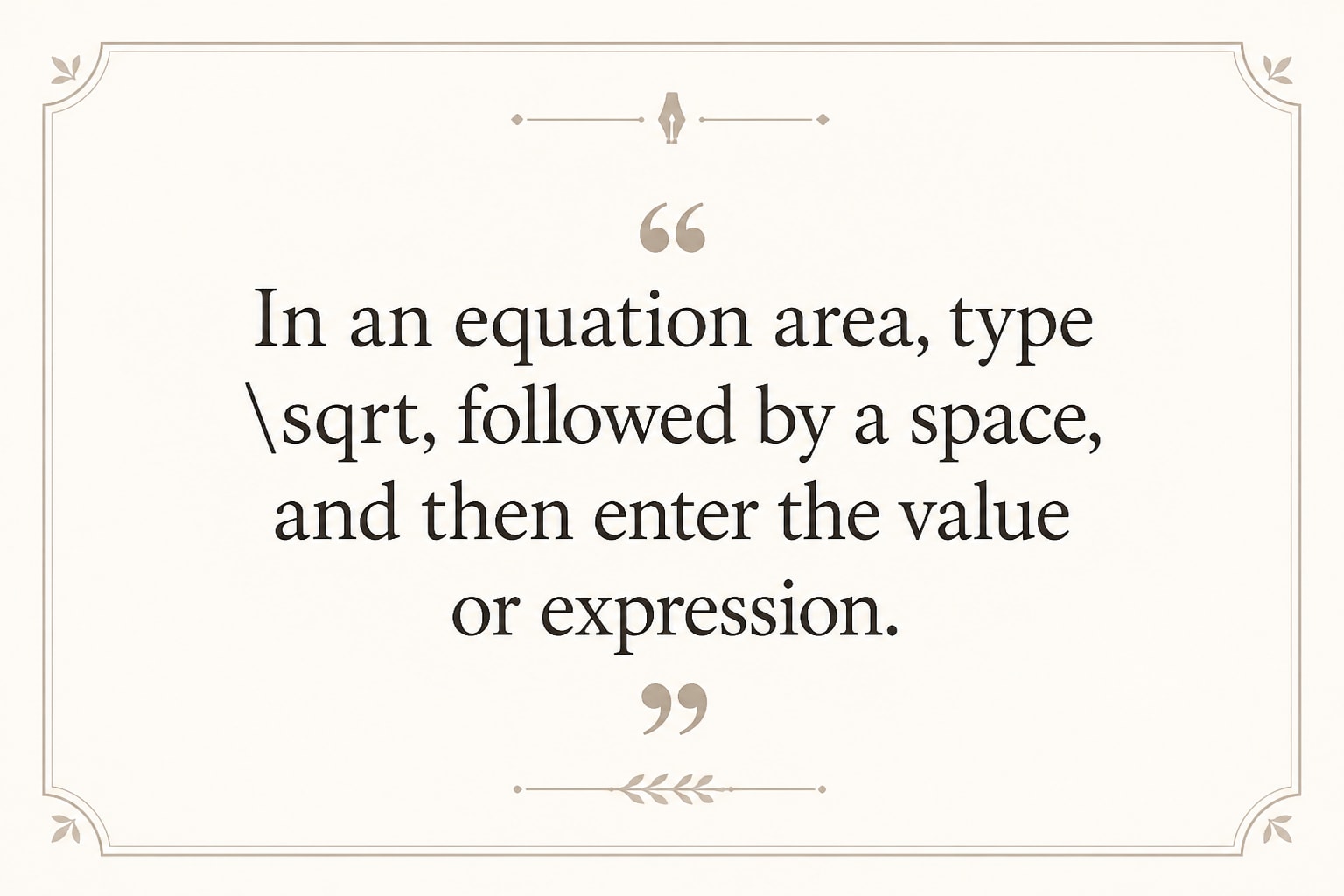
Word also accepts linear input. In an equation area, type sqrt, then a space, then enter the value or expression. Word converts the command into a radical in its professional format. Depending on your Word release and settings, you may need to press the spacebar after the command or switch the input mode to Professional.
For example, typing sqrt 49 in an equation area produces √49. Longer expressions may need grouping braces where Word supports them. Check each converted result carefully, since commands save real time across a formula-heavy chapter without replacing a visual review.
That review matters most for copied formulas, since a conversion can fail without warning. Paste one expression, compare it with the source, then continue with the rest of the manuscript. A missing exponent or misplaced fraction can change what a worked example teaches.
Control Equation Placement
By default, Word places an equation inline with the paragraph. That setting suits short expressions like √16 = 4. When you want readers to pause and follow a calculation, a displayed formula on its own line may read better.
Formulas that anchor a section or exercise deserve that separate line. Centering can help in a textbook or workbook. Left alignment, however, often supports accessibility and a more natural reading flow. Choose one treatment for similar formulas, then apply it throughout the book. Consistency lets readers recognize your visual system without getting distracted by the layout.
Format Square Roots for a Published Book
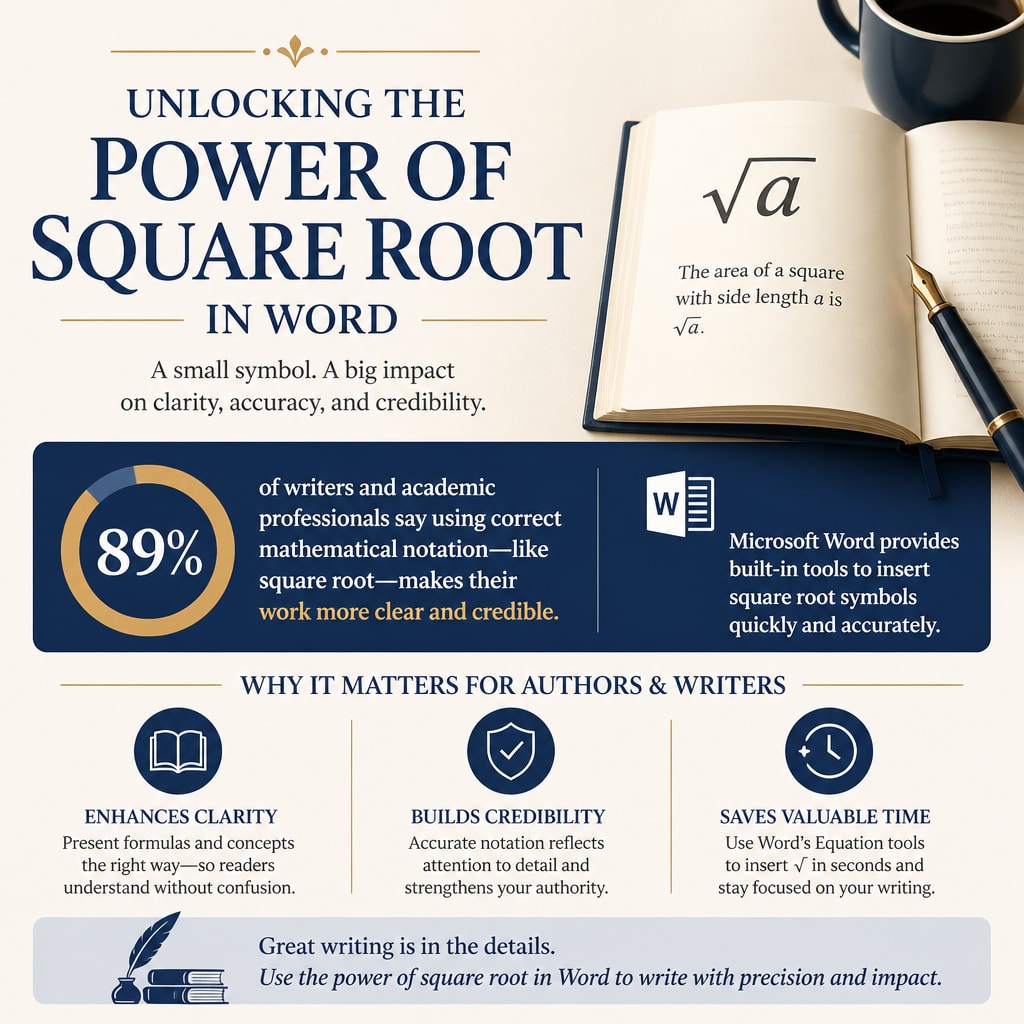
Inserting the root correctly solves only half the problem, since the formula still needs to fit the page, match the book’s type, and stay legible after export. For that reason, I review mathematical formatting during both manuscript editing and final proofing.
Match Type and Spacing
Word’s equation editor uses a mathematical typeface, Cambria Math by default, that may differ from your body font. In technical material, that contrast can feel appropriate. Within a literary essay, it may look jarring. To judge the effect, view each formula beside the surrounding paragraph, headings, captions, and callout boxes.
Size deserves the same check, since the symbols must stay large enough for print. On a monitor, a radical can look clear and still lose definition in a small paperback edition. Print a page at the planned trim size, then inspect it under ordinary reading light. That quick test catches thin strokes, cramped numerals, and awkward line breaks before the file reaches your printer or ebook converter.
Keep Radicals with Their Meaning
Readers lose the thread when a line break separates a radical from its result. To prevent that split, join a short inline expression with nonbreaking spaces, or move a longer formula onto its own line. In a worked example, put the explanation immediately before or after the formula so readers can connect the symbols with the calculation.
Suppose your book explains a square plot with an area of 144 square feet. Readers follow it best through a direct sentence like “To find the length of one side, calculate √144 to get 12 feet.” When the calculation deserves visual emphasis, a centered formula can follow. In that pairing, prose supplies the purpose. The formula supplies the structure.
Inspect Conversion to PDF and Ebook
Exported files can expose problems that remain hidden in the editable document. For example, a font substitution may alter the radical. Ebook conversion can also flatten a formula into an image. On another device, a copied symbol might display as an empty square.
To catch those failures, export a sample PDF and inspect every page with mathematical content. For an ebook, test the file on a phone, tablet, and ereader app when your budget allows. Reflowable ebooks create special problems because a formula may shift across lines whenever the screen size changes. Plain-language phrasing often helps a short expression survive that environment better than a large centered formula.
During review, keep the original Word file open beside an exported proof. Then compare each formula character by character. That comparison feels tedious until a reader finds a wrong value in a published workbook.
Fix Common Square Root Problems
Author manuscripts tend to repeat the same few mistakes. Most trace back to a fast input method that nobody checked on the final page.
A Root Bar Covers Too Little Content
Typing the radical symbol never draws a bar across a whole expression. Write √x + 4, and readers may take it as the square root of x followed by 4. To put the entire sum under the root, build it with the Equation tool and type x + 4 in the radical template.
That grouping carries mathematical meaning. In instructional writing, readers should never have to guess where a root ends. Build that structure explicitly every time.
The Symbol Looks Disconnected
Pasted symbols often arrive with their own font or baseline, out of step with nearby digits. To diagnose the mismatch, select the expression and compare its font settings with nearby text. If it still looks uneven, rebuild it with Equation on the Insert tab rather than forcing a symbol into place with manual spacing.
Those manual spaces rarely survive later layout changes. Changing the font, altering the page size, or converting the file can push them out of place. Structured formulas let Word keep the radical and its contents aligned through those changes.
The Formula Changes Meaning During Editing
Editors frequently revise the sentences around formulas. Somewhere in those edits, a line that once explained √25 may switch to √36 and still carry the old answer. To catch the mismatch, read each formula together with the sentence that introduces it and the one that interprets it.
For that reason, I recommend a final formula check separate from your ordinary copyedit. Flag the formula-heavy pages, verify every value, and ask a mathematically comfortable proofreader to review examples that carry instructional weight. Typos in decorative examples are embarrassing. In an exercise answer, the same slip teaches the wrong lesson.
Apply Square Roots in Author Workflows
Square roots appear far outside math textbooks. You may need one in a craft workbook, a science thriller, a genealogy project, a business plan, or a home renovation guide. In each case, let the reader’s task decide the formatting.
Use a Formula in a Workbook
Workbooks benefit from a predictable pattern. Introduce the concept in prose, display the formula, then walk through one complete example. For a print edition, leave room beneath that example for the reader to write.
For instance, a statistics workbook might explain standard deviation through a formula built around a square root. Place that formula near the instructions, labeling each variable in plain language. Readers should never have to flip back several pages to recall what a letter represents.
Use Plain Language in General Nonfiction
Business readers often need the idea more than the notation. You might write, “The model uses the square root of the sample size to estimate the margin of error.” That sentence conveys the relationship without asking anyone to decode a formula the book never uses again.
Adazing’s writing tools can help you revise explanations for clarity. Whether a symbol belongs in your chapter, however, is a call no generator can make. I make that call by asking what the reader must do with the information. Readers who must repeat the calculation benefit from a visible formula. If they need only the conclusion, a clean sentence usually works better.
Build a Consistent House Style
Early in the project, decide how you will handle radicals, variables, equals signs, formula numbering, and explanatory labels. Record those choices in your style sheet. Across a series, that consistency matters even more, especially when readers move from one workbook or technical volume to the next.
Your notes should also cover whether inline formulas use the equation editor, whether displayed formulas are centered, and how exercise answers appear. Share the finished style sheet with your proofreader and designer. With one shared reference, late-stage decisions stop turning into page-by-page improvisation.
FAQs on Formatting a Square Root in Word
How do I type a square root in Word?
For a simple symbol, insert √ through Symbol on the Insert tab. Properly formatted expressions need Equation on the same tab, followed by Radical. Typing sqrt in an equation area and pressing the spacebar also works, since Word converts the command into a radical structure.
Why does my square root bar stop too soon?
On its own, the √ symbol has no structural link to the terms after it. Word therefore cannot tell whether you mean √x + 4 or √(x + 4). To extend the bar, build the expression from a radical template and type everything you intend to cover in its placeholder.
Should I use a symbol or words in my book?
Choose a symbol for a short expression that readers need to see or calculate. When the mathematical idea supports ordinary prose and notation would interrupt the reading experience, words work better. Whichever you choose, apply it consistently across similar passages.
Make the Formula Serve the Reader
Square root formatting works best when readers can follow the expression without pausing over the layout. For that clarity, use a symbol for brief references, Word’s Equation tool for structured mathematics, and plain language when the concept matters more than the notation.
Before you publish, inspect the formula in the actual format your readers will receive. Check the Word document, PDF, paperback proof, and ebook when those editions apply. Small formatting decisions can keep an entire chapter accurate. That payoff makes every extra round of review worth the time.
