
The problem with writing styles is usually not a lack of talent. It is a lack of repeatable choices you can defend on the page. A unique voice is not a mystical personality trait either. It is the sum of what you consistently notice, what you consistently cut, and what you consistently refuse to do because it bores you or confuses your reader.
I have edited and marketed enough books to spot the pattern. Writers who “haven’t found their voice” are often writing in a polite, neutral middle that feels safe in a critique group and invisible in a Kindle sample. The fix is craft, not confidence. You pick a few controllable dials, you turn them on purpose, and you keep them steady long enough for readers to recognize you.
This matters more than most writers want to admit because voice is a tool for conversion. It affects whether a browser reads the next paragraph, whether a reviewer quotes you, and whether your next release sells to your existing audience. If your voice is inconsistent, your brand feels inconsistent, and your read-through suffers.
Table of Contents
Voice As A Set Of Controllable Choices
The most helpful mindset shift is treating voice like production, not self-expression. You are not waiting for “the real you” to show up. You are building a reliable reading experience, and you do that by making the same kinds of decisions again and again.
When I evaluate voice in a manuscript, I look for patterns in four places: diction, syntax, distance, and judgment. Diction is your word selection. Syntax is the shape and rhythm of your sentences. Distance is how close the narration sits to the character or the reader. Judgment is the attitude on the page, including what you mock, what you admire, and what you refuse to sentimentalize.
If you only work on one of these, you will get a partial effect. If you tune all four, your voice gets recognizable fast.
Diction As A Contract With The Reader
Your word choice signals genre, education level, era, and emotional temperature. A grimdark fantasy voice that uses modern corporate language will feel like a glitch. A breezy rom-com that keeps pulling out clinical terminology will feel cold. Your diction is a promise about what kind of ride the reader is on.
Here is a practical test I use. Pull a random page and highlight every abstract noun, every intensifier, and every vague verb. Words like “thing,” “very,” “really,” “seemed,” “felt,” “started,” “began.” If that markup lights up like a Christmas tree, your voice is probably generic because the language is doing less work than it should.
What to do next: Pick a list of ten “default” words you overuse and create substitutions that fit your genre. For a thriller, you might trade “looked” for “scanned,” “tracked,” “clocked,” or “checked.” For literary fiction, you might choose sharper sensory verbs and more precise emotional labels. Keep the list next to your draft for a week, then revise one chapter using only those swaps and see what changes.
Syntax That Carries Your Attitude
Sentence length is not just rhythm. It is posture. Long, layered sentences feel reflective or intimate when they are controlled. Shorter sentences feel decisive, anxious, funny, or blunt depending on placement. The voice you admire in other books often lives in syntax more than in vocabulary.
I do not tell writers to copy anyone’s style, but I do recommend imitation drills. Copywork trains your ear. Mary Oliver talked about copying poems as a way to learn how they are built, and the same principle applies to prose. You are learning cadence and control, not stealing content. For a grounded explanation of why deliberate practice like this works, see psychologist K. Anders Ericsson’s research on deliberate practice.
What to do next: Choose two authors in your genre whose prose you would recognize blind. Copy 300 to 500 words by hand or into a separate file. Then write a new scene of your own with the same sentence patterns. After that, rewrite the same scene in your natural voice. Compare the drafts and steal only what still feels honest, usually pacing and clarity.
Distance That Controls Intimacy
Narrative distance is one of the most underused voice tools, especially for indie authors who publish fast. If your distance keeps drifting, readers feel it even if they cannot name it.
Close distance reads like thought. “He should not have come.” Further distance reads like observation. “He had made a mistake in coming.” Both can work, but you need to choose where you live most of the time, then break your own pattern for effect.
What to do next: Take one chapter and label every paragraph as close, medium, or far. If you are writing in the first person, you still have distance choices, especially in how much the narrator interprets versus reports. Then revise the chapter so that 70 percent of the paragraphs are at the same distance. Your voice will feel steadier immediately.

What Makes Voice Feel “Unique” To A Reader
Uniqueness is a marketing word. Readers do not actually want unique. They want specific. A voice feels special when it is specific about what it notices and consistent about how it reacts.
I see three traits that reliably create that feeling: a distinctive filter, a consistent level of compression, and a clear value system. The filter is what your narrator pays attention to. Compression is how much you leave out. The value system is what the voice approves of or despises, even in subtle ways.
A Distinctive Filter
Your narrator does not have to sound quirky. Your narrator has to notice things your competition does not notice in the same way. For example, a paramedic protagonist will measure a room by exits, hazards, and body position. On the other hand, a jewelry thief will notice light, reflection, and how locks sit in their housings. Meanwhile, a burned-out teacher will notice tone, status games, and who is about to cry.
What to do next: Write a 250-word “arrival” scene. Your character enters a diner, a spaceship corridor, a courtroom, a suburban kitchen, whatever fits your book. Ban yourself from describing anything visually for the first five sentences. Force yourself into sound, smell, texture, temperature, and social pressure. That constraint pushes your filter into the foreground.
Compression That Creates Pace And Confidence
Compression is what you omit, and omission is where confidence shows. Overexplaining is the most common voice killer I see in early drafts. It usually comes from fear that the reader will not get it. Readers get more than you think, and they enjoy doing some work.
There is also a business reason to care. Kindle shoppers often decide in the sample, and rambling explanations raise bounce. Nielsen Norman Group has repeatedly shown that people skim online text in an F-shaped pattern, and the same behavior appears in digital reading when people are deciding whether to continue. Their classic summary of how users scan content is aimed at web pages, but the attention pattern maps cleanly to “sample browsing” behavior.

What to do next: Revise one scene and cut 10 percent of the words without cutting any plot events. Then read it aloud. If the scene becomes clearer, your voice wants more compression. If it becomes confusing, your voice needs different specificity, usually stronger verbs and sharper concrete details rather than extra explanation.
A Value System That Gives The Prose A Spine
Voice without a value system feels like a camera. Voice with a value system feels like a person. Your narrator might hate hypocrisy, worship competence, fear intimacy, love beauty, or treat authority as a joke. That bias shows up in the metaphors you reach for and in which details you frame as admirable or disgusting.
What to do next: write a one-page manifesto in your narrator’s voice about something trivial, like airport security, dating apps, small-town gossip, or artisan coffee. Then strip the manifesto for reusable patterns. Look for favorite sentence shapes, recurring types of comparison, and the emotional temperature. Bring those patterns into your actual chapters.
Finding Your Voice Through Revision, Not Draft One
Your first draft is mostly you telling yourself the story in whatever language gets the job done. Voice usually shows up in revision, when you can see what your story is actually about and what your characters actually care about.
I recommend a two-pass approach. Pass one is structural voice, where you align scenes to the promises of your genre and the emotional arc you are trying to deliver. Pass two is line-level voice, where you enforce your choices in diction, syntax, distance, and judgment.
A Voice Map For One Book
A voice map is a short document that describes the on-page behavior you are aiming for. It is not a vibe board. It is a rule you can follow when you are tired.
Include items like these:
- Preferred point of view distance.
- Typical sentence length range.
- Tolerance for adverbs.
- Swear frequency and style if you use them.
- Metaphor policy, meaning how often and what kind.
- Humor policy, meaning whether you punch up, punch down, or avoid cruelty.
- Dialogue density, meaning how much of the page is talk versus interiority.
What to do next: Write your voice map in 12 bullet points, then keep it open while you revise. When a chapter “doesn’t sound like you,” check the map. You will usually find you broke your own rules without noticing.
One Chapter As A Voice Laboratory
Do not try to fix your whole manuscript at once. Voice work is easiest when you run controlled experiments.
Pick one representative chapter. Revise it three different ways. One version with tighter compression and fewer explanations. One version with closer narrative distance. One version with more distinct diction, meaning sharper nouns and verbs and fewer placeholder words. Give the versions to a couple of trusted readers and ask a narrow question. Which one feels like the author knows exactly what they are doing?
What to do next: Apply the winning changes across the book in a systematic sweep. This is slow, and it is supposed to be. The consistency is where the voice becomes real to readers.
Read-Aloud Proofing For Voice Consistency
I use read-aloud proofing for more than typos. It exposes voice drift. When the voice slips, you hear it as a change in pacing, formality, or emotional honesty.
Most operating systems have built-in text-to-speech, and it is ruthless in the best way. It will not flatter your sentences. It will stumble over clutter. It will reveal when your dialogue all has the same cadence.
What to do next: Listen to two scenes back-to-back that are supposed to feel similar, like two romantic beats or two action beats. If the tempo changes for no reason, revise until the scenes share the same underlying rhythm.
Voice That Matches Genre, Branding, And Reader Expectation
Voice lives inside a market, and your market has expectations. This is where writers sometimes get stubborn. You can be original and still be legible to your category.
If you publish romance, readers expect emotional access, strong interiority, and a certain kind of warmth even when the book is dark. If you publish thrillers, readers expect forward motion, controlled exposition, and clarity under pressure. If you publish epic fantasy, readers tolerate more texture and naming density, but they still want orientation and stakes.
What does not change across genres is that the first pages have to earn trust. Your voice is a promise that the rest of the book will be worth the reader’s time.
Comparable Titles As Voice Anchors
Comp titles are not only for ads and metadata. They are a voice anchor. When you choose two or three books that sit near yours, you can study what readers in that niche accept as normal.
Look at things like paragraph length, profanity levels, how much backstory appears early, and how quickly the narrator makes judgments. You are not copying. You are calibrating.
What to do next: Take the “Look Inside” samples of three top sellers in your category. Analyze the first 1,000 words. Count dialogue lines. Count paragraph breaks. Note how often the prose names emotions versus implies them. Then compare your first 1,000 words. The gaps point to the adjustments your audience will reward.
Voice And The Three-Second Branding Test
A book cover is a thumbnail problem, but voice is also a branding problem. A reader should be able to recognize your tone from a quote graphic, your newsletter intro, your book description, and the first page of your novel. When those elements mismatch, you lose trust.
What to do next: Pull three short excerpts from your manuscript that show your voice at its best. Use them everywhere. Put one in your Amazon A+ Content if you have it. Put one on a quote card. Put one in your reader magnet. Consistency across touchpoints sells more effectively than novelty.
Series Voice And Read-Through
Series writers have an advantage. Readers want the next book to feel like coming home. You can shift stakes and setting, but the voice needs to stay familiar.
Written Word Media has shared survey work showing that discounted or free first-in-series promotions can drive later sales, which only pays off if book two delivers the same reading experience the first book promised. Their data on promo results for series entry points is a good reminder that marketing and voice are tied together by read-through.
What to do next: Create a “series voice sheet” that includes recurring diction choices, recurring sentence rhythm, and your standard narrative distance. Before you draft book two, reread two chapters from book one and match that baseline.
Tools And Exercises That Produce Voice On Demand
Voice improves when you can produce it under a deadline, not only when you feel inspired. That means building a few tools you can use anytime you sit down to write.
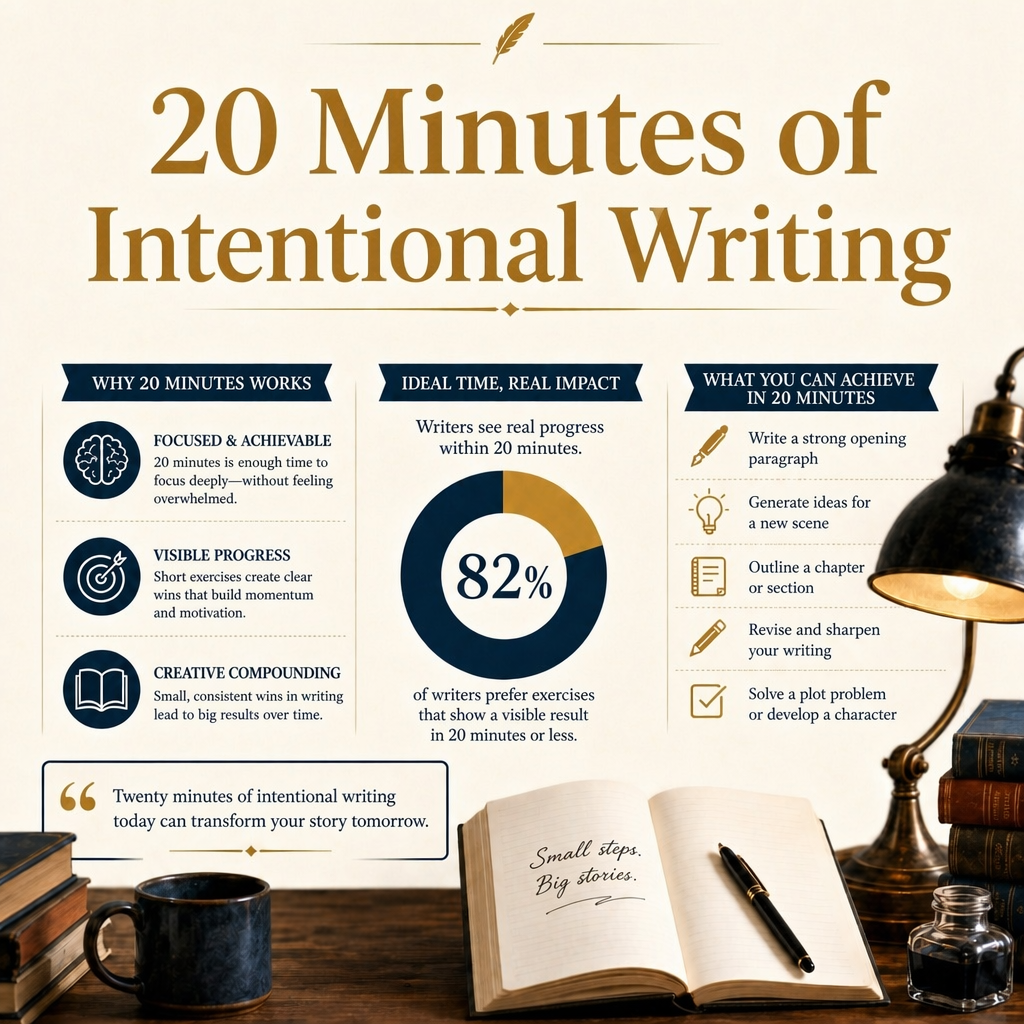
I like exercises that have a visible result in 20 minutes. If an exercise needs a weekend retreat and a special candle, it is entertainment.
The Fifteen-Minute Voice Warm-Up
Start with a constraint that forces choices. Write 300 words in your narrator’s voice with one hard rule. No adjectives. No adverbs. Only simple sentences. Only long sentences. Only concrete nouns. Pick one rule per session.
The goal is not to keep the rule forever. The goal is to reveal what you rely on and what you avoid.
What to do next: After the warm-up, write your actual scene and keep one lesson. Maybe you keep the stronger verbs you found when you banned adverbs. Maybe you keep the cleaner cadence you found when you forced shorter sentences.
Dialogue Pass For Character Voice Separation
If every character sounds like you, readers notice. They might not complain about it directly, but they will forget who is talking.
Do a dialogue-only pass. Copy a scene into a file and delete everything that is not spoken dialogue. If you cannot tell who is speaking without tags, your voices are too similar.
What to do next: Give each major character one consistent speech habit. Sentence length, formality level, metaphor style, or how often they answer questions with questions. Keep it subtle. One habit is enough.
Drafting Support With Author Tools
When you are drafting at speed, you need frictionless support, not another system that steals your attention. I built my workflow around tools that keep me writing and tools that keep my decisions consistent.
For example, when I want to maintain naming consistency and avoid accidental sameness, I use generators and lists. Adazing has name and word generators that help when your brain is fried, and your characters still need believable names that fit the book’s sound. When I want to get words down fast without losing the thread, I use writing tools like QuickWrite to keep momentum and reduce the temptation to polish every sentence mid-draft. You still have to do the voice work in revision, but momentum is what gets you to revision.
What to do next: Pick one tool for speed and one tool for consistency. Speed gets you volume. Consistency gets you a voice. Use both on purpose.
FAQs for Writing Styles: Find Your Unique Voice
How long does it take to find a writing voice?
You can make your voice noticeably clearer in a single revision pass if you focus on a few dials like narrative distance, compression, and verb choice. A voice that readers recognize across multiple books takes longer because consistency is the point. In my experience, most writers feel a real shift after finishing and revising one full book with the same standards, then carrying those standards into the next project.
Should I change my voice for different genres?
You should adjust your voice to meet the expectations of the genre you are selling into, especially pacing, emotional access, and the amount of explanation readers will tolerate. Your core sensibility can stay the same. I treat it like a wardrobe. You are still you, but you are dressing for the occasion so the reader does not feel tricked by the cover, blurb, and category.
How do I know if my voice is consistent enough?
I look for three signals. Beta readers describe your writing with the same adjectives without being prompted. Your first pages sound like your mid-book chapters when read aloud. Your promotional copy sounds like the book itself. If those three line up, you are consistent enough for readers to relax and enjoy the story.
A Voice Readers Can Follow And Trust
Your unique voice is the part of your craft you can repeat on demand. Pick a small set of choices about diction, syntax, distance, and judgment, then enforce them in revision until they become automatic. Once your voice is consistent, your marketing gets easier, your readers know what they are buying, and your next book has a stronger runway than your last.
