
Most writing strategies authors use for memorable plots come down to one uncomfortable truth you can test in ten pages. If your story does not force your protagonist to make hard, irreversible choices, your plot will feel like a sequence of things that happen, and readers will forget it the moment they close the book.
I am not talking about constant twists or bigger explosions. I mean the kind of plot that changes the character’s options, relationships, and self-image, then keeps changing them until the ending feels earned. You can draft gorgeous scenes and still ship a book with no plot pressure, and Amazon reviews will diagnose it with the vague, deadly phrase “it was slow”.
Below are the strategies I trust when outlining, revising, and triaging a drifting manuscript. They work across genres, and I will tell you where they bend based on category expectations.
Table of Contents
Plot Memory Comes From Choices That Cost Something
Readers remember decisions, not events. Events are easy to swap. A decision that burns a bridge is hard to forget because it changes the future, which is what a plot actually is. If your protagonist can do the next scene without paying for the previous one, you have motion, not momentum.
When I edit for plot, I mark every major scene with two questions. What did the protagonist choose, and what did that choice cost them immediately? If you cannot answer both, the scene might be pleasant, funny, even well-written, but it is not doing plot work.
Irreversible Decisions
Give your character doors that lock behind them. They quit the job and cannot go back. They tell the truth and lose protection. They lie and create a problem that will demand payment later. In romance, this is the confession that changes the power balance. In a thriller, it is the moment they involve law enforcement and trigger a clock. In fantasy, it is the oath that binds them to a faction.
Your practical move is simple. Make a list of five scenes where the protagonist could have chosen differently without breaking the story. Pick two and rewrite them so that the alternate choice would create a different book. If the alternate choice still leads to the same next chapter, raise the price.
Visible Costs On The Page
Costs have to show up, not exist in your head. A cost can be external, such as losing access, money, safety, or status. It can also be internal, such as shame, grief, or fracture of identity. The reader needs to feel the bite in the scene’s aftermath, preferably within a page or two, because delayed consequences often read as author convenience.
For revision, I like a fast diagnostic. In each chapter, underline the line where the consequence becomes visible. If you do not have a line, add one. If you have to underline three pages, tighten it.
Agency Under Pressure
If your protagonist is passive for long stretches, the book will feel like a tour. Sometimes passivity is the point, such as a character trapped in an institution or under a curse, but the character still needs agency somewhere, even if it is choosing the lesser loss. A refusal can be a choice. Endurance can be a choice. Silence can be a choice if it costs them.
I recommend you find one spot where the plot currently “happens” to the protagonist and rewrite it so they cause the next complication. You will feel the whole narrative posture change.

Design A Chain Of Causality That Readers Can Follow
Memorable plots are not random, and they are not a pile of clever turns. They are causality you can track. When readers say “I could not put it down,” they usually mean that every chapter answered one question and immediately raised a sharper one.
This is also why some books with high action still feel muddy. The scenes are exciting, but the because is missing. “Then” is not plot logic. “Therefore” and “but” are plot logic.
Scene Links That Use Therefore And But
I learned this principle from craft conversations around Trey Parker and Matt Stone’s story advice, which boils down to linking beats with “therefore” and “but” instead of “and then.” You can find the quote widely reported, including in this No Film School breakdown of their “therefore/but” rule. You do not need to worship the quote to use the test. It catches mushy middle syndrome fast.
Take your chapter list and write one sentence per chapter. Between each chapter sentence, write either “therefore” or “but”. If you keep writing “and then,” you have episodic structure. Episodic can work for certain cozy series or picaresque fiction, but you still need a throughline cost that accumulates.
Motivation That Is On The Page
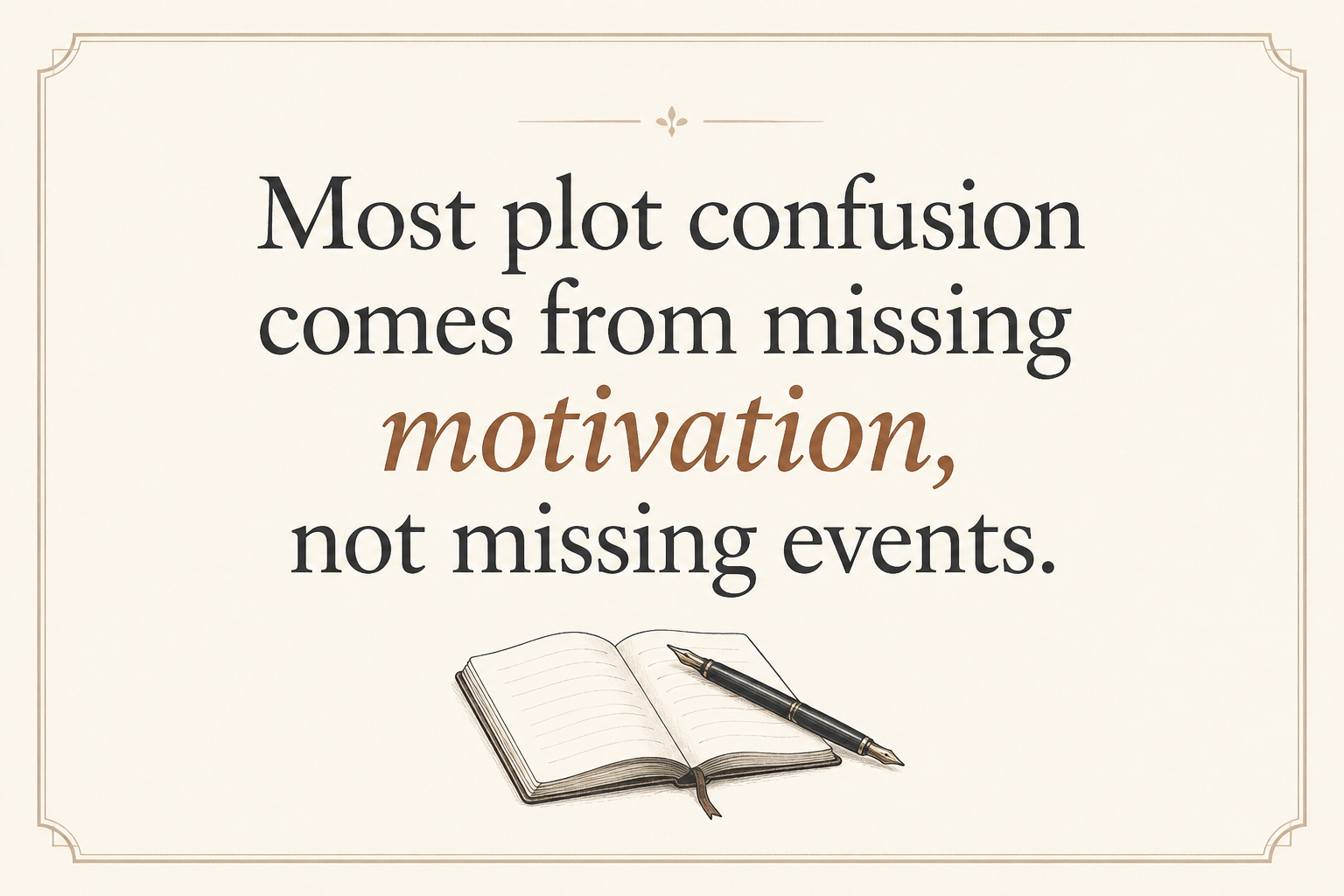
Most plot confusion comes from missing motivation, not missing events. You know why the character does it, but you never dramatize the why. The fix is not more exposition. The fix is a moment where desire and fear collide, and the character acts.
Here is what I do in revision. I add one beat before a big decision where the protagonist names what they want, even if only to themselves, and then I add the competing fear. Then I let the action happen. The reader does not need a therapy session. They need the hinge.
Clean Stakes That Escalate
Stakes should rise in a way a reader can measure. “Everything is at risk” is not measurable. “If she is late, the prosecutor files the charge, and her brother cannot be extradited” is measurable. If your stakes are vague, readers feel you’re reaching for importance instead of building it.
Your move is to rewrite the stakes line in each major turning point as a concrete consequence that would show up on a calendar, a bank statement, a body, or a relationship. If you cannot write it that way, the stakes are still conceptual.
Build Repeating Plot Patterns That Create Recognition
One reason readers remember a plot is pattern recognition. You show them a situation early, then you echo it later with higher pressure and a smarter, darker, or more costly choice. That repetition makes the story feel inevitable, which is different from predictable.
This is where the theme becomes practical. The theme is not a speech; it is the question your plot keeps asking in different forms.
Promises And Payoffs
When you introduce a loaded detail, you are making a promise. A gun in a drawer, a fragile marriage, a letter never opened. If you keep making promises and do not pay them off, readers feel cheated. If you pay them off too soon, the story feels small.
I use a promise list. While drafting or revising, I track every “loaded” element in a simple note: what it is, where it appears, what the implied payoff is, and when it pays off. If you write in Scrivener, you can do this in a project note. If you draft in Google Docs, a separate doc works. The method matters more than the tool.
Mirrors And Reversals
Mirroring is a plot strategy that does not require a fancy structure. Show the protagonist facing a version of the same moral problem twice. The first time, they chose safety. The second time, they chose truth. Or they make the same mistake again, and the cost doubles. Readers will remember the second scene because it reframes the first.
Your practical move is to pick one early scene where the protagonist avoids a hard truth. Write a late-book scene that forces the same truth in a public, costly setting. Then make the late choice matter.
Motifs That Carry Plot Information
Motifs get a bad reputation because people think they are decoration. In working manuscripts, a motif becomes powerful when it carries plot information. A specific lullaby that signals danger. A phrase that reveals a liar. A scent that tells the detective they have been here before.
If you want a motif that earns its place, tie it to a decision point. The motif should appear right before a choice or right after a consequence, so it becomes part of the reader’s recall system.
Use Constraints To Force Inventive Turns
The fastest way to get a plot that surprises even you is to constrain the protagonist’s options. Limit the time, information, resources, trust, and geography. Constraints create inventive solutions, and inventive solutions create plot turns that feel organic instead of random.
In my experience, “anything can happen” drafts often collapse because the author keeps choosing the easiest escape route. Constraints block the escape route.
Clocks That Actually Bite
A ticking clock is not a line of dialogue. It is a condition that changes what choices are available. If the hero has three hours, they cannot drive across the state, interview five witnesses, and sleep on it. The time limit forces a mistake, and mistakes generate plot.
When you set a clock, audit it. Does it remove options on the page? If the clock does not change behavior, it is scenery.
Information Gaps With Rules
Withholding information creates suspense only when the reader trusts there are rules. If the author can reveal any secret at any moment, the mystery feels like manipulation. Give yourself discipline. Decide what the protagonist knows, what the antagonist knows, and what the reader knows at each turning point.
I like a simple grid with three columns. It takes fifteen minutes to sketch, and it prevents those late-draft “wait, why did nobody mention this earlier” holes.
Social And Emotional Constraints
Some of the strongest constraints are relational. A heroine cannot tell the truth without destroying her sister’s career. A soldier cannot refuse an order without losing the unit’s protection. A father cannot pursue the villain without admitting he caused the original harm. These limits feel human, so the plot feels human.
Your move is to write one constraint sentence for each major character. “They cannot X because Y.” Then push the plot until they must choose between X and Y.
Revise For Plot Clarity With A Reader’s Eyes
Drafting generates material. Revision builds the machine. If your plot is forgettable, you often do not need more scenes. You need clearer cause-and-effect, stronger turning points, and better placement of information.
I will also say the quiet part out loud. You cannot market a confusing plot into a memorable one. Your cover and blurb can earn the click, but read-through comes from story logic and payoff.
The One Page Plot Audit
Condense your entire story into one page. Not a back cover blurb, an actual plot spine. List the inciting incident, first major turn, midpoint shift, second major turn, climax, and resolution. Under each, write the protagonist’s choice and the consequence.
If you cannot fit it on one page, you probably have too many competing plotlines. If you can fit it but the choices look soft, you have a tension problem. This audit gives you a target before you start rewriting chapters.
Chapter End Questions
Memorable plots train readers to ask the right question at the end of every chapter. The question has to be specific enough that the reader can predict what kind of scene might answer it, while still being uncertain about the outcome.
In revision, I write the end question in the margin for each chapter. “Will she get the file?” is fine. “What will happen next?” is useless. If you cannot name the question, rewrite the chapter ending so it creates one.
Tool Support Without Losing Your Voice
When I am doing heavy plot revision, I like tools that reduce friction. Adazing’s writing tools, including QuickWrite, can help you keep drafting velocity while you test alternate turns, and Adazing’s generators are handy when you are rebuilding secondary characters and need names, places, or terminology that match your world. The tools do not invent a plot for you, but they help you iterate faster, which is what revision demands.
If you use tools, set a boundary. Use them to speed up decisions you already understand, and do not use them to avoid the hard work of choosing what your story is about.
FAQs for Writing Strategies Authors Use for Memorable Plots
How do I know if my plot is memorable or just busy?
Track consequences. If big events happen but the protagonist’s available options stay the same, the plot is busy. A memorable plot narrows or reshapes options after every turning point, and you can point to specific losses or gains that force the next choice.
Do I need to outline to create a strong plot?
No, but you need a way to verify causality. Pantsers often draft forward on instinct and then outline in reverse during revision to find gaps. Outliners build the chain first and draft with fewer structural surprises. Pick the approach that keeps you productive, then apply the same tests: choices, costs, and therefore or but links.
How many twists should a memorable plot have?
As many as your genre expects and your story can support. A twist that reframes motive or raises the price is worth more than three twists that only reshuffle logistics. In romance, the “twist” is often an emotional reversal. In a thriller, it may be a reveal that changes what the protagonist thinks the game is.
A Plot Readers Remember
If you want a plot that sticks, you are building a chain of costly choices, clear consequences, and repeating patterns that pay off under pressure. Draft the scenes you love, then revise with discipline until each turning point locks a door behind the protagonist. Your reader will follow that kind of story anywhere because it feels like life, with sharper edges and better timing.
