
Writing sprints online work because they turn writing from a mood-based hobby into a scheduled performance. If you keep waiting for “the right time” to draft, you will keep getting exactly what you’ve been getting: scattered sessions, half-finished chapters, and the quiet dread of a deadline that keeps moving.
I’ve watched a lot of authors try to fix output by buying new notebooks, rearranging Scrivener folders, or promising themselves they’ll “get serious” next week. A good sprint does something more useful. It puts a fence around your attention for a short stretch, then asks you to produce.
The stakes are real. Your draft is the bottleneck for everything else: revision, cover design, blurb testing, ARCs, launch timing, ads, read-through. If you can create a repeatable way to draft on demand, you stop gambling with your publishing calendar.
Table of Contents
Why Online Writing Sprints Beat Solo Willpower
When you sprint alone, you’re negotiating with yourself every five minutes. That negotiation is where your word count goes to die. Online sprints remove the negotiation by creating a tiny social contract: you said you’d write for 20 minutes, and someone else is writing next to you.
This is not mystical accountability. It’s basic behavior design. A sprint gives you a start time, an end time, and a clear definition of “done” for that block. The smaller the block, the less room your brain has to turn the work into a referendum on your talent.
Social Pressure Is Mild, and That’s the Point
You do not need a drill sergeant. You need a room where writing is the default behavior. The moment you say “starting” and other writers say “same,” you’re less likely to wander off to check ads, email, or that one Goodreads review you swear you won’t read again.
There’s research behind this effect. Psychologist Robert Cialdini describes how commitment and consistency increase follow-through once people make a commitment that feels public. A sprint is a tiny, low-drama version of that principle, and it works well for writers because it doesn’t require you to be inspired, only present.
Time Boxing Cuts Decision Fatigue
Most writing sessions fail because you’re trying to do three jobs at once: generate, judge, and fix. Sprints force a separation. You generate during the timer. You judge and fix later.
This is similar to what psychologist Roy Baumeister’s work on self-control popularized as decision fatigue, the idea that repeated choices can drain your ability to stick to a task. The original claims have been debated, but the practical takeaway for writers remains: fewer in-session decisions mean fewer exits. I treat it like craft, not gospel. Reduce choices during drafting, and you draft more.
Online Rooms Solve the “Start Friction” Problem
Starting is the hardest part because it forces you to confront the mess. A sprint room lowers that friction. You join, you state a goal, the timer starts, and you’re already in motion before your brain can build a case for doing anything else.
If you only take one idea from this section, take this: sprints are a start ritual. Protect the ritual, and the words follow.

What A Good Online Sprint Actually Looks Like
A sprint is not “write as fast as you can and hope it’s good.” A sprint is controlled drafting. You pick a narrow target, write toward it without stopping, and you stop when the timer stops.
I recommend you treat sprints like intervals in training. You’re building endurance for focus. You’re also building trust with yourself that you can show up and produce even on days when the prose feels like wet cardboard.
Pick A Target You Can Finish In One Block
Your sprint goal should be something you can complete inside the timer. For example, “Chapter 12” is usually too big. “The argument scene where Mara lies to her sister” is better. For nonfiction, “the example that proves the claim in section 3” beats “write the book.”
The point is to end with a clean psychological win. Finishing trains you to finish. Publishing is a finishing business.
Use A Ratio That Matches Your Current Stamina
Most writers do well with 20/5 or 25/5 to start, meaning 20 to 25 minutes writing and a 5-minute break. If your attention is wrecked, do 10/3 and stack more rounds. If you’re drafting comfortably, 45/10 can work, but only if you can hold focus without turning it into a slow revision session.
I care less about the “perfect” interval and more about whether you can repeat it three times in a row. Repeatability is what turns a sprint into a habit.
End The Sprint With A Breadcrumb
Here’s a move that saves tomorrow’s session. In the last 60 seconds, leave yourself a note in the manuscript about what happens next, and write the next sentence stub if you can. Something like: “Next: he notices the ring, realizes it’s his father’s, asks the wrong question.”
That breadcrumb turns tomorrow’s start into a continuation. Continuation is easier than creation from a blank page.
How To Run Writing Sprints Online Without Wrecking Your Focus
Online is a gift and a trap. You can get community, structure, and momentum. You can also get chatter, notifications, and a new way to procrastinate that looks productive because it’s “writing adjacent.”
I recommend you decide what kind of sprint room you’re joining, then set boundaries that match it. Some rooms are social. Some rooms are silent. Neither is morally superior, but mixing them up mid-session is a great way to write 200 words and talk about writing for an hour.
Choose A Platform That Minimizes Temptation
Discord, Zoom, Google Meet, and Focusmate-style setups can all work. What matters is whether the platform pulls you toward side conversations. If you know you’ll chase every notification, pick the simplest tool and mute everything else.
If you sprint in Discord, put the sprint channel in its own category and mute the server during the writing block. If you sprint in Zoom, keep the chat closed during the timer. You are building a tunnel, not a lounge.
Use A Standard Script For Start And Check-In
The best sprint hosts keep the pre-sprint talk short and consistent. You do a 30 to 60-second check-in, you state your goal, and you start. Afterward, you report “words” or “done” or “not done” without apologizing.
If you’re hosting, I’d use a script like this:
“Goal. Timer length. Start. Quiet. End. Quick report. Break.”
That rhythm trains everyone’s nervous system. It also stops the group from turning into a critique circle right when people are trying to draft.
Protect Your Draft From Real-Time Feedback
I see this mistake a lot. Someone shares a paragraph during the break and asks if it’s working. Now their brain switches into performance mode, and the next sprint turns into self-editing and second-guessing.
If you need feedback, schedule it outside the sprint session. Drafting sprints are for production. Revision sprints are a different tool with different rules.
Ways To Use Online Sprints For Drafting, Revision, And Publishing Tasks
Sprints are not only for first drafts. They’re for any task where resistance is high and the work is measurable. As an author, that includes boring tasks that still sell books, like writing ad copy variations or formatting front matter.
I want you to stop treating those tasks as “not real writing.” They are part of shipping.
Sprints For First Draft Output
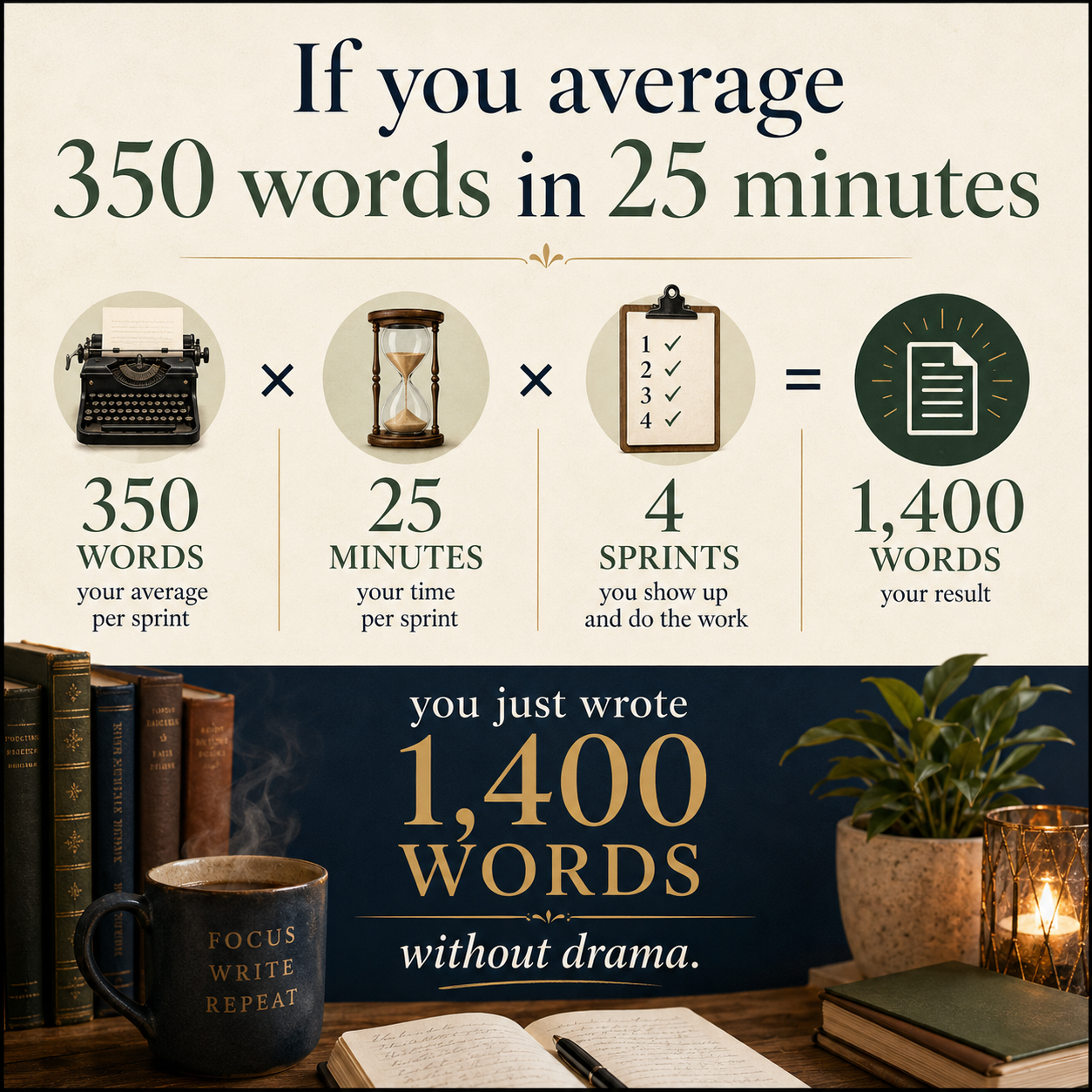
For drafting, the metric I like is words per sprint, tracked honestly. You don’t have to brag about it. You do need to see it. If you average 350 words in 25 minutes and you do four sprints, you just wrote 1,400 words without drama. Do that four days a week and you have a novel draft in months, not years.
If you are a slower drafter, that is fine. Your job is consistency. Speed shows up later as a side effect of confidence and familiarity.
Sprints For Revision That Actually Changes The Book
Revision sprints work best when the target is diagnostic. For example, “Fix chapter 7” is mushy. “Cut 300 words of explanation in chapter 7 and replace with one scene beat” is workable. Another strong target is “track the protagonist’s decision points and rewrite any scene where the decision is missing.”
Use a timer and a checklist. When the timer ends, stop. Revision expands to fill the time you give it, and perfectionism loves an unbounded container.
Sprints For Marketing And Admin Without Avoidance
This is where sprints quietly change your career. Put your marketing tasks into sprintable chunks: write five newsletter subject lines, draft one BookBub ad set, update your Amazon KDP description, build a simple reader magnet landing page.
At Adazing, I build tools because authors need fewer friction points. If you’re drafting and you get stuck on a character name, a fast name generator beats a 30-minute internet spiral. If you need a clean writing space, a tool like QuickWrite gives you a place to put words without inviting you to fiddle with formatting. The point is not the tool. The point is keeping your sprint sacred.
Common Sprint Mistakes That Keep You Stuck At The Same Word Count
Online sprints are simple. They are also easy to sabotage in ways that feel reasonable in the moment. If you fix these, you usually see an immediate jump in output.
Using Sprints To Research Instead Of Writing
Research is real work. It is also a very socially acceptable hiding place. If your sprint goal is “research 18th-century sailing knots,” you’re probably avoiding a scene that scares you.
I recommend a rule. During drafting sprints, you can write “TK” or “INSERT DETAIL” and keep moving. Outside the sprint, you can research and patch. This habit alone saves thousands of words’ worth of momentum over a draft.
Measuring Success By How Good It Felt
Some sprints feel electric and produce clean pages. Most sprints feel ordinary. A few feel like you’re shoveling gravel. The feeling is a bad metric.
Track output and completion of the target. If you hit the target, you win the sprint. If you missed it, you can adjust the target or the interval next time. That is the feedback loop that improves your process.
Joining Too Many Sprint Groups
Writers love collecting new systems. If you join five sprint servers, you will spend your week deciding where to sprint instead of sprinting.
Pick one primary room and one backup. Schedule two to four recurring sessions on your calendar. Treat them like a standing appointment with your future royalties.
FAQs for Writing Sprints Online: Get More Done
How long should an online writing sprint be?
I recommend 20 to 25 minutes for most authors because it is long enough to get into the scene and short enough to feel safe. If you are rebuilding a habit, start at 10 minutes and stack rounds. If you are drafting comfortably and not self-editing, 45-minute sprints can work.
Do I need to turn my camera on for online sprints?
No. Camera-on works for some people because it increases commitment, and camera-off works for others because it reduces self-consciousness. Pick the setting that keeps you writing. If the room requires video and that makes you tense, find a different room.
What do I do if I freeze during a sprint?
I write the next obvious sentence, even if it is ugly, and I add a bracketed note about what I am trying to accomplish in the scene. If I am truly stuck, I switch the sprint goal to “write a bad version of the scene outcome” and allow myself to be blunt. You can revise bad prose. You cannot revise a blank page.
A Sprint Habit That Ships Books
Online sprints are worth your time because they create a repeatable container for work that is otherwise too easy to postpone. If you want a simple plan, schedule three sprint sessions this week, pick one specific target for each, and track what you produce without judging it.
If you do that for a month, you will have more pages, more clarity about your process, and fewer excuses that sound smart. That is when writing starts behaving like a career.
