
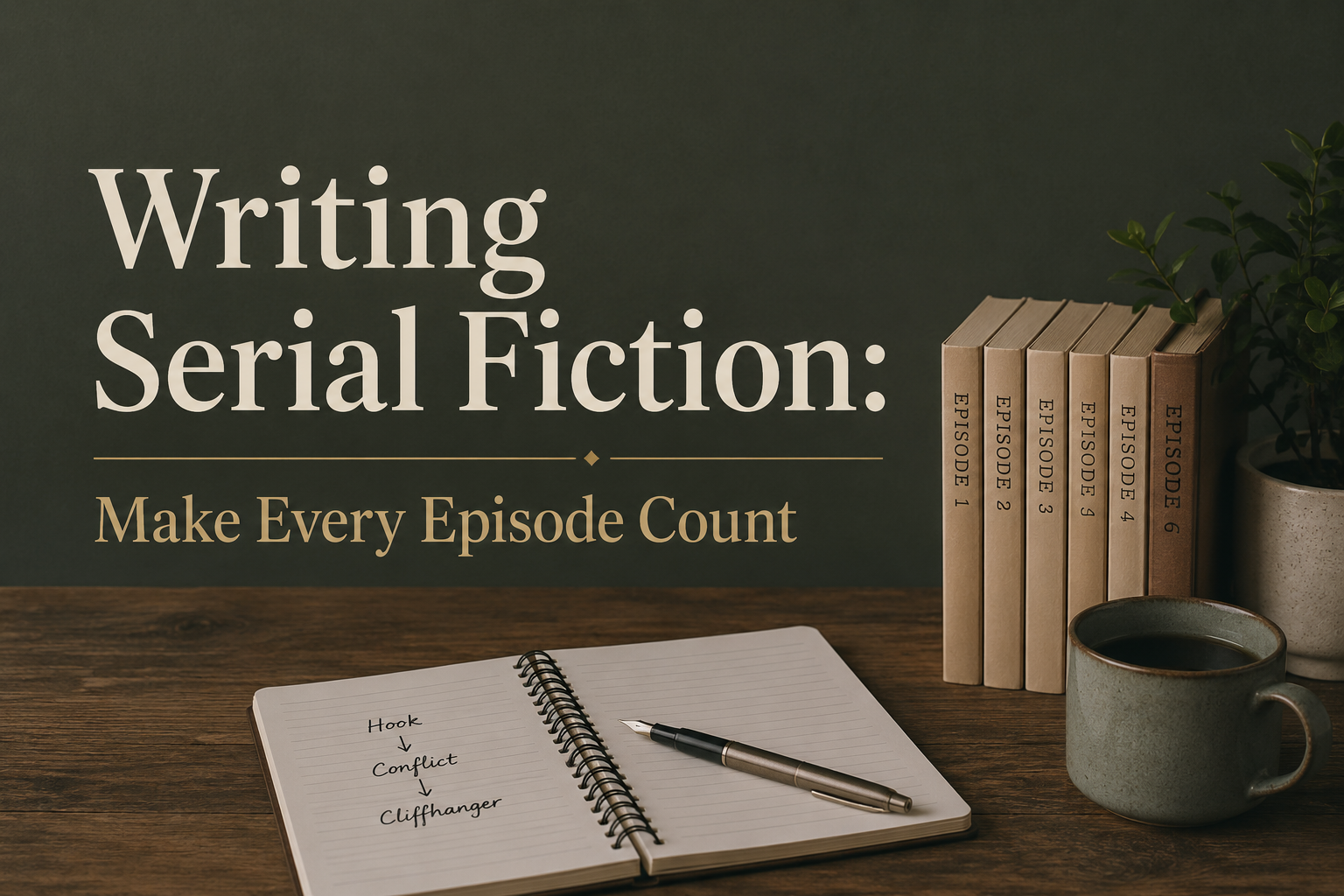
Your serial fiction lives or dies on whether each episode pays the reader back for showing up, and writing serial fiction forces you to treat every installment like a product that has to earn a click, a read, and a return visit. If an episode feels like connective tissue, your audience does what any sane reader does when their time gets taxed. They wander off, and they do not come back.
I like serials because they make craft visible. You can see reader behavior in real time, and you can feel where your pacing, promises, and cliffhangers actually work. The downside is that your weak spots stop being theoretical. A saggy middle is no longer a one-time slump inside a novel. It becomes three weeks of people forgetting you exist.
The fix is not louder drama or bigger twists every time. The fix is a repeatable episode design that delivers satisfaction on a schedule while still pulling a long arc forward. If you build that system, you can publish consistently without burning out, and you can turn casual episode readers into read-through that supports your books, your Patreon, or your eventual box set.
Table of Contents
Episode Value Over Word Count
The most common serial mistake I see is thinking an episode is a chapter. A chapter can end on a quiet beat because the next chapter is already sitting there. An episode is a new buying decision, even when it is free. If the reader closes the tab and feels nothing happened, you trained them to skip you next time.
So I measure an episode by value delivered, not by length. Value can be plot movement, a revelation, a payoff to a promise you made earlier, a character choice that changes the situation, or a scene that answers a specific question the reader carried in. If you cannot name the value in one sentence, the episode is not ready.
A Clean Episode Contract
Before you draft, write a one-line contract for the installment. I use a format like: “In this episode, the protagonist tries X, runs into Y, and ends with Z, changing the stakes.” That line stops you from spending 2,000 words on vibes and throat-clearing.
You do not need to reveal everything, and you should not. You do need to let the reader feel movement. Movement is what makes them trust you with their time.
One Scene That Cannot Be Skipped
If you want an episode to count, give it at least one scene that would damage the story if removed. Think of it as a load-bearing scene. It can be a confrontation, an escape, a discovery, a betrayal, a vow, a decision, a kiss that complicates everything, a clue that reframes a prior assumption.
When I edit serial drafts, I ask a blunt question. If a reader missed this episode and read the next one, would they be confused? If the answer is no, your episode is optional, and optional episodes kill retention.
A Practical Drafting Check
After drafting, highlight three sentences that only exist because this episode exists. They might be a new piece of information, a new problem, or a consequence. If you cannot find those sentences, you wrote a bridge, not an episode.

Promises, Payoffs, And Reader Memory
Serial readers have shorter story memory than novel readers, not because they are careless, but because time passes between sessions. If you post weekly, they have a week of life between episodes. If you post monthly, they have a month for other books, shows, and obligations. That gap changes how you handle setup and payoff.
Cliffhangers work because they create an open loop, and open loops stick in working memory. That is not mystical; it is basic cognition. The effect is well-known as the Zeigarnik effect, the tendency to remember uncompleted tasks better than completed ones. Your job is to open loops that matter, then close enough of them often enough that the reader trusts you.
Two Loops Per Episode
I like two active loops in each installment. One closes. One stays open. The closed loop is your satisfaction. The open loop is your propulsion. If you leave everything open, the story becomes an endless tease. If you close everything, the story becomes a series of disconnected vignettes.
Here is what that looks like in practice. The hero finds the stolen ledger. That closes the “can they locate it” loop. The last page reveals the ledger is a forgery, and now the “who set them up and why” loop opens.
Recaps That Respect The Reader
Recaps are tricky. Too little, and readers feel lost. Too much, and they feel talked down to and bored. I aim for 30 to 80 words at the start, folded into story motion, not a “previously on” dump. One sensory detail, one emotional state, one concrete fact. Then move.
In romance, that might be the taste of stale champagne at last night’s gala, the ache of regret, and the knowledge that the love interest saw the forged letter. In litRPG, it might be the new debuff, the location, and the timer that is still counting down.
Payoffs On A Predictable Schedule
If you want a simple rule that works across genres, put a meaningful payoff every one to three episodes. That payoff does not have to be the main mystery solved. It has to feel like a win, a loss, or a truth that changes decisions.
When I watch serials fail, it is usually because the author keeps “saving the good stuff” for later. Later is imaginary. Your reader only lives in the episode they are holding right now.
Structure That Carries Momentum
A strong episode has shape. It starts with a problem that matters now, it escalates, and it ends with a consequence that forces the next move. If your episode starts with characters chatting about what they might do, you are asking your reader to pay for your outlining process.
A Simple Episode Spine
If you want an episode template that is boring in the right way, try this spine.
First, a hook that reactivates curiosity inside the first 200 words. Then, an attempt. Then, resistance. Then, a turn that changes the situation. Finally, an ending beat that makes the next choice unavoidable.
This structure works because it matches how readers process scenes. Action creates expectation. Resistance creates tension. A turn creates surprise. Consequence creates momentum.
Cliffhangers That Do More Than Yell “Wait”
I like cliffhangers that force a reframe rather than cliffhangers that interrupt a scene mid-swing. “The door creaked open” is cheap suspense unless what is behind the door changes the meaning of the last three episodes.
Use cliffhangers in three categories.
- A decision cliffhanger, where the protagonist chooses the harder path.
- A revelation cliffhanger in which a fact reorders motives.
- A consequence cliffhanger, where the price arrives.
Those endings stick because they create a new story problem, and that is the only cliffhanger that earns its keep.
Scenes That Start Late And End Early
Serial pacing improves fast when you start scenes closer to the moment of change and leave once the change lands. I do not need to watch your detective park the car, climb the stairs, and knock on the door unless the staircase is where the trap is.
If you are worried this will remove texture, focus the texture on chosen moments. One sharp detail in the right place carries more atmosphere than a page of neutral movement.
Release Rhythm And The Reality Of Attention
Consistency matters in serials because your reader’s attention is a habit. You are training them to check in. That does not mean you have to publish daily. It means your schedule has to be something you can keep for months without collapsing.
Written Word Media’s reader surveys have repeatedly shown that readers discover books through advertising and email, then stick with authors they trust. Trust grows when you publish regularly and deliver what you promised. You can see their reporting on reader behavior and marketing channels in their reader survey resources.
Picking A Schedule You Can Survive
I recommend choosing a release cadence based on your drafting speed, your revision needs, and your life. Weekly is a sweet spot for many genres because it keeps memory warm without demanding daily output. Twice weekly works if you write fast and you stockpile episodes. Monthly works for long, high-effort installments, but you will need stronger recaps and louder reminders.
The wrong schedule is the one you announce publicly and then fail to meet. Misses happen, but a pattern of misses teaches readers to stop checking.
Buffering Like A Professional
If you want your serial to feel reliable, build a buffer. I like four to eight episodes in reserve before you publish the first installment. That buffer buys you safety when you get sick, travel, or hit a hard revision problem.
It also improves your storytelling. When you are not writing at the edge of panic, you can foreshadow with intention and clean up continuity errors that serials love to expose.
Platforms And Packaging Choices
Your platform changes reader expectations. Wattpad skews toward fast hooks and emotional immediacy. Kindle Vella rewards frequent episodes and coin-friendly pacing. Patreon readers often want behind-the-scenes notes and a sense of community. Substack readers respond to clear subject lines and a strong voice. Amazon KDP for box sets rewards clean series metadata and strong covers.
When you later bundle your serial into volumes, treat it like a real book launch. Your cover thumbnail matters, your blurb needs to sell curiosity, and your categories should match your comps. Amazon’s own documentation is blunt about how readers browse and filter in the store, and the KDP guidance on categories is worth reading because it shows you how your book actually gets shelved.
Tools And Workflows That Keep Episodes Sharp
Serial fiction punishes messy workflow because you have more deadlines and more continuity points. If you lose track of a minor character’s injury or a timeline detail, your comments section will catch it within minutes. That is not hostile. That is proof people are paying attention.
A Minimal Tracking System
You do not need a massive series bible to start, but you do need a single source of truth. Track names, ages, physical tells, locations, timeline dates, and unresolved clues. A simple spreadsheet works. A note app works. The medium matters less than the habit of updating it after every episode.
If you write fantasy or sci-fi, track your rules. Magic costs. Tech limits. Travel times. Readers forgive a lot, and they do not forgive broken rules you trained them to rely on.
Draft Fast, Revise For Promise Fulfillment
I draft serial episodes with momentum, then I revise with a specific lens. I look for promises I made and check whether I paid at least one of them. I look for scenes where characters talk about action instead of taking it. I look for the ending beat and ask whether it forces a next step.
This editing pass is where episodes start to count, because it is where you stop writing “more story” and start writing “the right story.”
Adazing Tools In A Serial Workflow
If you want practical help, I would use Adazing tools the same way I use any production toolkit. Use QuickWrite to keep drafting friction low and to keep your episode files organized, then use name generators and word generators when you hit the serial author’s classic trap of stalling on a minor character or a place name. You are not proving your artistic purity by spending an hour naming a bartender who appears once.
When you bundle episodes into a volume, Adazing’s cover maker can get you to a professional-looking concept fast, which matters because a box set cover that reads at thumbnail size sells better than a beautiful cover that turns into mush at 100 pixels. You still need genre-true typography and a clear focal image, but speed helps you test and iterate.
FAQs for Writing Serial Fiction: Make Every Episode Count
How long should a serial fiction episode be?
Length depends on platform and genre, but I would pick a length you can deliver consistently and then focus on whether the episode feels complete. Many successful serials run anywhere from 1,000 to 3,000 words per episode for frequent posting, and longer if the schedule is slower. If readers finish and feel no change has happened, the word count was wasted.
Should every episode end on a cliffhanger?
No. I would end most episodes with a consequence that points directly at the next problem, and I would use true cliffhangers when the story earns them. A steady diet of interrupted scenes numbs the reader. A steady diet of meaningful turns builds trust and keeps them returning.
How do I turn a serial into a book without it feeling repetitive?
I revise the compiled draft as a novel, not as a stitched feed. I trim redundant recaps, smooth pacing where episodic endings created extra beats, and add or tighten foreshadowing now that I can see the whole arc. Then I package it like a normal release on Amazon KDP, with a cover and blurb that match your category’s expectations and a series page that supports read-through.
The Standard Your Episodes Have To Meet
Every installment has to deliver a real change and a clean reason to return, because your reader is constantly deciding whether you are worth another slice of their attention. If you write each episode with a clear contract, two active story loops, and an ending consequence that forces the next move, you will feel the difference in retention.
Serial fiction rewards discipline more than genius. Build the repeatable episode shape, protect your schedule with a buffer, and treat packaging like publishing, because that is what you are doing.
