
The fastest way to fail at writing middle grade fiction is to treat it like “kid stuff” and hope charm covers the craft. Middle-grade readers are impatient, emotionally honest, and brutally clear about what bores them, and they will close your book without a second thought.
You, as the author, have to do two jobs at once. You have to build a story with real narrative muscle and deliver it through an age-appropriate lens that respects what an 8 to 12-year-old can feel, fear, and figure out on the page. If you get that balance right, middle grade becomes one of the most satisfying categories to write, and one of the most reliable for series read-through.
I’m going to show you how I approach middle grade at the level that actually moves the needle: voice, viewpoint, plot architecture, theme, and the practical realities of publishing and packaging the book.
Table of Contents
Know The Reader You Are Actually Writing For
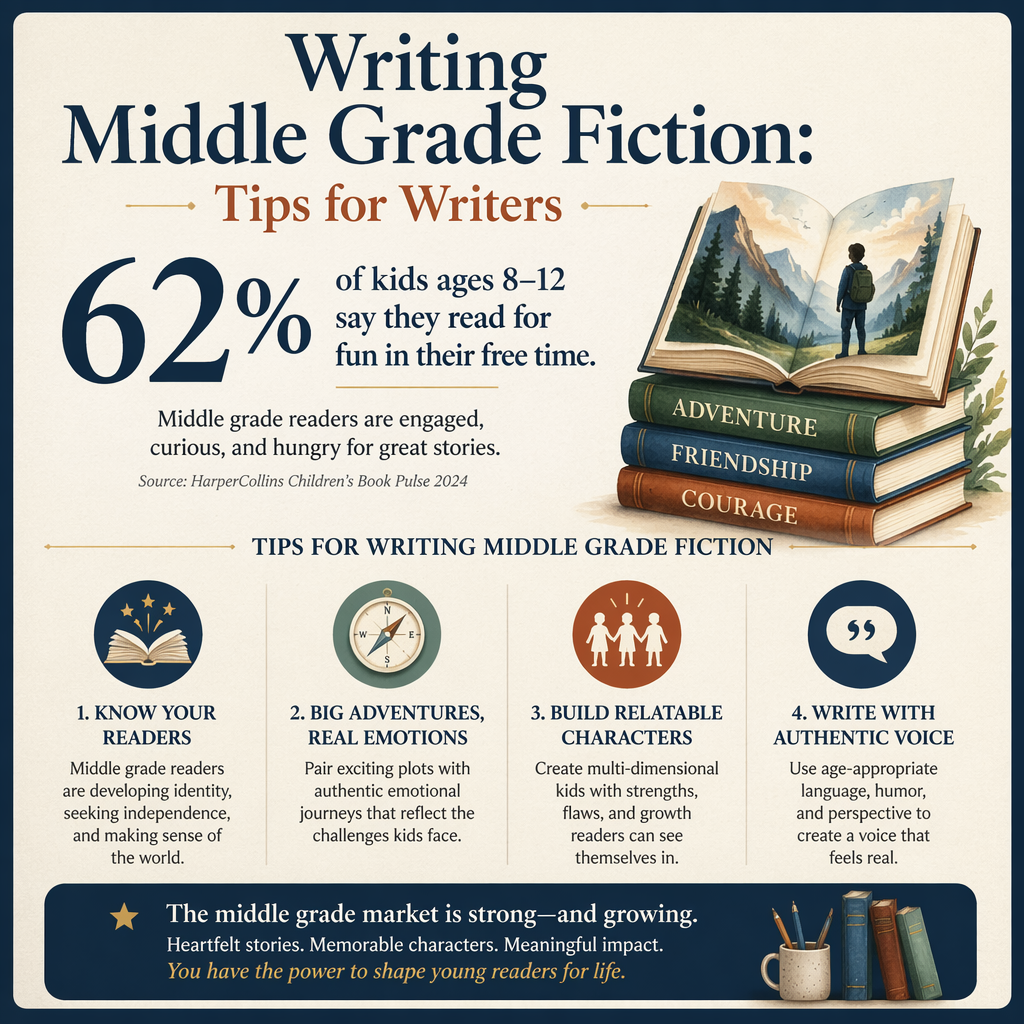
Middle grade is not “YA without romance,” and it is not “chapter books with bigger words.” It’s its own ecosystem. The center of gravity is independence. Your protagonist is starting to make choices that matter, often away from adults, and the consequences land emotionally even when the situations look playful on the surface.
Most middle-grade protagonists fall roughly between 10 and 13, with 11 to 12 sitting right in the sweet spot for broad appeal. Your reader is usually a little younger than your protagonist, which means your main character functions as a small step ahead, a believable guide into bigger feelings and bigger risk.
Age Band Clarity
If you don’t decide your age band early, your manuscript will wobble. The humor will skew one way, the vocabulary another, and your conflict will feel either too small or too intense. I recommend picking an age target and writing a one-paragraph “reader promise” for yourself: what kind of challenge the book offers, what emotional temperature it runs at, and what kind of ending you’re delivering. Then use that paragraph as a revision filter.
What Kids Want Versus What Adults Approve
This is the part most writers avoid admitting. You are writing for kids, but adults act as gatekeepers through libraries, classrooms, and parental buying. Your job is not to appease gatekeepers. Your job is to write a book kids love so much that adults happily hand it to them.
That means you can tackle real topics, grief, anxiety, identity, friendship betrayal, divorce, moving, bullying. You handle them with honesty and forward motion. Middle grade tends to dislike long “processing” scenes where nothing changes. Give the reader something to do with the feeling, even if that “something” is a messy attempt.
Market Reality You Should Not Ignore
If you plan to self-publish middle grade, be aware that discoverability behaves differently from adult genres. School and library channels matter, and so do reviews from credible kidlit sources. Pew Research reports that print still dominates American book reading, which matters because many middle-grade readers are still building stamina on paper. If you go ebook-first, you can still succeed, but you need to compensate with strong metadata, series packaging, and a marketing plan that reaches parents and educators.
What I’d do: Decide early whether you are writing for trade publishing, self-publishing, or a hybrid plan. Your trim size, illustration approach, price point, and even chapter length can shift based on that decision.

Voice, Point Of View, And The Middle Grade Lens
Middle-grade voice is a contract. It tells the reader, within a page or two, that you see the world the way they do right now, not the way you remember it from an adult distance. The most common failure I see is an “adult narrator wearing a kid costume,” where the sentences sound like a grown-up explaining childhood.
Close Perspective Without Adult Commentary
I recommend writing in a close third- or first-person that stays glued to the protagonist’s immediate interpretations. The character can be smart, witty, even surprisingly perceptive. What you want to cut is the adult aside that signals you, the author, are hovering above the scene to explain the moral of it.
A clean test during revision is to hunt for sentences that translate the kid’s feelings into adult language. If your character thinks, “This was the moment I realized my mother’s depression shaped our family systems,” you are not in middle grade anymore. Let the kid notice patterns the way a kid would: through routines, shifts in tone, small humiliations, and sudden tenderness.
Sentence Rhythm And Vocabulary
Middle-grade prose can be elegant, but it should not be ornate. You can use sophisticated words when the context teaches them, and when the voice naturally reaches for them. The goal is readability under momentum.
The National Center for Education Statistics tracks reading performance trends, and its reporting around reading proficiency is a useful reminder that many kids read below “grade level” while still craving great stories. You can see their long-term reading assessment results in the NAEP report card data. I don’t bring this up to scare you. I bring it up because clarity is inclusion. A kid who has to fight your sentences won’t reach the good part.
What I do in line edits: I shorten sentences that carry plot information, and I allow longer sentences when they carry voice, humor, or a spiraling emotional beat. That mix keeps pages turning.
Humor That Lands For The Right Age
Middle-grade humor is often physical, social, and status-based. It can be embarrassment, misunderstandings, or a plan that collapses in public. Sarcasm can work, but it has to come from character, not from a snarky author trying to entertain adult readers.
A practical step: Flag every joke and ask who it is for. If it’s mainly for the parent reading aloud, either cut it or rewrite it so the kid in the scene is the one creating the humor.
Plot And Pacing That Actually Pulls Kids Through
Middle-grade pacing is not about constant action. It’s about constant engagement. A quiet chapter can still be a page-turner if every scene forces a choice, exposes a secret, or tightens a social knot.
Start With A Problem, Not A Premise
Writers love premises. “A kid finds a portal.” “A girl discovers she can talk to animals.” Kids love problems. “If I don’t fix this by Friday, I’ll lose my best friend.” Give me the portal, yes, but attach it to a pressure that matters emotionally right now.
I recommend you write your first chapter around three beats: the normal day, the disruption, and the first decision your protagonist makes that cannot be undone. That last beat is what turns curiosity into commitment.
Chapters That Earn Their Ending
Cliffhangers work in middle grade, but the cheap version is just a “shock” line with no setup. The better version ends with a new question that grows out of the scene’s logic. You want the reader thinking, “Well, I have to see how they get out of that,” not “The author is yanking me around.”
What I do: I outline chapter endings as “turns.” Each chapter ends with new information, a new obstacle, or a new cost. If a chapter ends with the same emotional and tactical situation it began with, that chapter is a candidate for compression or deletion.
Length, Structure, And Series Thinking
Word count depends on age band and complexity, but many middle-grade novels land roughly between 25,000 and 55,000 words, with fantasy often running longer. Traditional publishers sometimes go longer if the concept supports it and the pacing stays tight.
If you are writing for an indie publication, series strategy matters. A stand-alone can sell, but a good series gives you read-through, which is where the math starts to work. Think in terms of a “series engine.” The protagonist has a recurring desire, a recurring problem-space, and recurring relationships that can evolve without resetting.
A concrete step: Write a one-page series map even if you only plan to publish one book. It will clarify the emotional arc and keep you from stuffing every idea into book one.
Theme And Emotional Truth Without Preaching
Middle grade is where readers practice big emotions in a safe container. That doesn’t mean you soften everything. It means you give meaning to what happens, usually through consequence and choice rather than lectures.
Theme As A Question The Character Lives
I treat theme like a question your character keeps answering differently as the story goes on. “What makes a real friend?” “When should you tell the truth?” “Who gets to decide who you are?” The plot keeps applying pressure until the character’s old answer no longer works.
A practical step: Write your theme question on an index card. Then, for each major scene, ask how that scene poses the question. If a scene does not poke it, that scene better be doing something else important, such as advancing the plot or deepening a relationship.
Adults On The Page
Adults in middle grade should feel real, but they usually cannot be the solution machine. If an adult can fix the central problem in ten minutes with a phone call, you need a different problem or a reason the adult cannot act. That reason has to be believable, not conveniently stupid.
What I recommend: Keep at least one adult as a “safe harbor” character, a teacher, a grandparent, a neighbor, someone kind. Then remove their ability to solve the plot. They can provide care, perspective, and sometimes a tool, but the protagonist still has to choose.
Hard Topics With Age-Appropriate Handling
You can write grief, trauma, mental health, addiction in the family, and other heavy material in middle grade. The boundary is not the topic. The boundary is how explicit you are, how long you linger, and whether you offer the reader a sense of agency and forward motion.
For a craft anchor, I recommend studying the way middle grade handles emotional intensity through implication and focus. The scene often stays on what the kid sees and misunderstands, which can be more powerful than an explicit explanation. It also keeps you inside the intended lens.
Revision, Packaging, And Publishing Realities
A polished middle-grade novel is usually built through revision, not drafted in one clean pass. The draft finds the story. The revision finds the reader.
Revision Passes That Pay Off
I do middle-grade revisions in three passes.
First, I check the agency. In every major sequence, the protagonist must make a choice that has consequences. Second, I check comprehension. I look for places where a kid might get lost, especially around scene goals, who knows what, and how the rules of the world work. Third, I check voice consistency. If the narration starts to sound like an adult essay, I rewrite until it sounds like a kid’s lived experience again.
A concrete step: Create a simple scene list with three columns: “Goal,” “Obstacle,” “Change.” If you cannot fill all three for a scene, that scene needs work.
Beta Readers, Sensitivity, And Feedback
Adult beta readers can help with structure and prose, but they are unreliable judges of kid appeal. If you can, get feedback from librarians, teachers, or parents who read a lot of current middle grade and consider kid readers in your target age band with a facilitator who can collect honest reactions.
Sensitivity feedback matters when you write outside your lived experience. It is not about writing timidly. It is about avoiding lazy harm. Use it early enough that you can revise without resenting the process.
Cover, Blurb, And Metadata For Middle Grade
Your cover is doing its most important work as a tiny thumbnail on Amazon or a small rectangle on a library website. Middle-grade covers tend to be more illustrated, more character-forward, and more clearly genre-coded than adult fiction. If your cover looks like adult literary fiction, you are asking a kid to take a social risk by carrying it around.
If you need a practical workflow, Adazing’s book cover tools can help you mock up concepts before you pay for final art. I like using fast iterations to test genre signals, title readability, and whether the main character’s vibe matches the story. That early visual clarity also helps you write cleaner back cover copy.
On the blurb, I follow one rule: I sell the problem, the desire, and the twist, and I stop before I explain the whole plot. Amazon’s own guidance on product detail pages is a reminder that shoppers skim and decide fast, and the same behavior applies to book descriptions. Their general principles for clear, scannable listings appear throughout their documentation, and you can start with Amazon KDP guidance for book details to understand what readers see and how you control it.
A concrete step: Run a “comp shelf” exercise. Pick five current middle-grade books similar in tone or category, then compare your cover, title, and description against those. You are not copying. You are checking whether your packaging tells the truth about your book.
FAQs for Writing Middle Grade Fiction: Tips for Writers
What point of view works best for middle grade?
The third person is the most flexible and widely accepted, and the first person can work beautifully if the voice is consistent and kid-true. I choose based on how much interiority the story needs and how comedic the voice is. If you tend to slip into adult commentary, close third gives you a little more control during revision.
How do I know if my themes are too heavy for middle grade?
I look at three factors: explicitness, duration, and agency. If the content is graphic, if the story lingers in despair for long stretches, or if the protagonist has no meaningful choices, it is probably mismatched. You can write hard things if you keep the focus on what the kid can do next, even when the “next” is small.
Can I self-publish middle grade successfully?
Yes, but you need to plan for different discovery mechanics than adult genres. Series read-through helps a lot, and packaging has to signal “middle grade” instantly. You will also benefit from reaching gatekeepers with ARCs, educator-friendly materials, and library-focused marketing alongside Amazon ads.
A Middle Grade Book That Kids Finish
A middle-grade novel succeeds when you respect the reader’s intelligence and you respect their time. Give them a protagonist who wants something now, build scenes around choices with consequences, keep the voice close and kid-true, and revise for clarity the way you would revise for suspense.
If you do that, your book stops being “a nice children’s story” and becomes the thing middle-grade readers actually chase: a world that understands them and a plot that refuses to let go.
