
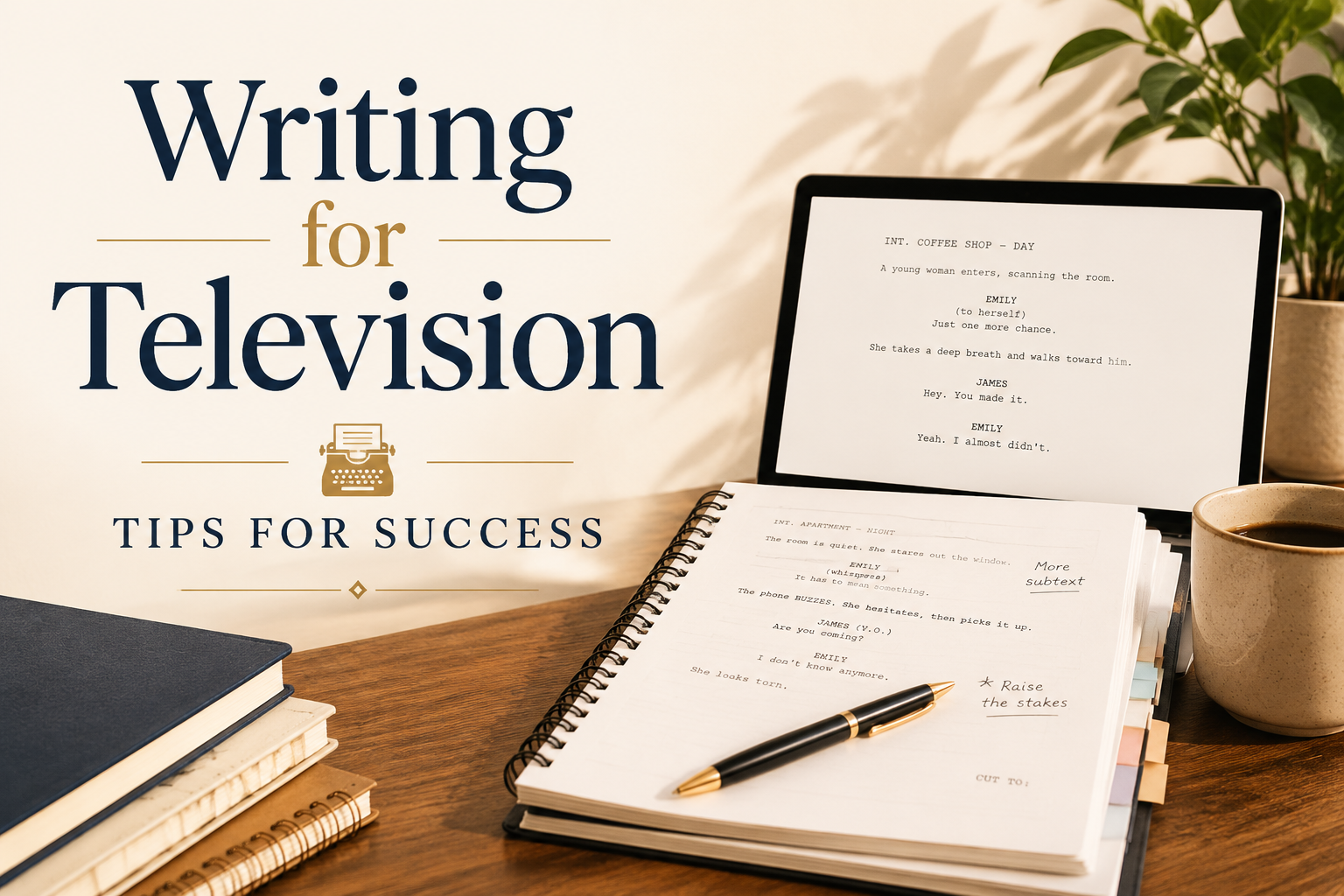
Screen time is expensive, and writing for television forces you to spend your story budget with discipline. When you switch from novels to writing for television, your biggest adjustment is accepting that your prose voice is not the product anymore. Your product is a repeatable engine that generates scenes a room of writers can build, actors can play, and a crew can shoot on schedule.
If you come from books, that can feel like someone took away your favorite tools. You cannot linger in interiority for pages. You cannot “fix it in revision” once production is rolling. You also have fewer pages to earn the audience’s trust, and you have executives and showrunners who care about clarity as much as artistry.
I’m going to give you the shifts that matter: how to think in scenes and beats, how to write a pilot that sells a series, how to handle collaboration without losing your voice, how to format so you look professional, and how to move from “good script” to “script people can produce.”
Table of Contents
Thinking In Scenes, Not Chapters
Novelists often structure by chapter, theme, or character interior arcs. Television structures stories by scenes that do one clear job, and the currency is conflict plus change. If a scene starts and ends at the same emotional temperature, it might read fine on the page, but it plays flat on screen because nothing moved.
A practical test I use is simple. At the end of every scene, I want to be able to answer two questions in one sentence each: what did the character want here, and what changed because they tried to get it? If you cannot answer those cleanly, the scene is probably atmosphere, backstory, or “nice writing” that will die the first time the budget meeting happens.
Scene Goals That Can Be Filmed
On the page, “she realizes she’s been wrong about her marriage” can be beautiful. On screen, that is a problem unless you externalize it. Give the actor something playable: a choice, a lie, a confession, a refusal, a physical task that becomes emotionally charged. You are still writing inner life, but you are doing it through behavior.
Take one chapter from your current novel and translate it into three scenes with visible objectives. Keep the same emotional turn, then cut every line that cannot be performed or filmed. This exercise will show you how much of your book voice is internal narration and push you toward dramatic action.
Beats, Turns, And The Value Of A Hard Cut
A television scene is built from beats: small units of intention and reaction. A beat changes when someone’s tactic changes, new information lands, or power shifts. You do not need to label beats in your script, but you do need to feel them the way you feel paragraph turns in prose.
End scenes late. Start scenes late. This habit does two things: it keeps pacing tight, and it gives editors clean-cut points. When you are unsure where to cut, cut on a decision, a reveal, or a reversal. If you cut after characters agree on the plan and then calmly walk out, you are burning seconds you never get back.
Subtext Over Explanation
Television dialogue cannot carry the same explanatory load as narration, and audiences are better at inference than many writers give them credit for. I see book writers lean on “as you know” conversations because they are trying to preserve the clarity they can achieve in prose. It reads like an instruction, and actors hate it.
Rewrite one exposition-heavy exchange in your draft so that each character is trying to get something from the other. Keep the information, but hide it inside conflict, bargaining, teasing, flirting, threat, or denial. If the line were not spoken in a fight, a negotiation, or a seduction, it probably belongs in a different form.
Building A Series Engine That Lasts
A television pilot is not a short story. It is a promise of dozens of stories. If you sell a pilot that only works once, you have written a really expensive first chapter.
When I evaluate a pilot, I look for the series engine: a repeatable situation that produces fresh conflict every episode. Think “workplace with competing agendas,” “family with secrets and shifting loyalties,” “case-of-the-week with a personal cost,” or “small town where everybody knows too much.” Without that engine, your pilot might be dramatic, but it will not be a show.
Logline Discipline For Writers Who Love Complexity
Novelists often resist loglines because they feel reductive. In TV, the logline is a stress test. If you cannot express your show in one sharp sentence, you will struggle to pitch it, and executives will struggle to market it.
Your logline needs four things: the protagonist, the arena, the goal, and the opposition. “A burned-out ER doctor tries to rebuild her career at a rural hospital where the staff is loyal to the man who ruined her,” tells me the engine and the friction. It also hints at an ongoing story.
Write ten loglines for your premise. I mean ten. You are not hunting for the cleverest wording. You are discovering what the show actually is when it is forced to be simple.
Character Webs That Generate Episodes
In novels, you can carry a scene with one character’s consciousness. In TV, characters generate story through relationships, and those relationships need built-in pressure. Your job is to create a web where any pairing produces sparks, not just your favorite duo.
I like a grid test. Put your main cast across the top and down the side, then fill in each square with one sentence: what does A want from B, and what is B afraid A will do? If you hit “I don’t know” too often, you do not have enough friction to sustain a season.
Episode Shape And Act Break Thinking
Even in a streaming world, act breaks still matter because they map to attention. You are writing for an audience that can pause, scroll, and abandon you in seconds. Cliffhangers are not a gimmick. They are a pacing tool.
For a broadcast-style structure, you typically build to big turns at act-outs. For streaming, the structure is looser, but the psychology is the same: you need regular moments that make the viewer choose “next episode.” Netflix has been open about measuring engagement and completion, and while they do not publish craft rules, the incentive is clear. If your scenes do not turn and your episodes do not build, the viewer leaves.
Outline one episode as eight to twelve sequences, each with a goal, obstacle, and turn. Treat each sequence like a miniature story. If you cannot find turns, you are probably writing mood, not drama.
Writing The Pilot That Gets Read
The hardest part of television writing is that your script is judged before it is produced. A novel can be discovered slowly. A pilot script is often read, compared to other scripts, and passed on quickly. That is not romance, but it is the market.
Professional readers and assistants are trained to notice pages that feel “shootable” and pages that feel like a novelist trying to sound cinematic. You can be lyrical on TV, but it has to be economical and playable.
Cold Opens That Earn Attention
Your first two pages are not where you “set the tone.” They are where you prove you can deliver a story. A strong cold open does one of these things: introduces the central problem, reveals the show’s moral question, or delivers a disruption that demands an explanation.
Write three different cold opens for the same pilot premise. One that starts on action, one that starts on a character choice, and one that starts on a mystery. Then pick the one that best demonstrates the engine. If your cold open could belong to ten other shows, it is not doing its job.
Clarity On The Page Without Directing
New TV writers often over-direct. They write camera moves, edit instructions, and performance notes. Some showrunners do that in production drafts, but if you are writing a spec or a sample, you want clean storytelling that implies the shot because the action is clear.
Keep action lines short and visual. Use strong verbs. Limit adjectives to what changes the meaning. If a detail will not be seen or heard, remove it. This discipline is the screenwriting version of cutting throat-clearing from a novel chapter.
If you want a practical way to train this, read the action lines aloud and ask yourself if an actor can do it and a crew can shoot it. If the answer is “it’s a feeling,” put that feeling into behavior or dialogue subtext.
Dialogue With Rhythm And Purpose
Television dialogue carries character, conflict, and pace. It cannot carry your narrator’s intelligence the way prose can. You need to build voices through choices: what a character avoids, how they frame questions, what they refuse to name, and when they interrupt.
A simple rewrite drill: take a conversation and cut the first two lines from both speakers. Most writers start too early with social grease, and TV does not have time for it. Then cut any line that repeats information the other person already knows. The remaining dialogue will feel sharper and more intentional.
Collaboration And Notes Without Losing Your Voice
Television is collaborative by design. If you are used to being the final authority on your manuscript, the notes process can be a shock. The skill you need is translation. You take a vague or even wrong note and translate it into a story problem you can solve.
When someone says “I didn’t connect with the protagonist,” they might mean the protagonist has no clear want, or the protagonist’s first choice is passive, or the protagonist’s pain is abstract. If an executive says “it’s too dark,” they might mean the show has no relief valve, or the humor is missing, or the stakes feel hopeless.
Notes Triage That Protects The Draft
I sort notes into three buckets. First, objective clarity problems: confusion about who wants what, what the rules are, or why a character did something. Second, audience alignment: tone, likability, and pacing. Third, taste notes: personal preferences that may not match the show.
Fix clarity problems immediately. Audience alignment notes deserve serious consideration because they often point to market reality. Taste notes only matter if the note-giver is someone who can kill the project, or if the note reveals a pattern you also see in other feedback.
After you collect notes, write a one-page plan that lists the story problems you are solving, not the exact edits you will make. This step keeps you from doing frantic patchwork that creates new holes.
Writers Room Mindset For Novelists
A good room is a machine that produces options. Your job is to pitch clean, build on others, and let go of your first idea when a better one appears. If you protect every line like it is sacred prose, you will slow the room down, and you will not be invited back.
You can practice this without a room. Take a premise and write five different ways a scene could end, including one ending you dislike. This exercise strengthens flexibility, which is a real survival skill in TV.
Credit, Money, And The Business Reality
Television contracts, credits, and payments vary by market and union status. If you work under the Writers Guild of America, your deal terms are guided by the MBA, and credit arbitration is its own world. Even outside that system, producers will care about the chain of title and clear agreements.
If you are serious about selling, read the WGA’s public resources so you understand the vocabulary people will use around you, including separation of rights, credit, and residuals. The WGA contract resources are a solid starting point for understanding how the business side shapes the creative side.
Tools, Format, And A Workflow You Can Repeat
You do not need fancy gear to write for television. However, you do need professional formatting and a workflow that keeps you producing pages. Scripts are read in a standardized form for a reason. It allows everyone to estimate timing, production demands, and workload. If your formatting is sloppy, people assume your craft is sloppy too.
Script Format Standards
Use proper screenwriting software and learn the basics: sluglines, action, character cues, dialogue, parentheticals used sparingly, and clean scene transitions. Final Draft is still common in professional settings, and WriterDuet is widely used for its collaborative features. The tool matters less than the output looking like it belongs on a desk in a production office.
For a quick reference for what “standard” looks like, I point writers to the Academy’s script sample in PDF format. It is not the only authority, but it is a clean baseline for how a script page behaves.
Planning The Draft Like A Production Document
Television writing rewards prep. If you outline like a novelist and leave major structural questions for later, you will spend weeks rewriting the first act because you did not know what your midpoint or finale needed to pay off.
I outline a pilot in layers: premise and engine, season question, pilot A-story, pilot B-story, and the ending that proves the series can continue. Then I do a scene list with one sentence per scene that includes the turn. Only after that do I draft.
If you already use book tools, you can adapt them. I have seen authors use Adazing’s QuickWrite to generate alternate scene approaches, sharpen loglines, and pressure-test dialogue choices before committing to pages. Treat it like a sparring partner, not a ghostwriter. You still decide what belongs in the script, and you still do the taste work.
Deadlines, Page Counts, And Realistic Output
A one-hour pilot usually runs around 55 to 65 pages depending on style and density. A half-hour comedy might land around 22 to 35 pages, again depending on single-cam versus multi-cam rhythm. The old “one page equals one minute” rule is a planning tool, not physics, but it is close enough to keep you honest.
The fastest way to finish drafts is to set a modest daily page goal and protect it. Two pages a day get you a pilot draft in a month. That does not sound romantic, but it is how working writers build samples that get read.
If you want an external reference on the one-page-per-minute convention and why it is approximate, the StudioBinder explanation of screenplay length gives a practical overview with real-world caveats.
FAQs for Writing for Television: Tips for Success
Should I adapt my novel into a TV pilot or write an original sample?
If your novel has a clean series engine and a high-concept hook, adapting it can be smart because you already have characters and a story world. You still need to rebuild it for TV structure, and you must treat the pilot as a promise of future episodes, not a summary of your book. If your novel is interior and voice-driven, I usually recommend writing an original sample first to prove you understand television on its own terms.
How many scripts do I need before I start pitching?
I like two strong samples: one pilot and one additional pilot in a different tone or genre, or a pilot plus a spec episode if you are targeting a staffing path that still values specs. One great sample beats four half-finished ones. If you cannot get a script to a polished, readable state, pitching only teaches you how to collect rejections faster.
What is the biggest mistake novelists make when writing TV scripts?
The mistake I see most is writing “beautiful” scenes that do not turn. The dialogue sounds pleasant, the world feels textured, and nothing changes by the end of the scene. Train yourself to write visible wants, obstacles, and reversals, and you will look like a screenwriter sooner than you think.
The Shift That Actually Gets You Hired
Television rewards writers who can deliver a story under constraints and still make it feel like art. If you want to succeed, stop trying to smuggle a novel onto the screen. Build an engine, write scenes that turn, format like a pro, and finish drafts on a schedule you can repeat. That combination is what gets your sample read, your pitch understood, and your career moving.
