
Most authors don’t lose agents, editors, or contest readers because their book is bad. They lose them because their writing a synopsis reads like a police report of the plot. A synopsis is a persuasive document dressed up as a summary, and the faster you accept that, the easier it gets to write one that keeps someone turning pages.
I’m going to be blunt because you’re busy. Your synopsis is not there to prove you packed a lot of events into your novel. It’s there to show you can tell a coherent story, that your protagonist drives the action, and that the ending pays off the premise. When you do that cleanly, you earn trust fast.
A synopsis has to spoil the ending, which feels like you’re committing a crime against the craft. You’re not. You’re demonstrating control. Here’s how to do it without flattening your book into mush.
Table of Contents
Synopsis Reality Check
The mistake I see most is mixing up a synopsis with a back-cover blurb. A blurb withholds. A synopsis reveals. They have different jobs, different lengths, and different levels of specificity. If you write a blurb-shaped synopsis, you’ll dodge the ending and lean on teaser language, and the reader you’re trying to convince will assume your plot falls apart.
A synopsis is used by readers who look for structure. Agents want to see if your premise sustains a full arc. Editors want to see if the midpoint turns, stakes, and resolution land. Contest judges want to see if you can execute. Even if you’re self-publishing, synopses come up in ads, promo applications, anthology calls, and pitching. Treat it as a professional tool, because that’s what it is.
What A Synopsis Has To Prove
I want your synopsis to prove three things, and I want it to prove them in order. First, your protagonist has a concrete goal. Second, the conflict escalates through choices and consequences, rather than random incidents. Third, the ending resolves the central story problem in a way that fits the setup.
If any of those pieces are missing, the synopsis starts to feel like a highlight reel of scenes. That is when a reader’s confidence drops. They don’t need every subplot. They need to see the spine hold.
What A Synopsis Is Allowed To Skip
You can usually skip travel, minor reversals, and “and then” connective tissue. You can compress repeated beats into a single line. You can refer to secondary characters by role rather than name if the cast is large, but in a smaller book, I prefer you name the major players and keep it consistent.
What you cannot skip is the causal chain; if an event forces a decision that creates the next disaster, that belongs, but if a scene exists because it’s funny, scenic, or emotionally nice, it probably doesn’t.
Length And Format Expectations
Agents and editors vary. Some ask for one page, some two, some a specific word count, and some want a paragraph version plus a longer version. Follow the submission guidelines exactly when you have them, even if you think they’re annoying. When you don’t have guidelines, I find 500 to 800 words covers most novels, and 800 to 1200 words works for more complex plots. Epic fantasy and multi-POV thrillers sometimes need more space, but wordy synopses rarely win points.
Standard formatting still matters. Use third person, present tense, and clear paragraph breaks unless the guidelines say otherwise. Present tense keeps the prose brisk and avoids the awkward time-jumps that show up when you summarize a past-tense novel in past tense.

Start With The Spine Of Your Story
If you try to write a synopsis by shrinking your book, you’ll create a mess. I write synopses by building up from the story spine because it is what a professional reader is scanning for anyway. Your first draft should feel almost too simple. That simplicity is your foundation.
The One-Sentence Core
Write one sentence that includes: protagonist, situation, goal, antagonist force, and stakes. Not vibes. Not a theme. A real engine. Here’s a template that works across genres.
“When [inciting incident] forces [protagonist] to pursue [goal], they face [antagonist force] and must [major choice] before [stakes consequence].”
If you can’t write that sentence without hedging, the synopsis will wobble no matter how pretty the prose is. Fix the story problem first, then the synopsis will suddenly feel possible.
The Three-Act Paragraph Plan
Next, I sketch three paragraphs, one for the setup, one for escalation, one for the resolution. This is not a formula to make your book generic. It’s a container that forces you to include the turning points rather than drown in events.
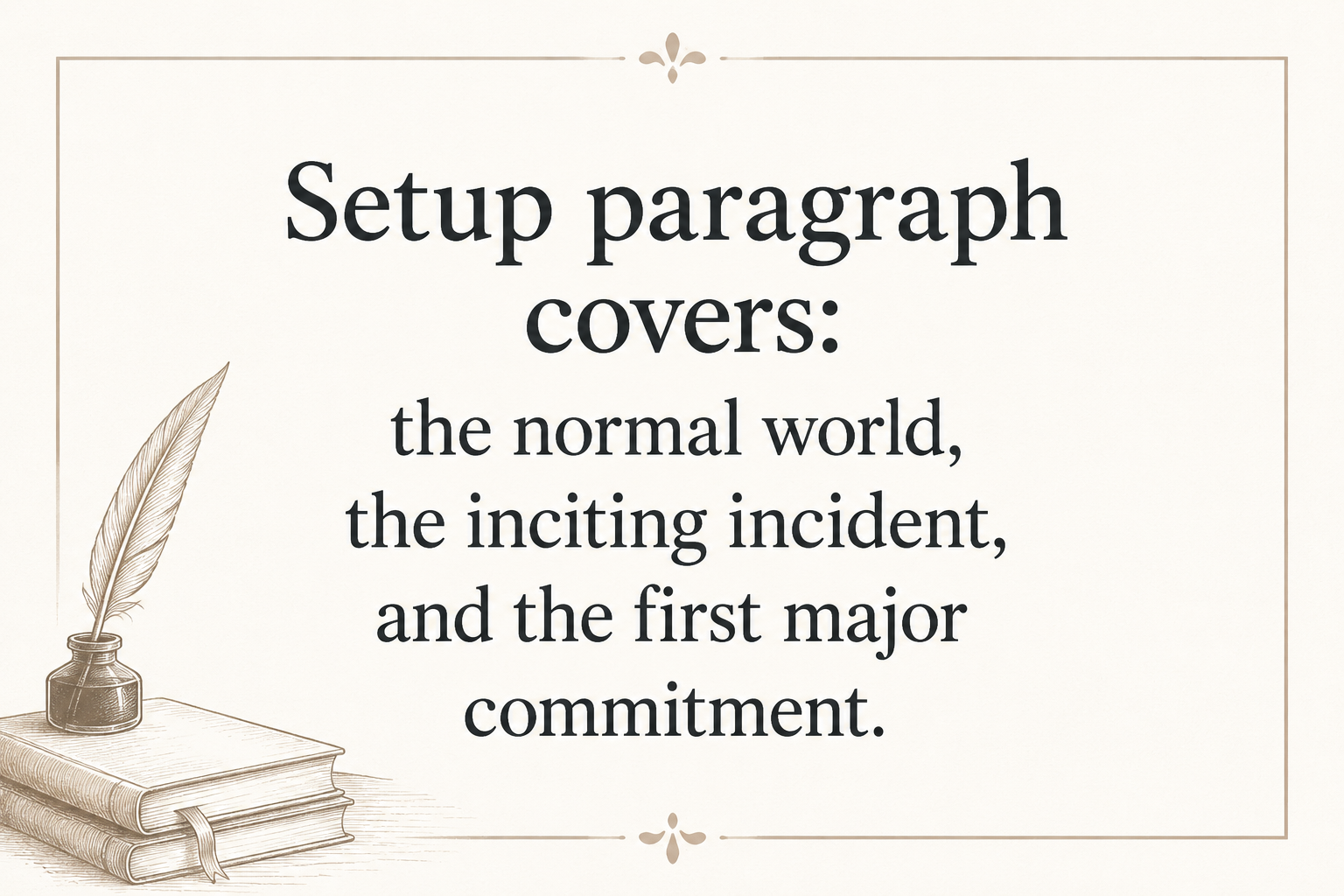
The setup paragraph covers: the normal world, the inciting incident, and the first major commitment. The escalation paragraph covers the rising complications, the midpoint shift, and the cost of pursuing the goal. Lastly, the resolution paragraph covers the dark moment, the final plan, the confrontation, and the new status quo.
Once you have those three paragraphs, you can expand each one into a full synopsis without losing the causal chain.
Choose The Right Throughline For Your Genre
This is where genre changes your emphasis. For example, a romance synopsis needs the relationship arc and the internal barriers, plus a clear ending state for the couple. A thriller synopsis needs the external ticking clock, the reveals, and how the protagonist outmaneuvers the antagonist. Meanwhile, a cozy mystery synopsis needs the sleuth’s method and the final unmasking. Fantasy and science fiction synopses must include enough world rules to make the plot decisions intelligible, but not a lecture on your magic system.
If you’re unsure what to foreground, look at your Amazon category and also-boughts. The books that show up beside yours are a clue to what readers expect as the main engine. Your synopsis should signal that engine without copying anyone’s plot.
Write The First 150 Words as if a Hiring Manager Is Reading
The opening of a synopsis is where most writers waste their best chance. They start with backstory, lore, or a tone poem about the setting. The person reading it is trying to decide if you can tell a clean story under pressure. Give them the inciting incident and the protagonist’s problem fast.
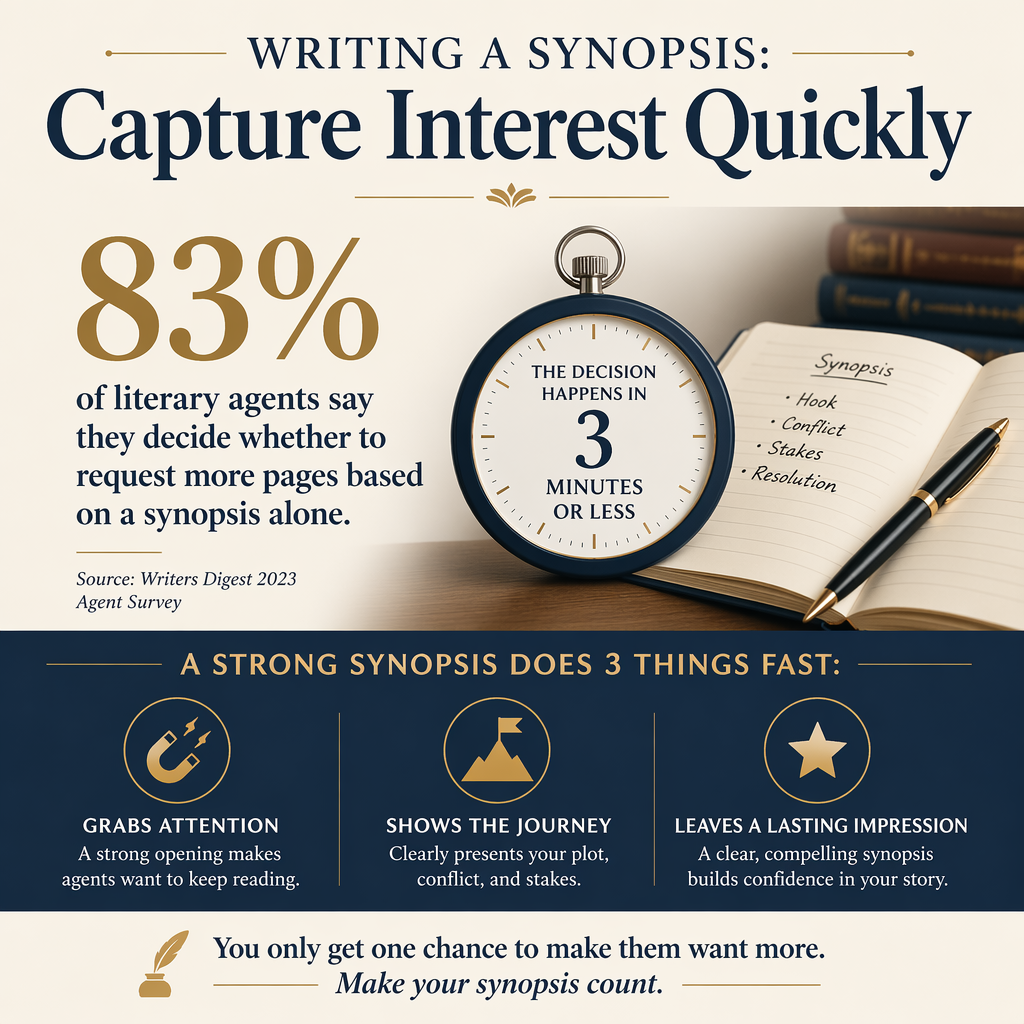
There’s a reason this matters beyond taste. Attention is scarce, and early relevance determines whether a reader stays engaged. Psychologists call this selective attention, and it’s why your synopsis needs to establish “what is this about” before it asks for patience. If you want a readable overview of how limited attention shapes what people notice, see the Britannica entry on attention.
Open With A Concrete Disruption
Give me a character in motion, not a biography. “Mara is a baker in a quiet town” is the background. “When Mara finds a body behind her bakery and the sheriff names her the prime suspect” is a disruption that implies a story. Your first paragraph should establish the protagonist, the trigger, and the immediate stakes.
If your book has multiple POVs, pick one anchor POV for the opening paragraph and expand to the ensemble only when the plot requires it. A synopsis that opens with six names reads like a seating chart.
Use Names Like You’re Paying Per Letter
Proper nouns are expensive in a synopsis. Each new name is one more thing a reader has to hold in working memory while also processing the plot. If you’ve ever felt your eyes slide off a synopsis, it’s usually because the name density is too high.
Research on working memory is deep, contested, and more complex than a single number, but the practical takeaway for a synopsis is stable. Readers have limited capacity for new items while reading. If you want a grounded overview, the APA discussion of working memory provides a clear explanation of why cognitive load rises fast.
So here is my rule. Name the protagonist, the primary antagonist or love interest, and any character who causes a major turn. Everyone else can be “her editor,” “his sister,” “the captain,” or “the rival mage,” as long as the role stays consistent.
Replace Adjectives With Decisions
When I see “dark,” “gritty,” “heartbreaking,” and “twist-filled” in a synopsis, I assume the writer is compensating for thin causality. Tone belongs in your sample pages. The synopsis should prove the engine through decisions, consequences, and reversals.
A line like “Devastated, he spirals” does not tell me what happens. A line like “He sells the evidence to pay his brother’s debts, and the police turn their suspicion onto him” tells me character, pressure, and plot in one move.
Compress Without Flattening
Compression is the craft here. You’re collapsing 80,000 to 150,000 words into a page or two while keeping the story intelligible. The way you do that is by summarizing at the level of turning points, not scenes, and by using clean causal language.
Turn Scenes Into Turning Points
Take a sequence of scenes and ask what changed. Did the protagonist gain new information, lose an ally, commit to a risk, or cross a moral line? That change is your synopsis sentence. Everything else is scaffolding you don’t have room for.
For example, a multi-scene investigation sequence can become: “She interviews the victim’s inner circle and realizes the alibi that cleared her ex is a manufactured timeline.” That one line implies multiple scenes without listing them.
Use Causal Connectors That Show Logic
I lean hard on words that show cause and consequence: “because,” “so,” “therefore,” “as a result,” “which forces,” or “until.” These connectors keep the synopsis from turning into disconnected bullet points written as sentences.
A good test is to highlight every sentence’s subject. If the subject keeps changing from event to event, you’re likely writing a timeline. If the subject stays with the protagonist and their choices, you’re writing a story.
Control Subplots With A Simple Rule
A subplot belongs in a synopsis when it changes the ending. That is the rule that keeps you sane. If the subplot only adds texture, it can go. If it creates a choice that affects the final confrontation, it stays.
Romance and family arcs often feel “optional” to writers who are focused on the external plot, but in many genres, those arcs are where the final decision comes from. Keep the emotional throughline that motivates the climax, and cut the rest.
Endings Sell Confidence
A synopsis that dodges the ending reads like you don’t trust your own book. A synopsis that explains the ending badly reads like you don’t understand what your story is about. The right ending paragraph does the opposite. It tells a pro reader, “This author can land a plane.”
State The Climax In Plain Language
Tell me where the final confrontation happens and what the protagonist does. Name the decisive choice. If the protagonist wins through sacrifice, tell me what they give up. If they win through cleverness, tell me what they finally understand that changes the game.
Resist the temptation to write “In a shocking twist, the villain is revealed.” Just reveal it. “The mentor has been feeding both sides information, and the protagonist realizes the only way to stop him is to expose her own crime.” That sentence does real work.
Show The New Status Quo
One or two sentences at the end should show the new normal. In romance, that is the relationship state, and what changed internally. In mystery, it’s the restoration of order plus whatever cost remains. In literary and upmarket work, it’s often the emotional outcome more than the external win.
This ending matters for marketing, too. Your new status quo often contains the promise readers are buying, and it’s closely tied to the language you’ll later use in ad copy, your book description, and even your cover design choices.
Match The Ending To The Promise
If your premise promises a courtroom takedown and your ending is a quiet internal realization, the synopsis exposes the mismatch instantly. Sometimes that mismatch is a manuscript problem. Sometimes it’s a positioning problem. Either way, you want to see it now, not after you’ve paid for a cover and set up Amazon KDP categories.
This is one reason I like writing the synopsis before a big revision pass. It forces you to articulate what the book is actually doing.
FAQs for Writing a Synopsis: Capture Interest Quickly
Should I write my synopsis in the present tense even if my novel is in the past tense?
Yes, unless the submission guidelines demand otherwise. Present tense keeps the summary feeling immediate and helps you avoid awkward tense stacking. The reader is assessing structure, so clarity beats stylistic loyalty.
How do I handle multiple POV characters in a synopsis?
I pick one primary thread and treat the other POVs as they intersect with it. If the book is truly ensemble, I group POVs by function, then summarize their arcs in larger moves instead of alternating every paragraph. The synopsis should read like one story with multiple angles, not five separate books taking turns.
Can I use my back-cover blurb as my synopsis?
No. A blurb’s job is curiosity, and it usually avoids spoilers and resolution. A synopsis has to disclose the ending and show the causal chain. You can reuse phrasing from your blurb if it’s clean and specific, but the structure and content need to be rebuilt for the synopsis purpose.
Write It Like A Professional Document
A synopsis earns its keep when it gives someone confidence in your storytelling fast. You get there by building from the story spine, opening with disruption, compressing at the turning-point level, and stating the ending with zero coyness.
If you want help staying consistent while you draft, I often write synopses in a separate file with my outline visible beside it, then I run a quick pass for name density and causal connectors. When I’m deep in production mode, I’ll also use Adazing tools for adjacent tasks, so I’m not burning attention on busywork, whether that’s brainstorming character names with a generator or drafting marketing copy variations in QuickWrite. The synopsis is still you, but the workflow around it does not have to be harder than it is.
