
Writing a novella is the fastest way I know to prove to yourself, and to your readers, that you can deliver a complete, satisfying story without hiding behind endless middle chapters. If your drafts keep ballooning, or your “short project” keeps turning into a novel you never finish, a novella forces clarity.
It also forces you to confront the part that matters in publishing: readers do not reward your effort; they reward the experience. A strong novella is not “a shorter novel.” It is a story built to move with intention, cut with confidence, and end before the tension goes stale.
I’m going to show you how to pick the right scope, design a structure that fits the form, draft it fast without writing trash, revise it like a professional, and then publish it in a way that actually helps your career instead of becoming a forgotten side project.
Table of Contents
Why Novellas Work When Novels Stall
A novella gives you the benefits of a book-sized story with the turnaround time of a serious writing sprint. That matters if you are building a backlist, training your storytelling instincts, or testing a new pen name or subgenre without spending a year only to find out you guessed wrong.
The form shines when you have one strong narrative engine. One problem that tightens, one desire that sharpens, one relationship that breaks or heals, one mystery that clicks into place. If your concept needs three plotlines, ten characters with equal weight, and two separate emotional arcs, you do not need a better outline. You need to admit you are writing a novel.
If you treat a novella like a compressed novel, you will cut “worldbuilding chapters” and think you did the job. Readers will still feel the sag because the issue is not word count. The issue is focus.
Word Count Targets That Actually Help
Genres argue about exact numbers, and I do not care about the argument. I care about reader expectations and retailer category norms. Most novellas land somewhere around 20,000 to 50,000 words, and that range is widely recognized in industry definitions, including the Science Fiction and Fantasy Writers Association Nebula Awards rules. That is a useful frame because it matches how many readers intuitively experience “a satisfying weekend read.”
If you aim for 15,000 words, you are often writing a long short story, which is a different rhythm. If you aim for 60,000 words, you are writing a short novel, and you should plan your pacing accordingly.
Career Uses That Pay Off
I like novellas for three specific career moves.
- First, they let you start a series with a lower commitment for new readers.
- Second, they fill the gaps between novels, especially if you release them as “between books” installments.
- Third, they let you test a cover, a blurb style, and an ad angle with less risk than a full novel.
Those uses work because they reduce friction. Readers try you faster, you publish faster, and you learn faster.
Picking A Novella Idea That Can Carry The Weight
A novella idea has to be load-bearing. You do not have room for a premise that needs ten chapters to get interesting. You need a concept that turns on contact.
I look for one of these engines.
- A decision that cannot be undone.
- A deadline that forces action.
- A secret that changes the meaning of everything.
- A relationship that becomes the plot, not a subplot.
If you do not have a single engine you can name in one sentence, you are about to outline a mess.
The One Sentence Spine
Write a spine sentence that includes character, desire, obstacle, and consequence.
For example, “A burned-out public defender must win the case of a client who insists he is guilty, or she will expose the bribery that paid for her mother’s medical care.” That sentence gives you forward motion and moral pressure. Both belong in a novella.
If your sentence turns into a paragraph, you are stacking plotlines. Cut until the sentence hurts, then cut one more clause.
Cast Size And Scene Budget
You are working with a strict scene budget. In most novellas, you have room for maybe 12 to 20 substantial scenes, depending on length and how tight you write. That is not a law; it is a reality check. Every time you add a character who needs development, you spend scenes you do not have.
I recommend a small cast with clear roles. One protagonist, one primary antagonist or opposing force, and one or two supporting characters who apply pressure or reveal a side of the protagonist. Anyone else should earn their existence by changing the direction of the story in the scene they appear.
Theme As A Cutting Tool
The theme is not decoration in a novella. It is your knife. Decide what the story is actually about in human terms, then use that to cut anything that does not serve it. If your theme is “loyalty costs more than people admit,” every scene should either raise the cost, reveal the lie, or force a choice.
When you are unsure whether a scene belongs, ask what it changes. If the answer is “it shows the setting” or “it gives backstory,” it probably goes.
Structuring A Novella For Momentum
A novella lives or dies on momentum. You can have gorgeous sentences and still lose the reader if the story takes too long to turn. I build novellas around tight escalation and early commitment.
If you are used to sprawling first acts, this will feel aggressive. That discomfort is useful. It is the feeling of writing with intent.
Open Close To The Problem
Start near the point where the protagonist can no longer avoid the story. You do not need the “normal life” chapter unless the contrast is doing work. In a novella, I want the inciting incident in the first 10 percent, preferably sooner.
If you are writing genre fiction, the promise of the premise needs to show up early. For example, a romance needs a meaningful collision. Mystery needs the hook of a question. Fantasy needs the signal that the world is different, even if the full system is revealed later.
Use A Simple Escalation Ladder
I plan escalation like a ladder with rungs you can count. Each major beat should increase at least one of these. Stakes, urgency, intimacy, danger, or moral cost. When a scene repeats a previous rung, the story stalls.
Try this as a planning move. List six to eight turning points, then write one sentence for how each turn makes the situation worse or more complicated. If you cannot articulate the “worse,” you do not have escalation.
Endings That Land Without Overexplaining
A novella ending has to feel inevitable and still surprise the reader a little. You get there by planting clear causes, then letting the consequences play out cleanly. Long denouements are where novellas go to die.
I aim for a final choice or confrontation that resolves the central question, then a short landing that shows the emotional result. If you need five chapters to “wrap things up,” you probably wrote a novel’s ending onto a novella’s body.
Drafting Fast Without Writing A Thin Story
Speed is not the goal. Finishing is the goal. A novella is a fantastic training ground because you can draft it in weeks, revise it in weeks, and ship it while the lessons are still fresh.
The trap is drafting fast by writing empty scenes. If your characters spend pages talking around the point, you are not writing a novella. You are writing procrastination in dialogue form.
A Draft Plan That Fits Real Life
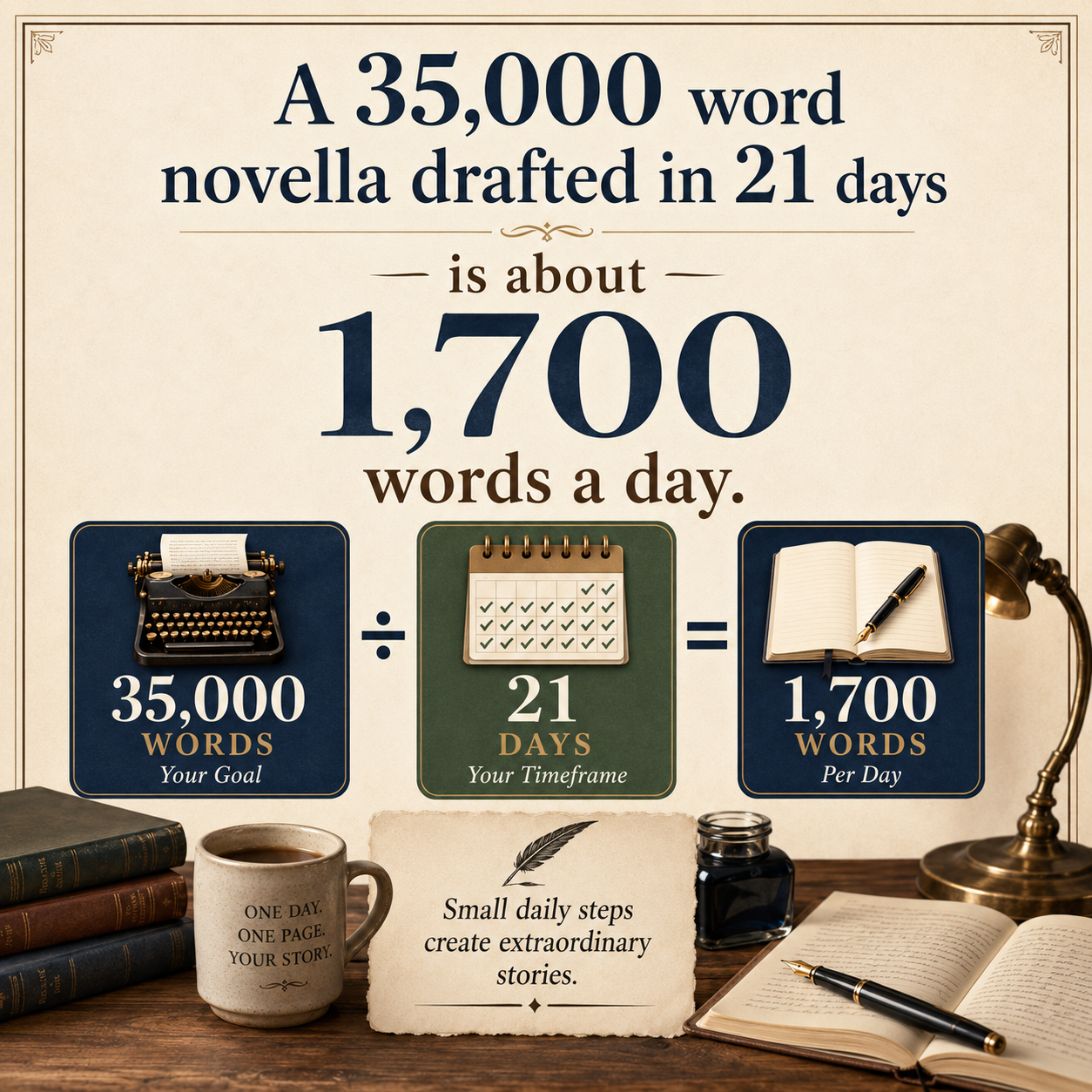
I like a simple drafting plan. Decide your target word count, then decide your deadline, then do the math. A 35,000-word novella drafted in 21 days is about 1,700 words a day. That is hard, but it is realistic for many working writers if they protect an hour or two daily.
If your life is chaotic, stretch the deadline. The form still helps you finish because it keeps the project small enough to hold in your head.
Scene Goals That Prevent Wandering
Before you draft a scene, write a one-line goal for it. Something changes, someone learns something, a decision is made, a plan fails, a relationship shifts. Then draft toward that change.
If you finish the scene and nothing has changed, cut it or fuse it with a scene that does. Readers feel that pages are wasted even when they cannot name why.
Tools That Reduce Friction Without Replacing Craft
I use tools when they remove stupid obstacles. If you lose time hunting for names, generating placeholder details, or wrestling with formatting, that is time you are not writing. Adazing builds tools for exactly that kind of friction. If you are drafting a novella and you need fast momentum, I would use Adazing’s name and word generators to avoid getting stuck on trivial decisions, and I would draft in a focused environment like QuickWrite when you need clean forward motion.
Those tools will not fix a weak premise or a limp middle. They will keep you writing long enough to face those problems honestly.
Revising And Publishing A Novella Like A Pro
Many novellas fail at revision because the author treats them as disposable. Readers do not care that it is shorter. They still want a complete emotional experience, clean prose, and satisfying payoffs.
You also have to publish them with intention. A novella can be a strong product, a strong series entry, or a strong lead magnet. It can also be a thing you upload and then wonder why nobody bought it. The difference is positioning.
Revision Passes That Matter Most
I run three main passes.
The structure pass: I check the escalation ladder and remove scenes that do not raise pressure. I also check the placement of reveals and decisions. If a revelation lands too late to matter, it needs to move earlier, or it needs to become the ending.
The character pass: I look for one dominant desire and one dominant fear, then I track whether the protagonist’s choices consistently express these feelings. In a novella, inconsistency reads as thin characterization.
The line pass: I cut throat-clearing, repeated information, and “explaining what the reader already understood.” Tight line work matters more in short forms because every paragraph occupies a larger percentage of the book.
Pricing And Format Trade-Offs
Novellas sell differently depending on format. Ebook readers are generally more open to shorter works, while print buyers often want a thicker book for the price. That does not mean you cannot do print. It means your pricing needs to take reader psychology into account.
If you enroll in KDP Select, you can also earn through Kindle Unlimited page reads, which can make novellas more viable in some genres, especially romance, fantasy, and thrillers. Amazon explains how page reads are counted and paid in its Kindle Unlimited and KDP Select help documentation. Read that and decide based on your genre, release schedule, and broader platform plans.
Blurb And Cover Signals For Shorter Fiction
Your cover still has to pass the thumbnail test. I have watched authors spend months polishing a manuscript and then publish it with a cover that looks like a 2009 default template. That choice has consequences.
I recommend you study the top 100 in your category on Amazon and note what repeats. Type style, contrast, figure versus symbol, color families, and how much detail survives at thumbnail size. If you use a tool like Adazing’s book cover maker, build three variants and test them as tiny images on your phone next to actual bestsellers in your niche. If your cover looks like it belongs in a different genre, readers will scroll past you without reading your blurb.
On blurbs, I want one central question and a clear genre promise. Do not summarize the plot beat by beat. Your blurb should sell the experience, and the shorter the book, the more precise that promise needs to be.
FAQs for Writing a Novella: Write Captivating Stories
How long should a novella be?
I aim for 20,000 to 50,000 words because this range aligns with common industry definitions and reader expectations. The SFWA Nebula Awards rules define a novella as 17,500 to 40,000 words, and that range is a useful benchmark even outside speculative fiction.
Can a novella be part of a series?
Yes, and in my experience, it works best when the novella has its own complete arc while still advancing the larger series question. Think “case of the week” that also escalates the season plot. If the novella feels like a chopped-off chunk of a novel, readers will wait for the “real book” and skip it.
Is it harder to market a novella than a novel?
It depends on your format and genre. Ebook-heavy genres often accept novellas easily, while print-focused audiences may resist shorter books at higher prices. If you are in Kindle Unlimited, shorter works can still perform well through page reads, and Amazon’s KDP Select documentation lays out the basics so you can decide if exclusivity fits your plan.
A Novella Plan You Can Finish
A novella rewards precision. Pick one load-bearing premise, build a clean escalation ladder, draft with scene-level change, and revise with a ruthless eye for momentum. If you do that, you will not just “write something shorter.” You will write something sharper, and that sharpness carries into every novel you write afterward.
If you want a practical workflow, pair your outline with tools that remove friction, then put your energy into the craft decisions that readers actually feel. That is how you turn a novella into a real asset for your writing career, not a side file on your hard drive.
