
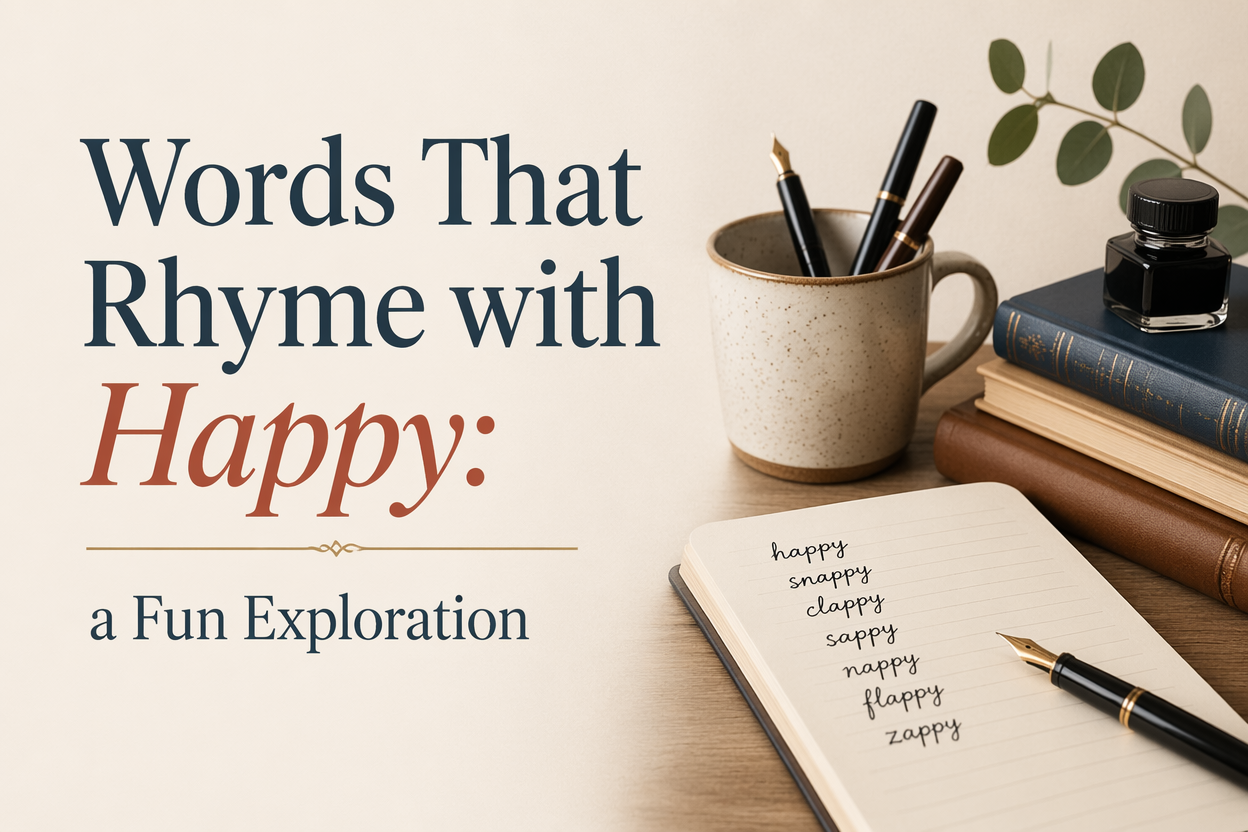
When you go hunting for words that rhyme with happy, you are rarely doing it for the rhyme itself. You are doing it because a line feels dead on the page, a chorus needs lift, a picture book needs play, or a character voice needs a little snap without turning into a greeting card.
“Happy” is a slightly awkward rhyme in clean, perfect English. If you treat it like a problem to solve, you’ll write safer lines. If you treat it like a sound to design around, you’ll write lines that feel inevitable.
The move that gets results is simple. Stop asking for a list, and start choosing a rhyme type based on your book’s voice, your reader’s ear, and how “noticeable” you want the rhyme to be.
Table of Contents
Why “Happy” Rhymes Feel Tricky on the Page
“Happy” ends with the -ee sound, and your ear wants a partner that lands with the same bounce. In many accents, “happy” sits closer to “HAP-pee” than “hah-PEE,” which makes it feel informal and conversational. That can be perfect for comedy, romance banter, kidlit, and cozy mystery narration. It can also undercut gravitas in a thriller or a serious memoir voice.
Another problem is that the most obvious perfect rhymes are words you probably don’t want in your final draft, because they read like you reached for a rhyming dictionary and took the first thing you saw. The rhyme isn’t wrong. The choice is wrong for tone.
If you want to ground this in something real and not vibes, look at how poets and lyricists talk about “slant rhyme” and “near rhyme” as a legitimate tool rather than a consolation prize. Britannica’s overview of rhyme and its types provides a clear taxonomy you can use as a checklist when you revise.
Perfect Rhyme vs. Near Rhyme
A perfect rhyme matches the final stressed vowel and everything after it. With “happy,” that pushes you toward an -appy family. A near rhyme cheats one element, often consonants, while keeping the vowel echo.
Rhyme Noticeability
I think of rhyme on a “noticeability slider.” At one end, you want the reader to grin because they heard the rhyme coming. At the other, you want a subtle musicality that supports the line without calling attention to itself. You can control that with rhyme type, word frequency, and placement.
Accent And Audience Reality
Some rhymes “work” only in certain dialects. That is not a moral issue; it is a production issue. If your audiobook narrator will be British and your rhyme only lands in General American, you have a mismatch. The safest move is to read the line out loud in the accent you expect your reader to hear in their head, then decide if you are happy with the music.

Perfect Rhymes for “Happy” That Actually Earn Their Keep
If you need a clean rhyme, start with the obvious family, then get picky about connotation. This is where most writers settle too early. They find a rhyme, it “fits,” and they move on. Later they wonder why the line feels thin.
Here are perfect rhymes and how they tend to read on the page. I’m not giving you a giant word dump. I’m giving you choices you can deploy with intent.
- Sappy: Sweet to the point of sentimental. Useful when your narrator is self-aware or teasing, dangerous when you are trying to be sincerely tender.
- Snappy: Brisk, sharp, stylish. Great for dialogue tags, character descriptions, and punchy rhyme in humor.
- Crappy: Blunt and contemporary. Works in comedic voice, YA, certain memoir tones, and characters who swear casually.
- Nappy: Means “diaper” in US usage and “sleep” in some UK usage. In kidlit, it can be gold. In adult fiction, it can derail a serious moment.
- Zappy: Energetic, poppy, slightly retro. Can work for children’s books or a knowingly corny voice.
- Scrappy: Tough, resourceful, underdog energy. Strong in sports romance, adventure, and gritty character sketches.
- Flappy: Physical comedy. Works when you want movement, birds, flags, loose clothing, or slapstick.
Now the craft move: don’t just insert the rhyme at the end of the line. Test it in three placements.
- End rhyme for maximum noticeability
- Internal rhyme to keep it musical but less sing-song
- Off-end rhyme where the rhyme lands, then you add one more word to soften the punch
If you are writing in tight meter, you will feel why “happy” is a pain. It is two syllables with stress up front, pushing you toward a trochaic beat. When that fight happens, I often swap the target word rather than forcing the line. “Happy” becomes “glad,” “bright,” “giddy,” “over the moon,” or a concrete image that shows happiness without naming it.
Near Rhymes That Sound Better Than Perfect Ones
Near rhymes are where professional-sounding lines live, especially outside of children’s rhyme. Your goal is to create an echo that the reader hears without the line sounding like you are “trying to rhyme.”
Near rhymes for “happy” that often behave well:
- Heavy: Vowel echo, different consonants. Great for irony or tonal contrast in lyrics and poetry.
- Many: Common word, subtle. It disappears into the line, which is what you want in serious prose-poetry.
- Carry: Soft slant rhyme that can feel romantic or reflective.
- Steady: Useful when you want the sense, not just the sound, to support the line.
- Ready: Crisp, forward motion. Nice for hooks and chapter epigraphs.
- Tally: Playful, slightly formal. Works in comedic narration.
- Tabby: Concrete, image-rich. If you can put a cat in the scene, you can probably sell this rhyme.
The practical test I use is the “eye-roll read.” I read the couplet to myself and notice if my face does that tiny cringe that says, “Yes, I see what you did.” If it does, I either weaken the rhyme to a near rhyme or I strengthen the line so the rhyme feels deserved.
Assonance And Consonance as Stealth Rhymes
If you want the musical feel of rhyme without the rhyme, build the line around vowel repetition. “Happy” gives you the short a and the long ee. You can echo those with clusters like “glad,” “laugh,” “cat,” and then “easy,” “free,” “sleepy.” That is not a rhyme list; it is sound design.
When A Near Rhyme Is the Better Marketing Choice
This matters for authors because rhyme shows up in your public-facing copy more than you think. Taglines, ad headlines, BookTok overlay text, and newsletter subject lines all benefit from rhythm. A perfect rhyme can feel “ad-y” in the worst way, like a jingle. Near rhyme keeps it sharp and modern.
How To Keep It From Feeling Accidental
Near rhyme works when the line has another reason to exist. Tight imagery, specific verbs, and a clear turn in meaning give the reader something to hold. Then the sound becomes a bonus instead of the whole point.
Genre-Driven Choices Authors Actually Need
You do not pick rhymes in a vacuum. You pick them inside a genre, and genre comes with reader expectations about sincerity, humor, and how much “performance” the prose can carry.
Children’s Books And Picture Books
Kidlit lets you be loud with rhyme. “Happy” with “snappy,” “zappy,” “flappy,” and “scrappy” can feel like motion, and motion is page-turning for read-aloud. The trap is rhythm drift. If you are writing rhyme for children, learn the difference between “I can rhyme” and “I can keep meter.” If you want a fast way to self-check, scan your lines and count stresses, not syllables.
Also, do not assume your rhymes are pronounceable when spoken quickly by a tired adult at bedtime. Read the whole manuscript aloud, standing up, at pace. You will find the tongue-twisters immediately.
Romance, Romcom, And Cozy Mystery Voice
In these genres, a rhyme can land as voice, especially in first-person narration. I like internal rhyme for this, because it reads like a clever mind at work, not like a poet performing. “Happy” paired with “snappy” can be a great fit for banter, but “sappy” is a loaded word. It can be a wink, or it can insult the emotional core of your scene. Decide which one you mean, then commit.
YA And Contemporary Fiction
YA readers have a sharp ear for anything that sounds like an adult trying to sound young.”Crappy” might be right for a character, but the line still needs specificity. A rhyme plus a vague line reads like a caption, and captions do not carry chapters.
Poetry, Lyrics, And Spoken Word
If you are writing for performance, you can get away with more “noticeable” rhyme because delivery sells it. That said, predictable end rhymes are the first thing a listener anticipates, which means you can use that anticipation. Set up the rhyme, then dodge it with a near rhyme. The audience feels the move even if they cannot name it.
How I Generate Better Rhymes Without Killing Momentum
The worst time to go hunting for rhymes is mid-draft, with your creative brain on one side and your inner editor tapping their watch on the other. I separate generation from selection. That is how you keep your drafting speed without settling for lazy lines.
Here is the process I recommend, and it works whether you are writing a sonnet, a picture book, a rap verse, or a cheeky chapter epigraph.
A Three-Pass Rhyme Method
- Pass one: Sound families. I write “happy” and list 10 to 20 sound neighbors fast, including ugly ones. sappy, snappy, scrappy, tabby, many, ready, steady, carry. No judging yet.
- Pass two: Meaning and tone. I circle the words that match the scene’s emotional temperature. If the scene is tender, I usually cross out “crappy” even if it fits, because it will pull the reader’s attention sideways.
- Pass three: Line rewrite. I rewrite the entire line so the rhyme is the inevitable ending rather than a bolt-on. This step is where the craft lives.
If you want help with tools, I built my workflow around quick generation. Adazing has name generators that are handy when you need options without burning 40 minutes in a thesaurus spiral, and QuickWrite is the kind of tool I use when I want to keep drafting while parking a “fix this later” note beside a stubborn line. The goal is not to let software write for you. The goal is to keep you writing while you stay picky.
A Revision Trick For Rhyme That Feels Forced
When a rhyme feels forced, the line usually has one of two problems. Either the image is generic, or the syntax has been twisted to land the rhyme word at the end. Fix the image first. Specific nouns and verbs give you more places to hide the rhyme and more ways to justify it.
Example:
- Generic: “I’m happy when you’re near.”
- Stronger image with a near rhyme option: “I’m happy when you’re ready to stay.”
That second line is not automatically “better” in every context, but you can feel how meaning opens choices. Now “ready,” “steady,” “many,” and “carry” become possible without bending the sentence.
A Practical Read-Aloud Audit
I do a read-aloud pass where I mark every rhyme that I notice. If I noticed it, your reader will notice it. Then I decide whether I want that attention. If the answer is no, I either swap to a near rhyme or I move the rhyme inside the line so it supports the rhythm without taking the spotlight.
FAQs for Words That Rhyme with Happy: A Fun Exploration
What are the most common perfect rhymes for “happy”?
The common perfect rhymes are “sappy,” “snappy,” “crappy,” “nappy,” “zappy,” “scrappy,” and “flappy.” In practice, “snappy” and “scrappy” tend to be the most usable in adult fiction voice, while “zappy,” “flappy,” and “nappy” show up more naturally in kidlit and comedic contexts.
Is it “cheating” to use near rhymes for “happy”?
No. Near rhyme is a standard tool in poetry and lyrics, and it often reads more sophisticated than a perfect rhyme. If your line starts sounding like a jingle, switching to a near rhyme like “many,” “ready,” “steady,” or “carry” usually fixes it while keeping the musical echo.
How do I keep rhyming from sounding childish in a novel?
I keep it subtle. I use internal rhyme, assonance, and consonance rather than obvious end rhymes, and I only let a clear rhyme land when the narrator’s voice would plausibly “perform” a little. If the scene is high-stakes, I usually remove rhyme entirely and focus on rhythm, because rhythm can intensify tension without calling attention to itself.
A Rhyme Choice You Can Trust
You do not need a bigger list of rhymes for “happy.” You need a better filter. Pick the rhyme type that matches your genre and the level of noticeability you want, then rewrite the line so the sound feels earned. If you do that consistently, your rhymes stop reading like a trick and start reading like voice.
