
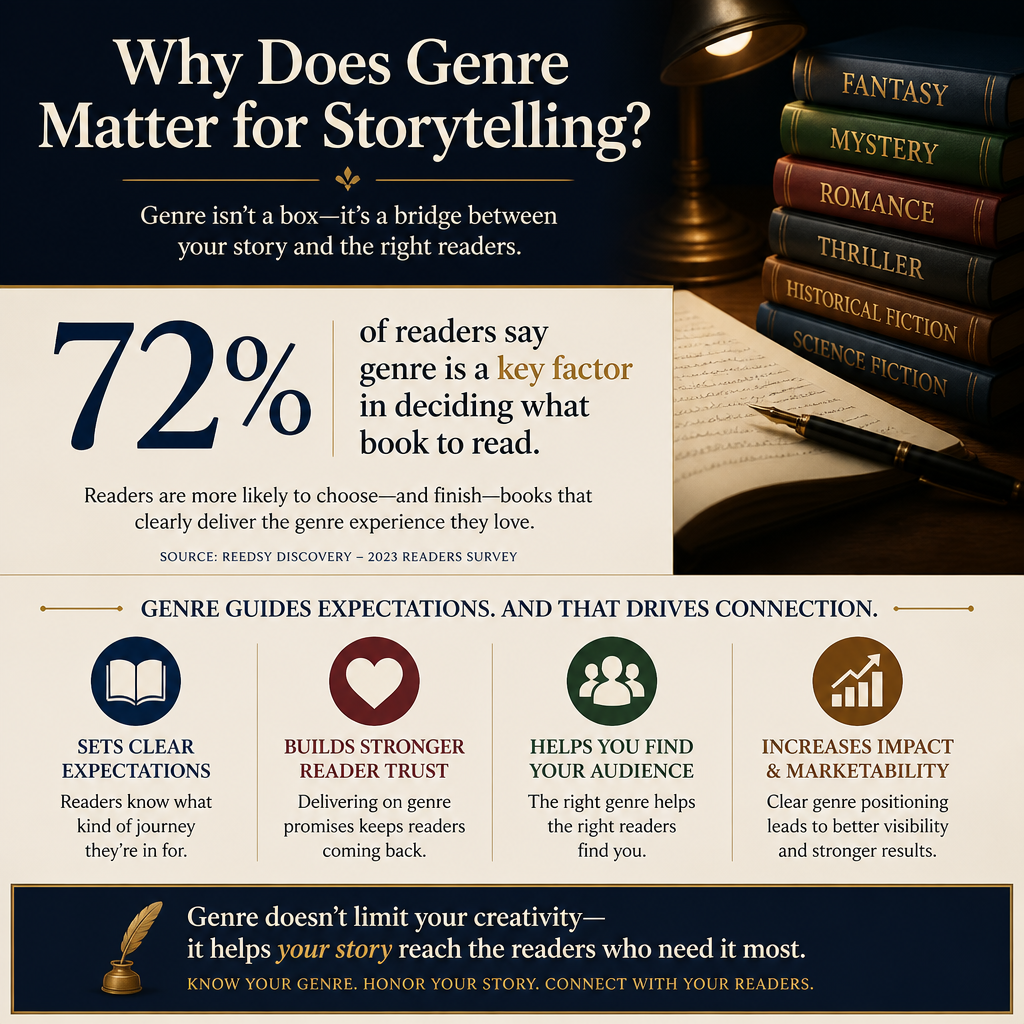
Genre matters for storytelling because it is the set of promises you are making before the reader even reaches page one, and those promises control attention, pacing, and satisfaction. When you match the promises, readers relax into the ride and keep turning pages. When you break them without meaning to, readers feel tricked, reviews turn sour, and your marketing has to work ten times harder to compensate.
I am not talking about writing by formula or sanding off your originality. I am talking about using genre the way a carpenter uses a level. It does not build the house for you, yet it keeps the structure from slowly tipping until the whole thing feels wrong.
If you want your work to land, you need to treat genre as a craft tool and a business tool. It guides the story decisions you make at the sentence level, and it tells strangers on Amazon KDP and Goodreads what kind of emotional result they can count on. That clarity is what gets you clean read-through and better word of mouth.
Table of Contents
Genre As A Promise To The Reader
The biggest reason genre matters is that readers buy outcomes. For example, a romance reader wants a love story that is centered, escalating, and emotionally resolved. A mystery reader wants fair-play questions, a trail of clues, and an answer that feels earned. A fantasy reader wants wonder, power systems or magic rules they can track, and a sense that the world has depth past the edge of the page.
Those expectations are not shallow. They are the reading contract that lets your audience invest without constantly asking, “What kind of book is this, and why should I keep trusting it?” When the contract is clear, you can surprise the reader within the lane rather than confusing them outside it.
Reader Expectations Start Before Page One
Your cover, title, subtitle, blurb, categories, and keywords are your opening chapter in disguise. If you package your book like a cozy mystery and deliver a bleak noir with graphic violence, you will get one-star reviews from the exact people you successfully attracted. That is not a craft problem. That is a signaling problem.
Amazon itself bakes this into discovery. Its recommendation system evaluates shopper behavior and book metadata to decide what to show next, which is why category alignment matters. Amazon spells out how categories and keywords influence discoverability in its own documentation, including the way you can place your book through category selection and keyword choices.
Promises Give You A Target For Satisfaction
Satisfaction is measurable in story terms. It shows up as a payoff that feels proportional to the setup, a climax that answers the central question, and an ending that delivers the expected emotional aftertaste. Genre tells you what “proportional” and “expected” mean for your audience.
If you are revising and the book feels fuzzy, ask yourself one blunt question. What did you promise, and where do you deliver it on the page? If you cannot point to the delivery scene, you do not have a hypothetical genre problem. You have a missing-scene problem in practice.

Genre As A Map For Structure And Pacing
Genre is also a structure engine. It gives you a default spine for escalation, reveals, reversals, and emotional turns. That does not mean every thriller needs the same plot beats on the same page count. It means thrillers tend to reward forward motion, frequent pressure, and clear stakes. Meanwhile, literary family sagas can linger and still satisfy because the payoff is often psychological insight and thematic resonance.
When writers say “my pacing is off,” I usually find a genre mismatch underneath. For example, they are writing a romance with long stretches where the relationship does not change. They are writing a mystery in which the investigation stops for chapters at a time. They are writing an epic fantasy where the protagonist has no urgent problem for the first hundred pages.
Scenes Need Genre-Specific Jobs
Every scene should do at least one job that your genre cares about. For example, in a mystery, a scene might plant a clue, complicate a suspect, or tighten the net around the investigator. In a romance, a scene might deepen intimacy, sharpen conflict, or raise the cost of choosing love. In a horror novel, a scene might reduce safety, reveal a rule of the monster, or isolate the character from help.
When you revise, label each scene with its genre job in the margin. If you have several scenes in a row that do not do a job your genre values, you have found the sag. Cut, combine, or re-aim those scenes so the book keeps earning its own promise.
Subgenre Tightens The Tolerances
Subgenre matters because it narrows the acceptable range. For example, a cozy mystery has different tolerances than a hardboiled detective novel. A sweet romance plays differently than dark romance. LitRPG has reader expectations around progression and system clarity that traditional fantasy readers might not care about.
This is where vague positioning hurts you. Saying “it is a romance” is often not enough. The reader needs to know if it is a small-town second-chance romance, a billionaire workplace romance, or romantic suspense with a serial killer. Each one changes pacing, intensity, and what counts as a satisfying ending.
Genre As A Tool For Character And Theme
Genre shapes character the way gravity shapes weather. It affects what kinds of choices feel plausible, what kinds of flaws get punished, and what kinds of growth feel earned. If you ignore genre, your character arc can land as flat even when the prose is strong.
Think of genre as the emotional problem your story is built to solve. For example, romance is often about vulnerability and commitment. Mystery is about truth and perception. Fantasy is often about power, responsibility, and belonging. Science fiction frequently asks “what changes when a new rule enters the world?” Those themes are not mandatory, yet they are common because they fit what the genre is built to deliver.
The Protagonist Wants What The Genre Rewards
In commercial fiction, the protagonist tends to want something the genre is good at paying off. For example, a heist story rewards competence and planning under pressure. A coming-of-age story rewards self-knowledge and a new place in the world. A thriller rewards decisive action under escalating threat.
If your protagonist wants something your genre does not naturally pay off, you need to work harder to build the bridge. You can do it, yet you should do it on purpose. Otherwise, your ending will feel like it landed in a different book.
Theme Lands When It Rides On Genre Mechanics
I see a lot of writers try to bolt theme onto the top of the story through speeches and reflections. Genre gives you a cleaner path. Put the theme into the problems the genre requires. If you are writing a mystery about corruption, make the clues point to systems, favors, and hidden incentives, not just one bad guy twirling a mustache. If you are writing romantic suspense about trust, put trust to the test in moments where the wrong choice gets someone hurt.
This is one reason genre fiction can hit hard. The theme is moving because it is tied to decisions that carry consequences.
Genre As A Marketing Signal That Affects Sales And Reviews
Storytelling lives inside a marketplace now, even if you hate thinking about it. Genre is the fastest way to tell strangers, “This is for you.” When that signal is strong, your ads are cheaper, your blurb converts better, and your reviews complain less about “not what I expected.”
Readers also use genre to find the next book. That behavior shows up in data. For example, Pew Research Center has tracked reading formats and habits for years, and their surveys show how readers split their reading time across print, ebooks, and audiobooks. That matters because genre audiences differ by format, and your packaging choices should respect where your genre lives.
Also-Boughts And Read-Through Depend On Fit
Your also-boughts on Amazon are a fingerprint. When you align with genre expectations, the algorithm groups you with books that share your audience, and that increases organic visibility. When your book is cross-wired, you get scattered also-boughts that do not feed each other, and your discovery stalls.
Read-through is the other half of the business impact. A series works when book one attracts the right readers and satisfies them enough to buy book two. Genre alignment is what makes that satisfaction predictable.
Cover And Blurb Are Genre Tools, Not Personal Expression
This is where many talented writers sabotage themselves. They treat the cover as art for their wall and the blurb as a mini synopsis, then wonder why clicks do not turn into sales. Your cover is doing its most important work as a thumbnail, and your blurb is doing its most important work as a tension engine.
When I build covers or help an author revise theirs, I start by grabbing ten top-selling covers in the exact subgenre and looking for common signals: typefaces, color temperature, figure vs. symbol, level of detail, and implied tone. Then I design for recognition first and distinctiveness second. If you need a fast way to test concepts, Adazing has cover tools that let you mock up variations and run a thumbnail test before you spend money on a final.
Genre-Bending Without Losing The Reader
Genre-bending works when you control the promises. The failure mode is easy to spot. The author thinks they are being fresh; the reader thinks they bought one kind of experience and got another.
If you want to blend genres, pick a primary genre and treat the other element as a modifier. For example, a fantasy romance still needs a satisfying romantic arc with a genre-appropriate ending. A mystery with supernatural elements still needs a solvable central question and a clear solution. A literary thriller still needs momentum and escalating threat, even if the prose is gorgeous.
Signal The Blend Early And Often
You cannot hide the ball and then act surprised when readers react. Signal the blend in the cover, the blurb, and the opening chapters. If there is a paranormal twist, show its shadow early. If the romance is central, let the love interest matter in the first act. If the story is a slow-burn, the prose needs to build tension through micro-shifts, not just wait for the plot to start.
I like to check this with a simple exercise. Write a one-sentence promise that includes the primary genre outcome and the secondary flavor. Then compare it to your cover and blurb. If a stranger cannot guess that sentence from your packaging, fix the packaging or fix the sentence.
Control The Ending Promise
Endings are where genre trust is won or lost. For example, romance readers expect a happy or at least hopeful resolution between the leads. Mystery readers expect clarity. Thriller readers expect the threat to be neutralized, even if it costs the hero something. Horror readers expect dread to be paid in blood, sanity, or irreversible change.
If you want to subvert an ending, you can, yet you have to pay for it. You pay for it by signaling the tone, positioning the book correctly, and delivering a different satisfaction that is strong enough to replace the expected one. Otherwise your subversion reads like a broken promise.
FAQs for Why Does Genre Matter for Storytelling?
Do I have to pick one genre for my book?
You need one primary shelf to sell and satisfy from. You can blend elements, yet you should decide which audience you are prioritizing, then build the structure and the ending to match that audience. The moment you try to please three different shelves equally, you usually please none of them.
How do I figure out my subgenre if my book feels unusual?
I look at comps first. Find five books your ideal reader already buys, then study their Amazon categories, cover signals, and review language. If your book belongs near those, your subgenre is probably sitting right there. If it is not, your next move is to adjust the manuscript, the packaging, or your target reader until those three line up.
Will writing to genre expectations make my work formulaic?
Only if you copy surface beats without understanding why they work. Genre expectations are about emotional outcomes and fairness. You can deliver those outcomes with fresh characters, unusual settings, and personal voice. Some of the most distinctive books in any category are the ones that keep the core promise while taking bold risks in everything else.
Where Genre Pays You Back
Genre is a constraint, and constraints are where craft gets sharp. When you treat genre as a promise, a pacing map, and a marketing signal, you stop guessing in the dark. Pick your primary genre, study the top books in your subgenre, then revise your scenes and packaging so they consistently deliver the same kind of satisfaction. If you do that, your storytelling improves, and your sales process gets simpler, which is exactly what you want when you are trying to write the next book instead of endlessly rescuing the last one.
