
What’s a dynamic character? A dynamic character changes in a meaningful, irreversible way because of what happens in your story, and readers can feel the difference on the page. If your protagonist walks through fire and comes out with the same beliefs, the same coping habits, and the same emotional blind spots, your plot may look busy while your story stays flat.
Writers get stuck writing this character for a practical reason. It is easier to outline external events than internal movement. You can plan a heist, a battle, a meet-cute, a betrayal. Planning a believable shift in worldview requires sharper cause-and-effect, while asking you to track what the character learns, what it costs, and what they do differently afterward.
Dynamic characters matter because change is the proof that the story mattered. It is the receipt you hand the reader at the end that says the time they spent had weight.

Table of Contents
Dynamic Character Defined for Working Writers
A dynamic character changes in their internal model of the world. That model might be moral belief, identity, fear response, attachment style, sense of agency, or what they think love costs. The change shows up in choices, not speeches. If the character claims they have changed but keeps selecting the same self-defeating option under pressure, readers trust the pressure rather than the monologue.
Dynamic does not mean dramatic. For example, a small internal pivot can carry a huge novel if it is earned. Meanwhile, a large transformation can fall apart if it arrives as a late author decision.
Change Versus Growth Versus Revelation
Writers use these terms interchangeably and then wonder why revisions feel slippery. I keep them distinct when I diagnose a manuscript.
Change means the character becomes a different decision-maker by the end. The inputs might be similar, the stakes might be higher, but the response has altered. Growth often means the character becomes more capable while staying fundamentally the same person. Competence increases, inner structure holds. Revelation means the reader learns something true about the character that was always there, even if the character did not articulate it.
You can build a satisfying story with any of the three. If you are promising a character arc and marketing the book around emotional impact, change usually pays the bill.
Dynamic Does Not Require Likability
Many authors sand down their protagonist because they think a dynamic arc requires the character to become nicer. That instinct often breaks the book. Readers do not demand niceness; they demand coherence. A character can become harder, colder, more decisive, or more ruthless and still satisfy if the shift tracks with the story’s pressure.
If you write thrillers, crime, horror, or dark romance, the dynamic arc may be a moral compromise rather than a redemption. Your job is to show the exact step where they cross the line, and the price they pay for believing they can cross back later.
Static Characters With Dynamic Stories
A static protagonist can work when the story engine is the world changing around them. Detective fiction sometimes uses this, as do certain action franchises. The protagonist’s fixed code becomes the measuring stick that reveals corruption, hypocrisy, or decay in the setting.
When you choose this route, you need to be intentional. If your marketing copy promises transformation and the book delivers constancy, readers feel tricked even if the plot was clean.
Why Dynamic Characters Drive Reader Satisfaction
Plot creates motion. Character change creates meaning. The satisfaction readers report after finishing a book usually comes from the feeling that something landed, and internal change is one of the most reliable landing zones.
A helpful lens comes from psychology research on narrative. In their 2000 study published in the Journal of Personality and Social Psychology, Melanie C. Green and Timothy C. Brock describe narrative transportation, the experience of being mentally absorbed into a story world. They link it to shifts in attitudes that can happen when readers are deeply engaged. That finding is not a directive to manipulate your audience; it shows why coherent inner movement matters. When readers are transported, they process the character’s choices as if they were rehearsing real decisions.
On the craft side, I see the same pattern in manuscripts that hold attention through the messy middle. The plot twists are rarely the sole reason. The book keeps pulling because the reader senses a human equation being solved. Every scene becomes a test of who this person is becoming.
Change Creates Scene-Level Questions
When a character is dynamic, every new situation carries a second question under the obvious one. The obvious question is, “Will they survive, win, escape, get the job, get the kiss?” The deeper question is, “What will they choose now that they have been changed by what happened before?”
This depth is how you write suspense without piling on explosives. It is also how you write romance tension without inventing misunderstandings that would vanish if two adults used text messages.
Dynamic Arcs Increase Reread Value
Readers reread books when they feel the early scenes contain seeds that bloom later. A dynamic arc creates that. The first time through, the reader experiences events. The second time, they track the setup for who the character becomes.
This effect is commercially useful. Read-through sells series. A strong arc in book one builds trust that the next book will deliver emotional payoff, not just another treadmill of events.
The Engine Behind Dynamic Change
Believable change requires three elements working together. Pressure forces the character to act. Consequences teach them something they cannot unlearn. Choice locks the new belief into behavior.
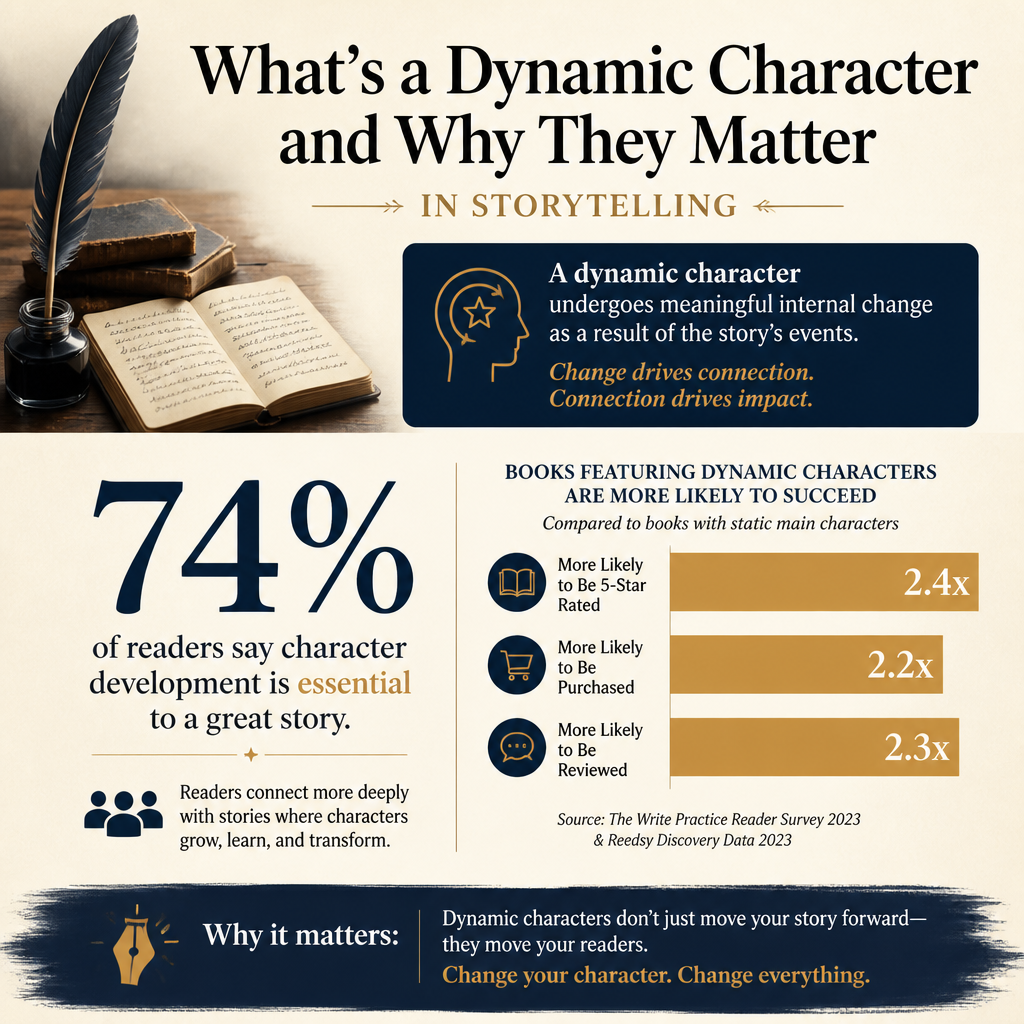
If your arc is not landing, one of these parts is usually missing. Authors often have pressure and choice but no learning. The protagonist makes a different decision at the end because the outline needs it, not because the story earned a new worldview.
Pressure That Targets the Fault Line
Pressure only changes people when it hits the wound. If the protagonist’s core issue is fear of abandonment, do not test them with a puzzle box in a locked room unless that puzzle box forces abandonment choices. A locked-room mystery can still do it, but the pressure has to connect. Otherwise you are writing two books at once, a plot book and an emotional book that barely talk.
I recommend you write one sentence that defines the character’s protective lie.
Examples:
“If I need anyone, I lose.”
“If I am not perfect, I am disposable.”
“If I am honest, people leave.” Then design obstacles that punish the lie until it becomes more expensive than change.
Consequences That Teach, Not Lecture
Consequences do the teaching because they create felt experience. A lecture creates information. Information rarely changes a character; it just gives them something to quote later.
In practice, I look for two kinds of consequences. External consequences are visible losses or gains, like losing a job, winning a case, breaking a friendship, or earning a rival’s respect. Internal consequences are the moments the character cannot quiet themselves anymore, when their old coping strategy stops working. If you want dynamic change, you need at least one consequence that touches identity.
There is a reason this reads as real. Psychologists have long described cognitive dissonance, the discomfort that arises when actions and beliefs clash, as a driver of attitude change. Leon Festinger’s original work on the concept is widely cited because it explains why people rationalize and why they sometimes shift beliefs to reduce inner conflict. A readable overview appears in Encyclopaedia Britannica’s entry on cognitive dissonance. Your character’s arc becomes believable when you force that clash and do not let them talk their way out for free.
Choice That Costs Something Real
The turning-point choice must cost the character something they hold dear. If the new decision saves everything, readers experience it as a trick. Cost creates commitment because the character cannot unpay it later.
The cost can be a relationship, status, safety, self-image, or a dream they carried for years. In romance, the cost is often pride or a protective belief. In fantasy, it may be power or allegiance. In literary fiction, it may be the story they tell themselves about being a good person.
Techniques I Use to Write Dynamic Characters on Purpose
Most “flat arc” problems come from drafting without tracking the arc as a system. You can fix that without rewriting your whole book if you start measuring the right things.
The Belief Ladder
I write the character’s starting belief, an intermediate belief, and the end belief. The intermediate belief matters because it prevents the arc from feeling like a switch flips on page 320.
Here is a clean template you can steal.
- Start belief: What they think keeps them safe.
- Midpoint belief: What they suspect might be true, but they hate it.
- End belief: What they now act on, even when it hurts.
Then I assign scenes to each rung. Early scenes reward the start belief. Middle scenes punish it. Late scenes force the end belief under high stakes. If you cannot identify the scene where each rung becomes necessary, you have found the weak spot.
Behavioral Tells Under Stress
Readers trust behavior under stress more than anything else. I pick one stress tell that represents the character’s old self. Examples include joking to deflect, going silent, over-explaining, picking fights, caretaking, or freezing.
When the character changes, the tell changes. It does not vanish; it mutates. For example, the jokester can be direct. The silent one chooses one honest sentence. The fighter learns to ask for what they want without swinging. You do not need to announce the change. You show it during pressure.
Scene Promises and Scene Payoffs
Every scene makes a promise about what the character will do next time. If they betray someone and feel nothing, you have promised a colder arc. If they betray someone and break afterward, you have promised remorse, repair, or deeper collapse. When your later scenes ignore the earlier promise, readers call it “out of character” even when the plot logic works.
This craft point has a marketing edge too. If your reviews complain that characters were inconsistent, that is not a vibes problem. It is a setup-and-delivery problem that shows up in the conversion math on your sales page.
Revision Checks That Catch Flat Arcs Before Publication
I treat character change as something you can audit. You do not have to guess if it is working. You can test it scene by scene, the same way you would A/B test a cover.
The Before and After Snapshot
Write two short paragraphs in your own notes. The first describes the character in chapter one as a decision-maker. The second describes them in the final chapter the same way. If you keep using the same verbs, you probably wrote a static arc by accident.
This check stays honest because it focuses on decisions. A character can gain skills, friends, and a new haircut and still be the same decision-maker.
The Midpoint Turn Test
At roughly the middle, something should break. If your midpoint is only a bigger explosion, the arc often stalls. The midpoint should force the character to attempt a new strategy or admit the old one has failed.
If you write a series, the midpoint can also be where the character’s series-long wound becomes visible, not solved. The important part is that the reader sees movement, not repetition.
The Contradiction Map
Dynamic change comes from contradictions. I list three things the character wants, three things they fear, and three rules they live by. Then I circle where those lists collide.
If nothing collides, your character will feel like a puppet who always knows what to do. If everything collides in every scene, your character will feel indecisive and exhausting. You want targeted collisions that escalate as the story tightens.
Tools That Help You Track the Arc
When I draft fast, I use tools to keep continuity from slipping while I chase momentum. This is where Adazing products fit naturally into the workflow. If you use QuickWrite or any drafting tool with a clean sidebar for notes, keep a living “belief ladder” note open while you write. You will catch drift early, and you will stop patching character logic after the fact, which is the expensive way to revise.
On the production side, this craft work also supports your packaging. A dynamic arc gives you sharper copy for your blurb because you can state a genuine internal stake, not only the external predicament. If you build covers with the Adazing book cover maker, your imagery and typography choices get easier when you know what the change is. A story about a woman learning agency reads differently at thumbnail than a story about a woman learning forgiveness.
FAQs for What’s a Dynamic Character and Why They Matter in Storytelling
Do I need a dynamic protagonist in every genre?
No. Some genres tolerate, or even prefer, a more static protagonist, especially when the series promise is procedural competence or a consistent moral code. If your book sells itself on emotional payoff, romance, coming-of-age, book-club fiction, or character-driven fantasy, a dynamic arc usually improves reader satisfaction.
How do I show character change without writing therapy scenes?
Put the change in decisions under pressure. Give the character a moment where the old move would be easier, then make them choose the new move and pay a cost for it. A single well-timed shift in behavior reads louder than pages of introspection.
What is the most common reason dynamic arcs feel unearned?
The turning point arrives without sufficient consequence. The character decides to change because the plot needs a win, not because the old belief became too expensive to hold. If you add one scene where the old belief causes a personal loss the character cannot rationalize away, the later change starts to feel inevitable.
Dynamic Change Is the Proof Your Story Landed
If you want a character who feels alive, stop chasing “depth” as a vibe and start engineering cause and effect. Define the protective lie, apply pressure that targets it, let consequences teach, and force a costly choice that locks in new behavior. When you do that, readers do not just watch events happen. They watch a person become someone else, and that is the part they remember when they close the book.
