
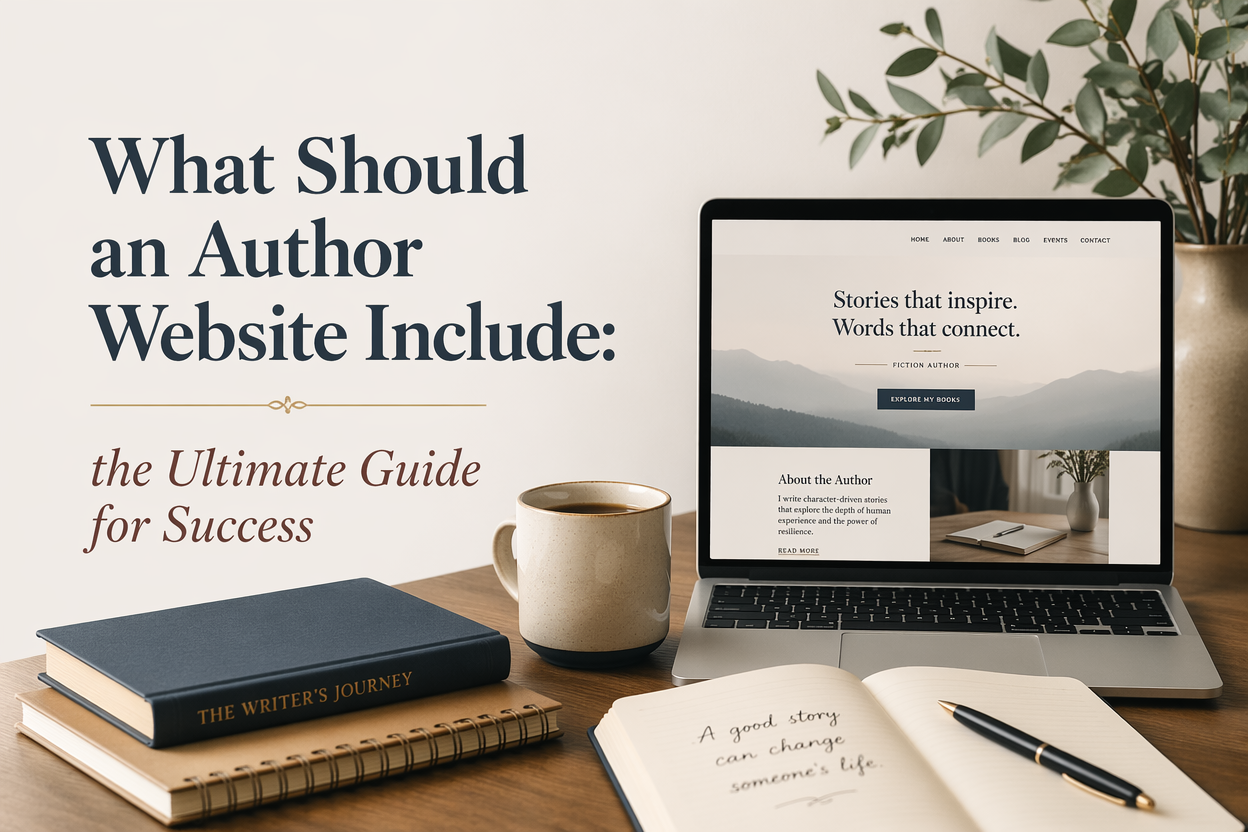
Your author website is either a quiet sales rep that works all year or a digital business card that your readers forget several seconds after closing the tab. When authors ask me, “What should an author website include?”, I answer with the same blunt test every time: can a stranger land on one page, understand what you write, trust you, and buy or join your list without hunting?
Social platforms are rented land. Your website is the only place you control the copy, the links, the signup, the pixel, and the reader experience. And it becomes more valuable the longer you publish because it connects every new release to everything you already wrote.
Treat your website like a storefront. It needs a clean window display, clear aisles, a checkout that works, and a simple way to get returning customers in the door. Anything else is decoration.
Table of Contents
Your Homepage As A Conversion Page
Your homepage is not your autobiography. It is a decision page. A reader clicks links from Amazon, Goodreads, TikTok, a podcast, or an email and silently asks, “Am I in the right place, and what do I do next?” If you do not answer fast, they bounce, and you never know you lost them.
I like homepages that do three jobs in order: identify the books, prove they’re for the right reader, and point to one primary action.
A Clear Value Statement Above The Fold
Put your genre and your promise in plain language where it cannot be missed. For example, “Cozy mysteries with small town secrets” beats “Stories from my imagination.” If you write nonfiction, lead with the reader benefit and a specific angle. “Habit building for exhausted parents” tells me who the book is for.
Add one supporting proof point, not a wall of badges. A single strong line works: “Over 1,000 five-star reviews across the series” if it is true, or “Winner” statements only if you can verify them. If you do not have proof points yet, use specificity: series name, setting, tropes, or problem you solve.
One Primary Call To Action
Choose one main action for new visitors. For most authors, it is your email list because it survives algorithms and it sells the backlist. If you are launching a book this month, the main action can be pre-order. Trying to push five actions at once is how you get none.
Place the button high on the page and repeat it after you show the books. Use concrete button copy like “Get The First Chapter” or “Read Book One”. Avoid vague labels like “Submit” or “Learn More”.
Fast Trust Signals That Do Not Feel Like Bragging
Readers scan for safety cues. Give them a few that matter: a short testimonial, a well-known review quote, a clean headshot, and professional covers. I care about covers because readers do. Nielsen Norman Group has repeatedly shown that people judge credibility based on design quality and visual presentation, which is why sloppy layouts quietly cost sales even when the writing is strong.
If your covers are not working as thumbnails, fix that first. I have watched authors rewrite entire homepages while their covers stayed unreadable at phone size. If you need a fast way to mock up new cover directions, Adazing has a cover maker that lets you test typography and genre signals before you pay for final design.

Book And Series Pages That Sell Without Begging
Most author sites bury the books under menus that sound like a library catalog. Treat your books like products. A reader who wants to start should never have to decode your reading order, and a reader who finished book one should have a clear path to book two.
A Dedicated Page For Every Book
Give every title its own URL. That gives you a stable link for ads, newsletters, podcast appearances, Linktree replacements, and back matter. Each book page should include the cover, a tight blurb, buy links, formats, and the series order.
Write a blurb for web reading. Keep paragraphs short, lead with character and conflict, and stop early. If you want a craft baseline, I stick to the same core rule I use for back covers: curiosity sells; plot recaps do not.
A Series Hub Page That Solves Reading Order
If you write series, you need a series hub page. Show the full reading order with covers, one-line hooks, and the same retailer links for each book. Do not split the series across multiple pages unless the series is huge and readers ask for it.
Add a “Start Here” block with book one, plus a “New Here?” note if you have multiple entry points. Romance and urban fantasy readers care deeply about order. Thriller readers care when arcs cross. Nonfiction readers care about which book to read first based on their problem.
Buy Links That Reduce Friction
Link to the retailers your readers actually use. Amazon is usually the anchor, but do not ignore Apple Books, Kobo, Google Play, and Barnes and Noble if your genre performs there. If you are wide, say so clearly. If you are in Kindle Unlimited, say so clearly.
I prefer clean button links over a messy paragraph of stores. If you use Bookshop.org for print, include it. If you sell on your own site, list that option at the top and explain the benefit in one line such as “Signed copies” or “Bonus epilogue.”
An Email List Setup That Readers Want
Your email list is your only reliable way to reach readers who already said yes to your work. A social post reaches whoever the platform feels like showing it to. An email reaches the people who asked for it, subject to deliverability and your own habits.
The best author websites treat the signup as the first step in the reader relationship, not a random pop-up that interrupts someone trying to check reading order.
A Reader Magnet With A Clear Promise
Offer something that fits the book a reader came for. The default is the first few chapters, a prequel novella, an epilogue, or a bonus scene. For nonfiction, offer a checklist, a template, a workbook excerpt, or a short email course.
Tell the reader what they get and when they get it. “Get the prequel novella instantly” is clean. If you have delivery delays or manual fulfillment for direct bonuses, say so.
Signup Placement That Matches Reader Intent
Put a signup on your homepage, in your site header or near the top, and on every book and series page. Add it to your about page too, because some readers go there first to decide if you are real.
If you use a pop-up, keep it polite. Trigger it after time on page or scroll depth. A pop-up that fires the moment someone arrives is the web equivalent of shouting your mailing address at a stranger while they are still stepping through the door.
Welcome Sequence That Does Actual Work
A signup form without a welcome sequence wastes effort. Write three to five emails that introduce your work, send the freebie, point to book one, and set expectations for how often you email.
I have seen this pay off even with small lists. Written Word Media has reported that email remains one of the highest ROI channels for authors and publishers, largely because it reaches readers directly and repeatedly. I point authors to Written Word Media guidance on email marketing for authors when they need a data-backed nudge to take the list seriously.
Credibility Pages That Build Reader Confidence
Readers do not need your full life story, but they do need enough context to trust the hand offering the book. The about page, contact page, and media page are where that trust gets built, especially for nonfiction and for authors who do events, interviews, or guest posts.
An About Page Written For Readers
Write your about page like back matter, not like a resume. Start with what you write and why readers enjoy it. Then add a few human details that fit your brand. End with the path forward, usually “Start with this book” plus an email signup.
If you write nonfiction, lead with credibility that matters to the topic you write. If your book is about strength training, your years as a coach matter. If your book is about managing anxiety, your personal experience matters if you share it carefully. Either way, tie it to how it helps the reader.
A Contact Page That Filters The Right Messages
Give readers a simple way to reach you, and give business contacts a better way to communicate. I like a contact form plus a dedicated email for rights, speaking, or press. If you do not want DMs for sensitive topics, say what you can and cannot respond to.
Add a note about response time. That single line prevents resentment on both sides.
A Media Kit Page That Saves You Hours
If you do podcasts, signings, workshops, or even local library talks, build a media kit page. Include your bio in short and long versions, high-resolution author photos, book covers, a one-sheet per book, and links to past interviews.
This page is also where you can list availability for school visits or conferences. Keep it factual and easy to scan. Event organizers love authors who do not make them chase assets.
Technical Foundations That Protect Sales And Sanity
A pretty website that loads slowly, breaks on mobile, or sends readers to dead links is quietly expensive. You do not notice it daily, but it bleeds conversions. I treat the technical baseline like proofreading. It is not glamorous, and it keeps you from looking careless.
Mobile-First Layout And Speed
Most readers will visit your site on a phone. Google has been explicit for years that it primarily uses mobile content for indexing and ranking, which is a polite way of saying your mobile experience matters more than your desktop design. See Google documentation on mobile-first indexing.
Test your homepage, a book page, and your signup on your own phone. Check tap targets, font size, and whether the buy buttons sit above the fold.
Basic SEO That Helps The Right Readers Find You
You do not need fancy SEO tricks. You need clean page titles, readable URLs, and one focus per page. For example, your book pages should include your name, the book title, and the series. Your images should have alt text. Your site should have a sitemap and no broken links.
Do not turn your homepage into a keyword dump. Readers can tell, and it reads as if a robot wrote it. The goal is discoverability plus trust, in that order.
Analytics And Simple Testing
Install analytics so you can see what works. Watch three numbers: traffic sources, top pages, and conversion rate on your email signup and buy buttons. If you do not track anything, you will keep changing the wrong things because the loudest opinion in your head will win.
Run small tests. Change one headline. Swap the order of your buy buttons. Adjust the reader magnet. Give each change a week or two, depending on your traffic.
If you build promo graphics or landing pages for ads, tools from Adazing like QuickWrite can help you draft cleaner copy for blurbs, taglines, and reader magnet pages without staring at a blank screen for an hour.
FAQs for What Should an Author Website Include: The Ultimate Guide for Success
Do I need a blog on my author website?
You only need a blog if you will maintain it and if it supports your book sales or your credibility as a nonfiction writer. For most fiction authors, a blog becomes a guilt factory that steals time from writing. I would rather you publish a strong books page, a series order page, and a reliable email signup than post monthly updates that readers never read.
Should I use a link-in-bio page or my homepage for social traffic?
If you have steady social traffic, create a simple landing page that matches the post’s promise and points to one or two actions. That can live on your domain and replace Linktree. Social readers move fast, so keep it clean, put the newest release first, and include your email freebie as the second option.
How many pages should an author website have at minimum?
I consider five pages the minimum: Home, Books, then a page per book or a combined series page if you only have one title, About, and Contact. Add a Media Kit page if you do appearances. Add a Reader FAQ page if you get the same questions about order, content warnings, or formats.
A Website That Grows With Your Backlist
Your author website works when it reduces reader effort. A stranger should be able to identify your genre, sample your voice, start the right book, and join your list in under a minute.
If you only fix three things this week, I would tighten your homepage headline, build a clean series-order page, and create a reader-magnet signup that fits your books. Then leave it alone long enough to collect data, because stability is part of what makes a website pay you back.
