
Most debates about what makes a story fantasy start in the wrong place, because “what makes a story fantasy” has less to do with pointy ears and more to do with the rules you ask the reader to accept. Fantasy is a promise: reality in your story can bend, and the bend matters to the plot, the character’s choices, and the price they pay.
As an author, you feel this question when you try to pitch your book, choose categories on Amazon KDP, write a blurb, or commission a cover. If you mislabel your story, you will attract the wrong readers, and they will punish you with early drop-offs and reviews that say “this wasn’t what I expected.” The goal is not to win a genre argument but rather to communicate your book’s reading experience with enough precision that the right reader clicks, buys, and keeps turning pages.
I treat fantasy as a craft decision, not a costume. You are building an alternate logic for the story, and the reader will follow you if you stay consistent and charge a fair emotional price for the wonder.
Table of Contents
Fantasy As A Contract With The Reader
Fantasy becomes fantasy the moment your story asks the reader to accept a reality that differs from consensus reality. Then, it uses that difference as a source of meaning. That can be overt, like spells and dragons, or quiet, like a curse that changes a family’s choices across generations. The presence of the impossible is not enough. A hallucination, a metaphor, or a lie can look identical on the page. The reader needs the text to treat the impossible as true inside the story’s reality.
If you want a clean line for your own decision-making, use this test. Could the story’s central conflict be solved in essentially the same way if the fantastic element were removed? If yes, you probably have a story with fantasy garnish. If no, you are writing fantasy, because the impossible is structural.
Belief Beats Spectacle
Readers do not require a ton of invented nouns. They require confidence. When the narration, the characters, and the consequences all agree that magic exists, fantasy reads like fantasy even if the magic appears once in chapter twelve. When the narration winks, hedges, or treats the impossible like a prank, readers slide toward magical realism, surrealism, or literary ambiguity.
For your next draft pass, pick three scenes that include your fantastic element and audit the surrounding language. Do your verbs assert reality or apologize for it? “The river remembers” lands. “It felt like the river remembered” changes the genre temperature.
Consequences As Genre Signaling
Fantasy readers are trained to look for cost. For example, a spell that solves everything for free tells them the author is not taking the rules seriously. A blessing that also distorts relationships, or a power that draws political attention, tells them you understand consequence.
I recommend writing a one-page “cost ledger” for your story. List every supernatural advantage and then write the bill that comes due, whether it is physical, moral, social, or spiritual. If you cannot find a bill, you have found a plot problem.
The Reader’s Cognitive Load
Fantasy asks the reader to learn. That learning can be delightful or exhausting, and you control the difference by how you pace information. Cognitive science backs the practical version of this. John Sweller’s Cognitive Load Theory describes how working memory gets overloaded when too much new material arrives at once, which is exactly what happens when a fantasy chapter dumps ten new terms and three calendars on page one.
Look at your first two chapters and underline every proper noun and invented concept. Then circle the ones the reader must understand to follow the current scene. Cut or delay the rest. You can keep the depth. You are changing the delivery’s order.

Magic Systems And The Shape Of Wonder
Magic can be systematic or mysterious, and both can be fantasy. The difference changes the kind of story you are writing and the kind of reader you attract. Systematic magic leans toward problem-solving, strategy, and competence arcs. Mysterious magic leans toward awe, dread, and moral ambiguity. Neither is “better.” The risk is mixing them without intention.
Hard Magic And Fair Play
Hard magic rests on knowable rules, even if the rules are not fully stated. Brandon Sanderson’s well-known “laws” are not scripture, but his first law is a useful craft lens: the author’s ability to solve problems with magic depends on how well the reader understands the magic. Sanderson has discussed this extensively in his lectures and essays, including his outline of the First Law of Magic.
If your climax hinges on a magical solution, plant the tool earlier and show its limits. Readers will forgive a lot in fantasy. They will not forgive a spell that first appeared on page 390 and fixes everything.
Soft Magic And Emotional Logic
Soft magic stays powerful when it obeys emotional logic. The reader may not know the rulebook, but they know the pattern of meaning. If the forest protects lost children, it should also punish cruelty. If a prophecy exists, it should distort human choices even before it comes true.
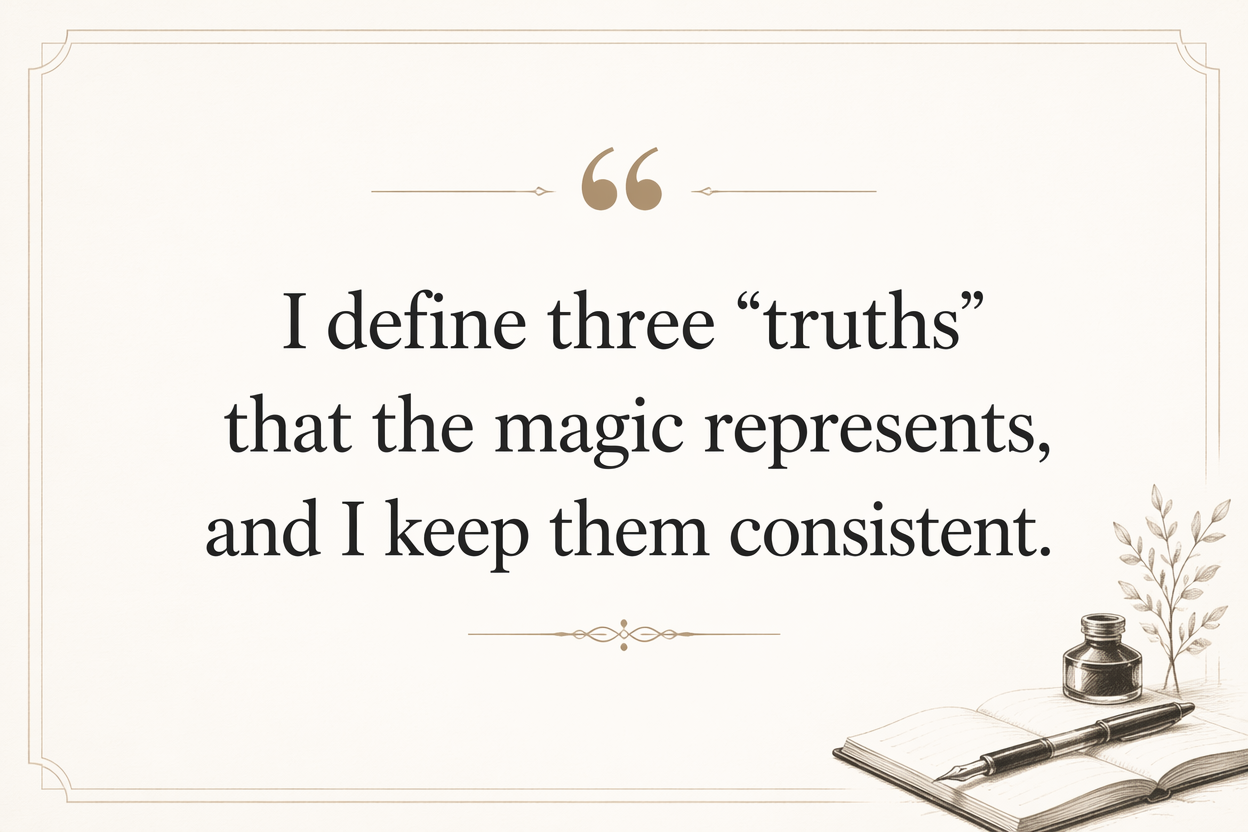
I use a simple method for soft magic. I define three “truths” that the magic represents, and I keep them consistent. A truth can be thematic (“pride invites downfall”), cultural (“names carry obligation”), or metaphysical (“death is a door that can be bribed”). When you feel yourself reaching for a convenient miracle, measure it against those truths.
Wonder Needs Contrast
Wonder is not endless fireworks. It is contrast between the ordinary and the extraordinary. When everything is wondrous, nothing is. This is why slice-of-life scenes matter in epic fantasy and why the mundane details of a wizard’s apprenticeship can make the spell feel sharper.
In revision, find one sequence where you stack magical set-pieces one after another. Insert a human scene between them that forces a choice, reveals a flaw, or shifts a relationship. You are not “slowing the pace.” You are creating the contrast that makes the next magical moment land.
Worldbuilding That Actually Serves Story
Fantasy has a reputation for worldbuilding excess because it is easy to confuse preparation with narrative. You can invent five religions and still have a flat story. You can invent one superstition and make it carry an entire novel if it changes what characters fear, desire, and risk.
When I evaluate worldbuilding, I look for causality. If the world’s differences do not visibly change daily life, law, war, family, and economics, the world reads like wallpaper. Readers will sense it even if they cannot name it.
Secondary Worlds And Hidden Fantasies
Secondary-world fantasy allows you to invent everything. It also charges you the price of clarity. You must ground the reader fast with familiar human needs and clean stakes. Hidden fantasy in our world lets you borrow default assumptions and disrupt them, which can be efficient and eerie. Each choice affects how much exposition you can get away with and how you pace reveals.
Pick your opening scene and write down what a new reader must understand to feel oriented. Then write down what can remain mysterious for fifty pages. Confusing those two lists is how promising fantasy manuscripts lose readers in the sample.
Culture Beats Geography
Maps are fun. Culture sells the world. Customs, taboos, food, inheritance, marriage rules, and what people do when they are afraid will give your world weight faster than another mountain range name. If you want readers to believe in your invented kingdom, show how a normal person survives inside it.
I recommend writing three “daily life” micro-scenes that never appear in the book: a child’s coming-of-age ritual, a marketplace argument, and a funeral. If you cannot write them convincingly, your world has not turned into a lived-in place yet.
History With Teeth
Fantasy histories work when they create current pressure. For example, ancient wars matter because borders are still contested. Old gods matter because the priesthood still has political power. A fallen empire matters because its roads decide trade routes today.
Audit your lore paragraphs. For every historical detail, write one sentence explaining how it affects a character’s immediate options in the current timeline. If you cannot write that sentence, the lore is probably a note for you, not a story for the reader.
Fantasy Subgenres And Reader Expectations
Authors often treat subgenres as marketing labels, then wonder why readers react so strongly. Subgenres are expectation engines. They tell the reader what the story will focus on, what kind of emotional payoff to anticipate, and what level of darkness or humor is likely.
This matters for your cover, your blurb, and your categories. Amazon KDP forces you to pick shelves. Goodreads readers apply their own. If your book reads like romantasy and you package it like grimdark, you will build the wrong audience and then disappoint them at scale.
Epic, Cozy, Grimdark, Urban, Romantasy
Epic fantasy promises scope: multiple factions, large-scale stakes, and a sense that the world’s fate is in motion.
Cozy fantasy promises comfort: bounded stakes, community repair, and a voice that lingers on the pleasures of daily life.
Grimdark promises moral corrosion and hard consequences, often with institutions that grind people down.
Urban fantasy promises contemporary friction between modern life and the supernatural.
Romantasy promises that the romance arc is central and will receive a satisfying level of page time and emotional resolution.
Your job is to decide which promise is primary. You can blend, but the reader will track which thread gets the most attention. For your outline, count scenes by function. How many scenes primarily advance romance, politics, mystery, or survival? The largest number is your actual genre signal.
Comp Titles As A Reality Check
Comp titles are not a submission-only tool. They are a sanity check for your own expectations. If you cannot name two recent books that share your reading experience, you either have a genuinely original blend, or you have not identified your real shelf.
I recommend pulling the top 100 in your likely Amazon categories and scanning covers and blurbs for tone promises. Then compare your manuscript’s tone at the sentence level. If your book opens with lyrical introspection and the category is selling fast banter and punchy stakes, you can still publish there, but you are choosing friction.
Packaging As Part Of The Genre Signal
Fantasy is one of the most design-sensitive genres because iconography carries meaning fast. A serif title over a painted landscape reads differently from bold sans-serif over a high-contrast character pose. Color palettes signal heat level, darkness, and target subgenre in seconds.
If you are building your own cover, I would run a thumbnail test before you fall in love with details. At Adazing, the cover tools exist for this exact problem, because a cover that looks gorgeous full-size can collapse into mush on a phone. Export the cover at Amazon thumbnail size, set it next to five bestsellers in your category, and see whether it belongs there at a glance.
Practical Tests To Confirm Your Story Reads As Fantasy
You can argue genre all day, and a reader will still decide during the sample. I rely on a few practical tests that catch most mismatches before launch.
The One-Sentence Premise Test
Write your premise in one sentence and include the fantastic element as a noun with a concrete effect. “A grifter discovers he can trade years of his life for perfect lies, and the debt collector is his future self” tells the reader what kind of fantasy they are entering. “A man learns the truth about himself” does not.
If you struggle to name the fantastic element, you probably have not integrated it into the engine of the plot.
The Scene-Level Causality Test
Pick five major scenes and answer one question for each. How did the fantasy element force a decision that would not exist in a realistic version of the story? If you cannot point to a forced decision, the magic is decoration.
This test is brutal and useful. It also shows you where to deepen the integration so the fantasy belongs in the bones of the book.
The Reader Onboarding Test
Give your first chapter to a reader who likes fantasy, and ask them only two questions. What rules did you think the story was playing by? What did you expect the book to focus on? Their answers will tell you whether your opening is signaling the right subgenre and the right level of magic.
If you want to run this test on yourself, paste the first 1,500 words into your drafting tool and highlight every sentence that teaches a rule. Too many rules in a row signals your pacing has become a lecture. Too few rules means readers will not know what kind of book they bought.
When I am drafting fast and need to keep the rule-teaching clean, I like working in a focused environment. Tools like Adazing QuickWrite are built for that kind of momentum, where you can stay inside the scene and leave the lore notes for later.
FAQs for What Makes a Story Fantasy: Unraveling the Magic and Wonder
Does fantasy require magic?
No. Fantasy requires that the impossible or the unreal be true within the story and shape structure. That can be gods, monsters, alternate physics, sentient landscapes, or supernatural contracts that shape choices. Many fantasy books include magic because it is a flexible way to express the impossible, yet the category is larger than spellcasting.
What is the difference between fantasy and magical realism?
The clearest craft distinction is how the text treats the impossible. Magical realism often presents the fantastic as ordinary inside a recognizable real world, with minimal explanation and a strong thematic intent. Fantasy tends to build an explicit alternate logic, even when it stays subtle, and it often invites the reader to engage with rules, lore, and consequence as part of the entertainment.
How do I know which fantasy subgenre to market as?
Start with what your book spends time on and what payoff it prioritizes. Count the scenes that advance romance, political conflict, mystery, or community repair. Then compare your tone and cover signals to the top books in the Amazon categories you want. If your manuscript and your packaging promise the same experience, you are close enough. If they promise different experiences, fix the promise before you buy ads or send ARCs.
Closing Thoughts
Fantasy works when you treat the unreal as a real force with real consequences, and when you communicate that promise clearly to the reader. Keep your rules consistent, charge a cost for power, build a world that changes daily life, and package the book so the right audience recognizes it at thumbnail size. When those pieces line up, the magic stops being decoration and turns into story.
