
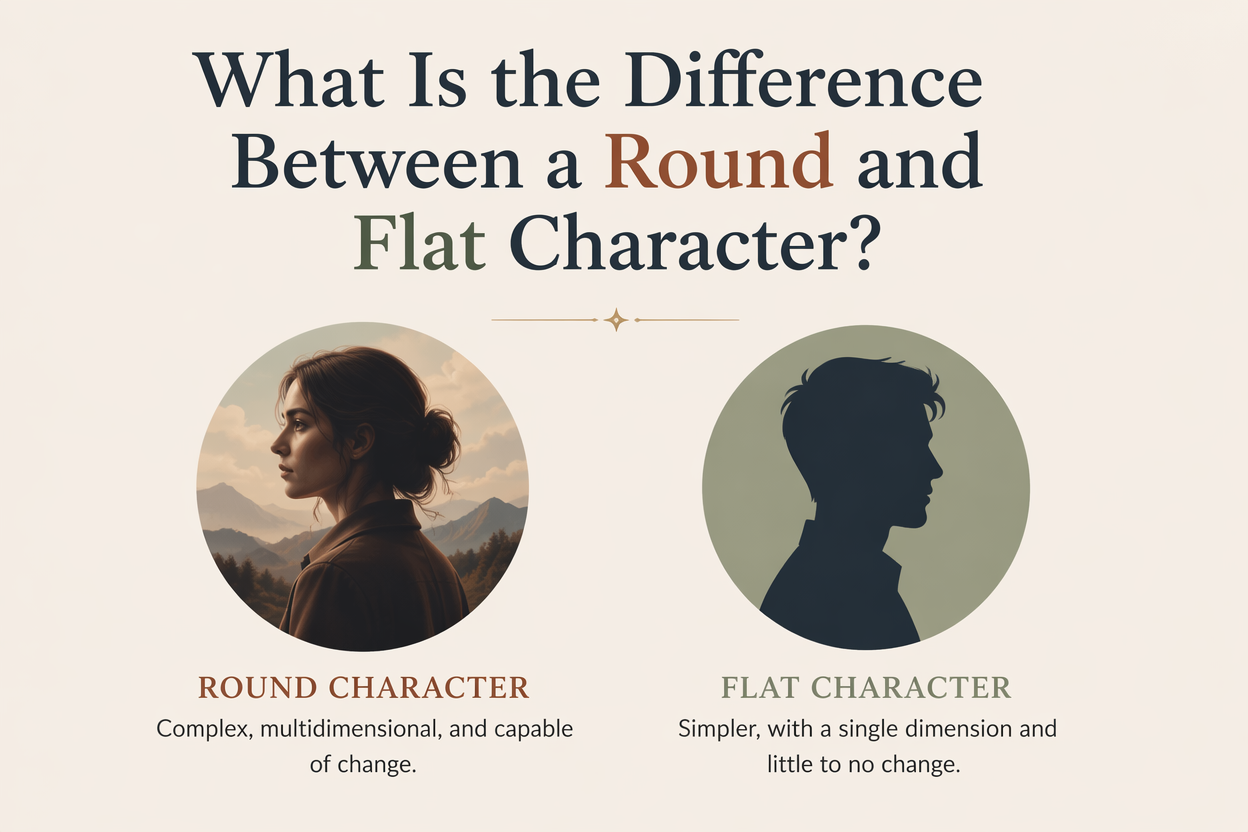
Most writers ask, “What is the difference between a round and flat character?” right after a critique partner says their cast feels thin, or right after an editor circles a scene and writes, “I don’t buy this choice.” The practical difference is simple: a flat character functions, and a round character changes the way the story breathes.
Flat characters aren’t a failure. They’re a tool. Round characters aren’t automatically better. They’re expensive, because they demand page space, interior logic, and consequences. If you treat the terms like a gold star system, you end up revising the wrong things and bloating scenes that should stay lean.
I’m going to give you a working definition you can apply to your draft, plus a few tests I use when I’m revising or diagnosing why a character isn’t landing with readers.
Table of Contents
Working Definitions You Can Actually Draft With
A flat character is built around one dominant idea. That idea can be a role (the medic, the rival, the strict dad), a trait (vain, timid, brutal), or a function in the plot (gatekeeper, informant, comic relief). They can be memorable, even lovable, while still being flat because they stay consistent and predictable, which keeps the story moving.
A round character has interior complexity that shows up on the page as contradiction under pressure. They can want two things at once, believe something they can’t live up to, or act against their own self-image in a way that still feels inevitable. Roundness is not about how many facts you invent about them. It’s about how many forces are operating within them when the plot is squeezed.
If you only remember one line, remember this: flatness is a stable pattern, and roundness is a pattern that can bend without breaking believability.
Traits Versus Tensions
Writers often try to “round” a character by adding more traits. You give the stoic detective a pet turtle and a fear of clowns and a favorite jazz record, and the draft still reads flat. That happens because you added labels rather than tension.
To create roundness, put two values in the same body and force them to compete. For example, a character might carry duty and mercy at once, or feel loyalty pulling against ambition, or want to keep her pride while also wanting badly to be loved. Then write scenes where the character has to pay for whichever side wins.
Information Versus Causality
A flat character can have a long backstory. A round character can have almost none on the page. What matters is causality. When something happens, do I understand why this person responds in this particular way, even if I don’t agree with it? Round characters create that feeling of specific cause and effect.
Consistency Versus Predictability
Consistency is good. Predictability is only good when you want speed. Flat characters give you both, and nothing else; a round character is consistent while still managing to surprise you, and the surprise never reads like a twist the author shoved in for spice.
The craft trick is to surprise the reader with the character’s choice, then immediately make the choice feel like the only choice they could have made.

What Flat Characters Do Better Than Round Characters
If your novel tried to make every speaking role round, you would end up with a book that feels like a dinner party where everyone talks at once, and nobody leaves. Flat characters keep the story legible and your protagonist in focus. They also make your world feel populated without demanding subplots that hijack the main line.
In my experience, the drafts that get messy are the ones where the author is afraid of flatness. They keep “developing” the bartender, the neighbor, the third cousin, and suddenly the midpoint has ten emotional arcs competing for oxygen.
Compression And Clarity
Flat characters let you compress. You can establish them fast, and the reader understands how to read them in the scene. That frees you to spend your limited page space where it matters, which is usually your protagonist, antagonist, and one to three supporting characters who carry the emotional load.
If you write genre fiction with tight pacing, flat characters are often the difference between “page-turner” and “well-written but slow.” Think of the classic gatekeeper who refuses entry, the cheerful innkeeper who points to the old ruins, the security guard who wants a bribe. Their job is to create friction or deliver information, then get out of the way.
Rhythm And Contrast
Flat characters also give you rhythm. For example, a consistent comic-relief side character can reset the emotional temperature after a brutal chapter. On the other hand, a rigid authority figure can keep pressure on the protagonist so the book doesn’t sag.
Round characters tend to blur contrast if you aren’t careful, because their scenes ask the reader to parse layers. Flat characters can be clean shapes against the more complicated silhouette of your lead.
Series Durability
In a series, flat secondary characters can be a gift. Readers like the familiar shopkeeper, the dispatcher, the cranky mentor. You can bring them back for continuity without re-opening a full arc every time. If you’re writing a long series, that restraint is a survival skill.
How To Tell If Your Protagonist Is Truly Round
Writers often assume the protagonist is round because they’re on page a lot. Page time does not equal complexity. I’ve seen plenty of main characters whose single trait drives a plot. They can still be entertaining, but if you want depth, you need evidence of internal tension.
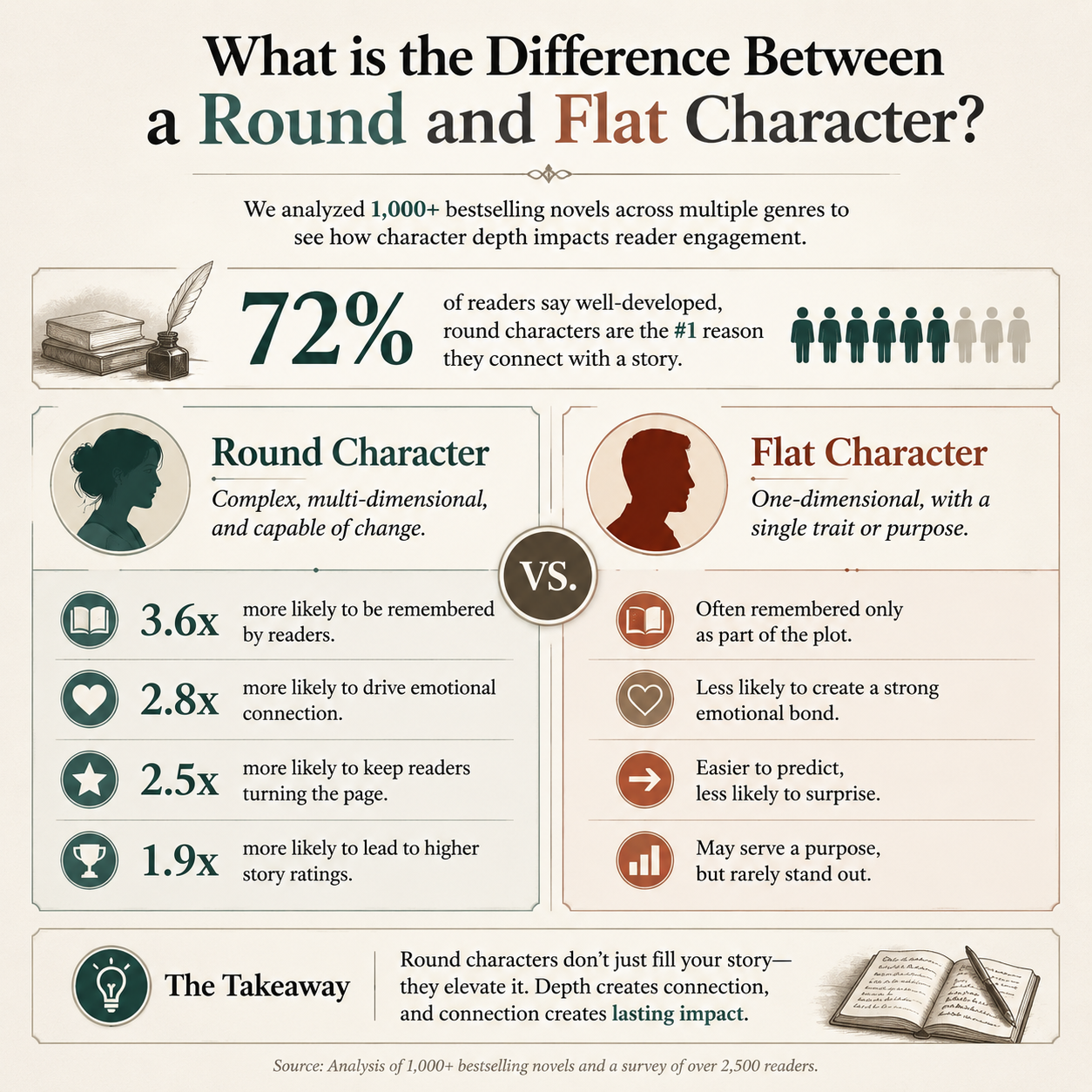
Here are the diagnostics I use when I’m editing my own work.
The Pressure Test
Put your protagonist under pressure and watch what breaks. A round character has a self-image that gets challenged. They believe themselves loyal until the moment they hesitate, brave until they start bargaining, decent until they do harm and call it necessary.
Should nothing break, what you likely wrote is a competent avatar rather than a person. Competence is fine on its own; it goes flat when it never costs them anything.
The Choice Test
Give them a choice where both options hurt. The flat version picks whichever option matches the trait and moves on, while a round one chooses, regrets, rationalizes, and lets that choice bend the next choice.
Regret is one of the fastest signals of roundness, because regret implies a competing value. If your character never regrets anything, you either wrote a saint, a sociopath, or a cardboard cutout that the plot carries around.
The Private Logic Test
Round characters have private logic that the reader can follow. They do something “wrong,” yet the reader understands how the character got there. This is why round villains are so sticky in the mind. Their reasoning is coherent, even when it’s warped.
If your character’s decisions feel like they exist to hit plot beats, the private logic is missing. The fastest repair is to write one paragraph in your notes where the character argues their case to a hostile judge. Then rewrite the scene so the reasoning shows up through action and subtext.
Common Misreads That Create Flat Characters By Accident
Most flatness problems I see are not laziness. They’re craft misunderstandings that push a character toward a single-note presentation.
Backstory As A Substitute For Motivation
Backstory can explain a wound, but it does not automatically generate a present-tense desire. A character can have a tragic past and still feel flat if they do not want something concrete right now.
If your draft has paragraphs of history and the character still feels thin, cut backstory until only the pieces that affect today remain. Then write a scene in which the character tries to get what they want, but fails in a way that exposes their values.
Quirks That Don’t Touch The Plot
Quirks are fun. They are also cheap. A character who collects antique spoons is still flat if spoon collecting never collides with a difficult decision. I’m not against quirks. I want the quirk to connect to a pressure point.
If you keep the spoon collection, attach it to something the character fears losing. Or make it the thing they sacrifice when the stakes rise. If it stays decorative, it reads decorative.
Dialogue That Only States The Function
Flat characters often reveal themselves through “functional dialogue.” Every line they speak exists to deliver information, agree, disagree, or cue the next plot move.
Round characters speak with agenda, evasion, and self-protection. Even when they answer a question, they do it the way a person does, which usually means imperfectly.
When I revise, I highlight any exchange where every line is perfectly responsive. Real people talk like that only when they are being deposed.
How Many Round Characters Your Book Can Support
You can support fewer round characters than you think. Roundness costs you scene time, and scene time costs you pacing. That trade-off changes by genre. For example, a literary family saga can support more round characters than a breakneck thriller, because the reader came for interior weather and relational complexity.
If you are writing commercial fiction, I usually see the best results when the story has two to four truly round characters: the protagonist, the antagonist or main opposing force, and one to two supporting characters whose arcs meaningfully intersect the main arc. Everyone else can be flat or lightly rounded, so the book stays clean.
A Practical Casting Audit
List your characters and write one sentence for each that answers, “What do they want, and what do they fear will happen if they don’t get it?” If you cannot answer in a sentence, you don’t have a clear engine. If you can answer but the want never puts them in conflict with anyone, they are decoration.
Next, mark which characters force the protagonist to change. That list is your roundness budget. Spend it deliberately.
Scene Ownership
Round characters own scenes. When they walk in, the scene shifts because they carry competing desires. Flat characters support scenes. They help the protagonist collide with the world.
If a side character keeps stealing scenes, you can either promote them and restructure the story, or you can flatten them on purpose. Flattening on purpose often means reducing interior access, simplifying their goal, and limiting their presence to scenes where they create a specific kind of pressure.
Tools That Help You Draft With Control
When you’re juggling a big cast, a small amount of structure keeps you sane. I use tools the way I use index cards: to keep my imagination from lying to me about what’s on the page.
If you want a fast way to stress-test character wants and scene purpose, a drafting tool like QuickWrite from Adazing can help because it pushes you to write forward in clean chunks. You can draft a “want and fear” line for each major character at the top of a scene, then write the scene under that constraint. When the scene drifts, you will feel it sooner.
FAQs for What is the Difference Between a Round and Flat Character?
Can a flat character be a protagonist?
Yes. Many action-driven stories rest on a protagonist defined by a single strong trait, like competence, honor, or stubbornness. The risk is emotional sameness. If you want to keep a flat-ish protagonist, give the plot escalating external costs and surround them with rounder supporting characters who challenge the protagonist’s worldview.
Do round characters always need an arc?
No. Roundness means complexity on the page, while an arc means meaningful change over the story. A character can be round and remain essentially the same if the story tests them and reveals them rather than transforming them. This approach works well in detective fiction and some series protagonists.
How do I fix a flat supporting character without adding a subplot?
Give them a single private stake that collides with the protagonist’s goal in an existing scene. You can do this in a line of dialogue, a refusal, or a small sacrifice. Rather than more chapters, all you need is one moment in which their want competes with the protagonist’s, and they choose themselves at a cost.
A Clean Way To Use Both
Round characters earn the reader’s emotional investment, and flat characters keep your story sharp. A think draft usually calls for rounding one or two characters whose choices shape the ending, then stopping there. Meanwhile, a bloated draft calls for the opposite move: flatten secondary characters until every scene has a clear owner and a clear conflict. Your book will read faster, and the characters that matter will hit harder.
