
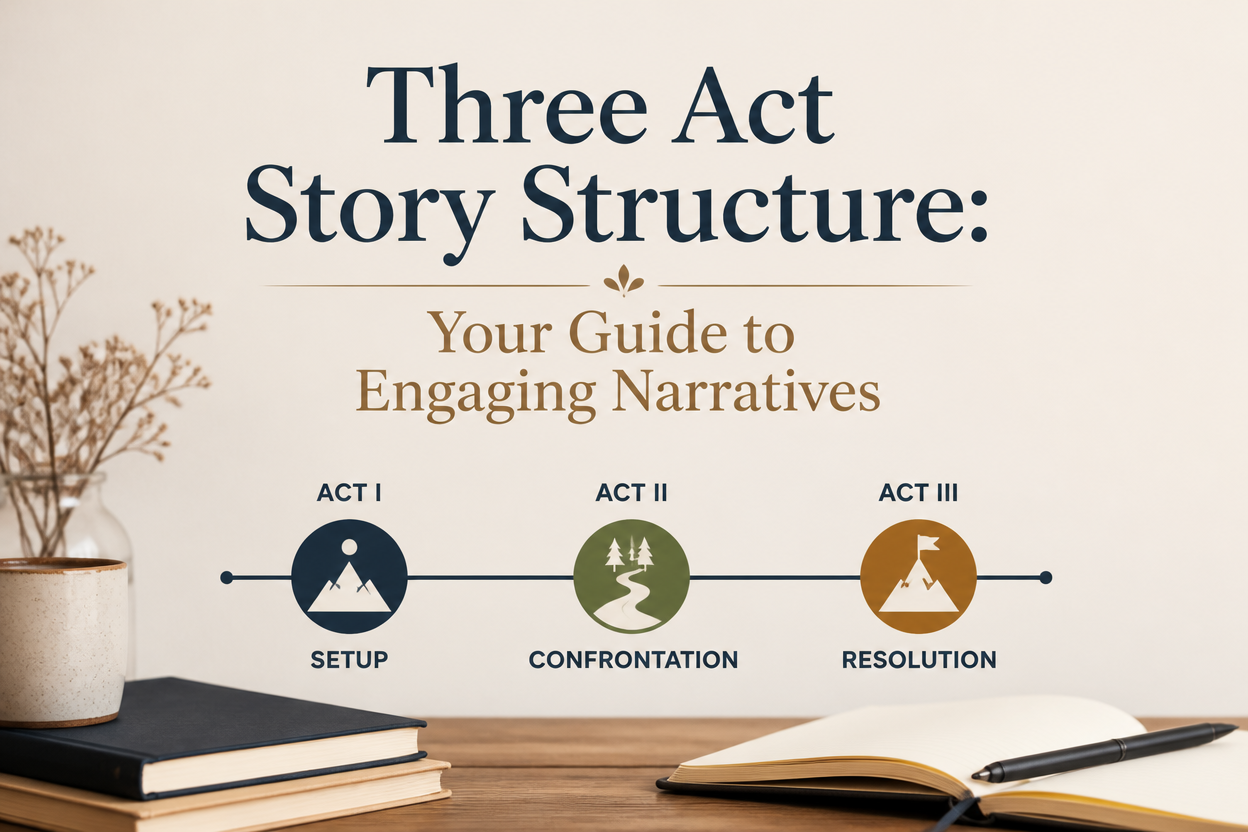
A novel can have a sharp premise and polished prose. Whether readers keep turning pages often depends on its three-act story structure. That framework gives your plot pressure, direction, and escalation without forcing you to write by formula. I use it as a diagnostic tool, especially when a manuscript has strong scenes that never build toward a meaningful change.
Across three acts, a story moves from stability to disruption and rising pressure, and finally into consequence and change. Each act has a different job. Act One creates a life worth disrupting. In Act Two, that original life becomes impossible to recover. Act Three then forces the protagonist to confront the story’s central problem by acting.
None of this requires three equal sections or a turning point on an exact page. For example, a 90,000-word mystery might place the first major turn around page 25 before spending half the book tightening the investigation. A 45,000-word romance may move through the same pattern in far fewer scenes. The structure measures dramatic movement. Genre and length decide the proportions.
Table of Contents
The Architecture Of Three-Act Story Structure
Story structure describes cause and effect across a narrative. A character makes a choice; that choice creates a consequence, and the consequence produces a harder choice. Readers feel momentum when each major event springs from what came before.
To track that chain, I often reduce the framework to three questions. What changes the protagonist’s ordinary life? What pressure keeps them from going back? And in the end, what final choice proves the protagonist has changed, failed, or deliberately refused to change?
The Opening Balance
Act One establishes the protagonist’s ordinary pattern, desire, and limitation. The reader needs only the few facts that shape the first meaningful decision, so the character’s full childhood and an entire fictional government can wait.
In a fantasy novel, a village healer might want to keep her brother alive through another winter. Her deeper limitation could be a refusal to treat soldiers after a war destroyed her family. That contradiction builds emotional pressure in the opening before the dragon, invasion, or royal summons appears.
The Three Major Movements
The first act moves from stability to disturbance. In the second, attempted control gives way to mounting consequence. The third carries the story from crisis to choice and shows what that choice costs.
Those movements give you a useful test for scene order. Each scene earns its position by changing what the protagonist knows, wants, or can do. If removing a scene changes nothing afterward, it probably needs a stronger consequence or a different purpose.
To apply that test before drafting, write one sentence for each movement. Together, those sentences should capture the starting condition, the pressure that follows, and the final decision. The exercise takes less than ten minutes and can catch a shapeless middle before you spend months drafting it.

Act One And The First Turning Point
Act One earns the reader’s attention by making the protagonist’s current life specific and introducing a problem too urgent to set aside. The first turning point then pushes the protagonist into a different set of circumstances where the old routine no longer solves that problem.
That sequence explains the mistake I see most often: treating the inciting incident as the whole first act. Any inciting incident, whether a murder, job loss, affair, magical discovery, or unexpected inheritance, creates disruption. Meaning comes from how the protagonist reacts.
Ordinary Life With Pressure Already Inside It
That reaction lands harder when your opening situation already contains a pressure point before the main event arrives. For example, a detective facing a murder investigation may also be hiding a disciplinary complaint. A widow opening a bakery could be carrying debt from her spouse’s secret gambling. Picture a teenager preparing for a music audition whose only source of support, a parent, is about to leave town.
Details like these stop the plot from feeling assembled from separate parts, since the external event hits a life that already has something to lose. To build that kind of life, give your protagonist a concrete short-term want and a deeper emotional need they have not yet learned to name.
The Inciting Incident And The Lock-In
The inciting incident disrupts the protagonist’s pattern. Commitment to a new direction comes later, at the first turning point. Occasionally both moments happen in the same scene. More often, several chapters separate them.
In a thriller, a woman might discover evidence that her missing sister is alive. That discovery starts the story. The turning point comes later, when she steals the evidence from the police archive and becomes a suspect herself. From that moment on, her investigation carries personal danger, legal risk, and a deadline.
To find that kind of turning point in your own draft, track decisions across the first act and set calendar time aside. Mark the moment the protagonist learns the problem, the moment they choose a response, and the moment that response closes a door behind them. That third mark usually gives you a stronger act break than a chapter count.
Act Two And The Pressure Of Consequences
Act Two occupies the largest portion of many novels. The protagonist needs room to pursue a plan, face resistance, revise it, and discover the original problem runs deeper than expected. The middle earns its length only when conditions change from scene to scene.
A weak middle repeats the same obstacle with different scenery. In a strong one, each attempt costs more than the last. Along the way, the protagonist might lose an ally, attract an enemy, sacrifice a value, reveal a secret, or create a problem the original strategy can no longer repair.
Progress With A Price
Those rising costs work best alongside partial victories. For example, a detective might find the getaway car. In a romance, the heroine finally gets the kiss she wanted. Give a science-fiction crew the abandoned station they were searching for, and the same pattern holds. Each gain should also uncover a larger threat or demand a difficult sacrifice.
To check that balance, write down four items for every major scene in Act Two: the protagonist’s goal, the opposing force, the immediate result, and the new complication. If the result confirms the protagonist’s previous position, revise the scene. Readers need the situation to change, even when the protagonist appears to gain ground.
The Midpoint Reversal
A midpoint reversal changes the protagonist’s understanding of the central problem. Sometimes the villain’s identity becomes clear. A romantic interest could confess a betrayal, or a supposedly safe location could prove to be a trap. In another version, the protagonist wins the visible contest and discovers that the victory serves the antagonist’s plan.
None of those reversals requires a spectacular explosion. In literary fiction, a quiet confession can carry greater force than a chase. Picture a father who learns his estranged daughter has read his old letters. Suddenly, he faces a relationship he spent years avoiding. That discovery changes the emotional terms of every later scene.
Place the midpoint near the center of your draft and test its effect on the chapters that follow. After the reversal, the protagonist should pursue the goal with different information, greater urgency, or a more personal stake. If later scenes unfold exactly as they would have without it, the midpoint needs more force.
Act Three And The Final Choice
Act Three collects the consequences of earlier choices and turns them into a final test. That test works when the protagonist must act with limited options and meaningful cost. A solution delivered by luck weakens the promise built across the first two acts.
The cost can take many forms, since the final confrontation may be physical, emotional, intellectual, or social. For example, a courtroom verdict, a public confession, a rescue attempt, or a refusal to repeat family cruelty can all serve as a climax. Which form fits depends on the question your novel has been asking.
The Crisis Before The Climax
At the crisis, your protagonist hits bottom or faces their hardest decision. Plans fail, allies leave, and evidence disappears until winning clearly requires a sacrifice the protagonist of chapter one would have refused.
That sacrifice forces an internal answer. Picture a cowardly character choosing exposure over safety. A controlling parent might finally free a child from a lifelong duty. Give the same moment to a revenge-driven hero, and they may spare the person who caused the original wound. Each choice should grow from the character’s accumulated experience. A speech explaining the theme can never do that work.
The Resolution And The New Normal
The climax answers the central external question. The resolution then shows how that answer reshapes the characters’ lives. Those consequences need only a few pages, as long as they have room to register.
Genre shapes how those consequences appear. In a mystery, show how the investigation affects the detective’s trust in institutions. A romance benefits from the practical shape of the shared life the couple has chosen. Fantasy readers will want to see who governs after the tyrant falls. Across all three, readers look for a sense of completion. That sense depends on visible proof in the characters’ new circumstances.
To gather that proof, write your final scene before you revise the middle. Then identify an action the protagonist can take at the end that the opening chapters made impossible. That difference gives you a clear measure of character movement. It also shows which scenes decorate the journey without advancing it, so you know what to cut.
Revision Through Structural Diagnosis
Structure becomes most useful during revision. You can finish a draft with beautiful language and still discover that the protagonist’s first consequential choice arrives on page 180. A structural pass locates that delay before you mistake it for a sentence-level flaw.
My own pass starts with a spreadsheet listing every chapter. For each one, I record the protagonist’s goal, the conflict, the result, and the information or decision that changes afterward. Once those rows are filled, I mark the inciting incident, first turning point, midpoint, crisis, climax, and resolution. Within an hour, the pattern usually becomes clear.
Signs Of A Delayed First Act
One common pattern is an overlong first act. The opening chapters may introduce several versions of the protagonist’s life without forcing a meaningful decision. Backstory can be interesting and still postpone the novel. In that case, start closer to the pressure that changes the character’s available choices.
Starting later still leaves room for quiet scenes. A quiet scene earns its place when it establishes a relationship, creates a promise, or makes the coming disruption hurt. If its information arrives before the reader has a reason to care, move or compress it.
Signs Of A Sagging Middle
A sagging middle causes just as much trouble. It sets in when the protagonist follows a plan that yields the same type of result again and again. To fix it, change the nature of the opposition. For example, a failed attempt may embarrass the protagonist in public. That embarrassment damages an alliance. Without that ally, the protagonist slides into a moral compromise. Escalation needs variety along with intensity.
Planning the midpoint revelation earlier can also help. Write the most damaging truth your protagonist could learn, and build scenes that make its discovery both plausible and costly. Suspense grows from delayed consequence. Withholding information forever only frustrates the reader.
Signs Of A Weak Ending
The ending can falter too, usually when the climax hinges on secondary characters, coincidences, or clues the protagonist never earned. Hand the decisive move to the character whose choices created the central problem.
To test whether the ending holds, read the final five chapters with one question in mind: what does each chapter force the protagonist to risk? If the answer comes back vague, sharpen the external stakes and connect them to the emotional wound established in Act One.
Tools can help you see patterns during this pass. For serious diagnosis, I use a simple scene spreadsheet. Writers who want help generating alternatives can try Adazing’s QuickWrite to test scene goals, complications, or character decisions. The software produces possibilities. Deciding which ones belong in your novel remains your job.
FAQs for Three Act Story Structure: Your Guide to Engaging Narratives
How Long Should Each Act Be?
No single proportion works for every genre. Many commercial novels give Act One roughly a quarter of the manuscript, Act Two about half, and Act Three the remaining quarter. Use those figures as a planning reference. Beyond them, follow the pace your story requires. A mystery may need a longer investigation. In a literary novel, the consequences after the central event may fill many more pages.
Does Every Novel Need Three Acts?
Every novel needs meaningful change, rising pressure, and consequence. Three acts offer one clear way to arrange those movements. Experimental fiction, episodic fiction, and stories with multiple protagonists may use other patterns. Testing the draft against three acts can still uncover missing turns, even when you choose a different final design.
What Should I Do When My Story Has Multiple Protagonists?
Give each major protagonist a visible desire, a distinct pressure pattern, and a decision affecting the shared conflict. Individual arcs can turn at different moments. The story benefits most when those turns relate clearly to one another. To track them, map each arc on a separate line and identify the scenes where one character’s decision changes another character’s options.
Structure That Serves The Story
Three-act story structure works because it connects events to choices. Use Act One to establish a life under pressure, Act Two to make every solution more costly, and Act Three to demand a decision proving what the protagonist has become. From there, revise scene by scene until the consequences travel cleanly from the opening disruption to the final image.
Structure should give you control over the reader’s experience without taking control away from your imagination. Start with the major turns and test the causal links between them. The finished novel will still hold surprises no amount of planning could invent.
