
Studying a strong synopsis example gives you a working model for compressing an entire manuscript into a clear account of character, conflict, escalation, and resolution. That model matters because a synopsis has a harder job than a book description. An agent, editor, or contest judge needs to understand the full story, including the ending, within a few hundred words.
That tight word count leads to the most common mistake I see: treating a synopsis like a short blurb. A blurb creates curiosity by withholding the outcome. In contrast, a synopsis reveals the outcome and proves that the plot holds together. You need both documents, and each one needs a different kind of precision.
To help you get that precision right, the sections below break down a complete synopsis example from a work of fiction, explain its structure, and adapt the same method for nonfiction. You’ll also learn how to cut a bloated synopsis without stripping away the story’s emotional spine.
Table of Contents
The Purpose Of A Manuscript Synopsis
A synopsis tells a publishing professional what happens in your manuscript from beginning to end. It identifies the protagonist, central problem, major turns, stakes, and outcome. To keep the account moving, every sentence should show how one event leads to the next.
When and where you send the synopsis depends on the request. Agents and editors may ask for one with a query letter, a partial or full manuscript, or a writing contest entry. Length requirements vary just as widely, ranging from a single page to three pages or a specific word count. Follow the requested format before you worry about style.
Beyond matching the format, the document should reflect the actual book. For example, if your manuscript has three point-of-view characters, the synopsis needs to explain how their storylines connect. Similarly, a synopsis for a novel built on a late revelation should state the reveal plainly. Without the ending, the document is incomplete, and the reader cannot judge the full arc.
Synopsis Versus Book Description
A book description sells the reading experience. It introduces a compelling situation, establishes the genre, and leaves the central question unresolved. In contrast, a synopsis explains the whole narrative so a publishing professional can evaluate how the story is built.
Picture the difference in a mystery novel. Its description might end with a detective discovering that the missing woman left behind a photograph marked with his own name. From there, the synopsis has to reveal who took the photograph, why the woman disappeared, how the detective responds, and what the discovery means in the final act.
Each document, then, serves its own audience. Aim the description at a prospective reader, and save the synopsis for someone deciding whether the manuscript works.
The Information A Reader Needs
As the synopsis progresses, give the reader four kinds of information. Open by establishing the protagonist and the ordinary life the central conflict will disrupt. Once the reader knows that life, introduce the event that forces a decision, then trace the complications and consequences it sets off. The final stretch explains the climax and the new condition the ending creates.
Those four stages leave little room for everything else in the book. Skip most subplots, setting details, and secondary characters, and keep the details that change the protagonist’s choices. For example, a minor character who appears twice can drop out of the synopsis if neither appearance alters the plot.

A Fiction Synopsis Example
To show how these pieces fit together, the short synopsis below summarizes an imaginary suspense novel. In the story, a forensic archivist named Mara Vale uncovers a government program to erase evidence of future crimes.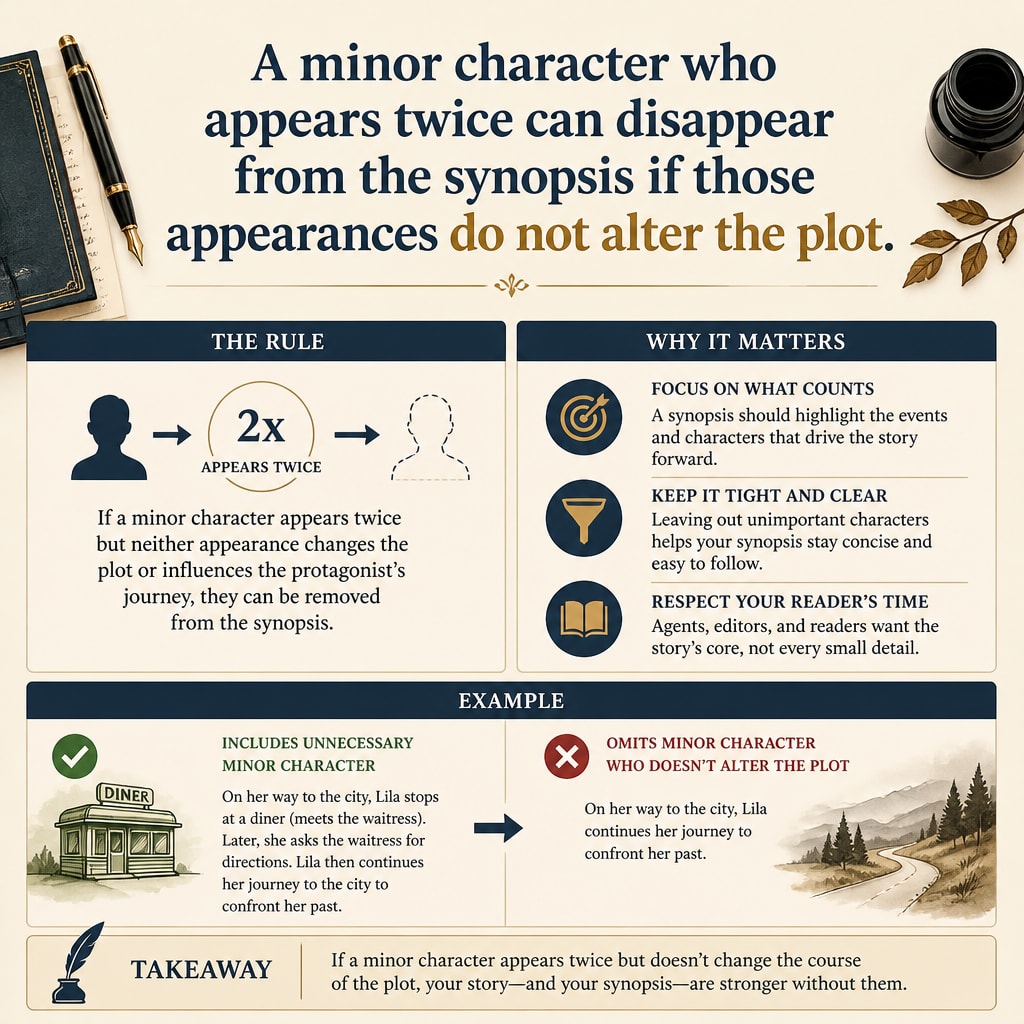
Example Synopsis
Mara Vale restores damaged records for the Central Archive. This government department preserves evidence after natural disasters and terrorist attacks. Her trust in the archive runs deep because its records helped her make sense of the bombing that killed her older brother twelve years earlier, and she accepts the official account naming a domestic extremist as the bomber.
The trust cracks during a routine restoration, when Mara finds a sealed file dated three days in the future. Inside are photographs of a train station not yet attacked, along with a list of casualties. Her supervisor orders her to destroy the file and warns her about the prison sentence for unauthorized access to predictive records. Mara copies the photographs before obeying.
When the train station attack occurs exactly as the file predicts, Mara studies the list and finds her brother’s name among the dead. On paper, he died twelve years earlier. The discovery leads her to doubt both the original bombing and the archive’s purpose, so she contacts Elias Trent, a former investigator who lost his career after claiming the government altered the bombing evidence.
According to Elias, the archive receives records from a future regime controlling public memory by editing the past. Mara dismisses the theory until another file appears, predicting an explosion at the archive and naming Mara as the person who will cause it. Soon after, her supervisor arrests Elias and tells Mara a foreign intelligence service fabricated the files.
With Elias in custody, Mara escapes with the archive’s oldest records and discovers her brother survived the bombing. He later joined the group sending future evidence backward in time. Its members have been trying to prevent a civil war, and they erased the original bombing from public records because the event created the political conditions for the conflict. Mara’s brother helped alter the evidence, then regretted the decision when the government began using the archive to control every record of dissent.
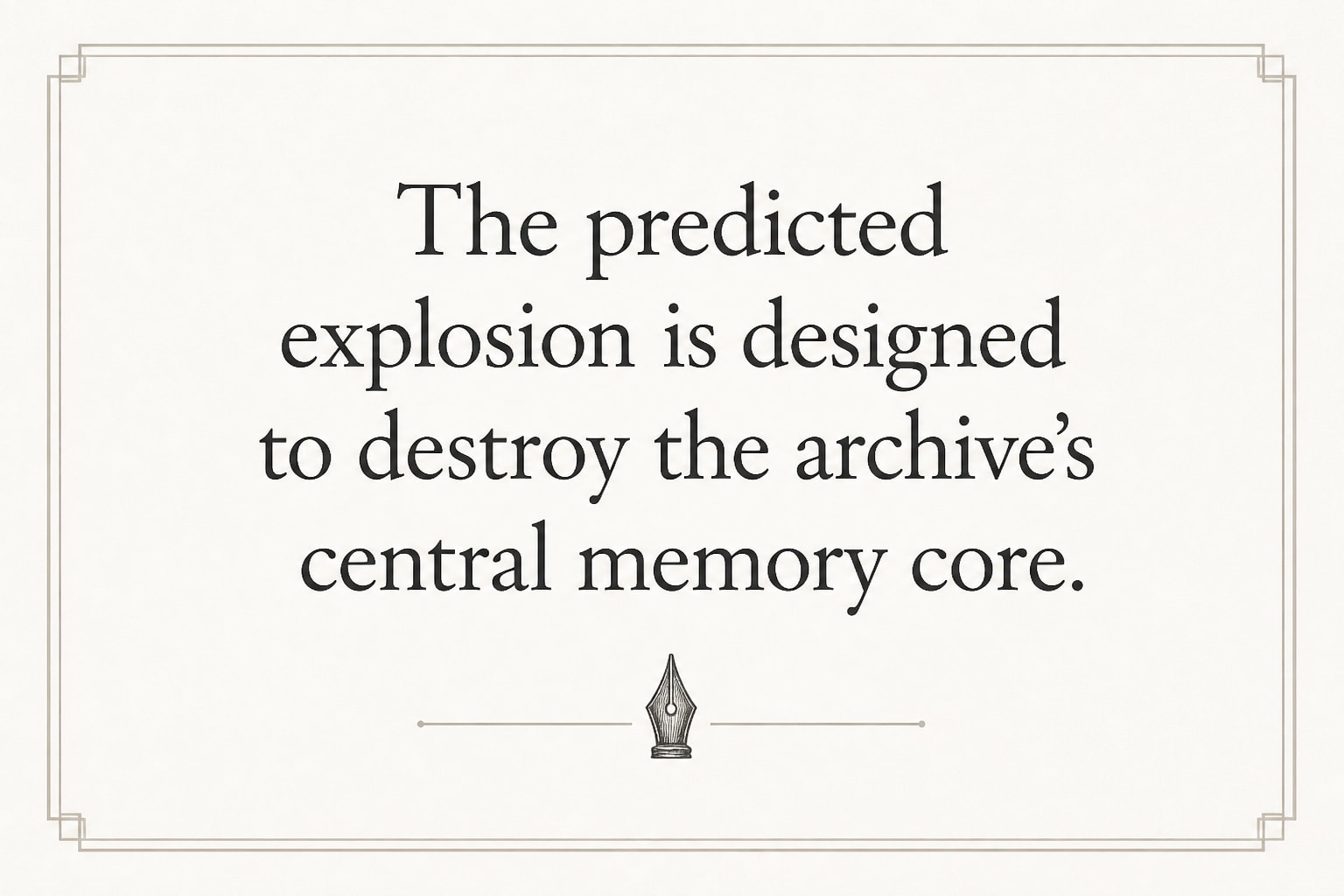
Government control over those records runs through the archive’s central memory core, the target of the predicted explosion. Mara learns the attack will also erase the group’s remaining evidence and trap millions of people inside an official history they know to be false. Her choice comes down to exposing the archive or allowing the memory system to remain intact.
When the explosion hits, Mara runs into the archive and releases the unedited records through the public emergency network. Those files reveal the government’s crimes, her brother’s role in the original cover-up, and the group’s plan to manipulate future events. Mara saves the records, and her brother dies in the blast after returning to help her.
After the archive falls, the country faces public outrage and political collapse. Mara accepts responsibility for releasing information that could trigger violence, then begins rebuilding the records with witnesses from every side of the conflict. Her brother is gone, and the erased years cannot be recovered. What Mara can build is a historical record no single institution controls.
Why The Example Works
The example names the protagonist in the opening sentence and gives her a specific role. Her work as a forensic archivist ties directly to the story’s central question about evidence and memory. With the question established, the first major discovery arrives early and shows the reader what disrupts Mara’s life.
From there, each paragraph adds a consequence. In order, Mara finds a future file, contacts Elias, learns her brother survived, discovers the archive’s purpose, and faces a choice with public stakes. Each step comes from a decision Mara makes, so the plot keeps moving and never reads like a catalogue of scenes.
The final decision gets enough space to feel earned. The closing paragraphs cover the climax, its cost, and Mara’s changed position after the conflict. Stopping at the explosion would leave the reader without the emotional and narrative resolution the manuscript promises.
The Structure Behind A Clear Synopsis
I draft a synopsis in five movements. This structure works especially well for commercial fiction because it follows the reader’s understanding of the plot from disruption to consequence.
Opening Situation And Inciting Incident
Introduce the protagonist, their current situation, and the event that sends the story on a new course. Keep the backstory brief, including only what helps the reader understand the protagonist’s first meaningful choice.
The setup for this first choice changes with the genre. For example, a romance synopsis might introduce a wedding planner who has sworn off relationships after a public breakup, then put her in charge of her former partner’s destination wedding. In fantasy, the opening could center on a disgraced healer whose forbidden ability awakens when someone poisons the crown’s heir. Both openings hand the protagonist a problem too urgent to ignore.
Rising Complications And Reversals
Show how the protagonist responds and how the response creates new problems. From those problems, keep the reversals that alter the goal, reveal new information, or raise the cost of failure. Several of these events can share a single paragraph as long as the link between them stays clear.
Clear links depend on causal language, so use it with care. Words such as “because,” “after,” and “therefore” help the reader follow the chain of events. When too many sentences begin with “Then,” the underlying plot may need a clearer cause-and-effect pass.
Climax And Resolution
Explain the final confrontation and the protagonist’s decisive action, naming what the action costs. From there, show the condition the ending creates. The outcome can be bleak or bittersweet and still satisfy, as long as the reader can see exactly where the story lands.
Knowing where the story lands also shapes the rest of the synopsis, so draft the ending paragraph before you polish the opening. In my experience, the conclusion often exposes a missing turn in the middle. Once you know what the protagonist finally chooses, you can select the earlier events that set up the decision.
Synopsis Length, Tense, And Point Of View
Treat the requested word count as a hard boundary. Depending on formatting, a one-page synopsis often lands between 400 and 600 words, and a two-page version may run closer to 800 or 1,000. Because submission guidelines control the decision, check the agent, publisher, or contest instructions before sending anything.
Unless those guidelines set the tense and point of view, write in present tense even when the manuscript itself uses past tense, since present tense gives the synopsis a direct, compressed quality. Third person is the safer default unless the submission request asks for something else. A memoir or first-person novel can carry a first-person synopsis. Still, third person usually makes the plot easier to evaluate.
Clear third-person narration also depends on visible character names. After you introduce a character, use the name consistently rather than switching among labels such as “the detective,” “the father,” and “the grieving man.” Titles and roles can clarify how two characters relate. Repeating them only eats into your word count.
Handling Multiple Point-Of-View Characters
When several characters carry the manuscript, organize the synopsis around the shared conflict. Introduce each major viewpoint character when their storyline becomes relevant, then connect the strands through the choices that bring them together.
To hold those strands together, avoid summarizing each character in isolation for several paragraphs. Separate summaries make a single novel read like three unrelated books. A better approach moves between storylines whenever one character’s action creates pressure for another.
Cutting Without Losing Meaning
Cut names for minor characters, repeated motivations, scenic description, clever dialogue, and plot events that lead nowhere. Those cuts leave room for the details that explain a major reversal or clarify the final choice.
To decide which details earn their place, ask what changes after each paragraph. If the answer is unclear, combine the paragraph with the surrounding material or remove it. Over several passes, the synopsis grows denser until every sentence carries plot or character information.
A Nonfiction Synopsis Example
Nonfiction synopses work differently because the manuscript may be organized around an argument, a method, a reported story, or a personal transformation. In each form, the reader needs to understand what the book offers, who it serves, how it unfolds, and why you are qualified to write it.
Consider a proposed nonfiction book called Small Press, Real Readers, summarized in the sample synopsis below.
Small Press, Real Readers explains how independent authors can build a reliable readership through focused positioning, strong packaging, and repeatable promotion. The book begins with the author’s central argument: discoverability depends on a series of consistent reader-facing choices rather than one dramatic launch campaign. It then examines genre signals, cover design, retailer copy, email lists, review teams, and long-term promotion.
Each chapter pairs publishing principles with examples from fiction and nonfiction authors working with limited budgets. The middle chapters show how to identify comparable books, choose useful categories and keywords, write a description that matches reader expectations, and plan promotional content for each stage of a launch. After release, the final section turns to read-through, backlist promotion, and decisions about paid advertising.
Those lessons are aimed at independent authors preparing a first release and at experienced writers whose sales have stalled. The book combines practical instruction with a realistic account of the trade-offs involved in self-publishing. The author’s background in writing, publishing, and book marketing supports the book’s advice. Worksheets and checklists then help readers apply each chapter to their own books.
This example gives a publisher the book’s argument, audience, contents, format, and author platform in a few paragraphs. Together, those elements help a publisher picture the finished book on a bookstore table or retailer page. For that picture to hold, the synopsis needs enough material to show the concept can sustain a full manuscript.
Revising Your Synopsis For Submission
Begin revising by checking each plot point against the manuscript and removing anything that changed during drafting. Synopses written from an early outline are the most likely to carry old names, abandoned motivations, and a climax the final chapter no longer supports.
Once the events are accurate, check the balance between plot and character. Events alone give the reader motion without meaning, so add the protagonist’s goal, fear, belief, or decision when the detail explains why an event matters. Rather than explaining every emotion, choose the internal change that connects the opening to the ending.
With plot and character in balance, read the synopsis aloud. Awkward repetition becomes obvious when you hear it, especially repeated verbs such as “discovers,” “learns,” and “realizes.” Hearing the draft also exposes vague language, so swap it for specific action. For example, “She faces many challenges” tells the reader almost nothing. A sentence like “She loses custody of her daughter after the court learns she forged the medical records” gives the reader a plot turn with stakes.
Your own ear can catch only so much, so ask another writer to read the synopsis once and summarize it. The retelling will show you whether the central conflict and ending are clear. Worldbuilding details can stay fuzzy for a critique partner. They only need a clear sense of who wants what, what prevents success, and what changes at the end.
After the story reads clearly to someone else, prepare a clean document with readable formatting, following the submission instructions for font, margins, file type, and page count. If you use Adazing writing tools during the drafting process, treat the generated material as a starting point and revise it through the lens of your actual manuscript. The final synopsis should rest on your own judgment.
FAQs for Synopsis Example for Your Manuscript
How Long Should A Manuscript Synopsis Be?
Use the length requested by the agent, publisher, or contest. If the guidelines leave length open, keep two versions on hand, one that fits on a single page and another that runs about two to three pages. Submission forms with tight limits call for the one-page document. When there is more room, the longer version gives a fuller account of the major turns.
Should A Synopsis Reveal The Ending?
Yes. The agent or editor reading it has to judge the manuscript’s full arc, so cover the complete story through the climax and resolution. Save suspense for your book description and query letter.
Can I Use A Synopsis Template?
A template can help you gather the right information. Let it guide your thinking, and keep the prose your own. Start by filling in the protagonist, central conflict, major reversals, climax, and resolution. Once those pieces are in place, revise the language until it sounds like your book and follows the submission requirements.
Make The Synopsis Prove The Story
Your synopsis succeeds when a reader can follow the manuscript’s causal chain and understand why the ending matters. To get there, give the protagonist a clear desire, connect each major turn to a choice, and reveal the outcome without apology. As a final pass, cut every sentence that explains material the reader already understands.
Those cuts work best on a complete draft, so write the full version first, even when you need a single page. Once the whole arc is visible, you can compress it with confidence, knowing exactly which parts matter. Strong pages still carry the submission, and a precise synopsis gives the right reader a reason to keep going.
