
For authors, an umlaut in Word matters whenever a character’s spelling carries cultural, linguistic, or legal meaning. A reader should see Zoë, Brontë, Schrödinger, or München exactly as you intend, whether the name appears in a novel, an author biography, a copyright page, or your Amazon KDP manuscript.
An umlaut consists of two dots placed above a vowel, as in ä, ö, and ü. German relies on those marks to change pronunciation and meaning, and names from other languages may depend on them to preserve a person’s established spelling. A missing mark can make a polished manuscript look careless, and a misplaced mark can create trouble in front matter, metadata, or an index.
Diacritics belong in the copyediting pass alongside spelling and punctuation. Which method you use to type them depends on your computer, your keyboard, and how often you need the character. Learn one reliable shortcut for routine typing, then keep a second method available for names and words you rarely use.
Table of Contents
Why Umlauts Matter In A Manuscript
A diacritic tells the reader how to pronounce a word. It also shows that you respected the language, name, or place you included. That standard matters in fiction with international characters, historical writing, memoir, travel books, language-learning material, and any nonfiction work that uses foreign terms.
Consider the difference between “schon” and “schön” in German. The first means “already,” and the second means “beautiful.” A character named Zoë also deserves the spelling she uses, especially if that name appears in dialogue, a dedication, or promotional copy. Readers often forgive a typo in a draft. Repeated errors in a finished book are much harder for them to forget.
Word can store and display Unicode characters, which gives you access to a much larger set of characters than the letters printed on your physical keyboard. Microsoft describes Unicode as a character-encoding standard that assigns code points to characters across writing systems. For hands-on steps, the Word support documentation explains how Unicode character codes work.
Spelling And Reader Trust
Your reader may never consciously praise a correctly placed umlaut. A missing one is a different story, especially when the word appears several times or is tied to a character’s identity. Copyeditors also flag inconsistent spellings because inconsistency creates uncertainty about whether two versions refer to the same person or place.
Search your manuscript for both versions of a recurring name, since a search for “Muller” will not necessarily turn up “Müller.” Without that double-check, a late correction can leave stray forms behind. Before the final proofread, build a short spelling sheet for recurring names, places, and foreign terms.
Unicode And Book Production
Unicode characters generally travel well through current word processors, ebook tools, and publishing platforms. Problems still appear when a font lacks a glyph, a file passes through old software, or a conversion process changes character encoding. Amazon KDP’s help page on ebook file formats covers supported manuscript types and conversion considerations.
For print books, export a PDF and inspect the actual pages. Ebooks need a different check, so open the converted file on at least one device or in a previewer. A word can look correct in Word and show a missing-glyph box after conversion if the chosen typeface lacks the character.

Using Word Keyboard Shortcuts
Keyboard shortcuts are the fastest method when you type umlauts often. On Windows, hold the Alt key and enter a numeric code on the number pad. The common lowercase codes are Alt+0228 for ä, Alt+0246 for ö, and Alt+0252 for ü. For uppercase, use Alt+0196 for Ä, Alt+0214 for Ö, and Alt+0220 for Ü.
Place your cursor where the character belongs, hold Alt, type the code using the numeric keypad, and release Alt. Typing the code on the number row above the letters usually does not work. A laptop may require Num Lock or an embedded number pad, so test the shortcut in a blank Word document before relying on it at the deadline.
Windows Alt Codes
These codes are easy to memorize as a small working set:
- ä: Alt+0228
- Ä: Alt+0196
- ö: Alt+0246
- Ö: Alt+0214
- ü: Alt+0252
- Ü: Alt+0220
- ß: Alt+0223
The final item, the German sharp S or Eszett, falls outside the umlaut family. Authors often need it in the same projects, so keep it on your reference sheet with the umlaut codes, and Straße and similar words will come out right every time.
Mac Keyboard Shortcuts
On a Mac, hold Option and press u, release both keys, then type the vowel. Follow that sequence with a and you get ä. Swapping in o gives you ö, and another u gives you ü. For uppercase letters, hold Shift when you type the final vowel.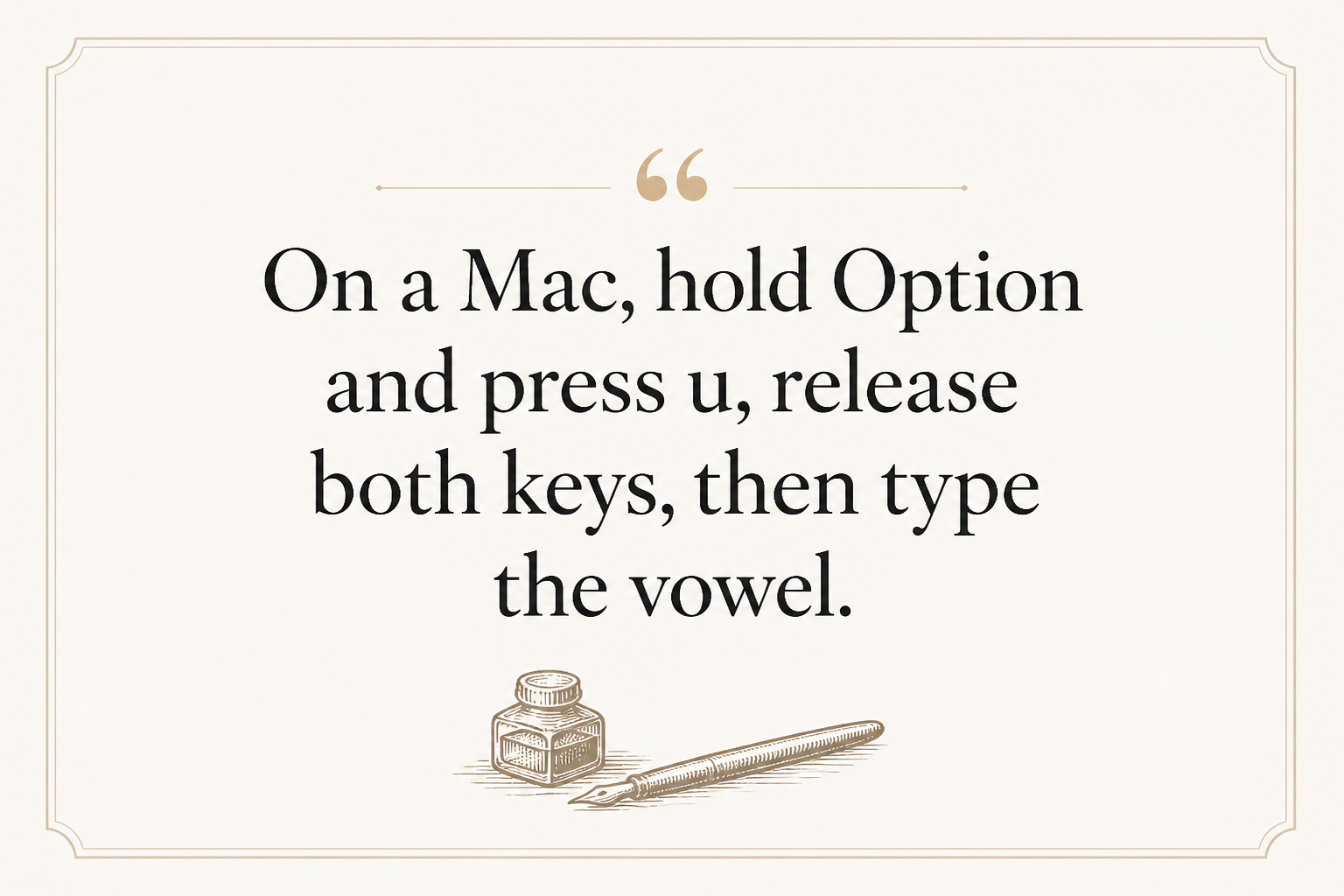
Mac keyboards also support a press-and-hold accent menu in many applications. Hold the vowel key until a row of accented choices appears, then select the desired character. For manuscript work, the Option method is the steadier choice, since it stays consistent and does not depend on the application showing the accent menu.
Test the shortcut in Word rather than assuming every application handles it the same way. The operating system, keyboard layout, and Word version can affect the result.
Inserting Umlauts Through Word Menus
The menu method works on both Windows and Mac and gives you a visual choice when you do not remember a code. Put the cursor in the target position, open the Insert tab, click Symbol, and choose More Symbols (Advanced Symbol on a Mac). In the dialog box, find the accented letter, select it, and click Insert.

Use a font with broad character coverage, such as Calibri, Arial, Times New Roman, or the typeface you plan to use in the book. Coverage matters here because the available characters change with the selected font. If you see an empty square or a missing character, choose a different font and check the result again.
Finding The Right Character
The Symbol dialog can display a long list, so use the font and subset controls to narrow the choices. For common Latin letters, the Latin-1 Supplement range contains many umlaut characters. You can also select the character and inspect its code in the dialog to confirm you chose a precomposed letter such as ü rather than a plain u paired with a separate combining mark.
Word also lets you insert a symbol by Unicode code point. Type 00E4 for ä, 00C4 for Ä, 00F6 for ö, 00D6 for Ö, 00FC for ü, and 00DC for Ü, then press Alt+X on Windows. Word converts the code into the corresponding character. Microsoft lists this Alt+X process in its instructions for inserting ASCII and Unicode characters.
Copying From A Trusted Source
For a rare character, copy and paste is perfectly reasonable. Pull the whole word from a reliable dictionary, official website, or a person’s published name. Then check the pasted text at a larger size before you move on.
Do not copy from an image or a scanned PDF when a text source exists. Optical character recognition can confuse an umlaut with quotation marks, noise, or two separate punctuation marks. A clean text source reduces the chance of carrying a hidden error into your book.
Creating AutoCorrect Entries
AutoCorrect saves time when a name or term appears throughout your manuscript. In Word for Windows, open File > Options > Proofing > AutoCorrect Options. On a Mac, the setting sits under the Word menu. Choose Preferences, then AutoCorrect. Add a short trigger in the Replace field and the properly accented word in the With field.
For example, you might replace “zoe-name” with “Zoë” or “munich-place” with “München.” Use an unusual trigger that will never appear in ordinary prose. Pick something like “uber,” and the replacement could corrupt an English sentence where you meant the ordinary word. A marker with punctuation or a distinctive letter sequence gives you better control.
Choosing Safe Triggers
Keep a list of every custom entry you add. AutoCorrect works across documents, so an entry created for a novel can affect a newsletter, query letter, or client project later. Review the list before you add a broad replacement.
Once the entry exists, run a test paragraph. Type the trigger at the beginning of a sentence, in the middle of a sentence, beside quotation marks, and before punctuation, then confirm that capitalization behaves as you expect. Word handles simple replacements well. Names with several capitalization patterns are another matter and may still need manual review.
Managing Repeated Names
AutoCorrect is useful for a character name that appears hundreds of times. That convenience carries some risk during revision. If you change the character’s name, update the AutoCorrect entry and search the manuscript for both the old and new versions.
For a single book, a custom glossary may serve you better than a permanent AutoCorrect rule. Adazing’s writing tools can help you generate and organize names during early drafting. When a name refers to a real person, language, or place, verify its spelling yourself before the book goes to print.
Checking Umlauts During Editing
Typing the character correctly solves only half the problem. You also need to confirm that the word remains correct through revision, formatting, and publication. The simplest safeguard is a dedicated diacritic check, run once after the copyedit and again after exporting the final file.
Search And Replace Checks
Start with a Find pass for the expected accented form. Next, look for the unaccented version and review each result. Word’s Find function can locate a plain spelling that slipped into a chapter, caption, table, or running head.
Keep a list that records the approved spelling, capitalization, language, and source. For example:
- Zoë, personal name, capital Z
- Müller, surname, capital M
- München, German place name
- Brontë, surname with final ë
That list gives you a reference during proofreading. A formatter can also use it to preserve the same spelling in the table of contents, index, cover copy, and sales description.
Proofing Fonts And Exports
Zoom in on every unusual character in the PDF proof. Check that the dots sit above the intended vowel and that the typeface does not make them resemble quotation marks. Then inspect the ebook preview on a phone or e-reader if you plan to release a digital edition.
Ask an ARC reader who understands the language to review names and foreign terms when the book depends on them. A general proofreader can catch a missing mark. A fluent reader can also catch a word that contains the right umlaut in the wrong linguistic context.
Choosing A Reliable Workflow
The right method depends on the project’s scale. A single name calls for Insert Symbol or a copy from a trusted source. If the manuscript is filled with German vocabulary, learn the keyboard shortcuts and build a spelling sheet. For a recurring invented name, use a carefully chosen AutoCorrect entry and review it after every major revision.
A finished manuscript benefits from a set order. Create the spelling sheet first, then correct the source text in Word and search for any unaccented versions. Once those fixes are in, export the print and ebook files, then inspect the rendered pages and preview screens. Each stage catches a different class of error.
Save a clean master file before you begin replacing characters. If an AutoCorrect rule produces an unexpected result, you can return to the previous version rather than reconstructing a chapter from memory. A five-minute backup protects hours of line editing.
Do not rely on the reader’s device to repair a missing character. Fonts and platforms vary, and a character that appears correctly on your computer can break in a conversion or display environment. Choose a supported font, preserve Unicode text, and inspect the final files as a reader sees them.
FAQs For Mastering Umlaut In Word
How Do I Type an Umlaut in Word on Windows?
Use an Alt code with the numeric keypad. Type Alt+0228 for ä, Alt+0246 for ö, or Alt+0252 for ü. For uppercase letters, use Alt+0196, Alt+0214, or Alt+0220. You can also type a Unicode code such as 00FC and press Alt+X.
How Do I Type An Umlaut In Word On A Mac?
Hold Option and press u, release both keys, then type the vowel. Follow the sequence with a for ä, o for ö, or u for ü. Use Shift with the final vowel for an uppercase form.
Why Does My Umlaut Disappear After I Export My Book?
The font may lack the character, or the conversion process may have dropped it. Use a font with broad Unicode coverage, export again, and inspect the PDF or ebook preview. When your software allows text searches in the exported file, run one, then review the printed or rendered page at a larger size.
Clean Characters, Credible Books
An umlaut takes seconds to type and can keep an entire page looking credible. Choose a method you can repeat, record the spellings that matter, and check the final book after conversion. Your reader may never mention the correctly placed dots above a vowel. That quiet accuracy is part of professional publishing. Every manuscript you release through Adazing or any other publishing channel deserves the same care.
